Astronomy:52 Europa
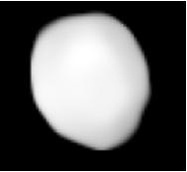 VLT-SPHERE image of Europa | |
| Discovery | |
|---|---|
| Discovered by | H. Goldschmidt |
| Discovery date | 4 February 1858 |
| Designations | |
| (52) Europa | |
| Pronunciation | /jʊˈroʊpə/[1] |
| Named after | Europa |
| 1948 LA | |
| Minor planet category | Main belt |
| Adjectives | Europan, Europian |
| Orbital characteristics[2] | |
| Epoch July 1, 2021 (JD 2,459,396.5, heliocentric) | |
| |{{{apsis}}}|helion}} | 3.442 AU (515 million km)* |
| |{{{apsis}}}|helion}} | 2.746 AU (411 million km) |
| 3.094 AU (463 million km) | |
| Eccentricity | 0.1125 |
| Orbital period | 5.443 yr (1989 d) |
| Mean anomaly | 21° |
| Inclination | 7.48° |
| Longitude of ascending node | 128.57° |
| 342.80° | |
| Physical characteristics | |
| Dimensions | (379±16)×(330±8)×(249±10) km[3] |
| Mean diameter | 319±4 km[4] 315±7 km[3] |
| Flattening | 0.33[lower-alpha 1] |
| Mass | (24±4)×1018 kg[4] (22.6±1.6)×1018 kg[lower-alpha 2][5] |
| Mean density | 1.41±0.23 g/cm3[4] 1.5±0.4 g/cm3[3] |
| Rotation period | 5.6304 h[2] |
| Geometric albedo | 0.057±0.007 geometric (0.679±0.017 BV, 0.338±0.028 UB)[2] |
| C/CF[2] | |
| Absolute magnitude (H) | 6.66[2] |
52 Europa is the sixth-largest asteroid in the asteroid belt, having a diameter of over 300 km, though it is not correspondingly massive. It is shaped like an ellipsoid with approximate dimensions of 380×330×250 km.[3] It was discovered on 4 February 1858, by Hermann Goldschmidt from his balcony in Paris. It is named after Europa, one of Zeus's conquests in Greek mythology, a name it shares with Jupiter's moon Europa.
Orbit

Sun · Earth · Mars · Jupiter · 52 Europa
Europa is a main belt asteroid that orbits the Sun at a distance of 2.746–3.442 astronomical units (AU) with a semi-major axis or average orbital distance of 3.094 AU once every 5.44 years[2] (for reference, Ceres's orbit is at 2.77 AU).[6]
Europa's orbit has an eccentricity of 0.1125 and an inclination of 7.482° with respect to the ecliptic.[2]
Physical characteristics

Europa is approximately the sixth largest asteroid by volume. Most likely it has a density of around 1.5 g/cm3, typical of C-type asteroids.[3] In 2007, James Baer and Steven R. Chesley estimated Europa to have a mass of (1.9±0.4)×1019 kg.[7] A more recent estimate by Baer suggests it has a mass of 3.27×10¹⁹ kg.[8]
Europa is a very dark carbonaceous C-type, and is the second largest of this group. Spectroscopic studies have found evidence of olivines and pyroxenes on the surface,[9] and there is some indication that there may be compositional differences between different regions.[10] It orbits close to the Hygiea asteroid family, but is not a member.
Lightcurve data for Europa have been particularly tricky to interpret, so much so that for a long time its period of rotation was in dispute (ranging from 5 1⁄2 hours to 11 hours), despite numerous observations.[11] It has now been determined that Europa is a prograde rotator, but the exact direction in which its pole points remains ambiguous. The most detailed analysis indicates that it points either towards about ecliptic coordinates (β, λ) = (70°, 55°) or (40°, 255°) with a 10° uncertainty.[12] This gives an axial tilt of about 14° or 54°, respectively.
In 1988 a search for satellites or dust orbiting this asteroid was performed using the UH88 telescope at the Maunakea Observatories, but the effort came up empty.[13]
Observations
The reputed cataclysmic variable star CV Aquarii, discovered in 1934 by Emily Hughes at Harvard College Observatory, was actually a misidentification of 52 Europa.[14]
Notes
References
- ↑ Webster, Noah (1884). A Practical Dictionary of the English Language
- ↑ 2.0 2.1 2.2 2.3 2.4 2.5 2.6 JPL data Retrieved 2021-09-29
- ↑ 3.0 3.1 3.2 3.3 3.4 Merline, W.J. (2013). "The Resolved Asteroid Program – Size, shape, and pole of (52) Europa". Icarus 225 (1): 794–805. doi:10.1016/j.icarus.2013.01.010. Bibcode: 2013Icar..225..794M.
- ↑ 4.0 4.1 4.2 4.3 P. Vernazza et al. (2021) VLT/SPHERE imaging survey of the largest main-belt asteroids: Final results and synthesis. Astronomy & Astrophysics 54, A56
- ↑ James Baer, Steven Chesley & Robert Matson (2011) "Astrometric masses of 26 asteroids and observations on asteroid porosity." The Astronomical Journal, Volume 141, Number 5
- ↑ "AstDyS-2 Ceres Synthetic Proper Orbital Elements". Department of Mathematics, University of Pisa, Italy. https://newton.spacedys.com/astdys/index.php?pc=1.1.6&n=1.
- ↑ Baer, James; Chesley, Steven R. (2007). "Astrometric masses of 21 asteroids, and an integrated asteroid ephemeris". Celestial Mechanics and Dynamical Astronomy (Springer Science+Business Media B.V. 2007) 100 (2008): 27–42. doi:10.1007/s10569-007-9103-8. Bibcode: 2008CeMDA.100...27B.
- ↑ Baer, James (2008). "Recent Asteroid Mass Determinations". Personal Website. http://home.earthlink.net/~jimbaer1/astmass.txt.
- ↑ Dotto, E. (2000). "ISO results on bright Main Belt asteroids: PHT–S observations". Astronomy & Astrophysics 358: 1133. Bibcode: 2000A&A...358.1133D. http://aa.springer.de/papers/0358003/2301133.pdf. Retrieved 29 April 2006.
- ↑ Sawyer, Scott Raleigh (1 January 1991). "A High-Resolution CCD Spectroscopic Survey of Low-Albedo Main Belt Asteroids.". PhD Thesis. Bibcode: 1991PhDT.......105S.
- ↑ Zappalà, V.; di Martino, M.; Cacciatori, S (1983). "On the ambiguity of rotational periods of asteroids: The peculiar case of 52 Europa". Icarus 56 (2): 319–324. doi:10.1016/0019-1035(83)90041-6. Bibcode: 1983Icar...56..319Z.
- ↑ Michałowski, T (2004). "Photometry and models of selected main belt asteroids I. 52 Europa, 115 Thyra, and 382 Dodona". Astronomy & Astrophysics 416: 353–366. doi:10.1051/0004-6361:20031706. Bibcode: 2004A&A...416..353M. http://www.rni.helsinki.fi/~mjk/Micha.pdf.
- ↑ Gradie, J.; Flynn, L. (March 1988), "A Search for Satellites and Dust Belts Around Asteroids: Negative Results", Abstracts of the Lunar and Planetary Science Conference 19: pp. 405–406, Bibcode: 1988LPI....19..405G.
- ↑ Schmeer, Patrick; Hazen, Martha L.. "CV Aquarii identified with (52) Europa". Journal of the American Association of Variable Star Observers 28: 103–105. Bibcode: 2000JAVSO..28..103S. http://www.aavso.org/publications/ejaavso/v28n2/103.pdf. Retrieved 29 April 2006.
Bibliography
- Template:Deprecated archive
- Sawyer, S. R. (1991). A High-Resolution CCD Spectroscopic Survey of Low-Albedo Main Belt Asteroids PhD thesis (Thesis). The University of Texas. Bibcode:1991PhDT.......105S.
- Schmeer, P., and M. L. Hazen, CV Aquarii identified with (52) Europa, Journal of the American Association of Variable Star Observers, Vol. 28, p. 103 (2000).
External links
- "Elements and Ephemeris for (52) Europa". http://scully.cfa.harvard.edu/cgi-bin/returnprepeph.cgi?d=b2011&o=00052.
- shape model deduced from lightcurve
- 52 Europa at AstDyS-2, Asteroids—Dynamic Site
- 52 Europa at the JPL Small-Body Database
 |  |


