Astronomy:Lakshmi Planum
From HandWiki
Short description: Planum on Venus
| File:200px Lakshmi Planum in dark red, in a topographically coloured radar image of Ishtar Terra | |
| Feature type | Planum |
|---|---|
| Coordinates | [ ⚑ ] : 68°36′N 339°18′E / 68.6°N 339.3°E |
| Diameter | 2,345.0 km |
| Eponym | Lakshmi |
Lakshmi Planum is a plateau feature approximately 2 million km2 ringed by rugged mountains,[1][2] the surface of Venus on the Western Ishtar Terra.[3] It is named after Lakshmi, the Hindu goddess of wealth.
It is roughly 3.5 to 5 kilometers (2.2 to 3.1 mi) above the mean planetary radius, featuring two large oval depressions (Colette and Sacajawea).[2]
The plains of Lakshmi are made up of radar-dark, homogeneous, smooth lava flows.[4]
Lakshmi Planum is ringed by intensely deformed terrain,[5] some of which is shown in the southern portion of the image and is called Clotho Tessera.[6]
-
 Lineated plains in Lakshmi Region.Two sets of parallel lineations are seen intersecting almost at right angles
 -
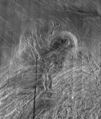 The radar smooth region in the northern part of the image is Lakshmi Planum, ringed by the intensely deformed terrain of Clotho Tessera.
 -
 Sacajawea Patera, a large, elongate caldera on the smooth plateau of Lakshmi Planum, approximately 1.2 km deep and 120 by 215 km in diameter.


References
- ↑ Roberts, Kari M.; Head, James W. (1990). "Lakshmi Planum, Venus: Characteristics and models of origin". Earth, Moon, and Planets 50–51 (1): 193–249. doi:10.1007/BF00142395. Bibcode: 1990EM&P...50..193R.
- ↑ 2.0 2.1 Roberts, Kari M.; Head, James W. (1989). "Lakshmi Planum: A Distinctive Highland Volcanic Province" (in en). Venus Geoscience Tutorial and Venus Geologic Mapping Workshop 708: 37. ISSN 0161-5297. Bibcode: 1989LPICo.708...37R. https://ui.adsabs.harvard.edu/abs/1989LPICo.708...37R/abstract.
- ↑ "Planetary Names". https://planetarynames.wr.usgs.gov/Feature/3244.
- ↑ Catalog Page for PIA00241
- ↑ Ivanov, M. A.; Head, J. W. (2008-12-01). "Formation and evolution of Lakshmi Planum, Venus: Assessment of models using observations from geological mapping". Planetary and Space Science 56 (15): 1949–1966. doi:10.1016/j.pss.2008.09.003. ISSN 0032-0633. Bibcode: 2008P&SS...56.1949I. https://www.sciencedirect.com/science/article/pii/S0032063308002766.
- ↑ Catalog Page for PIA00240
| Geography |  | ||||||||||||
|---|---|---|---|---|---|---|---|---|---|---|---|---|---|
| Moons | |||||||||||||
| Astronomy |
| ||||||||||||
| Exploration |
| ||||||||||||
| Related | |||||||||||||


External links
 |  |


