Astronomy:NGC 3073
From HandWiki
| NGC 3073 | |
|---|---|
| File:250px NGC 3073 imaged by the Hubble Space Telescope | |
| Observation data (J2000 epoch) | |
| Constellation | Ursa Major |
| Right ascension | 10h 00m 52.042s[1] |
| Declination | +55° 37′ 08.17″[1] |
| Redshift | 0.003933[2] |
| Helio radial velocity | 1177 km/s[2] |
| Distance | 65 Mly (20 Mpc)[3] |
| Group or cluster | NGC 3079 Group |
| Apparent magnitude (V) | 13.40[3] |
| Apparent magnitude (B) | 14.07[3] |
| Characteristics | |
| Type | SAB0−[3] |
| Size | ~40,300 ly (12.36 kpc) (estimated)[4] |
| Apparent size (V) | 1.2′ × 1.1′[4] |
| Other designations | |
| HOLM 156B, UGC 5374, MCG+09-17-007, PGC 28974[2][4] | |
NGC 3073 is a dwarf lenticular galaxy in the constellation Ursa Major.[5][6][7] It is at a distance of about 65 million light-years (20 megaparsecs) from Earth.[3] NGC 3073 was discovered by German-British astronomer William Herschel on 1 April 1790. [8]
NGC 3073 belongs to the NGC 3079 Group (also known as LGG 188), which contains six galaxies.[9] The other galaxies in the group are NGC 3079, UGC 5421, UGC 5479, UGC 5459, and UGC 5460.[10] The galaxies NGC 3073 and NGC 3079 are also listed together as Holm 156 in Erik Holmberg's A Study of Double and Multiple Galaxies Together with Inquiries into some General Metagalactic Problems, published in 1937.[11]
Gallery
-
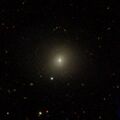 NGC 3073 imaged by SDSS

See also
References
- ↑ 1.0 1.1 Skrutskie, Michael F.; Cutri, Roc M.; Stiening, Rae; Weinberg, Martin D.; Schneider, Stephen E.; Carpenter, John M.; Beichman, Charles A.; Capps, Richard W. et al. (1 February 2006). "The Two Micron All Sky Survey (2MASS)". The Astronomical Journal 131 (2): 1163–1183. doi:10.1086/498708. ISSN 0004-6256. Bibcode: 2006AJ....131.1163S.
- ↑ 2.0 2.1 2.2 "NGC 3073". SIMBAD. Centre de données astronomiques de Strasbourg. http://simbad.u-strasbg.fr/simbad/sim-basic?Ident=NGC+3073.
- ↑ 3.0 3.1 3.2 3.3 3.4 Gil de Paz, Armando et al. (December 2007). "The GALEX Ultraviolet Atlas of Nearby Galaxies". The Astrophysical Journal Supplement Series 173 (2): 185–255. doi:10.1086/516636. Bibcode: 2007ApJS..173..185G.
- ↑ 4.0 4.1 4.2 "Results for object NGC 1285". NASA and Caltech. http://ned.ipac.caltech.edu/byname?objname=NGC+1285.
- ↑ "SIMBAD". France: University of Strasbourg. http://simbad.u-strasbg.fr/simbad/sim-id?Ident=NGC%25203073.
- ↑ "A Fundamental Relation Between Supermassive Black Holes and Their Host Galaxies". Astrophysical Journal Letters. https://cds.cern.ch/record/455379/files/0006053.pdf.
- ↑ Irwin, J. A.; Seaquist, E. R. (1991). "INIS Repository Search - Single Result". International Nuclear Information System (The Astrophysical Journal): 111–130. https://inis.iaea.org/search/searchsinglerecord.aspx?recordsFor=SingleRecord&RN=22078871. Retrieved 2020-09-10.
- ↑ Seligman, Courtney. "New General Catalogue Objects: NGC 3073". https://cseligman.com/text/atlas/ngc30a.htm#3073.
- ↑ Shafi, N.; Oosterloo, T. A.; Morganti, R.; Colafrancesco, S.; Booth, R. (2015-12-01). "The "shook up" galaxy NGC 3079: the complex interplay between HI, activity and environment". Monthly Notices of the Royal Astronomical Society 454 (2): 1404–1415. doi:10.1093/mnras/stv2034. Bibcode: 2015MNRAS.454.1404S.
- ↑ Garcia, A. M. (1993). "General study of group membership. II. Determination of nearby groups". Astronomy and Astrophysics Supplement Series 100: 47. Bibcode: 1993A&AS..100...47G.
- ↑ Holmberg, Erik (1937). "A Study of Double and Multiple Galaxies Together with Inquiries into some General Metagalactic Problems". Annals of the Observatory of Lund 6: 1. Bibcode: 1937AnLun...6....1H.
External links
- NGC 3073 on WikiSky: DSS2, SDSS, GALEX, IRAS, Hydrogen α, X-Ray, Astrophoto, Sky Map, Articles and images
 |  |


