Astronomy:NGC 7793

From HandWiki
NGC 7793
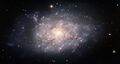
Hubble Space Telescope image of the small bulge and spiral arms of NGC 7793
Observation data (J2000 epoch)
ConstellationSculptor
Right ascension 23h 57m 49.753s[1]
Declination−32° 35′ 27.71″[1]
Redshift0.000749[2]
Helio radial velocity227 km/s[3]
Distance12.2 Mly (3.7 Mpc)[4]
Group or clusterSculptor Group[5]
Apparent magnitude (V)10.0[6]
Characteristics
TypeSA(s)d[2]
MassStellar: 3.2×10⁹ M
Size~50,900 ly (15.61 kpc) (estimated)[2]
Apparent size (V)9.3′ × 6.3′[6]
Other designations
ESO 349- G 012, IRAS 23552-3252, MCG-06-01-009, PGC 73049[2]

NGC 7793 is a flocculent spiral galaxy in the southern constellation of Sculptor. It was discovered on July 14, 1826, by Scottish astronomer James Dunlop.[7][8] The galaxy is located at a distance of 12.2[4] million light years and is receding with a heliocentric radial velocity of 227 km/s.[3] NGC 7793 is one of the five brightest galaxies within the Sculptor Group.[6][5]

The morphological class of NGC 7793 is SA(s)d,[2] indicating it is unbarred spiral galaxy (SA) with no inner ring structure (s) and the arms are loosely wound and disorganized (d). It is flocculent in appearance with a very small bulge and a star cluster at the nucleus.[6] The galactic disk is inclined at an angle of 53.7° to the line of sight from the Earth. The visible profile is elliptical in form with an angular size of 9.3′ × 6.3′[6] and a major axis aligned along a position angle of 99.3°.[2] There are two nearby dwarf galaxy companions.[9]

NGC 7793 hosts the ultra-luminous X-ray pulsar (ULXP) referred to as NGC 7793 P13 (previously believed to harbor a black hole), which consists of a 0.42-second pulsar in a 64-day orbit with a 18–23 solar mass B9Ia companion star.[10]

Supernova

One supernova has been observed in NGC 7793. SN 2008bk (Type II-P, mag. 12.6) was discovered by Berto Monard (bio-it) on March 25, 2008.[11][12][13] It reached apparent magnitude 12.5, making it the second-brightest supernova of 2008.[14] The progenitor of this supernova was a red supergiant, observed only 547 days prior to the explosion.[15]

See also

References

  1. 1.0 1.1 Brown, A. G. A. (August 2018). "Gaia Data Release 2: Summary of the contents and survey properties". Astronomy & Astrophysics 616: A1. doi:10.1051/0004-6361/201833051. Bibcode2018A&A...616A...1G.  Gaia DR2 record for this source at VizieR.
  2. 2.0 2.1 2.2 2.3 2.4 2.5 "Results for object NGC 7793". https://ned.ipac.caltech.edu/byname?objname=NGC+7793. 
  3. 3.0 3.1 Tully, R. Brent et al. (August 3, 2016). "Cosmicflows-3". The Astronomical Journal 152 (2): 50. doi:10.3847/0004-6256/152/2/50. Bibcode2016AJ....152...50T. 
  4. 4.0 4.1 Lianou, S. et al. (November 2019). "Dust properties and star formation of approximately a thousand local galaxies". Astronomy & Astrophysics 631: 19. doi:10.1051/0004-6361/201834553. A38. Bibcode2019A&A...631A..38L. 
  5. 5.0 5.1 I. D. Karachentsev; E. K. Grebel; M. E. Sharina; A. E. Dolphin et al. (2003). "Distances to nearby galaxies in Sculptor". Astronomy and Astrophysics 404 (1): 93–111. doi:10.1051/0004-6361:20030170. Bibcode2003A&A...404...93K. 
  6. 6.0 6.1 6.2 6.3 6.4 König, Michael; Binnewies, Stefan (2017). The Cambridge Photographic Atlas of Galaxies. Cambridge University Press. p. 68. ISBN 9781108103091. https://books.google.com/books?id=OEszDwAAQBAJ&pg=PA68. 
  7. Seligman, Courtney. "New General Catalogue Objects: NGC 7793". https://cseligman.com/text/atlas/ngc77a.htm#7793. 
  8. James, Dunlop (1828). "A Catalogue of Nebulae and Clusters of Stars in the Southern Hemisphere observed in New South Wales". Philosophical Transactions of the Royal Society 118: 113–151. doi:10.1098/rstl.1828.0010. Bibcode1828RSPT..118..113D. https://zenodo.org/record/1432362. 
  9. Mondal, Chayan et al. (March 2021). "Tracing Young Star-forming Clumps in the Nearby Flocculent Spiral Galaxy NGC 7793 with UVIT Imaging". The Astrophysical Journal 909 (2): 13. doi:10.3847/1538-4357/abe0b4. 203. Bibcode2021ApJ...909..203M. 
  10. Israel, G.L. (September 2016). "Discovery of a 0.42-s pulsar in the ultraluminous X-ray source NGC 7793 P13". Monthly Notices of the Royal Astronomical Society: Letters 466: L48–L52. doi:10.1093/mnrasl/slw218. 
  11. Monard, L. A. G. (2008). "Supernova 2008bk in NGC 7793". Central Bureau Electronic Telegrams (1315): 1. Bibcode2008CBET.1315....1M. http://www.cbat.eps.harvard.edu/cbet/001300/CBET001315.txt. 
  12. David Bishop. "Supernova 2008bk in NGC 7793". https://www.rochesterastronomy.org/sn2008/sn2008bk.html. 
  13. "SN 2008bk". IAU. https://www.wis-tns.org/object/2008bk. 
  14. David Bishop. "Bright Supernovae – 2008". https://www.rochesterastronomy.org/sn2008/index.html. 
  15. Mattila, S.; Smartt, S. J.; Eldridge, J. J.; Maund, J. R.; Crockett, R. M.; Danziger, I. J. (2008). "VLT Detection of a Red Supergiant Progenitor of the Type II-P Supernova 2008bk". The Astrophysical Journal 688 (2): L91–L94. doi:10.1086/595587. Bibcode2008ApJ...688L..91M.