Astronomy:R Sculptoris
  | |
| Observation data Equinox J2000.0]] (ICRS) | |
|---|---|
| Constellation | Sculptor |
| Right ascension | 01h 26m 58.09462s[1] |
| Declination | −32° 32′ 35.4377″[1] |
| Apparent magnitude (V) | +5.72[2] |
| Characteristics | |
| Spectral type | C6,5ea(Np)[3] |
| U−B color index | +7.67[2] |
| B−V color index | +3.87[2] |
| Variable type | SRb[4] |
| Astrometry | |
| Radial velocity (Rv) | −5.40[5] km/s |
| Proper motion (μ) | RA: −9.784[1] mas/yr Dec.: −30.900[1] mas/yr |
| Parallax (π) | 2.2724 ± 0.1471[1] mas |
| Distance | 1,180±140 ly (361±44 pc) |
| Absolute magnitude (MV) | −0.45[6] |
| Details | |
| Mass | 1.3±0.7 [7] M☉ |
| Radius | 411±43[8] R☉ |
| Luminosity | 8,000±1,000[8] L☉ |
| Surface gravity (log g) | −0.5±0.1[8] cgs |
| Temperature | 2640±80 [7] K |
| Metallicity [Fe/H] | 0.0[3] dex |
| Other designations | |
| Database references | |
| SIMBAD | data |
R Sculptoris is a variable star system in the southern constellation of Sculptor.[10][11] Parallax measurements provide a distance estimate of approximately 1,435 ± 98 light-years from the Sun.[1] An independent estimate based on measurements of an ejected shell surrounding the star yield a distance of 1,180 ± 140 light-years.[12] The star is drifting closer with a radial velocity of −5.4 km/s.[5]
Benjamin Apthorp Gould discovered that the star's brightness varies, in 1872. It was listed with its variable star designation, R Sculptoris, in Annie Jump Cannon's 1907 work Second Catalog of Variable Stars.[13] Although the General Catalogue of Variable Stars lists its maximum brightness as magnitude 9.1,[14] far too faint to be seen with the naked eye, both AAVSO and ASAS data shows that R Sculptoris is occasionally brighter than 6th magnitude, and faintly visible to the naked eye under excellent observing conditions.[15][16]

This is an aging giant star on the asymptotic giant branch with a stellar classification of C6,5ea(Np),[3] which indicates a carbon-rich atmosphere. It is a semi-regular pulsating star of the SRb[4] type that is nearing the end of its fusing lifespan. A sine curve fitted to the last ten pulsation cycles prior to 2017 give a pulsation period of 376 days with an amplitude of 0.75 magnitude. The star is shedding its outer atmosphere, and it is surrounded by a thin shell of dust and gas that was created during the most recent thermal pulse around 2,000 years ago.[12]
Observations have revealed a spiral structure in the material around the star.[18] The spiral is suspected to be caused by an unseen companion star.[10] The spiral windings are consistent with an orbital period of ~350 years.[18]
Gallery
-
![This image captures approximately 20x20 milliarcseconds.[19]](/wiki/images/thumb/2/2b/R_Sculptoris_A_red_giant_sheds_its_skin.jpg/120px-R_Sculptoris_A_red_giant_sheds_its_skin.jpg) This image captures approximately 20x20 milliarcseconds.[19]
This image captures approximately 20x20 milliarcseconds.[19] -
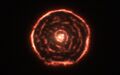 Spiral spotted by ALMA around the star (data visualisation).
 -
 R Sculptoris and its hidden companion, taken by Hubble Space Telescope
![This image captures approximately 20x20 milliarcseconds.[19]](/wiki/File:R_Sculptoris_A_red_giant_sheds_its_skin.jpg)
.jpg)

References
- ↑ 1.0 1.1 1.2 1.3 1.4 1.5 Brown, A. G. A. (August 2018). "Gaia Data Release 2: Summary of the contents and survey properties". Astronomy & Astrophysics 616: A1. doi:10.1051/0004-6361/201833051. Bibcode: 2018A&A...616A...1G. Gaia DR2 record for this source at VizieR.
- ↑ 2.0 2.1 2.2 Ducati, J. R. (2002). "VizieR Online Data Catalog: Catalogue of Stellar Photometry in Johnson's 11-color system". CDS/ADC Collection of Electronic Catalogues 2237. Bibcode: 2002yCat.2237....0D.
- ↑ 3.0 3.1 3.2 Cruzalèbes, P. et al. (2013). "Fundamental parameters of 16 late-type stars derived from their angular diameter measured with VLTI/AMBER". Monthly Notices of the Royal Astronomical Society 434 (1): 437. doi:10.1093/mnras/stt1037. Bibcode: 2013MNRAS.434..437C.
- ↑ 4.0 4.1 Samus, N. N. et al. (2009). "General Catalogue of Variable Stars (Samus+ 2007-2013)". VizieR On-line Data Catalog: B/GCVS. Originally Published in: 2009yCat....102025S 1. Bibcode: 2009yCat....102025S.
- ↑ 5.0 5.1 Gontcharov, G. A. (2006). "Pulkovo Compilation of Radial Velocities for 35 495 Hipparcos stars in a common system". Astronomy Letters 32 (11): 759–771. doi:10.1134/S1063773706110065. Bibcode: 2006AstL...32..759G.
- ↑ Anderson, E.; Francis, Ch. (2012), "XHIP: An extended hipparcos compilation", Astronomy Letters 38 (5): 331, doi:10.1134/S1063773712050015, Bibcode: 2012AstL...38..331A
- ↑ 7.0 7.1 Wittkowski, M et al. (2017). "Aperture synthesis imaging of the carbon AGB star R Sculptoris. Detection of a complex structure and a dominating spot on the stellar disk". Astronomy & Astrophysics 601: A3. doi:10.1051/0004-6361/201630214. Bibcode: 2017A&A...601A...3W.
- ↑ 8.0 8.1 8.2 Drevon, J.; Millour, F.; Cruzalèbes, P.; Paladini, C.; Hron, J.; Meilland, A.; Allouche, F.; Hofmann, K.-H. et al. (2022-09-01). "Locating dust and molecules in the inner circumstellar environment of R Sculptoris with MATISSE" (in en). Astronomy & Astrophysics 665: A32. doi:10.1051/0004-6361/202141609. ISSN 0004-6361. Bibcode: 2022A&A...665A..32D.
- ↑ "R Scl". SIMBAD. Centre de données astronomiques de Strasbourg. http://simbad.u-strasbg.fr/simbad/sim-basic?Ident=R+Scl.
- ↑ 10.0 10.1 "Hubble Gazes at R Sculptoris and its Hidden Companion". SpaceDaily. 11 January 2015. http://www.spacedaily.com/reports/Hubble_Gazes_at_R_Sculptoris_and_its_Hidden_Companion_999.html.
- ↑ "Curious spiral spotted by ALMA around red giant star R Sculptoris (data visualisation)". Image Archive. ESO. http://www.eso.org/public/images/eso1239a/. Retrieved 11 October 2012.
- ↑ 12.0 12.1 Maercker, M. et al. (April 2018). "An independent distance estimate to the AGB star R Sculptoris". Astronomy & Astrophysics 611: 8. doi:10.1051/0004-6361/201732057. A102. Bibcode: 2018A&A...611A.102M.
- ↑ Cannon, Annie J. (1907). "Second catalogue of variable stars". Annals of Harvard College Observatory 55: 1–94. Bibcode: 1907AnHar..55....1C. https://articles.adsabs.harvard.edu/pdf/1907AnHar..55....1C. Retrieved 16 December 2024.
- ↑ Samus, N.N.; Kazarovets, E.V.; Durlevich, O.V.; Kireeva, N.N.; Pastukhova, E.N.. "R Scl". Lomonosov Moscow State University. http://www.sai.msu.su/gcvs/cgi-bin/search2.cgi?search=R+Scl.
- ↑ "Plot a light curve". American Association of Variable Star Observers. https://www.aavso.org/LCGv2/.
- ↑ "ASAS All Star Catalogue". University of Warsaw. https://www.astrouw.edu.pl/asas/?page=aasc.
- ↑ "ASAS All Star Catalogue". The All Sky Automated Survey. http://www.astrouw.edu.pl/asas/?page=aasc.
- ↑ 18.0 18.1 Maercker, M. et al. (2012). "Unexpectedly large mass loss during the thermal pulse cycle of the red giant star R Sculptoris". Nature 490 (7419): 232–4. doi:10.1038/nature11511. PMID 23060194. Bibcode: 2012Natur.490..232M.
- ↑ "A red giant sheds its skin". https://www.eso.org/public/images/potw1807a/. Retrieved 12 February 2018.
Further reading
- Nola Taylor Redd (October 11, 2012). "Strange Star Spiral Offers Clues to Sun's Fate". SPACE.com (Scientific American). https://www.scientificamerican.com/article.cfm?id=strange-star-spiral. Retrieved 31 October 2012.
| Stars |
| ||||||||||
|---|---|---|---|---|---|---|---|---|---|---|---|
| |||||||||||
| |||||||||||
| Galaxies |
| ||||||||||
| |||||||||||
| |||||||||||

 |  |


