Chemistry:Abrine
| File:Abrine.svg | |
| File:L-Abrine.png | |
| Names | |
|---|---|
| IUPAC name
(2S)-3-(1H-indol-3-yl)-2-(methylamino)propanoic acid
| |
| Other names
Abrine; N-Methyl-L-tryptophan; N-Methyl-L-tryptophane; N-methyltryptophan; N-Me-Trp-OH; E9M; α-Carboxy-N-methyltryptamine; α-COOH-NMT; AR; L-(+)-Abrine; (+)-Abrine; (±)-Abrine; ABR
| |
| Identifiers | |
3D model (JSmol)
|
|
| ChEBI | |
| ChEMBL | |
| ChemSpider | |
| EC Number |
|
| KEGG | |
PubChem CID
|
|
| UNII | |
| |
| |
| Properties | |
| C12H14N2O2 | |
| Molar mass | 218.256 g·mol−1 |
Except where otherwise noted, data are given for materials in their standard state (at 25 °C [77 °F], 100 kPa). | |
| Infobox references | |

L-Abrine, also known as N-methyltryptophan, is a levorotatory amino acid that is primarily an alkaloid and also a derivative of L-tryptophan, in which a methyl group is attached to the nitrogen atom in the α-position. L-Abrine is found mainly in the seeds of Abrus precatorius.[1][2][3]
Pharmacology
L-Abrine enhances the efficacy of immunotherapy for liver cancer by suppressing tumor defense mechanisms through inhibition of the IDO1 enzyme and by acting in synergy with PD-1 inhibitors drugs.[4] L-Abrine effectively inhibits lung cancer metastasis by blocking the MAPK signaling pathway through direct binding to the ERK protein, which leads to the reversal of the epithelial-mesenchymal transition and the activation of the Nrf2 antioxidant system without causing systemic toxicity, L-abrine may be effective both as a standalone agent and in combination with ERK inhibitors.[5] L-Abrine has also been studied as an agonist of peroxisome proliferator-activated receptors.[6]
L-abrine inhibited the SPTBN2 protein, which blocks the membrane localization of the SLC7A11 transporter and induces ferroptosis in resistant cancer cells.[7] L-abrin exhibits a marked sedative effect and potentiates the effects of hypnotics; however, its binding to GABAA receptors is relatively weak and is most likely complemented by effects on other brain systems.[8]
Natural occurrence
L-Abrine has been found in plants of the genus Abrus, with Abrus precatorius being the primary source (ranging from 0.5 to 1.0% of dry weight).[9] It was previously believed that L-abrine was characteristic only of the genus Abrus, but it has also been identified in the chemical composition of Pereskia aculeata and Pereskia grandifolia.[10][11]
-
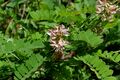 A view of the Abrus precatorius plant
 -
A view of the Pereskia aculeata plant
-
 A view of the Pereskia grandifolia plant


References
- ↑ Ghosal, S.; Dutta, S. K. (1971-01-01). "Alkaloids of Abrus precatorius". Phytochemistry 10 (1): 195–198. doi:10.1016/S0031-9422(00)90270-X. ISSN 0031-9422. Bibcode: 1971PChem..10..195G. https://www.sciencedirect.com/science/article/pii/S003194220090270X.
- ↑ Laskar, Subrata; Espino, Omar; Bandyopadhyay, Debasish (2019). "Isolation, Solid-state Structure Determination, In Silico and In Vitro Anticancer Evaluation of an Indole Amino Acid Alkaloid L-Abrine". Current Cancer Drug Targets 19 (9): 707–715. doi:10.2174/1568009619666190111111937. ISSN 1873-5576. PMID 30636612.
- ↑ Wooten, Joe Valentine; Pittman, Christopher T.; Blake, Thomas A.; Thomas, Jerry D.; Devlin, John J.; Higgerson, Renee A.; Johnson, Rudolph C. (2014). "A case of abrin toxin poisoning, confirmed via quantitation of L-abrine (N-methyl-L-tryptophan) biomarker". Journal of Medical Toxicology: Official Journal of the American College of Medical Toxicology 10 (4): 392–394. doi:10.1007/s13181-013-0377-9. ISSN 1937-6995. PMID 24522983.
- ↑ Liang, Xiaowei; Gao, Hongwei; Xiao, Jian; Han, Shan; He, Jia; Yuan, Renyikun; Yang, Shilin; Yao, Chun (2023). "Abrine, an IDO1 inhibitor, suppresses the immune escape and enhances the immunotherapy of anti-PD-1 antibody in hepatocellular carcinoma". Frontiers in Immunology 14. doi:10.3389/fimmu.2023.1185985. ISSN 1664-3224. PMID 37334368.
- ↑ Shen, Yufang; Xiao, Linyu; Liu, Lina; Liao, Lianting; Zou, Xianmin; Shen, Pengfei; Zhao, Jinlong; Yuan, Renyikun et al. (2026-03-27). "Abrine targets ERK to suppress EMT and lung metastasis model via MAPKs and Nrf2/Keap-1/HO-1 signaling". Frontiers in Immunology 17. doi:10.3389/fimmu.2026.1789110. ISSN 1664-3224. PMID 41972188.
- ↑ Chen, Kuan-Chung; Chen, Calvin Yu-Chian (2014). "In Silico Identification of Potent PPAR-γ Agonists from Traditional Chinese Medicine: A Bioactivity Prediction, Virtual Screening, and Molecular Dynamics Study". Evidence-Based Complementary and Alternative Medicine: ECAM 2014. doi:10.1155/2014/192452. ISSN 1741-427X. PMID 24971147.
- ↑ Deng, Jun; Lin, Xu; Qin, Jiajia; Li, Qi; Zhang, Yingqiong; Zhang, Qingyi; Ji, Cong; Shen, Shuying et al. (2024). "SPTBN2 suppresses ferroptosis in NSCLC cells by facilitating SLC7A11 membrane trafficking and localization". Redox Biology 70. doi:10.1016/j.redox.2024.103039. ISSN 2213-2317. PMID 38241838.
- ↑ Ferdous, Jannatul; Bhuia, Md. Shimul; Chowdhury, Raihan; Sheikh, Salehin; Ansari, Siddique Akber; Bappi, Mehedi Hasan; Islam, Muhammad Torequl (2024-10-04). "Modulatory Sedative Activity of Abrine on Diazepam in Thiopental Sodium Mediated Sleeping Mice: An In Vivo Approach with Receptor Binding Affinity of GABAergic Transmission" (in en). ChemistrySelect 9 (37). doi:10.1002/slct.202403725. ISSN 2365-6549. https://chemistry-europe.onlinelibrary.wiley.com/doi/10.1002/slct.202403725.
- ↑ Dodge, Anthony G.; Carrasquillo, Kelvin; Rivera, Luis; Xu, Lei; Wackett, Lawrence P.; Sadowsky, Michael J. (2015). "Rapid method using two microbial enzymes for detection of L-abrine in food as a marker for the toxic protein abrin". Applied and Environmental Microbiology 81 (5): 1610–1615. doi:10.1128/AEM.03492-14. ISSN 1098-5336. PMID 25527549. Bibcode: 2015ApEnM..81.1610D.
- ↑ Pinto, Nícolas de Castro Campos; Duque, Ana Paula do Nascimento; Pacheco, Natália Ramos; Mendes, Renata de Freitas; Motta, Erick Vicente da Silva; Bellozi, Paula Maria Quaglio; Ribeiro, Antônia; Salvador, Marcos José et al. (2015-12-02). "Pereskia aculeata : A plant food with antinociceptive activity" (in en). Pharmaceutical Biology 53 (12): 1780–1785. doi:10.3109/13880209.2015.1008144. ISSN 1388-0209. PMID 26084799. http://www.tandfonline.com/doi/full/10.3109/13880209.2015.1008144.
- ↑ Amaral, Eduarda C.; Veiga, Alan de A.; Atherino, Juliana C.; Souza, Wesley M. de; Kita, Diogo H.; Lívero, Francislaine A.; Ratti, Gustavo da Silva; Rosa, Simony R. B. et al. (2025-12-23). "Unveiling the Phytochemical Diversity of Pereskia aculeata Mill. and Pereskia grandifolia Haw.: An Antioxidant Investigation with a Comprehensive Phytochemical Analysis by Liquid Chromatography with High-Resolution Mass Spectrometry". Pharmaceuticals (Basel, Switzerland) 19 (1): 38. doi:10.3390/ph19010038. ISSN 1424-8247. PMID 41599639.
 |  |


