Engineering:Nuclear weapon design
.jpg)
Nuclear weapons design means the physical, chemical, and engineering arrangements that cause the physics package[1] of a nuclear weapon to detonate. There are three existing basic design types:
- Pure fission weapons are the simplest, least technically demanding, were the first nuclear weapons built, and so far the only type ever used in warfare, by the United States on Japan in World War II.
- Boosted fission weapons are fission weapons that use nuclear fusion reactions to generate high-energy neutrons that accelerate the fission chain reaction and increase its efficiency. Boosting can more than double the weapon's fission energy yield.
- Staged thermonuclear weapons are arrangements of two or more "stages", most usually two, where the weapon derives a significant fraction of its energy from nuclear fusion (as well as, usually, nuclear fission). The first stage is typically a boosted fission weapon (except for the earliest thermonuclear weapons, which used a pure fission weapon). Its detonation causes it to shine intensely with X-rays, which illuminate and implode the second stage filled with fusion fuel. This initiates a sequence of events which results in a thermonuclear, or fusion, burn. This process affords potential yields hundreds or thousands of times greater than those of fission weapons.[2]
Pure fission weapons have been the first type to be built by new nuclear powers. Large industrial states with well-developed nuclear arsenals have two-stage thermonuclear weapons, which are the most compact, scalable, and cost-effective option once the necessary technical base and industrial infrastructure are built.
Most known innovations in nuclear weapon design originated in the United States, though some were later developed independently by other states.
In early news accounts, pure fission weapons were called atomic bombs or A-bombs and weapons involving fusion were called hydrogen bombs or H-bombs. Practitioners of nuclear policy, however, favor the terms nuclear and thermonuclear, respectively.
| Nuclear weapons |
|---|
 |
| Background |
Nuclear reactions
Nuclear fission separates or splits heavier atoms to form lighter atoms. Nuclear fusion combines lighter atoms to form heavier atoms. Both reactions generate roughly a million times more energy than comparable chemical reactions, making nuclear bombs a million times more powerful than non-nuclear bombs, which a French patent claimed in May 1939.[3]
In some ways, fission and fusion are opposite and complementary reactions, but the particulars are unique for each. To understand how nuclear weapons are designed, it is useful to know the important similarities and differences between fission and fusion. The following explanation uses rounded numbers and approximations.[4]
Fission
When a free neutron hits the nucleus of a fissile atom like uranium-235 (235U), the uranium nucleus splits into two smaller nuclei called fission fragments, plus more neutrons (for 235U three about as often as two; an average of just under 2.5 per fission). The fission chain reaction in a supercritical mass of fuel can be self-sustaining because it produces enough surplus neutrons to offset losses of neutrons escaping the supercritical assembly. Most of these have the speed (kinetic energy) required to cause new fissions in neighboring uranium nuclei.[5]
The uranium-235 nucleus can split in many ways, provided the atomic numbers add up to 92 and the mass numbers add up to 236 (uranium-235 plus the neutron that caused the split). The following equation shows one possible split, namely into strontium-95 (95Sr), xenon-139 (139Xe), and two neutrons (n), plus energy:[6]
The immediate energy release per atom is about 180 million electron volts (MeV); i.e., 74 TJ/kg. Only 7% of this is gamma radiation and kinetic energy of fission neutrons. The remaining 93% is kinetic energy (or energy of motion) of the charged fission fragments, flying away from each other mutually repelled by the positive charge of their protons (38 for strontium, 54 for xenon). This initial kinetic energy is 67 TJ/kg, imparting an initial speed of about 12,000 kilometers per second (i.e. 1.2 cm per nanosecond). The charged fragments' high electric charge causes many inelastic coulomb collisions with nearby nuclei, and these fragments remain trapped inside the bomb's fissile pit and tamper until their kinetic energy is converted into heat. Given the speed of the fragments and the mean free path between nuclei in the compressed fuel assembly (for the implosion design), this takes about a millionth of a second (a microsecond), by which time the core and tamper of the bomb have expanded to a ball of plasma several meters in diameter with a temperature of tens of millions of degrees Celsius.
This is hot enough to emit black-body radiation in the X-ray spectrum. These X-rays are absorbed by the surrounding air, producing the fireball and blast of a nuclear explosion.
Most fission products have too many neutrons to be stable so they are radioactive by beta decay, converting neutrons into protons by throwing off beta particles (electrons), neutrinos and gamma rays. Their half-lives range from milliseconds to about 200,000 years. Many decay into isotopes that are themselves radioactive, so from 1 to 6 (average 3) decays may be required to reach stability.[7] In reactors, the radioactive products are the nuclear waste in spent fuel. In bombs, they become radioactive fallout, both local and global.[8]
Meanwhile, inside the exploding bomb, the free neutrons released by fission carry away about 3% of the initial fission energy. Neutron kinetic energy adds to the blast energy of a bomb, but not as effectively as the energy from charged fragments, since neutrons do not give up their kinetic energy as quickly in collisions with charged nuclei or electrons. The dominant contribution of fission neutrons to the bomb's power is the initiation of subsequent fissions. Over half of the neutrons escape the bomb core, but the rest strike 235U nuclei causing them to fission in an exponentially growing chain reaction (1, 2, 4, 8, 16, etc.). Starting from one atom, the number of fissions can theoretically double a hundred times in a microsecond, which could consume all uranium or plutonium up to hundreds of tons by the hundredth link in the chain. Typically in a modern weapon, the weapon's pit contains 3.5 to 4.5 kilograms (7.7 to 9.9 lb) of plutonium and at detonation produces approximately 5 to 10 kilotonnes of TNT (21 to 42 TJ) yield, representing the fissioning of approximately 0.5 kilograms (1.1 lb) of plutonium.[9][10]
Materials which can sustain a chain reaction are called fissile. The two fissile materials used in nuclear weapons are: 235U, also known as highly enriched uranium (HEU), "oralloy" meaning "Oak Ridge alloy",[11] or "25" (a combination of the last digit of the atomic number of uranium-235, which is 92, and the last digit of its mass number, which is 235); and 239Pu, also known as plutonium-239, or "49" (from "94" and "239").[12]
Uranium's most common isotope, 238U, is fissionable but not fissile, meaning that it cannot sustain a chain reaction because its daughter fission neutrons are not (on average) energetic enough to cause follow-on 238U fissions. However, the neutrons released by fusion of the heavy hydrogen isotopes deuterium and tritium will fission 238U. This 238U fission reaction in the outer jacket of the secondary assembly of a two-stage thermonuclear bomb produces by far the greatest fraction of the bomb's energy yield, as well as most of its radioactive debris.
For national powers engaged in a nuclear arms race, this fact of 238U's ability to fast-fission from thermonuclear neutron bombardment is of central importance. The plenitude and cheapness of both bulk dry fusion fuel (lithium deuteride) and 238U (a byproduct of uranium enrichment) permit the economical production of very large nuclear arsenals, in comparison to pure fission weapons requiring the expensive 235U or 239Pu fuels.
Fusion
Fusion produces neutrons which dissipate energy from the reaction.[13] In weapons, the most important fusion reaction is called the D-T reaction. Using the heat and pressure of fission, hydrogen-2, or deuterium (2D), fuses with hydrogen-3, or tritium (3T), to form helium-4 (4He) plus one neutron (n) and energy:[14]

Tritium production
An essential nuclear reaction is the one that creates tritium, or hydrogen-3. Tritium is employed in two ways. First, pure tritium gas is produced for placement inside the cores of boosted fission devices in order to increase their energy yields. This is especially so for the fission primaries of thermonuclear weapons. The second way is indirect, and takes advantage of the fact that the neutrons emitted by a supercritical fission "spark plug" in the secondary assembly of a two-stage thermonuclear bomb will produce tritium in situ when these neutrons collide with the lithium nuclei in the bomb's lithium deuteride fuel supply.
Elemental gaseous tritium for fission primaries is also made by bombarding lithium-6 (6Li) with neutrons (n), only in a nuclear reactor. This neutron bombardment will cause the lithium-6 nucleus to split, producing an alpha particle, or helium-4 (4He), plus a triton (3T) and energy:[14]
But as was discovered in the first test of this type of device, Castle Bravo, when lithium-7 is present, one also has some amounts of the following two net reactions:
- 7Li + 1n → 3T + 4He + 1n
- 7Li + 2H → 2 4He + 1n + 15.123 MeV
Most lithium is 7Li, and this gave Castle Bravo a yield 2.5 times larger than expected.[15]
The neutrons are supplied by the nuclear reactor in a way similar to production of plutonium 239Pu from 238U feedstock: target rods of the 6Li feedstock are arranged around a uranium-fueled core, and are removed for processing once it has been calculated that most of the lithium nuclei have been transmuted to tritium.
Of the four basic types of nuclear weapon, the first, pure fission, uses the first of the three nuclear reactions above. The second, fusion-boosted fission, uses the first two. The third, two-stage thermonuclear, uses all three.
Pure fission weapons

The first task of a nuclear weapon design is to rapidly assemble a supercritical mass of fissile (weapon grade) uranium or plutonium. A supercritical mass is one in which the percentage of fission-produced neutrons captured by other neighboring fissile nuclei is large enough that each fission event, on average, causes more than one follow-on fission event. Neutrons released by the first fission events induce subsequent fission events at an exponentially accelerating rate. Each follow-on fissioning continues a sequence of these reactions that works its way throughout the supercritical mass of fuel nuclei. This process is conceived and described colloquially as the nuclear chain reaction.
To start the chain reaction in a supercritical assembly, at least one free neutron must be injected and collide with a fissile fuel nucleus. The neutron joins with the nucleus (technically a fusion event) and destabilizes the nucleus, which explodes into two middleweight nuclear fragments (from the severing of the strong nuclear force holding the mutually-repulsive protons together), plus two or three free neutrons. These race away and collide with neighboring fuel nuclei. This process repeats over and over until the fuel assembly goes sub-critical (from thermal expansion), after which the chain reaction shuts down because the daughter neutrons can no longer find new fuel nuclei to hit before escaping the less-dense fuel mass. Each following fission event in the chain approximately doubles the neutron population (net, after losses due to some neutrons escaping the fuel mass, and others that collide with any non-fuel impurity nuclei present).
For the gun assembly method (see below) of supercritical mass formation, the fuel itself can be relied upon to initiate the chain reaction. This is because even the best weapon-grade uranium contains a significant number of 238U nuclei. These are susceptible to spontaneous fission events, which occur randomly (it is a quantum mechanical phenomenon). Because the fissile material in a gun-assembled critical mass is not compressed, the design need only ensure the two sub-critical masses remain close enough to each other long enough that a 238U spontaneous fission will occur while the weapon is in the vicinity of the target. This is not difficult to arrange as it takes but a second or two in a typical-size fuel mass for this to occur. (Still, many such bombs meant for delivery by air (gravity bomb, artillery shell or rocket) use injected neutrons to gain finer control over the exact detonation altitude, important for the destructive effectiveness of airbursts.)
This condition of spontaneous fission highlights the necessity to assemble the supercritical mass of fuel very rapidly. The time required to accomplish this is called the weapon's critical insertion time. If spontaneous fission were to occur when the supercritical mass was only partially assembled, the chain reaction would begin prematurely. Neutron losses through the void between the two subcritical masses (gun assembly) or the voids between not-fully-compressed fuel nuclei (implosion assembly) would sap the bomb of the number of fission events needed to attain the full design yield. Additionally, heat resulting from the fissions that do occur would work against the continued assembly of the supercritical mass, from thermal expansion of the fuel. This failure is called predetonation. The resulting explosion would be called a "fizzle" by bomb engineers and weapon users. Plutonium's high rate of spontaneous fission makes uranium fuel a necessity for gun-assembled bombs, with their much greater insertion time and much greater mass of fuel required (because of the lack of fuel compression).
There is another source of free neutrons that can spoil a fission explosion. All uranium and plutonium nuclei have a decay mode that results in energetic alpha particles. If the fuel mass contains impurity elements of low atomic number (Z), these charged alphas can penetrate the coulomb barrier of these impurity nuclei and undergo a reaction that yields a free neutron. The rate of alpha emission of fissile nuclei is one to two million times that of spontaneous fission, so weapon engineers are careful to use fuel of high purity.
Fission weapons used in the vicinity of other nuclear explosions must be protected from the intrusion of free neutrons from outside. Such shielding material will almost always be penetrated, however, if the outside neutron flux is intense enough. When a weapon misfires or fizzles because of the effects of other nuclear detonations, it is called nuclear fratricide.
For the implosion-assembled design, once the critical mass is assembled to maximum density, a burst of neutrons must be supplied to start the chain reaction. Early weapons used a modulated neutron generator code named "Urchin" inside the pit containing polonium-210 and beryllium separated by a thin barrier. Implosion of the pit crushes the neutron generator, mixing the two metals, thereby allowing alpha particles from the polonium to interact with beryllium to produce free neutrons. In modern weapons, the neutron generator is a high-voltage vacuum tube containing a particle accelerator which bombards a deuterium/tritium-metal hydride target with deuterium and tritium ions. The resulting small-scale fusion produces neutrons at a protected location outside the physics package, from which they penetrate the pit. This method allows better timing of the first fission events in the chain reaction, which optimally should occur at the point of maximum compression/supercriticality. Timing of the neutron injection is a more important parameter than the number of neutrons injected: the first generations of the chain reaction are vastly more effective due to the exponential function by which neutron multiplication evolves.
The critical mass of an uncompressed sphere of bare metal is 50 kg (110 lb) for uranium-235 and 16 kg (35 lb) for delta-phase plutonium-239. In practical applications, the amount of material required for criticality is modified by shape, purity, density, and the proximity to neutron-reflecting material, all of which affect the escape or capture of neutrons.
To avoid a premature chain reaction during handling, the fissile material in the weapon must be kept subcritical. It may consist of one or more components containing less than one uncompressed critical mass each. A thin hollow shell can have more than the bare-sphere critical mass, as can a cylinder, which can be arbitrarily long without ever reaching criticality. Another method of reducing criticality risk is to incorporate material with a large cross-section for neutron capture, such as boron (specifically 10B comprising 20% of natural boron). Naturally this neutron absorber must be removed before the weapon is detonated. This is easy for a gun-assembled bomb: the projectile mass simply shoves the absorber out of the void between the two subcritical masses by the force of its motion.
The use of plutonium affects weapon design due to its high rate of alpha emission. This results in Pu metal spontaneously producing significant heat; a 5 kilogram mass produces 9.68 watts of thermal power. Such a piece would feel warm to the touch, which is no problem if that heat is dissipated promptly and not allowed to build up the temperature. But this is a problem inside a nuclear bomb. For this reason bombs using Pu fuel use aluminum parts to wick away the excess heat, and this complicates bomb design because Al plays no active role in the explosion processes.
A tamper is an optional layer of dense material surrounding the fissile material. Due to its inertia it delays the thermal expansion of the fissioning fuel mass, keeping it supercritical for longer. Often[when?] the same layer serves both as tamper and as neutron reflector.
Gun-type assembly

Little Boy, the Hiroshima bomb, used 64 kg (141 lb) of uranium with an average enrichment of around 80%, or 51 kg (112 lb) of uranium-235, just about the bare-metal critical mass . When assembled inside its tamper/reflector of tungsten carbide, the 64 kg (141 lb) was more than twice critical mass. Before the detonation, the uranium-235 was formed into two sub-critical pieces, one of which was later fired down a gun barrel to join the other, starting the nuclear explosion. Analysis shows that less than 2% of the uranium mass underwent fission;[16] the remainder, representing most of the entire wartime output of the giant Y-12 factories at Oak Ridge, scattered uselessly.[17]
The inefficiency was caused by the speed with which the uncompressed fissioning uranium expanded and became sub-critical by virtue of decreased density. Despite its inefficiency, this design, because of its shape, was adapted for use in small-diameter, cylindrical artillery shells (a gun-type warhead fired from the barrel of a much larger gun). Such warheads were deployed by the United States until 1992, accounting for a significant fraction of the U-235 in the arsenal[citation needed], dismantled to comply with treaties limiting warhead numbers.{{Citation needed|date=June 2021|reason=Very doubtful given the only lower yield and grave safety issues associated with the gun-type design.[citation needed]
Implosion-type

For both the Trinity device and the Fat Man (Nagasaki) bomb, nearly identical plutonium fission through implosion designs were used. The Fat Man device specifically used 6.2 kg (14 lb), about 350 ml or 12 US fl oz in volume, of Pu-239, which is only 41% of bare-sphere critical mass . Surrounded by a U-238 reflector/tamper, the Fat Man's pit was brought close to critical mass by the neutron-reflecting properties of the U-238. During detonation, criticality was achieved by implosion. The plutonium pit was squeezed to increase its density by simultaneous detonation, as with the "Trinity" test detonation three weeks earlier, of the conventional explosives placed uniformly around the pit. The explosives were detonated by multiple exploding-bridgewire detonators. It is estimated that only about 20% of the plutonium underwent fission; the rest, about 5 kg (11 lb), was scattered.

An implosion shock wave might be of such short duration that only part of the pit is compressed at any instant as the wave passes through it. To prevent this, a pusher shell may be needed. The pusher is located between the explosive lens and the tamper. It works by reflecting some of the shock wave backward, thereby having the effect of lengthening its duration. It is made out of a low density metal – such as aluminium, beryllium, or an alloy of the two metals (aluminium is easier and safer to shape, and is two orders of magnitude cheaper; beryllium has high neutron-reflective capability). Fat Man used an aluminium pusher.
The series of RaLa Experiment tests of implosion-type fission weapon design concepts, carried out from July 1944 through February 1945 at the Los Alamos Laboratory and a remote site 14.3 km (8.9 mi) east of it in Bayo Canyon, proved the practicality of the implosion design for a fission device, with the February 1945 tests positively determining its usability for the final Trinity/Fat Man plutonium implosion design.[18]
The key to Fat Man's greater efficiency was the inward momentum of the massive U-238 tamper. (The natural uranium tamper did not undergo fission from thermal neutrons, but did contribute perhaps 20% of the total yield from fission by fast neutrons). After the chain reaction started in the plutonium, it continued until the explosion reversed the momentum of the implosion and expanded enough to stop the chain reaction. By holding everything together for a few hundred nanoseconds more, the tamper increased the efficiency.
Plutonium pit

The core of an implosion weapon – the fissile material and any reflector or tamper bonded to it – is known as the pit. Some weapons tested during the 1950s used pits made with U-235 alone, or in composite with plutonium,[19] but all-plutonium pits are the smallest in diameter and have been the standard since the early 1960s. Casting and then machining plutonium is difficult not only because of its toxicity, but also because plutonium has many different metallic phases. As plutonium cools, changes in phase result in distortion and cracking. This distortion is normally overcome by alloying it with 30–35 mMol (0.9–1.0% by weight) gallium, forming a plutonium-gallium alloy, which causes it to take up its delta phase over a wide temperature range.[20] When cooling from molten it then has only a single phase change, from epsilon to delta, instead of the four changes it would otherwise pass through. Other trivalent metals would also work, but gallium has a small neutron absorption cross section and helps protect the plutonium against corrosion. A drawback is that gallium compounds are corrosive.
Because plutonium is chemically reactive it is common to plate the completed pit with a thin layer of inert metal, which also reduces the toxic hazard.[21] The gadget used galvanic silver plating; afterward, nickel deposited from nickel tetracarbonyl vapors was used,[21] but thereafter and since, gold became the preferred material. Recent designs improve safety by plating pits with vanadium to make the pits more fire-resistant.{{Citation needed|date=June 2021|reason=Modern pits are sealed in a fire resistant
Levitated-pit implosion

The first improvement on the Fat Man design was to put an air space between the tamper and the pit to create a hammer-on-nail impact. The pit, supported on a hollow cone inside the tamper cavity, was said to be "levitated". The three tests of Operation Sandstone, in 1948, used Fat Man designs with levitated pits. The largest yield was 49 kilotons, more than twice the yield of the unlevitated Fat Man.[22]
It was immediately clear[according to whom?] that implosion was the best design for a fission weapon. Its only drawback seemed to be its diameter. Fat Man was 1.5 metres (5 ft) wide vs 61 centimetres (2 ft) for Little Boy.
The Pu-239 pit of Fat Man was only 9.1 centimetres (3.6 in) in diameter, the size of a softball. The bulk of Fat Man's girth was the implosion mechanism, namely concentric layers of U-238, aluminium, and high explosives. The key to reducing that girth was the two-point implosion design.
Two-point linear implosion

In the two-point linear implosion, the nuclear fuel is cast into a solid shape and placed within the center of a cylinder of high explosive. Detonators are placed at either end of the explosive cylinder, and a plate-like insert, or shaper, is placed in the explosive just inside the detonators. When the detonators are fired, the initial detonation is trapped between the shaper and the end of the cylinder, causing it to travel out to the edges of the shaper where it is diffracted around the edges into the main mass of explosive. This causes the detonation to form into a ring that proceeds inward from the shaper.[23]
Hollow-pit implosion
Fusion-boosted fission

The easiest fusion reaction to achieve is found in a 50–50 mixture of tritium and deuterium.[24] For fusion power experiments this mixture must be held at high temperatures for relatively lengthy times in order to have an efficient reaction. For explosive use, however, the goal is not to produce efficient fusion, but simply provide extra neutrons early in the process. Since a nuclear explosion is supercritical, any extra neutrons will be multiplied by the chain reaction, so even tiny quantities introduced early can have a large effect on the outcome. For this reason, even the relatively low compression pressures and times (in fusion terms) found in the center of a hollow pit warhead are enough to create the desired effect.{{Citation needed|date=June 2021|reason=Even a modest ~0.1kt provides enormous pressures and temperatures in a pit suitable In the boosted design, the fusion fuel in gas form is pumped into the pit during arming. This will fuse into helium and release free neutrons soon after fission begins. The neutrons will start a large number of new chain reactions while the pit is still critical or nearly critical. Once the hollow pit is perfected, there is little reason not to boost; deuterium and tritium are easily produced in the small quantities needed, and the technical aspects are trivial.[24]
Boosting reduces diameter in three ways, all the result of faster fission:
The first device whose dimensions suggest employment of all these features (two-point, hollow-pit, fusion-boosted implosion) was the Swan device. It had a cylindrical shape with a diameter of 29 cm (11.6 in) and a length of 58 cm (22.8 in).

After the success of Swan, 28 or 30 centimetres (11 or 12 in) seemed to become the standard diameter of boosted single-stage devices tested during the 1950s. Length was usually twice the diameter, but one such device, which became the W54 warhead, was closer to a sphere, only 38 centimetres (15 in) long.
One of the applications of the W54 was the Davy Crockett XM-388 recoilless rifle projectile. It had a dimension of just 28 centimetres (11 in), and is shown here in comparison to its Fat Man predecessor (150 centimetres or 60 inches).
Another benefit of boosting, in addition to making weapons smaller, lighter, and with less fissile material for a given yield, is that it renders weapons immune to predetonation. It was discovered in the mid-1950s that plutonium pits would be particularly susceptible to partial predetonation if exposed to the intense radiation of a nearby nuclear explosion (electronics might also be damaged, but this was a separate problem).[citation needed] RI (Radio Interference)[clarification needed] was a particular problem before ory weapons useless. Boosting reduces the amount of plutonium needed in a weapon to below the quantity which would be vulnerable to this effect.[citation needed]
Multi-stage thermonuclear

The entire fusion fuel canister would need to be enveloped by fission energy, to both compress and heat it, as with the booster charge in a boosted primary. The design breakthrough came in January 1951, when Edward Teller and Stanislaw Ulam invented radiation implosion – for nearly three decades known publicly only as the Teller-Ulam H-bomb secret.[25][26]
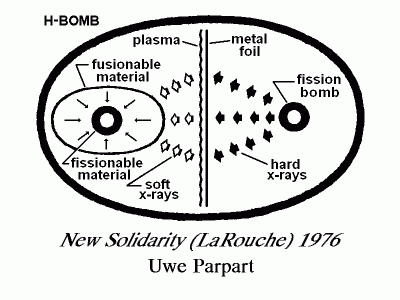
In radiation implosion, the burst of X-ray energy coming from an exploding primary is captured and contained within an opaque-walled radiation channel which surrounds the nuclear energy components of the secondary. The radiation quickly turns the plastic foam that had been filling the channel into a plasma which is mostly transparent to X-rays, and the radiation is absorbed in the outermost layers of the pusher/tamper surrounding the secondary, which ablates and applies a massive force[27] (much like an inside out rocket engine) causing the fusion fuel capsule to implode much like the pit of the primary. As the secondary implodes a fissile "spark plug" at its center ignites and provides neutrons and heat which enable the lithium deuteride fusion fuel to produce tritium and ignite as well. The fission and fusion chain reactions exchange neutrons with each other and boost the efficiency of both reactions. The greater implosive force, enhanced efficiency of the fissile "spark plug" due to boosting via fusion neutrons, and the fusion explosion itself provide significantly greater explosive yield from the secondary despite often not being much larger than the primary.

- Warhead before firing. The nested spheres at the top are the fission primary; the cylinders below are the fusion secondary device.
- Fission primary's explosives have detonated and collapsed the primary's fissile pit.
- The primary's fission reaction has run to completion, and the primary is now at several million degrees and radiating gamma and hard X-rays, heating up the inside of the hohlraum, the shield, and the secondary's tamper.
- The primary's reaction is over and it has expanded. The surface of the pusher for the secondary is now so hot that it is also ablating or expanding away, pushing the rest of the secondary (tamper, fusion fuel, and fissile spark plug) inward. The spark plug starts to fission. Not depicted: the radiation case is also ablating and expanding outward (omitted for clarity of diagram).
- The secondary's fuel has started the fusion reaction and shortly will burn up. A fireball starts to form.
For example, for the Redwing Mohawk test on July 3, 1956, a secondary called the Flute was attached to the Swan primary. The Flute was 38 centimetres (15 in) in diameter and 59 centimetres (23.4 in) long, about the size of the Swan. But it weighed ten times as much and yielded 24 times as much energy (355 kilotons vs 15 kilotons).
In engineering terms, radiation implosion allows for the exploitation of several known features of nuclear bomb materials which heretofore had eluded practical application. For example:
- For the secondary to be imploded by the hot, radiation-induced plasma surrounding it, it must remain cool for the first microsecond, i.e., it must be encased in a massive radiation (heat) shield. The shield's massiveness allows it to double as a tamper, adding momentum and duration to the implosion. No material is better suited for both of these jobs than ordinary, cheap uranium-238, which also happens to undergo fission when struck by the neutrons produced by D-T fusion. This casing, called the pusher, thus has three jobs: to keep the secondary cool; to hold it, inertially, in a highly compressed state; and, finally, to serve as the chief energy source for the entire bomb. The consumable pusher makes the bomb more a uranium fission bomb than a hydrogen fusion bomb. Insiders never used the term "hydrogen bomb".[28]
- Finally, the heat for fusion ignition comes not from the primary but from a second fission bomb called the spark plug, embedded in the heart of the secondary. The implosion of the secondary implodes this spark plug, detonating it and igniting fusion in the material around it, but the spark plug then continues to fission in the neutron-rich environment until it is fully consumed, adding significantly to the yield.[29]
In the ensuing fifty years, no one has come up with a more efficient way to build a thermonuclear bomb. It is the design of choice for the United States, Russia, the United Kingdom, China, and France, the five thermonuclear powers. On 3 September 2017 North Korea carried out what it reported as its first "two-stage thermo-nuclear weapon" test.[30] According to Dr. Theodore Taylor, after reviewing leaked photographs of disassembled weapons components taken before 1986, Israel possessed boosted weapons and would require supercomputers of that era to advance further toward full two-stage weapons in the megaton range without nuclear test detonations.[31] The other nuclear-armed nations, India and Pakistan, probably have single-stage weapons, possibly boosted.[29]
Interstage
In a two-stage thermonuclear weapon the energy from the primary impacts the secondary. An essential energy transfer modulator called the interstage, between the primary and the secondary, protects the secondary's fusion fuel from heating too quickly, which could cause it to explode in a conventional (and small) heat explosion before the fusion and fission reactions get a chance to start.{{Citation needed|date=June 2021|reason=While some might modulate, the important part is filling the radiation channels with lo There is very little information in the open literature about the mechanism of the interstage. Its first mention in a U.S. government document formally released to the public appears to be a caption in a graphic promoting the Reliable Replacement Warhead Program in 2007. If built, this new design would replace "toxic, brittle material" and "expensive 'special' material" in the interstage.[32] This statement suggests the interstage may contain beryllium to moderate the flux of neutrons from the primary, and perhaps something to absorb and re-radiate the x-rays in a particular manner.[33] There is also some speculation that this interstage material, which may be code-named Fogbank, might be an aerogel, possibly doped with beryllium and/or other substances.[34][35]
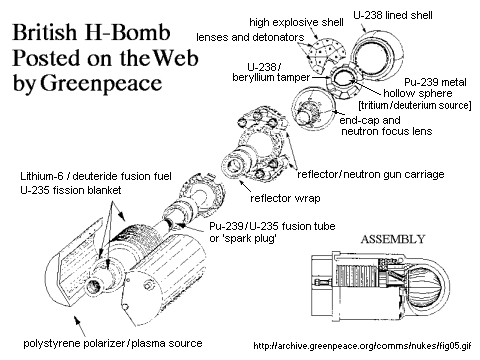
The interstage and the secondary are encased together inside a stainless steel membrane to form the canned subassembly (CSA), an arrangement which has never been depicted in any open-source drawing.[36] The most detailed illustration of an interstage shows a British thermonuclear weapon with a cluster of items between its primary and a cylindrical secondary. They are labeled "end-cap and neutron focus lens", "reflector/neutron gun carriage", and "reflector wrap". The origin of the drawing, posted on the internet by Greenpeace, is uncertain, and there is no accompanying explanation.[37]
Other designs
While every nuclear weapon design falls into one of these categories, specific designs have occasionally become the subject of news accounts and public discussion, often with incorrect descriptions about how they work and what they do. Examples:
Single stage
Minor actinide fission weapons


Neptunium-237 is considered the most immediately concerning minor actinide isotope for weaponization. Comprising ~0.05% of spent nuclear fuel, ~5 tons are produced annually worldwide. The International Atomic Energy Agency has established monitoring for facilities capable of separation of the isotope, but is yet to classify it as a "special fissionable material", alongside plutonium-239, uranium-233, and enriched uranium.[38] In September 2002, researchers at the Los Alamos National Laboratory briefly produced the first known nuclear critical mass involving a significant quantity of neptunium, in combination with shells of enriched uranium (uranium-235), discovering that the critical mass of a bare sphere of neptunium-237 "ranges from kilogram weights in the high fifties to low sixties,"[39] showing that it "is about as good a bomb material as [uranium-235]."[40] The United States federal government made plans in March 2004 to move America's supply of separated neptunium to a nuclear-waste disposal site in Nevada.[41]
Certain isotopes of americium are also considered weaponizable, despite considerable challenge, based on the testimony of nuclear weapons physicists.[42]
Layer cake

The layer cake was an early design for a weapon using thermonuclear reactions, involving an spherical implosion bomb design that contained alternating layers of fission and fusion fuel. As a single-stage device, it was only capable of generating a limited amount of fusion reactions and could not be scaled up indefinitely, and has been equated with boosted fission weapons. It could, however, provide interim capability for high yields, mostly from the low-cost materials of lithium deuteride and natural or depleted uranium, as opposed to expensive fissile material.
Layer cake devices were researched by at least the United States, Soviet Union, United Kingdom, and China. The Soviet Union and China constructed and tested layer cake nuclear weapons, while the others did not. The U.S. name for the design, "Alarm Clock," came from Teller: he called it that because it might "wake up the world" to the possibility of the potential of the Super.[43] The Russian name for the same design was more descriptive of its design: Sloika (Russian: Слойка), a layered pastry cake.
The United States never developed or tested the design in this form, because its inherent limitations made it unappealing compared to the "Classical Super" design, despite it being a fairly straightforward development compared to the "Classical Super." In the Soviet Union, however, the Sloika was tested as RDS-6s on August 12, 1953, with a yield of 400 kilotons of TNT, of which 15-20% was from thermonuclear fusion reactions.
The test used lithium-6 deuteride and mixed with a small quantity of lithium-6 tritide. It was the first nuclear test to ignite a solid thermonuclear fuel; previous US tests in Operation Greenhouse and Ivy had used cryogenic or gaseous deuterium and tritium. Because the Soviet Sloika test was an air drop, it was sometimes claimed that the USSR won the race to make the first deliverable hydrogen bomb, as the first U.S. thermonuclear test (Ivy Mike, 1952) was of an undeliverably large "device." Those who push back against some claims make a distinction between "true," staged thermonuclear weapons and "boosted" weapons, and include the "Sloika" with the latter. The first Soviet test of a staged thermonuclear weapon design, RDS-37, was not until 1955. It has been argued that the Sloika, rather than a dead-end, was integral to the Soviet development of staged thermonuclear weapons, as efforts to better implode Sloika-style designs were the Soviet path towards radiation implosion.[44]
The Soviet Union later tested RDS-27, a modification of RDS-6s to use only lithium deuteride, without the expensive tritium, allowing mass production. The device was tested in the 1955 nuclear test series and demonstrated an expected lower yield of 250 kilotons.[45]
In its pursuit of thermonuclear weapons, the third Chinese nuclear weapons test was also a layer-cake design. Chinese nuclear scientists had acquired some details of the sloika from the Soviets at some point during their period of nuclear cooperation. It was codenamed "596L", as it was based on China's first nuclear device, "596", a fission implosion bomb, but with an extra layer of lithium deuteride represented by the "L". The weapon was tested on 9 May 1966, dropped from a Xi'an H-6 bomber over Lop Nur, and yielded approximately 220 kt.[46]
Multi-stage
Multi-stage fission weapons
The idea of using radiation implosion channelled from one fission bomb to effectively compress a second fission bomb was considered as part of the British hydrogen bomb programme, which mistakenly believed this would be necessary before igniting a third thermonuclear stage. This original configuration was nicknamed "Tom, Dick, and Harry", although British weapon designers soon focused on more conventional two-stage weapons and used "Dick" to refer to their thermonuclear secondaries. Nonetheless, components for such a "triple bomb" were constructed as the "Halliard 1" option of the Operation Grapple test series. A small radiation casing contained the primary and secondary fission bombs, and sat inside a large radiation casing alongside the thermonuclear tertiary. Despite previous test successes making any Halliard test unnecessary, the weapon was fired at the request of the United States, to whom the concept was "novel and of deep interest". It was fired as the Grapple Z3 shot on 11 September 1958, yielding 800 kilotons.[47]
Clean bombs
Designs with lead tampers

On March 1, 1954, the largest-ever U.S. nuclear test explosion, the 15-megaton Castle Bravo shot of Operation Castle at Bikini Atoll, delivered a promptly lethal dose of fission-product fallout to more than 6,000 square miles (16,000 km2) of Pacific Ocean surface.[48] Radiation injuries to Marshall Islanders and Japanese fishermen made that fact public and revealed the role of fission in hydrogen bombs.
Other high fusion yield fraction tests include the 50-megaton Tsar Bomba at 97% fusion,[49] the 9.3-megaton Hardtack Poplar test at 95%,[50] and the 4.5-megaton Redwing Navajo test at 95% fusion.[51]
Designs with no tampers
The Ripple concept, which used ablation to achieve fusion using very little fission, was and still is by far the cleanest design. Unlike previous clean bombs, which were clean simply by replacing the uranium-238 tamper with lead, Ripple was inherently clean. The fission sparkplug was replaced by a large deuterium-tritium gas core, surrounded by a tamper-like lithium deuteride shell. It is assumed that thin concentric shells of a high-Z material like lead, driven by the small Kinglet primary allowed propagated sustained shockwaves to the core, sustaining the thermonuclear burn and giving the device its name. The design was influenced by the nascent field of inertial confinement fusion. Ripple was also extremely efficient; plans for a 15 kt/kg were made during Operation Dominic. Shot Androscoggin featured a proof-of-concept Ripple design, resulting in a 63-kiloton fizzle (significantly lower than the predicted 15 megatons). It was repeated in shot Housatonic, which featured a 9.96 megaton explosion that was reportedly >99.9% fusion.[52]
Beginning with the 1958 Soviet nuclear tests, physicists Yuri Trutnev and Yuri Babayev developed very lightweight thermonuclear weapons with no use of fissile material in the secondary stage. These weapons were adapted into the majority of Soviet and modern Russian weapons.[53][54] It is possible this design involves a deuterium-tritium mixture ignition, similar to the Soviet peaceful nuclear explosion devices.[55]
In the Soviet peaceful nuclear explosion program "Nuclear Explosions for the National Economy", "clean" bombs were used for a 1971 triple salvo test related to the Pechora–Kama Canal project. It was reported that about 250 nuclear devices might be used to get the final goal. The Taiga test was to demonstrate the feasibility of the project. Three of these devices of 15 kiloton yield each were placed in separate boreholes, simultaneously detonated, catapulting a radioactive plume into the air that was carried eastward by wind. The resulting trench was around 700 metres (2,300 ft) long and 340 metres (1,120 ft) wide, with an unimpressive depth of just 10 to 15 metres (30 to 50 ft).[56] Despite their "clean" nature, the area still exhibits a noticeably higher (albeit mostly harmless) concentration of fission products, the intense neutron bombardment of the soil, the device itself and the support structures also activated their stable elements to create a significant amount of man-made radioactive elements like 60Co. A larger scale project as was envisioned, however, would have had significant consequences both from the fallout of radioactive plume and the radioactive elements created by the neutron bombardment.[57]
Third generation
First and second generation nuclear weapons release energy as omnidirectional blasts. Third generation[58][59][60] nuclear weapons are experimental special effect warheads and devices that can release energy in a directed manner, some of which were tested during the Cold War but were never deployed. These include:
- Project Prometheus, also known as "Nuclear Shotgun", which would have used a nuclear explosion to accelerate kinetic penetrators against ICBMs.[61]
- Project Excalibur, a nuclear-pumped X-ray laser to destroy ballistic missiles.
- Nuclear shaped charges that focus their energy in particular directions.
- Project Orion explored the use of nuclear explosives for rocket propulsion.
Fourth generation and pure fusion weapons
The idea of "4th-generation" nuclear weapons has been proposed as a possible successor to the examples of weapons designs listed above. These methods tend to revolve around using non-nuclear primaries to set off further fission or fusion reactions. For example, if antimatter were usable and controllable in macroscopic quantities, a reaction between a small amount of antimatter and an equivalent amount of matter could release energy comparable to a small fission weapon, and could in turn be used as the first stage of a very compact thermonuclear weapon. Extremely-powerful lasers could also potentially be used this way, if they could be made powerful-enough, and compact-enough, to be viable as a weapon. Most of these ideas are versions of pure fusion weapons, and share the common property that they involve hitherto unrealized technologies as their "primary" stages.[62]
While many nations have invested significantly in inertial confinement fusion research programs, since the 1970s it has not been considered promising for direct weapons use, but rather as a tool for weapons- and energy-related research that can be used in the absence of full-scale nuclear testing. Whether any nations are aggressively pursuing "4th-generation" weapons is not clear. In many cases (as with antimatter) the underlying technology is presently thought to be very far from being viable, and if it was viable would be a powerful weapon in and of itself, outside of a nuclear weapons context, and without providing any significant advantages above existing nuclear weapons designs[63]
Since the 1950s, the United States and Soviet Union investigated the possibility of releasing significant amounts of nuclear fusion energy without the use of a fission primary. Such "pure fusion weapons" were primarily imagined as low-yield, tactical nuclear weapons whose advantage would be their ability to be used without producing fallout on the scale of weapons that release fission products. In 1998, the United States Department of Energy declassified the following:
(1) Fact that the DOE made a substantial investment in the past to develop a pure fusion weapon
(2) That the U.S. does not have and is not developing a pure fusion weapon; and
(3) That no credible design for a pure fusion weapon resulted from the DOE investment.[64]
Scientists such as Arjun Makhijani have argued that ICF programs, including the United States' stockpile stewardship components of the National Ignition Facility, Z Pulsed Power Facility, and Los Alamos magnetized target fusion could contribute to or be primarily pursued for eventual use in pure fusion weapons. Such experiments have also been contested as violations of the Comprehensive Nuclear-Test Ban Treaty.
Arbitrarily large multi-staged devices
The idea of a device which has an arbitrarily large number of Teller-Ulam stages, with each driving a larger radiation-driven implosion than the preceding stage, is frequently suggested,[65][66] but technically disputed.[67] There are "well-known sketches and some reasonable-looking calculations in the open literature about two-stage weapons, but no similarly accurate descriptions of true three stage concepts."[67]
During the mid-1950s through early 1960s, scientists working in the weapons laboratories of the United States investigated weapons concepts as large as 1,000 megatons,[68] and Edward Teller announced the design of a 10,000-megaton weapon code-named SUNDIAL at a meeting of the General Advisory Committee of the Atomic Energy Commission.[69] Much of the information about these efforts remains classified,[70][71] but such "gigaton" range weapons do not appear to have made it beyond theoretical investigations.
While both the US and Soviet Union investigated (and in the case of the Soviets, tested) "very high yield" (e.g. 50 to 100-megaton) weapons designs in the 1950s and early 1960s,[72] these appear to represent the upper-limit of Cold War weapon yields pursued seriously, and were so physically heavy and massive that they could not be carried entirely within the bomb bays of the largest bombers. Cold War warhead development trends from the mid-1960s onward, and especially after the Limited Test Ban Treaty, instead resulted in highly-compact warheads with yields in the range from hundreds of kilotons to the low megatons that gave greater options for deliverability.
Following the concern caused by the estimated gigaton scale of the 1994 Comet Shoemaker-Levy 9 impacts on the planet Jupiter, in a 1995 meeting at Lawrence Livermore National Laboratory (LLNL), Edward Teller proposed to a collective of U.S. and Russian ex-Cold War weapons designers that they collaborate on designing a 1,000-megaton nuclear explosive device for diverting extinction-class asteroids (10+ km in diameter), which would be employed in the event that one of these asteroids were on an impact trajectory with Earth.[73][74][75]
Specific effect
Salted bombs

A salted bomb is a nuclear weapon which intentionally disperses a large quantity of one or more selected radioisotopes, typically produced in-situ from irradiation by the weapon detonation, and designed to make the blast area inhospitable to humans for many years. This is distinct from most nuclear weapons, which also produce and disperse deadly radioisotopes as the fission products of uranium and plutonium, but this fission is part of the device's yield, and fission product radioactivity drops off more rapidly.
A commonly selected radioisotope is cobalt-60 (The element Chemistry:cobalt does not exist.), which could be formed from the weapon's neutron irradiation of a tamper or jacket of natural cobalt (almost entirely cobalt-59).
The table below gives relative values for gamma radiation from standard nuclear weapon fission product fallout, with a range of short-, medium-, and long-lived half-lives, versus from cobalt-60, which has a half-life of 5.27 years. Cobalt-60 has a higher relative intensity from six months after detonation to 75 years after detonation, at which point long-lived fission product radiation overtakes cobalt again:
| Gamma radiation relative intensity[76] | ||
|---|---|---|
| Time since detonation | Cobalt-60 | Fission products |
| 1 hour | 1 | 15,000 |
| 1 week | 1 | 35 |
| 1 month | 1 | 5 |
| 6 months | 1 | 1 |
| 1 year | 8 | 1 |
| 5 years | 150 | 1 |
| 75 years | 1 | 1 |
Salted weapons were investigated by U.S. Department of Defense.[77] Such a weapon was tested at least once in the Operation Redwing series as shot Flathead. The device was a TX-28S variant of the B28 nuclear bomb, where the "S" stood for "Salted".[78]
The triple "taiga" nuclear salvo test, as part of the preliminary March 1971 Pechora–Kama Canal project, produced a small amount of fission products and therefore a comparatively large amount of case material activated products are responsible for most of the residual activity at the site today, namely The element Chemistry:cobalt does not exist.. As of 2011,[update] fusion generated neutron activation was responsible for about half of the gamma dose at the test site. That dose is too small to cause deleterious effects, and normal green vegetation exists all around the lake that was formed.[79][80]
Neutron bombs
ERWs are more accurately described as suppressed yield weapons. When the yield of a nuclear weapon is less than one kiloton, its lethal radius from blast, 700 m (2,300 ft), is less than that from its neutron radiation. However, the blast is more than potent enough to destroy most structures, which are less resistant to blast effects than even unprotected human beings. Blast pressures of upwards of 20 psi (140 kPa) are survivable, whereas most buildings will collapse with a pressure of only 5 psi (30 kPa).
| Standard | Enhanced | |
|---|---|---|
| Blast | 50% | 40% |
| Thermal energy | 35% | 25% |
| Instant radiation | 5% | 30% |
| Residual radiation | 10% | 5% |
A neutron bomb is only feasible if the yield is sufficiently high that efficient fusion stage ignition is possible, and if the yield is low enough that the case thickness will not absorb too many neutrons. This means that neutron bombs have a yield range of 1–10 kilotons, with fission proportion varying from 50% at 1 kiloton to 25% at 10 kilotons (all of which comes from the primary stage). The neutron output per kiloton is then 10 to 15 times greater than for a pure fission implosion weapon or for a strategic warhead like a W87 or W88.[81]
Weapon design laboratories
All the nuclear weapon design innovations discussed in this article originated from the following three labs in the manner described. Other nuclear weapon design labs in other countries duplicated those design innovations independently, reverse-engineered them from fallout analysis, or acquired them by espionage.[82]
Lawrence Berkeley
By the time he moved his operation to the new secret town of Los Alamos, New Mexico, in the spring of 1943, the accumulated wisdom on nuclear weapon design consisted of five lectures by Berkeley professor Robert Serber, transcribed and distributed as the (classified but now fully declassified and widely available online as a PDF) Los Alamos Primer.[83] The Primer addressed fission energy, neutron production and capture, nuclear chain reactions, critical mass, tampers, predetonation, and three methods of assembling a bomb: gun assembly, implosion, and "autocatalytic methods", the one approach that turned out to be a dead end.
Los Alamos
In 1945, using the results of critical mass experiments, Los Alamos technicians fabricated and assembled components for four bombs: the Trinity Gadget, Little Boy, Fat Man, and an unused spare Fat Man.[84] According to the Los Alamos National Laboratory website, the term, "gadget" was commonly used during the 1940s to describe experimental and engineering devices to protect secrecy around the project. Records in the NSRC refer to "the gun gadget" (Little Boy) and "the implosion gadget" (Fat Man) and the Trinity device as "The Gadget."[85]
After the war, those who could, including Oppenheimer, returned to university teaching positions. Those who remained worked on levitated and hollow pits and conducted weapon effects tests such as Crossroads Able and Baker at Bikini Atoll in 1946.[86]
Lawrence Livermore
Shifting gears, Livermore settled for taking ideas Los Alamos had shelved and developing them for the Army and Navy. This led Livermore to specialize in small-diameter tactical weapons, particularly ones using two-point implosion systems, such as the Swan. Small-diameter tactical weapons became primaries for small-diameter secondaries. Around 1960, when the superpower arms race became a ballistic missile race, Livermore warheads were more useful than the large, heavy Los Alamos warheads. Los Alamos warheads were used on the first intermediate-range ballistic missiles, IRBMs, but smaller Livermore warheads were used on the first intercontinental ballistic missiles, ICBMs, and submarine-launched ballistic missiles, SLBMs, as well as on the first multiple warhead systems on such missiles.[87]
Explosive testing
Template:First nuclear tests Nuclear weapons are in large part designed by trial and error. The trial often involves test explosion of a prototype.
In a nuclear explosion, a large number of discrete events, with various probabilities, aggregate into short-lived, chaotic energy flows inside the device casing. Complex mathematical models are required to approximate the processes, and in the 1950s there were no computers powerful enough to run them properly. Even today's computers and simulation software are not adequate.[88]
Light pipes
The picture below shows the Shrimp device, detonated on March 1, 1954, at Bikini, as the Castle Bravo test. Its 15-megaton explosion was the largest ever by the United States. The silhouette of a man is shown for scale. The device is supported from below, at the ends. The pipes going into the shot cab ceiling, which appear to be supports, are actually diagnostic light pipes. The eight pipes at the right end (1) sent information about the detonation of the primary. Two in the middle (2) marked the time when X-rays from the primary reached the radiation channel around the secondary. The last two pipes (3) noted the time radiation reached the far end of the radiation channel, the difference between (2) and (3) being the radiation transit time for the channel.[89]

From the shot cab, the pipes turned horizontally and traveled 2.3 km (7,500 ft) along a causeway built on the Bikini reef to a remote-controlled data collection bunker on Namu Island. While x-rays would normally travel at the speed of light through a low-density material like the plastic foam channel filler between (2) and (3), the intensity of radiation from the exploding primary creates a relatively opaque radiation front in the channel filler, which acts like a slow-moving logjam to retard the passage of radiant energy. While the secondary is being compressed via radiation-induced ablation, neutrons from the primary catch up with the x-rays, penetrate into the secondary, and start breeding tritium via the third reaction noted in the first section above. This 6Li + n reaction is exothermic, producing 5 MeV per event. The spark plug has not yet been compressed and thus remains subcritical, so no significant fission or fusion takes place as a result. If enough neutrons arrive before implosion of the secondary is complete, though, the crucial temperature differential between the outer and inner parts of the secondary can be degraded, potentially causing the secondary to fail to ignite. The first Livermore-designed thermonuclear weapon, the Morgenstern device, failed in this manner when it was tested as Castle Koon on April 7, 1954. The primary ignited, but the secondary, preheated by the primary's neutron wave, suffered what was termed as an inefficient detonation;[90]: 165 thus, a weapon with a predicted one-megaton yield produced only 110 kilotons, of which merely 10 kt were attributed to fusion.[91]: 316
It is not clear from the public record how successful the Shrimp light pipes were. The unmanned data bunker was far enough back to remain outside the mile-wide crater, but the 15-megaton blast, two and a half times as powerful as expected, breached the bunker by blowing its 20-ton door off the hinges and across the inside of the bunker. (The nearest people were 32 kilometres (20 mi) farther away, in a bunker that survived intact.)[92]
Fallout analysis
Fallout analysis revealed to designers that, with the (n, 2n) reaction, the Shrimp secondary effectively had two and half times as much lithium-6 as expected. The tritium, the fusion yield, the neutrons, and the fission yield were all increased accordingly.[93]
Underground testing

The Yucca Flat section of the NTS is covered with subsidence craters resulting from the collapse of terrain over radioactive caverns created by nuclear explosions (see photo).
Production facilities
 | The examples and perspective in this section deal primarily with the United States and do not represent a worldwide view of the subject. (June 2014) (Learn how and when to remove this template message) |
When two-stage weapons became standard in the early 1950s, weapon design determined the layout of the new, widely dispersed U.S. production facilities, and vice versa.
Warhead design safety

Gun-type
In-flight pit insertion
Steel ball safety method
right
Chain safety method
One-point safety
Wire safety method
In the last test before the 1958 moratorium the W47 warhead for the Polaris SLBM was found to not be one-point safe, producing an unacceptably high nuclear yield of 200 kg (440 lb) of TNT equivalent (Hardtack II Titania). With the test moratorium in force, there was no way to refine the design and make it inherently one-point safe. A solution was devised consisting of a boron-coated wire inserted into the weapon's hollow pit at manufacture. The warhead was armed by withdrawing the wire onto a spool driven by an electric motor. Once withdrawn, the wire could not be re-inserted.[94] The wire had a tendency to become brittle during storage, and break or get stuck during arming, preventing complete removal and rendering the warhead a dud.[95] It was estimated that 50–75% of warheads would fail. This required a complete rebuild of all W47 primaries.[96] The oil used for lubricating the wire also promoted corrosion of the pit.[97]
Strong link/weak link
Permissive action link
References
Notes
- ↑ The physics package is the nuclear explosive module inside the bomb casing, missile warhead, or artillery shell, etc., which delivers the weapon to its target. While photographs of weapon casings are common, photographs of the physics package are quite rare, even for the oldest and crudest nuclear weapons. For a photograph of a modern physics package see W80.
- ↑ "To the Outside World, a Superbomb more Bluff than Bang", Life (New York) 51 (19, November 10, 1961): 34–37, 1961, https://books.google.com/books?id=4VMEAAAAMBAJ&pg=PA34, retrieved 2010-06-28. Article on the Soviet Tsar Bomba test. Because explosions are spherical in shape and targets are spread out on the relatively flat surface of the earth, numerous smaller weapons cause more destruction. From page 35: "... five five-megaton weapons would demolish a greater area than a single 50-megatonner."
- ↑ Caisse Nationale de la Recherche Scientifique (National Fund for Scientific Research), "Perfectionnements aux charges explosives (Improvements to explosive charges)", FR patent 971324, published 1951-01-16.
- ↑ The main source for this section is Samuel Glasstone and Philip Dolan, The Effects of Nuclear Weapons, Third Edition, 1977, U.S. Dept of Defense and U.S. Dept of Energy (see links in General References, below), with the same information in more detail in Samuel Glasstone, Sourcebook on Atomic Energy, Third Edition, 1979, U.S. Atomic Energy Commission, Krieger Publishing.
- ↑ "nuclear fission | Examples & Process | Britannica". https://www.britannica.com/science/nuclear-fission.
- ↑ Glasstone and Dolan, Effects, p. 12.
- ↑ Glasstone, Sourcebook, p. 503.
- ↑ "Nuclear explained – U.S. Energy Information Administration (EIA)". https://www.eia.gov/energyexplained/nuclear/.
- ↑ Sublette, Carey. "NWFAQ: 4.2.5 Special Purpose Applications". https://nuclearweaponarchive.org/Nwfaq/Nfaq4-2.html#Nfaq4.2.5. "Modern boosted fission triggers take this evolution towards higher yield to weight, smaller volume, and greater ease of radiation escape to an extreme. Comparable explosive yields are produced by a core consisting of 3.5–4.5 kg of plutonium, 5–6 kg of beryllium reflector, and some 20 kilograms of high explosive containing essentially no high-Z material."
- ↑ Sublette, Carey. "NWFAQ: 4.4.3.4 Principles of Compression". https://nuclearweaponarchive.org/Nwfaq/Nfaq4-4.html#Nfaq4.4.3.4. "A simplistic computation of the work done in imploding a 10 liter secondary in the "W-80" ... the primary actually produced (5 kt)..."
- ↑ "Atomic Glossary". Nuclear Museum. https://ahf.nuclearmuseum.org/ahf/history/atomic-glossary/.
- ↑ Rhodes, Richard (1986). The Making of the Atomic Bomb. New York: Simon & Schuster. p. 563. ISBN 0-671-44133-7. OCLC 13793436.
- ↑ "neutrons carry off most of the reaction energy", Glasstone and Dolan, Effects, p. 21.
- ↑ 14.0 14.1 Glasstone and Dolan, Effects, p. 21.
- ↑ Parsons, Keith M.; Zaballa, Robert A. (2017). Bombing the Marshall Islands: A Cold War Tragedy. Cambridge University Press. pp. 53–56. ISBN 978-1-108-50874-2
- ↑ Glasstone and Dolan, Effects, pp. 12–13. When 454 g (one pound) of 235U undergoes complete fission, the yield is 8 kilotons. The 13 to 16-kiloton yield of the Little Boy bomb was therefore produced by the fission of no more than 2 pounds (910 g) of 235U, out of the 141 pounds (64,000 g) in the pit. Thus, the remaining 139 pounds (63 kg), 98.5% of the total, contributed nothing to the energy yield.
- ↑ Compere, A.L., and Griffith, W.L. 1991. "The U.S. Calutron Program for Uranium Enrichment: History,. Technology, Operations, and Production. Report", ORNL-5928, as cited in John Coster-Mullen, "Atom Bombs: The Top Secret Inside Story of Little Boy and Fat Man", 2003, footnote 28, p. 18. The total wartime output of Oralloy produced at Oak Ridge by July 28, 1945, was 165 pounds (75 kg). Of this amount, 84% was scattered over Hiroshima (see previous footnote).
- ↑ Hoddeson, Lillian (2004). Critical Assembly: A Technical History of Los Alamos During the Oppenheimer Years, 1943–1945. Cambridge University Press. p. 271. ISBN 978-0-521-54117-6.
- ↑ "Restricted Data Declassification Decisions from 1945 until Present" – "Fact that plutonium and uranium may be bonded to each other in unspecified pits or weapons."
- ↑ "Restricted Data Declassification Decisions from 1946 until Present". https://fas.org/sgp/othergov/doe/rdd-7.html.
- ↑ 21.0 21.1 Fissionable Materials section of the Nuclear Weapons FAQ, Carey Sublette, accessed Sept 23, 2006
- ↑ All information on nuclear weapon tests comes from Chuck Hansen, The Swords of Armageddon: U.S. Nuclear Weapons Development since 1945, October 1995, Chucklea Productions, Volume VIII, p. 154, Table A-1, "U.S. Nuclear Detonations and Tests, 1945–1962".
- ↑ Nuclear Weapons FAQ: 4.1.6.3 Hybrid Assembly Techniques , accessed December 1, 2007. Drawing adapted from the same source.
- ↑ 24.0 24.1 Sublette, Carey. "Fission-Fusion Hybrid Weapons". https://nuclearweaponarchive.org/.
- ↑ So I pieced together from Edward's testament and from his memoir that Stan had come to him in February of 1951 American Institute of Physics interview with Richard Garwin by Ken Ford, dated December 2012
- ↑ he was going to use first hydrodynamics and just the shockwaves and then neutron heating, which would have been a disaster. It would have blown it up before it got going. It was Teller who came up with the radiation. , American Institute of Physics interview with Marshall Rosenbluth by Kai-Henrik Barth, dated August 2003
- ↑ 4.4 Elements of Thermonuclear Weapon Design . Nuclearweaponarchive.org. Retrieved on 2011-05-01.
- ↑ Until a reliable design was worked out in the early 1950s, the hydrogen bomb (public name) was called the superbomb by insiders. After that, insiders used a more descriptive name: two-stage thermonuclear. Two examples. From Herb York, The Advisors, 1976, "This book is about ... the development of the H-bomb, or the superbomb as it was then called." p. ix, and "The rapid and successful development of the superbomb (or super as it came to be called) ..." p. 5. From National Public Radio Talk of the Nation, November 8, 2005, Siegfried Hecker of Los Alamos, "the hydrogen bomb – that is, a two-stage thermonuclear device, as we referred to it – is indeed the principal part of the US arsenal, as it is of the Russian arsenal."
- ↑ 29.0 29.1 Howard Morland, "Born Secret" , Cardozo Law Review, March 2005, pp. 1401–1408.
- ↑ Kemp, Ted (3 September 2017). "North Korea hydrogen bomb: Read the full announcement from Pyongyang". CNBC News. https://www.cnbc.com/2017/09/03/north-korea-hydrogen-bomb-read-the-full-announcement-from-pyongyang.html.
- ↑ "Israel's Nuclear Weapon Capability: An Overview". https://www.wisconsinproject.org/israels-nuclear-weapon-capability-an-overview/.
- ↑ "Improved Security, Safety & Manufacturability of the Reliable Replacement Warhead", NNSA March 2007.
- ↑ A 1976 drawing which depicts an interstage that absorbs and re-radiates x-rays. From Howard Morland, "The Article", Cardozo Law Review, March 2005, p. 1374.
- ↑ Ian Sample (6 March 2008). "Technical hitch delays renewal of nuclear warheads for Trident". The Guardian. https://www.theguardian.com/uk/2008/mar/06/military.greenpolitics?gusrc=rss&feed=politics.
- ↑ "ArmsControlWonk: FOGBANK" , March 7, 2008. (Accessed 2010-04-06)
- ↑ "SAND8.8 – 1151 Nuclear Weapon Data – Sigma I", Sandia Laboratories, September 1988.
- ↑ The Greenpeace drawing. From Morland, Cardozo Law Review, March 2005, p. 1378.
- ↑ An, J S; Shin, J S; Kim, J S; Kwack, E H; Kim, B K (2000-05-01). "The proliferation potential of neptunium and americium". https://www.osti.gov/etdeweb/biblio/20101205.
- ↑ Sanchez, Rene G.; Loaiza, David J.; Kimpland, Robert H.; Hayes, David K.; Cappiello, Charlene C.; Myers, William L.; Jaegers, Peter J.; Clement, Steven D. et al.. "Criticality of a 237Np Sphere". Japanese Atomic Energy Agency. http://typhoon.jaea.go.jp/icnc2003/Proceeding/paper/2.14_107.pdf.
- ↑ Weiss, Peter (2 July 2009). "Neptunium nukes?: Little-studied metal goes critical". Science News 162 (17): 259. doi:10.2307/4014034.
- ↑ Yarris, Lynn (2005-11-29). "Getting the Neptunium out of Nuclear Waste". Berkeley laboratory, U.S. Department of Energy. http://newscenter.lbl.gov/feature-stories/2005/11/29/getting-the-neptunium-out-of-nuclear-waste/.
- ↑ Pellaud, Bruno (2002-07-12). "Proliferation aspects of plutonium recycling". Comptes Rendus. Physique (Cellule MathDoc/Centre Mersenne) 3 (7–8): 1067–1079. doi:10.1016/s1631-0705(02)01364-6. ISSN 1878-1535. https://comptes-rendus.academie-sciences.fr/physique/item/10.1016/S1631-0705(02)01364-6.pdf. Retrieved 2025-04-30.
- ↑ Rhodes 1995, p. 256.
- ↑ Wellerstein, Alex; Geist, Edward (2017). "The secret of the Soviet hydrogen bomb". Physics Today 70 (4): 40. doi:10.1063/PT.3.3524. Bibcode: 2017PhT....70d..40W.
- ↑ Goncharov, German A (2005-11-30). "The extraordinarily beautiful physical principle of thermonuclear charge design (on the occasion of the 50th anniversary of the test of RDS-37 — the first Soviet two-stage thermonuclear charge)". Physics-Uspekhi 48 (11): 1187–1196. doi:10.1070/PU2005v048n11ABEH005839. ISSN 1063-7869. Bibcode: 2005PhyU...48.1187G. https://iopscience.iop.org/article/10.1070/PU2005v048n11ABEH005839. Retrieved 2025-06-14.
- ↑ Zhang, Hui (2024-04-11). "The short march to China's hydrogen bomb" (in en-US). https://thebulletin.org/2024/04/the-short-march-to-chinas-hydrogen-bomb/.
- ↑ Arnold, Lorna (2001-06-09). Britain and the H-Bomb. New York: Palgrave MacMillan. pp. 186–189. ISBN 978-0-312-23518-5.
- ↑ See map.
- ↑ 4.5 Thermonuclear Weapon Designs and Later Subsections . Nuclearweaponarchive.org. Retrieved on 2011-05-01.
- ↑ Operation Hardtack I . Nuclearweaponarchive.org. Retrieved on 2011-05-01.
- ↑ Operation Redwing . Nuclearweaponarchive.org. Retrieved on 2011-05-01.
- ↑ Grams, Jon (2021-06-06). "Ripple: An Investigation of the World's Most Advanced High-Yield Thermonuclear Weapon Design". Journal of Cold War Studies (The MIT Press) 23 (2): 133–161. doi:10.1162/jcws_a_01011. ISSN 1531-3298. https://muse.jhu.edu/article/794729/pdf. Retrieved 2025-04-07.
- ↑ "Достояние России." (in ru). https://elib.biblioatom.ru/text/dostoyanie-rossii_2006/p38.
- ↑ "На благо России. К 75-летию акад. РАН Ю.А. Трутнева." (in ru). https://elib.biblioatom.ru/text/na-blago-rossii-k-75-letiyu-trutneva_2002/p64.
- ↑ "Ядерные испытания СССР. Мирные ядерные взрывы: обеспечение общей и радиационной безопасности при их проведении." (in ru). https://elib.biblioatom.ru/text/mirnye-yadernye-vzryvy_2001/p149.
- ↑ Ramzaev, V.; Repin, V.; Medvedev, A.; Khramtsov, E.; Timofeeva, M.; Yakovlev, V. (July 2011). "Radiological investigations at the "Taiga" nuclear explosion site: Site description and in situ measurements" (in en). Journal of Environmental Radioactivity 102 (7): 672–680. doi:10.1016/j.jenvrad.2011.04.003. PMID 21524834. Bibcode: 2011JEnvR.102..672R. https://linkinghub.elsevier.com/retrieve/pii/S0265931X11000750.
- ↑ Ramzaev, V.; Repin, V.; Medvedev, A.; Khramtsov, E.; Timofeeva, M.; Yakovlev, V. (July 2012). "Radiological investigations at the "Taiga" nuclear explosion site, part II: man-made γ-ray emitting radionuclides in the ground and the resultant kerma rate in air" (in en). Journal of Environmental Radioactivity 109: 1–12. doi:10.1016/j.jenvrad.2011.12.009. PMID 22541991. Bibcode: 2012JEnvR.109....1R. https://linkinghub.elsevier.com/retrieve/pii/S0265931X11003043.
- ↑ Barnaby, Frank (2012). The Role and Control of Weapons in the 1990s. Routledge. ISBN 978-1134901913. https://books.google.com/books?id=H8wwRGrD6V4C&q=third+generation+nuclear+weapons+project+excalibur+prometheus&pg=PT148. Retrieved 2020-11-02.
- ↑ "Bulletin of the Atomic Scientists". Educational Foundation for Nuclear Science, Inc. March 1991. https://books.google.com/books?id=rwwAAAAAMBAJ&q=shaped+nuclear+charge+third+generation+nuclear+weapons&pg=PA31.
- ↑ SDI: Technology, survivability, and software. DIANE. ISBN 978-1428922679. https://books.google.com/books?id=XDTo_35uQcUC&q=sdi+nuclear+shotgun&pg=PA122. Retrieved 2020-11-02.
- ↑ Barnaby, Frank (2012). The Role and Control of Weapons in the 1990s. Routledge. ISBN 978-1134901913. https://books.google.com/books?id=H8wwRGrD6V4C&q=prometheus+nuclear+shotgun&pg=PT148. Retrieved 2020-11-02.
- ↑ Gsponer, Andre (2005). "Fourth Generation Nuclear Weapons: Military effectiveness and collateral effects". arXiv:physics/0510071.
- ↑ Never say "never" . Whyfiles.org. Retrieved on 2011-05-01.
- ↑ "Restricted Data Declassification Decisions, 1946 to the Present (RDD-7)". 1 January 2001. https://sgp.fas.org/othergov/doe/rdd-7.html.
- ↑ Winterberg, Friedwardt (2010). The Release of Thermonuclear Energy by Inertial Confinement: Ways Towards Ignition. World Scientific. pp. 192–193. ISBN 978-9814295918. https://books.google.com/books?id=B7RV_vASz0EC&q=arbitrarily+large+gains%22staged+Teller-Ulam&pg=PA192. Retrieved 2020-11-02.
- ↑ Croddy, Eric A.; Wirtz, James J.; Larsen, Jeffrey, Eds. (2005). Weapons of Mass Destruction: An Encyclopedia of Worldwide Policy, Technology, and History. ABC-CLIO, Inc.. p. 376. ISBN 978-1-85109-490-5. https://books.google.com/books?id=ZzlNgS70OHAC&q=almost+unlimited+yield&pg=RA1-PA376. Retrieved 2020-11-02.
- ↑ 67.0 67.1 "Fission, Fusion and Staging". https://www.ieri.be/fr/publications/ierinews/2011/juillet/fission-fusion-and-staging..
- ↑ The Air Force and Strategic Deterrence 1951–1960. USAF historical division Liaison Office by George F. Lemmer 1967, p. 13. Formerly restricted data .
- ↑ Wellerstein, Alex (12 September 2012). "In Search of a Bigger Boom". https://blog.nuclearsecrecy.com/2012/09/12/in-search-of-a-bigger-boom/.
- ↑ "2013 FOIA Log". https://documents.theblackvault.com/documents/foia/FOIA%2014-00108-H.pdf.
- ↑ "Case No. FIC-15-0005". https://www.energy.gov/sites/prod/files/2016/04/f30/FIC-15-0005.pdf.
- ↑ Wellerstein, Alex (29 October 2021). "An Unearthly Spectacle: The Untold Story of the World's Biggest Bomb". Bulletin of the Atomic Scientists. https://thebulletin.org/2021/11/the-untold-story-of-the-worlds-biggest-nuclear-bomb/.
- ↑ "A new use for nuclear weapons: hunting rogue asteroids A persistent campaign by weapons designers to develop a nuclear defense against extraterrestrial rocks slowly wins government support 2013". 2013-10-16. https://publicintegrity.org/national-security/a-new-use-for-nuclear-weapons-hunting-rogue-asteroids/.
- ↑ Jason Mick (October 17, 2013). "The mother of all bombs would sit in wait in an orbitary platform". http://www.dailytech.com/Russia+US+Eye+Teamup+to+Build+Massive+Nuke+to+Save+Planet+from+an+Asteroid/article33569.htm.
- ↑ planetary defense workshop LLNL 1995
- ↑ Sublette, Carey. "Nuclear Weapons FAQ: 1.6". https://nuclearweaponarchive.org/Nwfaq/Nfaq1.html#nfaq1.6.
- ↑ Glasstone, Samuel (1962). The Effects of Nuclear Weapons. U.S. Department of Defense, U.S. Atomic Energy Commission. pp. 464–466. https://books.google.com/books?id=Ovu108BraNUC.
- ↑ "Operation Redwing". 1997-10-22. https://nuclearweaponarchive.org/Usa/Tests/Redwing.html.
- ↑ Ramzaev, V; Repin, V; Medvedev, A; Khramtsov, E; Timofeeva, M; Yakovlev, V (2011). "Radiological investigations at the 'Taiga' nuclear explosion site: Site description and in situ measurements". Journal of Environmental Radioactivity 102 (7): 672–680. doi:10.1016/j.jenvrad.2011.04.003. PMID 21524834. Bibcode: 2011JEnvR.102..672R.
- ↑ Ramzaev, V; Repin, V; Medvedev, A; Khramtsov, E; Timofeeva, M; Yakovlev, V (2012). "Radiological investigations at the 'Taiga' nuclear explosion site, part II: man-made γ-ray emitting radionuclides in the ground and the resultant kerma rate in air". Journal of Environmental Radioactivity 109: 1–12. doi:10.1016/j.jenvrad.2011.12.009. PMID 22541991. Bibcode: 2012JEnvR.109....1R.
- ↑ "Neutron bomb: Why 'clean' is deadly". BBC News. July 15, 1999. https://news.bbc.co.uk/1/hi/sci/tech/395689.stm.
- ↑ William J. Broad, "The Hidden Travels of The Bomb: Atomic insiders say the weapon was invented only once, and its secrets were spread around the globe by spies, scientists and the covert acts of nuclear states", New York Times, December 9, 2008, p. D1.
- ↑ Server, Robert (1992). The Los Alamos Primer (1st ed.). Berkeley: University of California Press. ISBN 978-0520075764.
- ↑ Miller, Julie (October 10, 2023). "A Tale of Two Bomb Designs | Los Alamos National Laboratory" (in en). https://www.lanl.gov/media/publications/the-vault/1023-a-tale-of-two-bomb-designs.
- ↑ Carr, Riz Ali and Alan (29 August 2022). "The Gadget and A Gadget | Los Alamos National Laboratory" (in en). https://www.lanl.gov/media/publications/the-vault/0822-gadget-and-a-gadget.
- ↑ Best, Jeremy (13 December 2021). "Analyzing the Arkansas | Los Alamos National Laboratory" (in en). https://www.lanl.gov/media/publications/national-security-science/1221-arkansas.
- ↑ Sybil Francis, Warhead Politics: Livermore and the Competitive System of Nuclear Warhead Design, UCRL-LR-124754, June 1995, Ph.D. Dissertation, Massachusetts Institute of Technology, available from National Technical Information Service. This 233-page thesis was written by a weapons-lab outsider for public distribution. The author had access to all the classified information at Livermore that was relevant to her research on warhead design; consequently, she was required to use non-descriptive code words for certain innovations.
- ↑ Walter Goad, Declaration for the Wen Ho Lee case , May 17, 2000. Goad began thermonuclear weapon design work at Los Alamos in 1950. In his Declaration, he mentions "basic scientific problems of computability which cannot be solved by more computing power alone. These are typified by the problem of long range predictions of weather and climate, and extend to predictions of nuclear weapons behavior. This accounts for the fact that, after the enormous investment of effort over many years, weapons codes can still not be relied on for significantly new designs."
- ↑ Chuck Hansen, The Swords of Armageddon, Volume IV, pp. 211–212, 284.
- ↑ Hansen, Chuck (1995). Swords of Armageddon. IV. https://www.uscoldwar.com/. Retrieved 2016-05-20.
- ↑ Hansen, Chuck (1995). Swords of Armageddon. III. https://www.uscoldwar.com/. Retrieved 2016-05-20.
- ↑ Dr. John C. Clark, as told to Robert Cahn, "We Were Trapped by Radioactive Fallout", The Saturday Evening Post, July 20, 1957, pp. 17–19, 69–71.
- ↑ Rhodes, Richard (1995). Dark Sun; the Making of the Hydrogen Bomb. Simon and Schuster. p. 541. ISBN 9780684804002. https://archive.org/details/darksunmakinghyd00rhod.
- ↑ Chuck Hansen, The Swords of Armageddon, Volume VII, pp. 396–397.
- ↑ Sybil Francis, Warhead Politics, pp. 141, 160.
- ↑ Harvey, John R.; Michalowski, Stefan (1994). "Nuclear Weapons Safety:The Case of Trident". Science & Global Security 4 (3): 261–337. doi:10.1080/08929889408426405. Bibcode: 1994S&GS....4..261H. https://scienceandglobalsecurity.org/archive/sgs04harvey.pdf.
- ↑ From Polaris to Trident: The Development of the U.S. Fleet Ballistic Missile Technology. ISBN 978-0521054010. https://books.google.com/books?id=95eoQSNDp6gC&q=warhead+corrosion&pg=PA214..
Bibliography
- Cohen, Sam, The Truth About the Neutron Bomb: The Inventor of the Bomb Speaks Out, William Morrow & Co., 1983
- Coster-Mullen, John, "Atom Bombs: The Top Secret Inside Story of Little Boy and Fat Man", Self-Published, 2011
- Glasstone, Samuel and Dolan, Philip J., editors, The Effects of Nuclear Weapons (third edition) (PDF), U.S. Government Printing Office, 1977.
- Grace, S. Charles, Nuclear Weapons: Principles, Effects and Survivability (Land Warfare: Brassey's New Battlefield Weapons Systems and Technology, vol 10)
- Hansen, Chuck, "Swords of Armageddon: U.S. Nuclear Weapons Development since 1945 " (CD-ROM & download available). PDF. 2,600 pages, Sunnyvale, California, Chucklea Publications, 1995, 2007. ISBN 978-0-9791915-0-3 (2nd Ed.)
- The Effects of Nuclear War , Office of Technology Assessment (May 1979).
- Rhodes, Richard. The Making of the Atomic Bomb. Simon and Schuster, New York, (1986 ISBN 978-0-684-81378-3)
- Rhodes, Richard. Dark Sun: The Making of the Hydrogen Bomb. Simon and Schuster, New York, (1995 ISBN 978-0-684-82414-7)
- Smyth, Henry DeWolf, Atomic Energy for Military Purposes , Princeton University Press, 1945. (see: Smyth Report)
- Dalton Ellery Girão Barroso, A Física dos Explosivos Nucleares (Physics of nuclear explosives), Livraria da Física, 2009
 This article incorporates text from a free content work. Nuclear Weapons FAQ: 1.6, Carey Sublette,
External links
- Carey Sublette's Nuclear Weapon Archive is a reliable source of information and has links to other sources.
- Nuclear Weapons Frequently Asked Questions: Section 4.0 Engineering and Design of Nuclear Weapons
- The Federation of American Scientists provides solid information on weapons of mass destruction, including nuclear weapons and their effects
- More information on the design of two-stage fusion bombs
- Militarily Critical Technologies List (MCTL), Part II (1998) (PDF) from the US Department of Defense at the Federation of American Scientists website.
- "Restricted Data Declassification Decisions from 1946 until Present", Department of Energy report series published from 1994 until January 2001 which lists all known declassification actions and their dates. Hosted by Federation of American Scientists.
- The Holocaust Bomb: A Question of Time is an update of the 1979 court case USA v. The Progressive, with links to supporting documents on nuclear weapon design.
- Annotated bibliography on nuclear weapons design from the Alsos Digital Library for Nuclear Issues
- The Woodrow Wilson Center's Nuclear Proliferation International History Project or NPIHP is a global network of individuals and institutions engaged in the study of international nuclear history through archival documents, oral history interviews and other empirical sources.
| |||||||||||||||||||||||||||||||||||||||||||||||||||||||
| |||||||||||||||||||||||||||||||||||||||||||||||||||||||


 |  |