Software:Side Pocket
| Side Pocket | |
|---|---|
 Arcade flyer | |
| Developer(s) |
|
| Publisher(s) | |
| Composer(s) | List
|
| Platform(s) | Arcade, Genesis, NES, Super NES, Game Boy, Game Gear, WonderSwan |
| Release | June 1986
|
| Genre(s) | Sports (cue sports) |
| Mode(s) | Single-player, multiplayer |
Script error: The function "nihongo_foot" does not exist. is a pocket billiards simulation released as an arcade video game by Data East in 1986. It was ported to the Nintendo Entertainment System and Game Boy, while an enhanced remake was later released on the Sega Genesis, Super Nintendo Entertainment System, and Game Gear. The game spawned two sequels, as well as arcade spin-off series titled Pocket Gal.
G-Mode owns the intellectual property rights to the Side Pocket series, and licenses these games globally.
Gameplay

The primary play mode, called "Pocket Game", is a straight pool-like game set within a limited number of lives; the player must achieve a predetermined score to advance through four or five levels, each with increasing number of balls. The player earns points by pocketing balls, pocketing balls on consecutive shots, and pocketing balls in numerical order. On occasion, a flashing star appear in a pocket, and if the player pockets a ball into that pocket in the same shot, a bonus will be awarded in the form of points, extra lives or a bonus round. One life is lost if the player scratches or fails to pocket a ball in two consecutive turns.
In the two-player mode, the player can choose between Pocket Game or 9-Ball Game. In two-player Pocket Game, the game plays similarly, except the two players take turns and there are no lives; if one player misses or scratches, control of the cue ball simply changes to the other player. In 9-Ball Game, each player has three lives and one life is lost if a player incurs a foul. However, the lives will be restored if the player makes a legal shot on the next turn.
In the Game Boy and Game Gear version, there is also an additional practice mode, which is essentially a single-player version of 9-Ball Game.
A variety of trick shot challenges are also available to the player(s), to earn additional points or extra life, requiring the player pot all balls into select pockets using a single shot. The player may put various spins on the ball, such as left and right english, and perform massés and jump shots.

The Genesis, SNES and Game Gear versions features a photo-realistic representation of the player characters. The characters are a homage to the 1986 billiards-themed film The Color of Money, with the characters bearing resemblance to Vincent Lauria (played by Tom Cruise) and Fast Eddie (played by Paul Newman), the two main characters from the film.
Ports and sequels
Side Pocket was ported to the Nintendo Entertainment System and Game Boy. The NES version plays almost identical to the arcade version, but the Pocket Game mode features 4 levels and the player starts with 5 lives, as opposed to 2. The NES version also introduce four different rack configuration that become standard in later versions, whereas the arcade version only feature six-ball and nine-ball racks.
The Game Boy version of Side Pocket is a slight modification from the NES version, featuring a smaller playing field (to compensate with Game Boy's screen), new set of soundtrack and a different screen layout. Like in NES version, the Pocket Game mode features 4 levels and the player starts with 5 lives. One unique addition to the Game Boy version is the ability to play single-player nine-ball mode, while in other versions this mode is limited only to two players.
Enhanced remakes of the game were later released for the Sega Genesis, Super Nintendo Entertainment System, and Game Gear. This version features updated contents compared to the original NES and Game Boy versions, including revamped graphics, new soundtrack, and photo-realistic background sceneries during gameplay. The main game modes remain identical to the original, with several alteration on the Pocket Game mode. This mode now features five levels represented as "cities" (Los Angeles, San Francisco, Las Vegas, New York City, and Atlantic City) and the player starts with eight lives. In addition, a new "trick shot" mode is featured, in which the player can try one of the 19 trick shot levels, each with increasing difficulty.
The Game Gear port is a stripped-down version of the Genesis version, which plays more akin to the original rendition, more specifically the NES version. However, most elements from the Genesis/SNES version are retained, such as the background images (scaled down to 8-bit), some of the soundtracks, and the trick shot levels.
Sequels
Software:Minnesota Fats: Pool Legend expands greatly upon the original game by adding various pool games (including eight-ball, straight pool, and one-pocket) and the ability to play against computer-controlled opponents.
Side Pocket 3 uses a first-person view, and adds new characters to the game.
Pocket Gal
_(90x90).png)
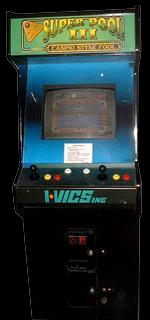
Pocket Gal is the arcade adaptation of the NES version of Side Pocket released exclusively for Japan in 1987. Gameplay remains similar to the NES game, although the lesser number of lives makes the game more challenging. It also has different music and sound effects, alongside hidden nudity as rewards for completing certain levels. An English version was also released under the name Pocket Gal 2. There is also another version of the game called Super Pool III which removes the nudity. This version was published by I-Vics in North America.[9][10]
.png)
In 1992, a sequel called Pocket Gal Deluxe was released in Japan and Europe. While the gameplay remains the same, Pocket Gal Deluxe features revamped graphics, more levels and includes a MIDI-based jazz music. Furthermore, Pocket Gal Deluxe also serve as the basis for the Genesis, Super Nintendo Entertainment System, and Game Gear versions of Side Pocket.
Reception
In Japan, Game Machine listed Side Pocket on their August 1, 1986 issue as being the eighth most-successful table arcade unit of the month.[11] It went on to be the eighth highest-grossing table arcade game of 1987 in Japan.[12]
In reviewing the NES version, Computer Gaming World declared it "far and away the best billiards simulation ever published for any system". The features that went beyond realistic pool were especially praised as enhancing the game's play.[13]
Reviewing the SNES version, GamePro praised the variety of modes, the audio and graphical improvements over the NES version, and the realistic details. They recommended the game "for pool enthusiasts and casual video game pool players alike. There are plenty of great options and genuine pool strategies to keep serious players interested, and yet it's simple enough to play without the manual."[14] They gave the Game Gear version a more mixed review, commenting that the representation of the player's stick as a stream of balls is needlessly cumbersome, and that the graphics and sound are poor. However, they summarized, "Determining the precise angle and power for a shot can be harder than taking a geometry test, but it's definitely more fun."[15] Electronic Gaming Monthly also complained of poor sounds but were more impressed with the graphics, describing them as exceptional for a portable system. They praised the game for its trick shots and generally strategic gameplay and gave it a 6.25 out of 10.[16]
Entertainment Weekly gave the game a B− and wrote: "Insipid electronic lounge sounds are an integral component of Side Pocket (for Genesis), which presents American pool halls as a series of squeaky-clean (no beer stains on the felt here), nonconfrontational venues where your sole objective is to play pool—and not, say, impress your date with how many shots of tequila you can down in five minutes. Embodying this utilitarian approach is the game's hyper-realistic, overhead-angle table display—not as realistic, unfortunately, is its follow-the-dotted-line aiming system, which allows you to hit the cue ball in only about half a dozen places. An extensive trick-shot menu—apparently meant to compensate for this glaring limitation—is intriguing, but completely superfluous."[17]
Italian magazine Consolmania, however, gave the Genesis version 80.[18]
In 1995, Total! ranked the game 70th on their Top 100 SNES Games, writing: "A bit flawed and there are no UK pool rules but in two-player mode this is a real giggle."[19] In 1996, Super Play listed Side Pocket 90th in its Top 100 SNES Games of All Time.[20]
Notes
References
- ↑ "ライセンス一覧表". Data East. http://www.dataeast-corp.co.jp/dev/license/license2.htm.
- ↑ "The Official Game Pak Directory". Nintendo Power (Nintendo of America). May 1993. https://archive.org/details/NintendoPower-OfficialGamePakDirectory.
- ↑ "サイドポケット (FC)の関連情報 | ゲーム・エンタメ最新情報のファミ通.com". https://www.famitsu.com/game/title/19876/page/1.
- ↑ "Game Boy (original) Games". Nintendo of America. http://www.nintendo.com/consumer/downloads/dmg_games.pdf.
- ↑ "Software List (Software Licensee Release)" (in ja). Sega Corporation. https://www.sega.jp/history/hard/megadrive/software_l.html.
- ↑ "Review Crew: Side Pocket". Electronic Gaming Monthly (36): 24. July 1992. https://archive.org/details/ElectronicGamingMonthly_201902/Electronic%20Gaming%20Monthly%20Issue%20036%20%28July%201992%29/page/n23/mode/1up. Retrieved April 10, 2022.
- ↑ "サイドポケット (SFC)の関連情報 | ゲーム・エンタメ最新情報のファミ通.com". https://www.famitsu.com/game/title/17507/page/1.
- ↑ "Super NES Games". Nintendo of America. http://www.nintendo.com/consumer/downloads/snes_games.pdf.
- ↑ "Welcome to Gaming Hell - Where Zoanthropes Go to Die". https://www.gaminghell.co.uk/.
- ↑ "Super Pool III cabinet". https://r.mprd.se/MAME/cabinets/spool3.png.
- ↑ "Game Machine's Best Hit Games 25 - テーブル型TVゲーム機 (Table Videos)". Game Machine (Amusement Press, Inc.) (289): 25. 1 August 1986.
- ↑ "Game Machine's Best Hit Games 25: '87". Game Machine (Amusement Press, Inc.) (324): 20. 15 January 1988. https://onitama.tv/gamemachine/pdf/19880115p.pdf#page=11.
- ↑ Kunkell, Bill (July 1988), "Video Gaming World: Side Pocket", Computer Gaming World: 45
- ↑ "ProReview: Side Pocket". GamePro (IDG) (55): 121. February 1994.
- ↑ "Side Pocket". GamePro (IDG) (60): 134. July 1994.
- ↑ "Review Crew: Side Pocket". Electronic Gaming Monthly (EGM Media, LLC) (59): 40. June 1994.
- ↑ "Side Pocket". Entertainment Weekly. https://ew.com/article/1992/10/30/side-pocket/.
- ↑ "Consolemania 014". December 1992. https://archive.org/details/Consolemania-014/page/n39.
- ↑ "Top 100 SNES Games". Total! (43): 47. July 1995. https://archive.org/details/total-43/page/n45/mode/2up. Retrieved February 27, 2022.
- ↑ "The Super Play All-time top 100 SNES games". Super Play (Future Publishing) (42). April 1996.
External links
- Side Pocket at Killer List of Videogames
- MobyGames is a commercial database website that catalogs information on video games and the people and companies behind them via crowdsourcing. This includes over 300,000 games for hundreds of platforms.[1] Founded in 1999, ownership of the site has changed hands several times. It has been owned by Atari SA since 2022.
Features
Edits and submissions to the site (including screenshots, box art, developer information, game summaries, and more) go through a verification process of fact-checking by volunteer "approvers".[2] This approval process after submission can range from minutes to days or months.[3] The most commonly used sources are the video game's website, packaging, and credit screens. There is a published standard for game information and copy-editing.[4] A ranking system allows users to earn points for contributing accurate information.[5]
Registered users can rate and review games. Users can create private or public "have" and "want" lists, which can generate a list of games available for trade with other registered users. The site contains an integrated forum. Each listed game can have its own sub-forum.
History

MobyGames was founded on March 1, 1999, by Jim Leonard and Brian Hirt, and joined by David Berk 18 months later, the three of which had been friends since high school.[6][7] Leonard had the idea of sharing information about computer games with a larger audience. The database began with information about games for IBM PC compatibles, relying on the founders' personal collections. Eventually, the site was opened up to allow general users to contribute information.[5] In a 2003 interview, Berk emphasized MobyGames' dedication to taking video games more seriously than broader society and to preserving games for their important cultural influence.[5]
In mid-2010, MobyGames was purchased by GameFly for an undisclosed amount.[8] This was announced to the community post factum , and the site's interface was given an unpopular redesign.[7] A few major contributors left, refusing to do volunteer work for a commercial website.{{Citation needed|date=June 2025} On December 18, 2013, MobyGames was acquired by Jeremiah Freyholtz, owner of Blue Flame Labs (a San Francisco-based game and web development company) and VGBoxArt (a site for fan-made video game box art).[9] Blue Flame Labs reverted MobyGames' interface to its pre-overhaul look and feel,[10] and for the next eight years, the site was run by Freyholtz and Independent Games Festival organizer Simon Carless.[7]
On November 24, 2021, Atari SA announced a potential deal with Blue Flame Labs to purchase MobyGames for $1.5 million.[11] The purchase was completed on 8 March 2022, with Freyholtz remaining as general manager.[12][13][14] Over the next year, the financial boost given by Atari led to a rework of the site being built from scratch with a new backend codebase, as well as updates improving the mobile and desktop user interface.[1] This was accomplished by investing in full-time development of the site instead of its previously part-time development.[15]
In 2024, MobyGames began offering a paid "Pro" membership option for the site to generate additional revenue.[16] Previously, the site had generated income exclusively through banner ads and (from March 2014 onward) a small number of patrons via the Patreon website.[17]
On February 13, 2025, Freyholtz stepped down as the site lead to move onto new projects, leaving operations to Tracy Poff, a veteran coder on the site, and Atari staff.[18]
See also
- IGDB – game database used by Twitch for its search and discovery functions
References
- ↑ 1.0 1.1 Sheehan, Gavin (2023-02-22). "Atari Relaunches The Fully Rebuilt & Optimized MobyGames Website". https://bleedingcool.com/games/atari-relaunches-the-fully-rebuilt-optimized-mobygames-website/.
- ↑ Litchfield, Ted (2021-11-26). "Zombie company Atari to devour MobyGames". https://www.pcgamer.com/zombie-company-atari-to-devour-mobygames/.
- ↑ "MobyGames FAQ: Emails Answered § When will my submission be approved?". Blue Flame Labs. 30 March 2014. http://www.mobygames.com/info/faq7#g1.
- ↑ "The MobyGames Standards and Practices". Blue Flame Labs. 6 January 2016. http://www.mobygames.com/info/standards.
- ↑ 5.0 5.1 5.2 Miller, Stanley A. (2003-04-22). "People's choice awards honor favorite Web sites". Milwaukee Journal Sentinel.
- ↑ "20 Years of MobyGames" (in en). 2019-02-28. https://trixter.oldskool.org/2019/02/28/20-years-of-mobygames/.
- ↑ 7.0 7.1 7.2 Plunkett, Luke (2022-03-10). "Atari Buys MobyGames For $1.5 Million". https://kotaku.com/mobygames-retro-credits-database-imdb-atari-freyholtz-b-1848638521.
- ↑ "Report: MobyGames Acquired By GameFly Media". Gamasutra. 2011-02-07. https://www.gamedeveloper.com/game-platforms/report-mobygames-acquired-by-gamefly-media.
- ↑ Corriea, Alexa Ray (December 31, 2013). "MobyGames purchased from GameFly, improvements planned". http://www.polygon.com/2013/12/31/5261414/mobygames-purchased-from-gamefly-improvements-planned.
- ↑ Wawro, Alex (31 December 2013). "Game dev database MobyGames getting some TLC under new owner". Gamasutra. https://www.gamedeveloper.com/business/game-dev-database-mobygames-getting-some-tlc-under-new-owner.
- ↑ "Atari invests in Anstream, may buy MobyGames". November 24, 2021. https://www.gamesindustry.biz/articles/2021-11-24-atari-invests-in-anstream-may-buy-mobygames.
- ↑ Rousseau, Jeffrey (2022-03-09). "Atari purchases Moby Games". https://www.gamesindustry.biz/atari-purchases-moby-games.
- ↑ "Atari Completes MobyGames Acquisition, Details Plans for the Site's Continued Support". March 8, 2022. https://www.atari.com/atari-completes-mobygames-acquisition-details-plans-for-the-sites-continued-support/.
- ↑ "Atari has acquired game database MobyGames for $1.5 million" (in en-GB). 2022-03-09. https://www.videogameschronicle.com/news/atari-has-acquired-game-database-mobygames-for-1-5-million/.
- ↑ Stanton, Rich (2022-03-10). "Atari buys videogame database MobyGames for $1.5 million". https://www.pcgamer.com/atari-buys-videogame-database-mobygames-for-dollar15-million/.
- ↑ Harris, John (2024-03-09). "MobyGames Offering “Pro” Membership". https://setsideb.com/mobygames-offering-pro-membership/.
- ↑ "MobyGames on Patreon". http://www.patreon.com/mobygames.
- ↑ "An update on MobyGames leadership". 2025-02-13. https://www.mobygames.com/forum/3/thread/269628/an-update-on-mobygames-leadership/#post-269628.
 |
Wikidata has the property:
|

External links
- No URL found. Please specify a URL here or add one to Wikidata.

 |  |
| Franchises |  | |
|---|---|---|
| Related | ||
| |