Astronomy:Leo Cluster
| Leo Cluster | |
|---|---|
 legacy surveys image of the center of the Leo Cluster | |
| Observation data (Epoch J2000) | |
| Constellation(s) | Leo |
| Right ascension | 11h 44m 36.5s[1] |
| Declination | 19° 45′ 32″[1] |
| Brightest member | NGC 3842 |
| Number of galaxies | ~100[2] |
| Richness class | 2[3] |
| Bautz–Morgan classification | II-III[3] |
| Redshift | 0.022 (6 595 km/s)[1] |
| Distance (co-moving) | 113 Mpc (368.6 Mly) for h−10.705 |
| X-ray flux | (81.40 ± 6.0%)×10−12 erg s−1 cm−2 (0.1–2.4 keV)[1] |
| Other designations | |
| Abell 1367 | |
The Leo Cluster (Abell 1367) is a galaxy cluster about 330 million light-years distant (z = 0.022[1]) in the constellation Leo, with at least 70 major galaxies. The galaxy known as NGC 3842 is the brightest member of this cluster.[4] Along with the Coma Cluster, it is one of the two major clusters comprising the Coma Supercluster,[5] which in turn is part of the CfA2 Great Wall, which is hundreds of millions light years long and is one of the largest known structures in the universe.[6]
A team of scientists decided to observe the Leo Cluster with the intention of creating a catalog of extended ionized gas (EIG) clouds. This data also led to the discovery of many star-forming parents (galaxies) within the cluster. These star-forming galaxies turned out to be very similar to those found in the neighboring Coma cluster. The EIGs in the Leo cluster, however, turned out to be longer in the Leo cluster than the Coma cluster. This likely means that the Leo cluster and its stars are probably younger than most comparable clusters in the universe and evolve at a different pace.[7]
Most dense galaxy clusters are composed mostly of elliptical galaxies. The Leo Cluster, however, mostly contains spiral galaxies, suggesting that it is much younger than other comparable clusters, such as the Coma Cluster. It is also home to one of the universe's largest known black holes, which lies in the center of NGC 3842. The black hole is 9.7 billion times more massive than the Sun.[4]
It can be very difficult for stars to form within the Leo Cluster. This is because infalling galaxies have a tendency to strip gas away from other stars that are attempting to form. This has led to the creation of a "hot zone" where stars are unable to maintain their gas long enough to properly form.[8]
There appears to be a number of subpopulations within the Leo Cluster. The first consists of elliptical galaxies that seem to be roughly as old as the universe. The second subpopulation contains red-sequence lenticular (lens shaped) galaxies whose ages are directly tied to their mass. The third and final subpopulation is of galaxies where star formation is still taking place, and are morphologically distributed.[9]
Gallery
-
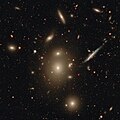 Legacy surveys image of the brightest galaxy in the Leo Cluster (NGC 3842 center), as well as surrounding galaxies
 -
 The NGC 3860 + NGC 3860B pair in the Leo Cluster
 -
 NGC 3816, which is located in the outskirts of the Leo Cluster
 -
 Amateur image of the Leo Cluster


See also
References
- ↑ 1.0 1.1 1.2 1.3 1.4 "NASA/IPAC Extragalactic Database". Results for Abell 1367. http://ned.ipac.caltech.edu/cgi-bin/nph-objsearch?objname=ABELL+1367&img_stamp=yes&extend=no&hconst=70.5&omegam=0.27&omegav=0.73&corr_z=1.
- ↑ "Abell 1367". Albert Highe: Observing Projects. http://pw2.netcom.com/~ahighe/a1367.html.
- ↑ 3.0 3.1 Abell, George O.; Corwin, Harold G. Jr.; Olowin, Ronald P. (May 1989). "A catalog of rich clusters of galaxies". Astrophysical Journal Supplement Series 70 (May 1989): 1–138. doi:10.1086/191333. ISSN 0067-0049. Bibcode: 1989ApJS...70....1A.
- ↑ 4.0 4.1 "Are You Ready, Willing, and Abell? - Sky & Telescope" (in en-US). Sky & Telescope. 2017-04-26. http://www.skyandtelescope.com/observing/are-you-ready-willing-and-abell/.
- ↑ "The Coma Supercluster". http://www.atlasoftheuniverse.com/superc/com.html.
- ↑ "Webb Deep-Sky Society: Galaxy of the Month: NGC3842" (in en). https://www.webbdeepsky.com/galaxies/object?object=NGC3842.
- ↑ Yagi, Masafumi; Yoshida, Michitoshi; Gavazzi, Giuseppe; Komiyama, Yutaka; Kashikawa, Nobunari; Sadanori Okamura (2017). "Extended Ionized Gas Clouds in the Abell 1367 Cluster" (in en). The Astrophysical Journal 839 (1): 65. doi:10.3847/1538-4357/aa68e3. ISSN 0004-637X. Bibcode: 2017ApJ...839...65Y. http://stacks.iop.org/0004-637X/839/i=1/a=65.
- ↑ "Abell 1367 - The Leo Galaxy Cluster" (in en-gb). http://www.beskeen.com/gallery/galaxy/abell1367/abell1367.shtml.
- ↑ Mouhcine, M.; Kriwattanawong, W.; James, P. A. (2011-04-01). "The galaxy population of Abell 1367: the stellar mass–metallicity relation" (in en). Monthly Notices of the Royal Astronomical Society 412 (2): 1295–1308. doi:10.1111/j.1365-2966.2010.17993.x. ISSN 0035-8711. Bibcode: 2011MNRAS.412.1295M.
External links
- The Coma Supercluster with images of A1367
- Leo-Galaxienhaufen (Abell 1367)
- Abell 1367 - The Leo Galaxy Cluster
- http://www.slate.com/blogs/bad_astronomy/2013/07/03/leo_cluster_a_buzzing_hive_of_galaxies.html
- http://www.cloudynights.com/page/articles/cat/column/small-wonders/small-wonders-leo-r486
Coordinates:  11h 44m 29.5s, +19° 50′ 21″


 |  |


