Astronomy:4022 Nonna
| Discovery [1] | |
|---|---|
| Discovered by | L. Chernykh |
| Discovery site | Crimea–Nauchnij |
| Discovery date | 8 October 1981 |
| Designations | |
| (4022) Nonna | |
| Named after | Nonna Mordyukova [1] (Soviet actress) |
| 1981 TL4 · 1966 PC 1984 OJ | |
| Minor planet category | main-belt [1][2] · (inner) Vestian [3][4] |
| Orbital characteristics [2] | |
| Epoch 23 March 2018 (JD 2458200.5) | |
| Uncertainty parameter 0 | |
| Observation arc | 65.34 yr (23,865 d) |
| |{{{apsis}}}|helion}} | 2.6585 AU |
| |{{{apsis}}}|helion}} | 2.0576 AU |
| 2.3580 AU | |
| Eccentricity | 0.1274 |
| Orbital period | 3.62 yr (1,323 d) |
| Mean anomaly | 99.638° |
| Mean motion | 0° 16m 19.92s / day |
| Inclination | 5.0911° |
| Longitude of ascending node | 278.34° |
| 34.066° | |
| Physical characteristics | |
| Mean diameter | 3.67±7.00 km[5] 7.13 km (calculated)[3] |
| Rotation period | 2.5868±0.0002 h[lower-alpha 1] 2.5873±0.0003 h[lower-alpha 2][lower-alpha 3] 2.5877±0.0005 h[6][lower-alpha 4] 2.62±0.02 h[7][lower-alpha 5] |
| Geometric albedo | 0.20 (assumed)[3] 0.907±0.440[5] |
| QV [8] · S (assumed)[3] | |
| Absolute magnitude (H) | 12.90[5] · 13.1[2][3] 13.45±0.47[8] |
4022 Nonna, provisional designation 1981 TL4, is a Vestian asteroid from the inner regions of the asteroid belt, approximately 4 kilometers (2.5 miles) kilometers in diameter. It was discovered on 8 October 1981, by Soviet–Russian astronomer Lyudmila Chernykh at the Crimean Astrophysical Observatory.[1] The asteroid was named after Soviet actress Nonna Mordyukova. The nearly fast rotator has an exceptionally low lightcurve-amplitude indicating a nearly spherical shape.[3]
Orbit and classification
Nonna is a member of the Vesta family (401).[3][4] Vestian asteroids have a composition akin to cumulate eucrites (HED meteorites) and are thought to have originated deep within 4 Vesta's crust, possibly from the Rheasilvia crater, a large impact crater on its southern hemisphere near the South pole, formed as a result of a subcatastrophic collision. Vesta is the main belt's second-largest and second-most-massive body after Ceres.[9][10]
It orbits the Sun in the inner main-belt at a distance of 2.1–2.7 AU once every 3 years and 7 months (1,323 days; semi-major axis of 2.36 AU). Its orbit has an eccentricity of 0.13 and an inclination of 5° with respect to the ecliptic.[2] The asteroid was first observed at Goethe Link Observatory in October 1952. The body's observation arc begins with its observation as 1966 PC at Crimea-Nauchnij in August 1966, more than 15 years prior to its official discovery observation.[1]
Physical characteristics
Nonna has been characterized as a Q- and V-type asteroid by Pan-STARRS' photometric survey,[8] while the Collaborative Asteroid Lightcurve Link (CALL) assumes it to be a common S-type asteroid.[3] The overall spectral type of Vestian asteroids is typically that of a V-type.[9]: 23
Rotation period
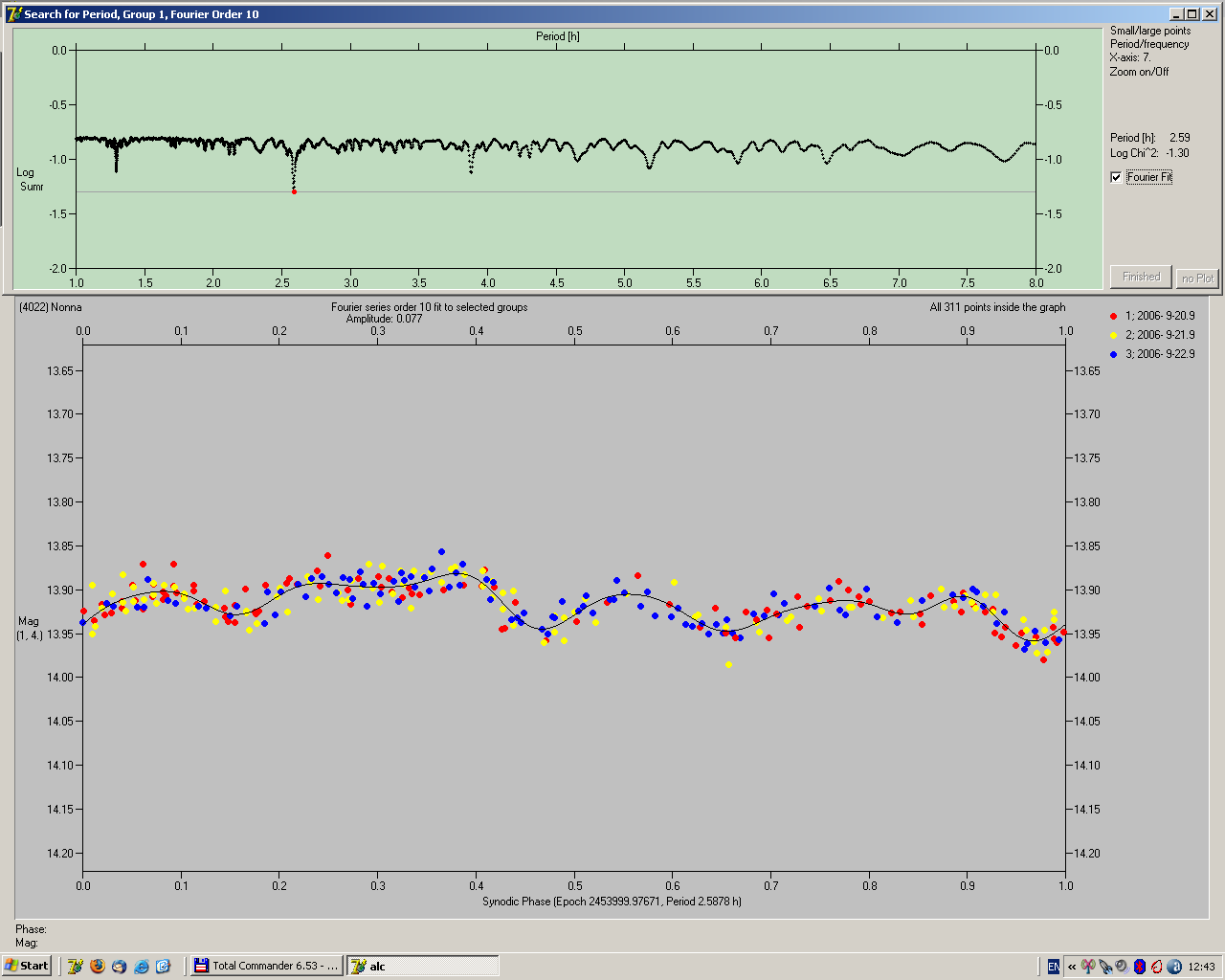
Since 2006, several rotational lightcurves of Nonna have been obtained from photometric observations at Modra Observatory by astronomers Adrián Galád and Petr Pravec.[lower-alpha 1][lower-alpha 2][lower-alpha 3] Analysis of the best-rated lightcurve from September 2006 gave a rotation period of 2.5877 hours with a brightness variation of 0.077 magnitude ({{{1}}}).[6][lower-alpha 4] A measurement by French amateur astronomer René Roy gave a similar result of 2.62 hours, after using an alternative period solution.[7][lower-alpha 5] All lightcurves showed an unusually low amplitude which is indicative for a spheroidal shape. The asteroid's short period is close to that of a fast rotator.
Diameter and albedo
According to the survey carried out by the NEOWISE mission of NASA's Wide-field Infrared Survey Explorer, Nonna measures 3.67 kilometers in diameter and its surface has an exceptionally high albedo of 0.907.[5] Conversely, CALL assumes a standard stony albedo of 0.20 and calculates a much larger diameter of 7.13 kilometers based on an absolute magnitude of 13.1.[3]
Naming
This minor planet was named after Soviet cinema actress Nonna Mordyukova (1925–2008), a celebrated People's Artist of the USSR. The official naming citation was published by the Minor Planet Center on 25 August 1991 (M.P.C. 18645).[11]
Notes
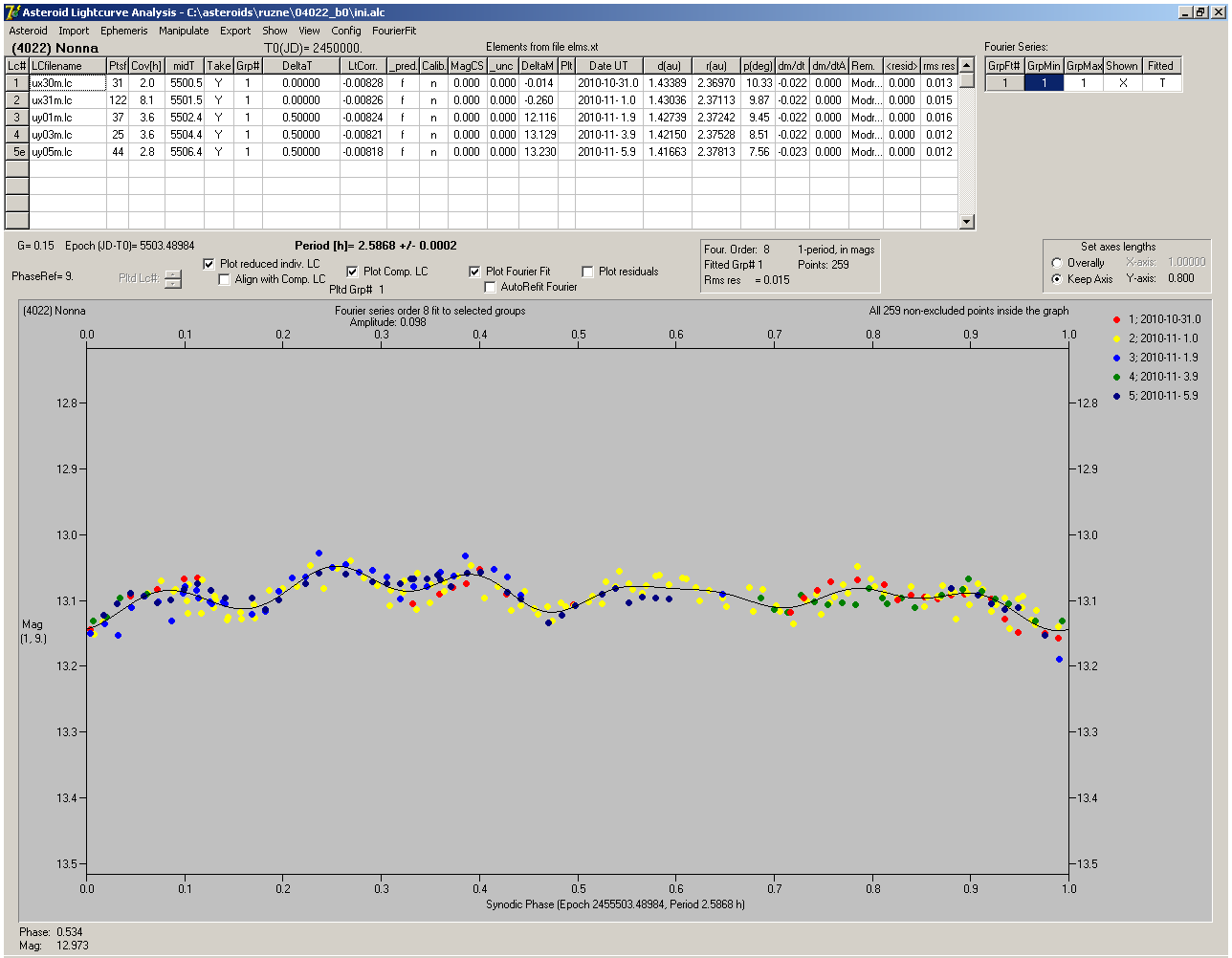
- ↑ 1.0 1.1 Pravec (2010) web: lightcurve plot of (4022) Nonna with a rotation period 2.5868±0.0002 hours and a brightness amplitude of 0.10±0.01 mag from March 2010. Quality Code is 3. Summary figures at the LCDB and Pravec, P.; Wolf, M.; Sarounova, L. (2010) with data sheet
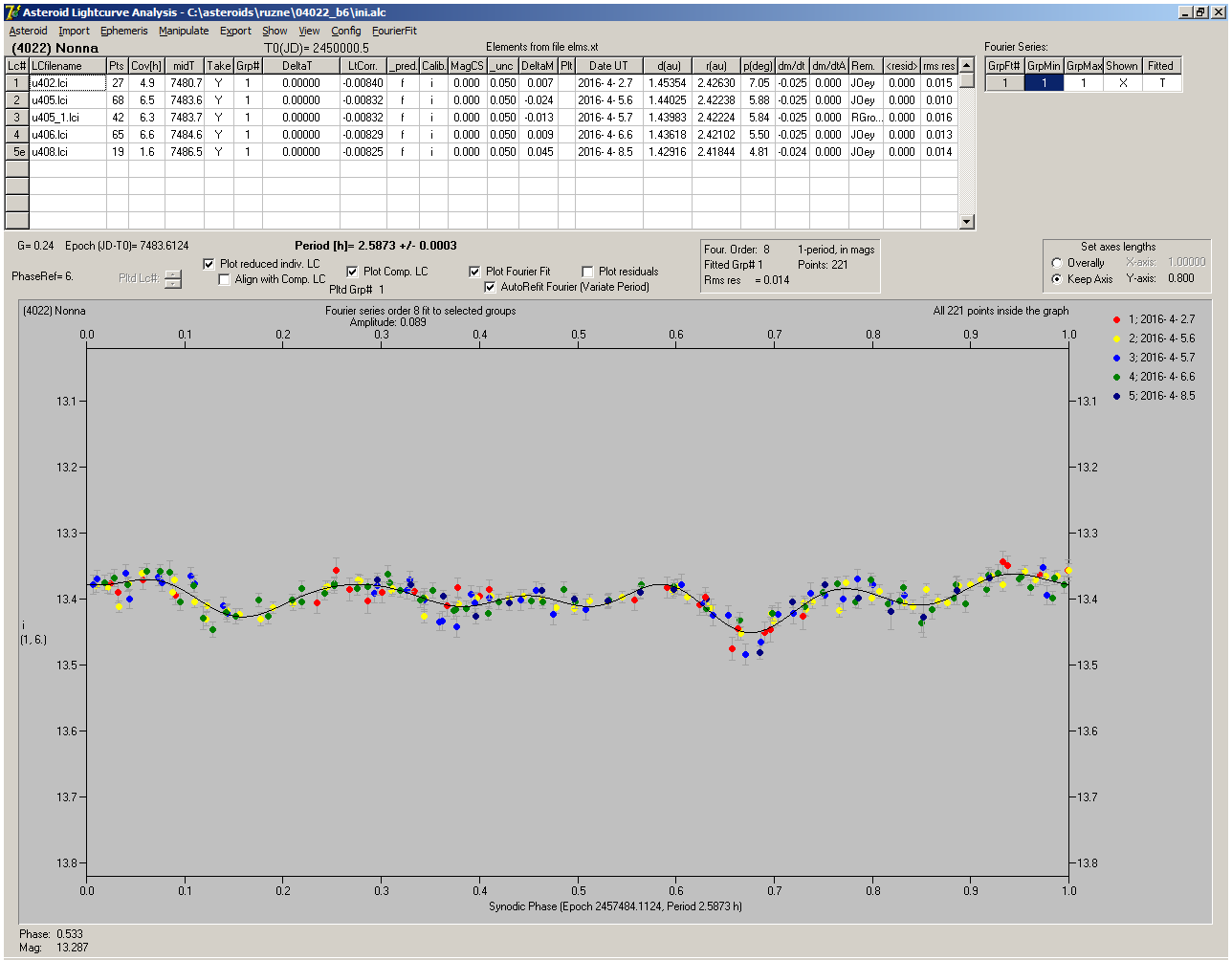
- ↑ 2.0 2.1 Pravec (2016) web: lightcurve plot of (4022) Nonna with a rotation period 2.5873±0.0003 hours and a brightness amplitude of 0.09±0.01 mag from April 2016. Quality Code is 3. Summary figures at the LCDB and Pravec, P.; Wolf, M.; Sarounova, L. (2016) with data sheet
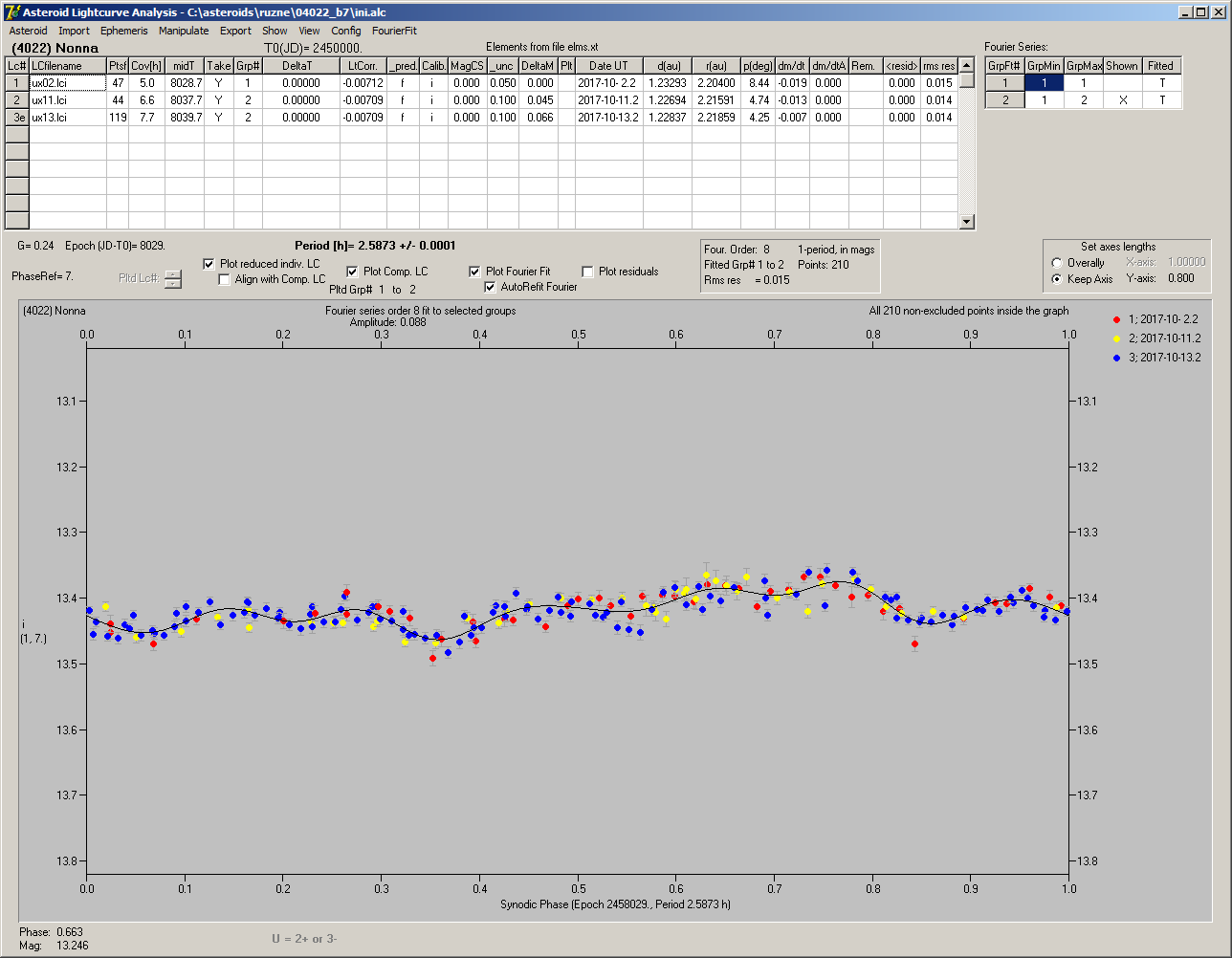
- ↑ 3.0 3.1 Pravec (2017) lightcurve plot of (4022) Nonna with a rotation period of 2.5873±0.0001 hours and an amplitude of 0.088 mag, from October 2017. Ondrejov data obtained by the NEO Photometric Program and collaborating projects with data sheet
- ↑ 4.0 4.1 Galad/Pravec (2006) lightcurve plot of (4022) Nonna with a rotation period of 2.578 hours and an amplitude of 0.077 mag, from September 2006. Ondrejov data obtained by the NEO Photometric Program and collaborating projects with data sheet
- ↑ 5.0 5.1 Period by René Roy from August 2003, corrected by the LCDB. Original period reported: 1.31 hours; amended to 2.62 hours. LCDB-comment: "this seems unlikely and so the double period was entered for the details record." Quality code of 2-.
References
- ↑ 1.0 1.1 1.2 1.3 1.4 "4022 Nonna (1981 TL4)". Minor Planet Center. https://www.minorplanetcenter.net/db_search/show_object?object_id=4022.
- ↑ 2.0 2.1 2.2 2.3 "JPL Small-Body Database Browser: 4022 Nonna (1981 TL4)". Jet Propulsion Laboratory. https://ssd.jpl.nasa.gov/sbdb.cgi?sstr=2004022.
- ↑ 3.0 3.1 3.2 3.3 3.4 3.5 3.6 3.7 3.8 "LCDB Data for (4022) Nonna". Asteroid Lightcurve Database (LCDB). http://www.minorplanet.info/PHP/generateOneAsteroidInfo.php?AstInfo=4022%7CNonna.
- ↑ 4.0 4.1 "Asteroid 4022 Nonna – Nesvorny HCM Asteroid Families V3.0". Small Bodies Data Ferret. https://sbntools.psi.edu/ferret/SimpleSearch/results.action?targetName=4022+Nonna#Asteroid%204022%20NonnaEAR-A-VARGBDET-5-NESVORNYFAM-V3.0.
- ↑ 5.0 5.1 5.2 5.3 Masiero, Joseph R.; Mainzer, A. K.; Grav, T.; Bauer, J. M.; Cutri, R. M.; Nugent, C. et al. (November 2012). "Preliminary Analysis of WISE/NEOWISE 3-Band Cryogenic and Post-cryogenic Observations of Main Belt Asteroids". The Astrophysical Journal Letters 759 (1): 5. doi:10.1088/2041-8205/759/1/L8. Bibcode: 2012ApJ...759L...8M.
- ↑ 6.0 6.1 Galád, Adrián; Pravec, Petr; Gajdos, Stefan; Kornos, Leonard; Világi, Jozef (October 2007). "Seven Asteroids Studied from Modra Observatory in the Course of Binary Asteroid Photometric Campaign". Earth 101 (1–2): 17–25. doi:10.1007/s11038-007-9146-6. Bibcode: 2007EM&P..101...17G.
- ↑ 7.0 7.1 Behrend, Raoul. "Asteroids and comets rotation curves – (4022) Nonna". Geneva Observatory. http://obswww.unige.ch/~behrend/page4cou.html#004022.
- ↑ 8.0 8.1 8.2 Veres, Peter; Jedicke, Robert; Fitzsimmons, Alan; Denneau, Larry; Granvik, Mikael; Bolin, Bryce et al. (November 2015). "Absolute magnitudes and slope parameters for 250,000 asteroids observed by Pan-STARRS PS1 - Preliminary results". Icarus 261: 34–47. doi:10.1016/j.icarus.2015.08.007. Bibcode: 2015Icar..261...34V.
- ↑ 9.0 9.1 Nesvorný, D.; Broz, M.; Carruba, V. (December 2014). "Identification and Dynamical Properties of Asteroid Families". Asteroids IV. pp. 297–321. doi:10.2458/azu_uapress_9780816532131-ch016. ISBN 9780816532131. Bibcode: 2015aste.book..297N.
- ↑ Kelley, Michael S.; Vilas, Faith; Gaffey, Michael J.; Abell, Paul A. (September 2003). "Quantified mineralogical evidence for a common origin of 1929 Kollaa with 4 Vesta and the HED meteorites". Icarus 165 (1): 215–218. doi:10.1016/S0019-1035(03)00149-0. Bibcode: 2003Icar..165..215K. https://zenodo.org/record/1259601.
- ↑ "MPC/MPO/MPS Archive". Minor Planet Center. https://www.minorplanetcenter.net/iau/ECS/MPCArchive/MPCArchive_TBL.html.
External links
- Asteroid Lightcurve Database (LCDB), query form (info )
- Dictionary of Minor Planet Names, Google books
- Asteroids and comets rotation curves, CdR – Observatoire de Genève, Raoul Behrend
- Discovery Circumstances: Numbered Minor Planets (1)-(5000) – Minor Planet Center
- 4022 Nonna at AstDyS-2, Asteroids—Dynamic Site
- 4022 Nonna at the JPL Small-Body Database
 |  |