Astronomy:NGC 4162
| NGC 4162 | |
|---|---|
 NGC 4162 imaged by SDSS | |
| Observation data (J2000 epoch) | |
| Constellation | Coma Berenices |
| Right ascension | 12h 11m 52.5190s[1] |
| Declination | +24° 07′ 25.346″[1] |
| Redshift | 0.008579±0.000005[1] |
| Helio radial velocity | 2,572±1 km/s[1] |
| Distance | 118.00 ± 5.96 Mly (36.179 ± 1.828 Mpc)[1] |
| Apparent magnitude (V) | 12.87[1] |
| Characteristics | |
| Type | (R)SA(rs)bc[1] |
| Size | ~85,800 ly (26.31 kpc) (estimated)[1] |
| Apparent size (V) | 2.3′ × 1.4′[1] |
| Other designations | |
| IRAS 12093+2423, UGC 7193, MCG+04-29-046, PGC 038851[1] | |
NGC 4162 is a spiral galaxy in the constellation of Coma Berenices. Its velocity with respect to the cosmic microwave background is 2,878±21 km/s, which corresponds to a Hubble distance of 138.5 ± 9.8 Mly (42.45 ± 2.99 Mpc).[1] However, 19 non-redshift measurements give a closer mean distance of 118.00 ± 5.96 Mly (36.179 ± 1.828 Mpc).[2] It was discovered by German-British astronomer William Herschel on 10 April 1785.[3]
NGC 4162 has an active galactic nucleus, i.e. it has a compact region at the center of a galaxy that emits a significant amount of energy across the electromagnetic spectrum, with characteristics indicating that this luminosity is not produced by the stars.[4]
Supernovae
Three supernovae have been observed in NGC 4162:
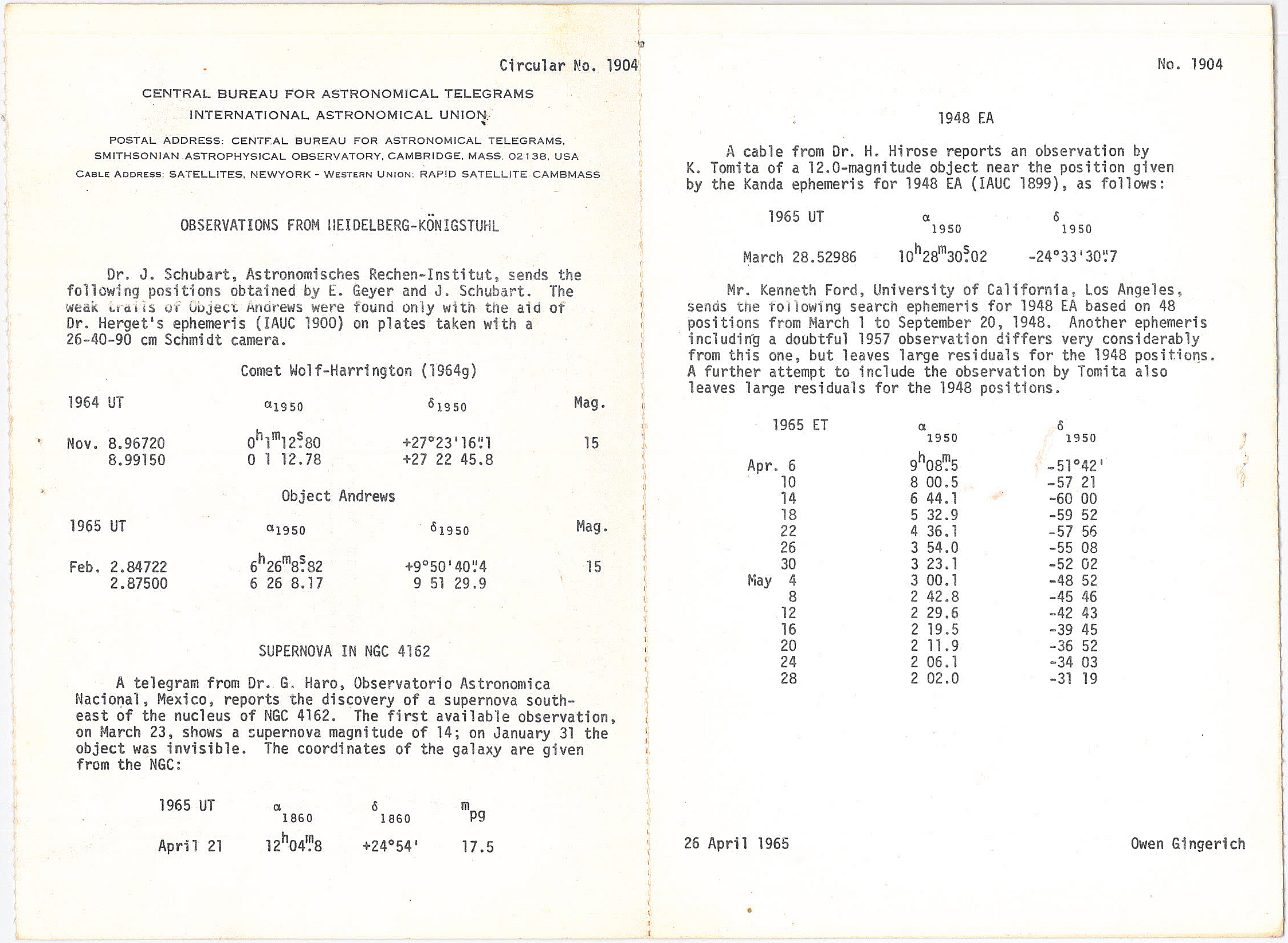
- SN 1965G (type unknown, mag. 14) was discovered by Mexican astronomer Guillermo Haro on 23 March 1965.[5][6]
- SN 2001hg (Type II, mag. 17.4) was discovered by Tim Puckett and Ajai Sehgal on 4 December 2001.[7][8]
- SN 2019edo (Type II, mag. 16.7) was discovered by ASAS-SN on 27 April 2019.[9][10]
See also
References
- ↑ 1.00 1.01 1.02 1.03 1.04 1.05 1.06 1.07 1.08 1.09 1.10 "Results for object NGC 4162". NASA and Caltech. https://ned.ipac.caltech.edu/byname?objname=NGC+4162.
- ↑ "Distance Results for NGC 4162". NASA. https://ned.ipac.caltech.edu/cgi-bin/nDistance?name=NGC+4162.
- ↑ Seligman, Courtney. "New General Catalogue Objects: NGC 4162". https://cseligman.com/text/atlas/ngc41a.htm#4162.
- ↑ "NGC 4162". SIMBAD. Centre de données astronomiques de Strasbourg. http://simbad.u-strasbg.fr/simbad/sim-basic?Ident=NGC+4162.
- ↑ Gingerich, Owen (26 April 1965). "Circular No. 1904". Smithsonian Astrophysical Observatory, IAU. http://www.cbat.eps.harvard.edu/IAUCs/IAUC1904.jpg.
- ↑ "SN 1965G". IAU. https://www.wis-tns.org/object/1965G.
- ↑ Puckett, T.; Sehgal, A. (2001). "Supernova 2001hg in NGC 4162". International Astronomical Union Circular (7766): 1. Bibcode: 2001IAUC.7766....1P. http://www.cbat.eps.harvard.edu/iauc/07700/07766.html#Item1.
- ↑ "SN 2001hg". IAU. https://www.wis-tns.org/object/2001hg.
- ↑ Brimacombe, J. et al. (2019). "Discovery of 10 ASAS-SN Supernovae". The Astronomer's Telegram 12713: 1. Bibcode: 2019ATel12713....1B. https://www.astronomerstelegram.org/?read=12713.
- ↑ "SN 2019edo". IAU. https://www.wis-tns.org/object/2019edo.
External links
- NGC 4162 on WikiSky: DSS2, SDSS, GALEX, IRAS, Hydrogen α, X-Ray, Astrophoto, Sky Map, Articles and images
Coordinates:  12h 11m 52.5190s, +24° 07′ 25.346″
Template:NGC objects: 4001-5000
 |  |