Astronomy:NGC 4571
| NGC 4571 | |
|---|---|
.jpg) NGC 4571 imaged by the Hubble Space Telescope | |
| Observation data (J2000 epoch) | |
| Constellation | Coma Berenices |
| Right ascension | 12h 36m 56.3959s[1] |
| Declination | +14° 13′ 02.627″[1] |
| Redshift | 0.001107±0.0000118[1] |
| Helio radial velocity | 332±4 km/s[1] |
| Distance | 52.59 ± 1.66 Mly (16.124 ± 0.508 Mpc)[1] |
| Apparent magnitude (V) | 11.8[1] |
| Characteristics | |
| Type | SA(r)d[1] |
| Size | ~71,600 ly (21.96 kpc) (estimated)[1] |
| Apparent size (V) | 3.6′ × 3.2′[1] |
| Other designations | |
| VCC 1696, IRAS 12344+1429, IC 3588, UGC 7788, MCG+02-32-156, PGC 42100[1] | |
NGC 4571 is a spiral galaxy located in the constellation of Coma Berenices. It was discovered by German-British astronomer William Herschel on 14 January 1787.[2] It was also observed by German astronomer Friedrich Schwassmann on 23 November 1900, causing it to be listed in the Index Catalogue as IC 3588.[2] John Dreyer thought this galaxy might be the "lost" Messier 91, but in 1969, amateur astronomer William C. Williams realized that M91 was actually NGC 4548.[3]
Physical properties
The finding of Cepheids by the Canada France Hawaii Telescope in 1994 has established that this galaxy is a member of the Virgo Cluster.[3]
Despite being classified as a late-type galaxy, NGC 4571 has features more typical of spiral galaxies of earlier Hubble type such as a high color index, both low star formation rate and H-Alpha brightness, and relatively little neutral hydrogen,[4] suggesting it may have lost most of its gas due to interactions with Virgo's intragalactic medium and/or past interactions with other galaxies of the cluster.[5][6][7]
The low-surface brightness galaxy Malin 1 is located close to this object.[8] It is totally unrelated, however as it lies at a much higher distance.
Gallery
-
 NGC 4571 imaged by the Hubble Space Telescope
 -
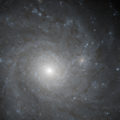 NGC 4571 by Hubble Space Telescope
 -
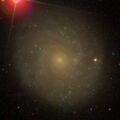 NGC 4571 (SDSS DR14)


References
- ↑ 1.00 1.01 1.02 1.03 1.04 1.05 1.06 1.07 1.08 1.09 "Results for object NGC 4571". NASA and Caltech. https://ned.ipac.caltech.edu/byname?objname=NGC+4571.
- ↑ 2.0 2.1 Seligman, Courtney. "New General Catalogue Objects: NGC 4571". https://cseligman.com/text/atlas/ngc45a.htm#4571.
- ↑ 3.0 3.1 Students for the Exploration and Development of Space Messier 91, Accessed online 14 April 2011
- ↑ Kennicutt, R. C. Jr. (1983). "On the evolution of the spiral galaxies in the Virgo cluster". The Astronomical Journal 88: 483–488. doi:10.1086/113334. Bibcode: 1983AJ.....88..483K.
- ↑ Kennicutt, R. C. Jr. (1985). "An H I and optical study of the gas poor Virgo cluster spiral NGC 4571". ESO Workshop on the Virgo Cluster of Galaxies, Garching, West Germany, September 4–7, 1984 88: 91–94. doi:10.1086/113334. Bibcode: 1985ESOC...20...91K.
- ↑ Kenney, J. D.; Young, J. S. (1986). "CO in H I-deficient Virgo cluster spiral galaxies". The Astrophysical Journal Letters 301: L13–L17. doi:10.1086/184614. Bibcode: 1986ApJ...301L..13K.
- ↑ van der Hulst, J. M.; Skillman, E. D.; Kennicutt, R. C.; Bothun, G. D. (1987). "The neutral hydrogen content of red spiral galaxies". Astronomy and Astrophysics 177: 63–70. Bibcode: 1987A&A...177...63V.
- ↑ Bothun, Gregory D.; Impey, Christopher D.; Malin, David F.; Mould, Jeremy R. (1987). "Discovery of a huge low-surface-brightness galaxy - A protodisk galaxy at low redshift?". The Astronomical Journal 94: 23–29. doi:10.1086/114443. Bibcode: 1987AJ.....94...23B.
External links
- SEDS – NGC 4571
Template:NGC objects:4500-4999
Coordinates:  12h 36m 56.3959s, +14° 13′ 02.627″
 |  |


