Biology:Plum
A plum is a fruit of some species in Prunus subg. Prunus. Dried plums are usually called prunes.[1]


Plums are likely to have been one of the first fruits domesticated by humans, with origins in Eastern Europe, the Caucasus Mountains and China. They were brought to Britain from Asia, and their cultivation has been documented in Andalusia, southern Spain. Plums are a diverse group of species, with trees reaching a height of 5–6 metres (16–20 ft) when pruned. The fruit is a drupe, with a firm and juicy flesh. Plums can be eaten fresh, dried to make prunes, used in jams, or fermented into wine and distilled into brandy. Plum seeds (also called kernels) contain the cyanide-like poison, amygdalin, a cyanogenic glycoside.
In 2023, China produced 55% of the world total of plums. Japanese or Chinese plums dominate the fresh fruit market, while European plums are also common in some regions.
History
Plums are likely to have been one of the first fruits domesticated by humans.[2] Three of the most abundantly cultivated species are not found in the wild, only around human settlements: Prunus domestica has been traced to East European and Caucasian mountains, while Prunus salicina and Prunus simonii originated in China. Plum remains have been found in Neolithic age archaeological sites along with olives, grapes and figs.[3][4] According to Ken Albala, plums originated in Iran.[5] They were brought to Britain from Asia .[6]
An article on plum tree cultivation in Andalusia (southern Spain) appears in Ibn al-'Awwam's 12th-century agricultural work, Book on Agriculture.[7]
Plum cultivation is recorded in medieval monasteries in England. A garden with 'ploumes' and 'bulaces' is referred to by Chaucer.[8]
The cultivation of plums increased during the 17th and 18th centuries. During this period greengages were given their English name and the Mirabelle plum became firmly established.[8] Advances in the development of new varieties in England were made by Thomas Rivers. Two examples of River's work are the varieties Early Rivers and Czar. Both are still esteemed. The fame of the Victoria plum, first sold in 1844, has been put down to good marketing rather than any inherent quality.[8]
Etymology and names
The name plum comes from Old English plūme "plum, plum tree", an evolution of plūmā, which was a common West Germanic loanword from Latin prūnum,[9][10] which borrowed it from Ancient Greek προῦμνον : proûmnon,[11] itself believed to be a loanword from an unknown language of Asia Minor.[1][12] In the late 18th century, the word plum was used to indicate "something sweet or agreeable", probably in reference to tasty fruit pieces in desserts, as in the word sugar plum.[12]
Description
Plums are a diverse group of species. The commercially important plum trees are medium-sized, usually pruned to 5–6 metres (16–20 ft) height. The tree is of medium hardiness.[13] Without pruning, the trees can reach 12 metres (39 ft) in height and spread across 10 metres (33 ft). They blossom in different months in different parts of the world; for example, in about January in Taiwan and early April in the United Kingdom.[14]
Fruits are usually of medium size, between 2–7 centimetres (0.79–2.76 in) in diameter, globose to oval. The flesh is firm and juicy. The fruit's peel is smooth, with a natural waxy surface that adheres to the flesh. The plum is a drupe, meaning its fleshy fruit surrounds a single hard fruitstone which encloses the fruit's seed.
Cultivation and uses
- Different plum cultivars
-
 Japanese or Chinese plum
 -
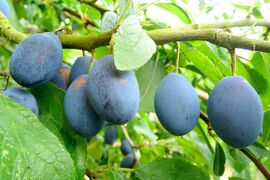 Damsons (European plum)
 -
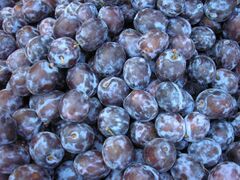 Prune plums (European plum)
 -
 Victoria plums (European plum)
 -
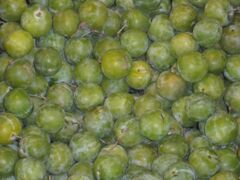 Greengages (European plum)
 -
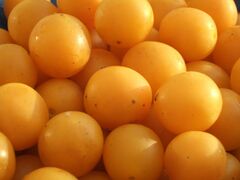 Mirabelles (European plum)
 -
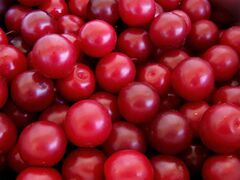 Myrobalan or cherry plums


Japanese or Chinese plums are large and juicy with a long shelf life and therefore dominate the fresh fruit market. They are usually clingstone and not suitable for making prunes.[15] They are cultivars of Prunus salicina or its hybrids. The cultivars developed in the US are mostly hybrids of P. salicina with P. simonii and P. cerasifera. Although these cultivars are often called Japanese plums, two of the three parents (P. salicina and P. simonii) originated from China and one (P. cerasifera) from Eurasia.[16]

In some parts of Europe, European plum (Prunus domestica) is also common in fresh fruit market. It has both dessert (eating) or culinary (cooking) cultivars, which include:
- Damson (purple or black skin, green flesh, clingstone, astringent)
- Prune plum (usually oval, freestone, sweet, fresh eaten or used to make prunes)
- Greengage (firm, green flesh and skin even when ripe)
- Mirabelle (dark yellow, predominantly grown in northeast France)
- Victoria (yellow flesh with a red or mottled skin)
- Yellowgage or golden plum (similar to greengage, but yellow)
In West Asia, myrobalan plum or cherry plum (Prunus cerasifera) is also widely cultivated. In Russia, apart from these three commonly cultivated species, there are also many cultivars resulting from hybridization between Japanese plum and myrobalan plum, known as Russian plum (Prunus × rossica).[17]
When it flowers in the early spring, a plum tree will be covered in blossoms, and in a good year approximately 50% of the flowers will be pollinated and become plums. Flowering starts after 80 growing degree days.[18]
If the weather is too dry, the plums will not develop past a certain stage, but will fall from the tree while still tiny, green buds, and if it is unseasonably wet or if the plums are not harvested as soon as they are ripe, the fruit may develop a fungal condition called brown rot. Brown rot is not toxic, and some affected areas can be cut out of the fruit, but unless the rot is caught immediately, the fruit will no longer be edible. Plum is used as a food plant by the larvae of some Lepidoptera, including November moth, willow beauty and short-cloaked moth.[19]
The taste of the plum fruit ranges from sweet to tart; the skin itself may be particularly tart. It is juicy and can be eaten fresh or used in jam-making or other recipes. Plum juice can be fermented into plum wine. In central England, a cider-like alcoholic beverage known as plum jerkum is made from plums. Dried, salted plums are used as a snack, sometimes known as saladito or salao.
 China China |
6,888,895 |
 Romania Romania |
645,090 |
 Chile Chile |
433,934 |
 Serbia Serbia |
362,713 |
 Turkey Turkey |
355,132 |
 Iran Iran |
354,789 |
| World | 12,489,827 |
| Source: FAOSTAT of the United Nations[20] | |
Various flavors of dried plum are available at Chinese grocers and specialty stores worldwide. They tend to be much drier than the standard prune. Cream, ginseng, spicy, and salty are among the common varieties. Licorice is generally used to intensify the flavor of these plums and is used to make salty plum drinks and toppings for shaved ice or baobing. Pickled plums are another type of preserve available in Asia and international specialty stores. The Japanese variety, called umeboshi, is often used for rice balls, called onigiri or omusubi. The ume, from which umeboshi are made, is more closely related, however, to the apricot than to the plum.
In the Balkans, plum is converted into an alcoholic drink named slivovitz (plum brandy, called in Bosnian, Croatian, Montenegrin or Serbian šljivovica).[21][22] A large number of plums, of the Damson variety, are also grown in Hungary, where they are called szilva and are used to make lekvar (a plum paste jam), palinka (traditional fruit brandy), plum dumplings, and other foods. In Romania, 80% of the plum production is used to create a similar brandy, called țuică.[23]
As with many other members of the rose family, plum kernels contain cyanogenic glycosides, including amygdalin.[24] Prune kernel oil is made from the fleshy inner part of the pit of the plum. Though not available commercially, the wood of plum trees is used by hobbyists and other private woodworkers for musical instruments, knife handles, inlays, and similar small projects.[25]
Production
In 2023, world production of plums (data combined with sloes) was 12.5 million tonnes, led by China with 55% of the total, and Romania and Chile as the next largest producers (table).
| Nutritional value per 100 g (3.5 oz) | |
|---|---|
| Energy | 192 kJ (46 kcal) |
11.42 g | |
| Sugars | 9.92 g |
| Dietary fiber | 1.4 g |
0.28 g | |
0.7 g | |
| Vitamins | Quantity %DV† |
| Vitamin A equiv. | 2% 17 μg2% 190 μg73 μg |
| Thiamine (B1) | 2% 0.028 mg |
| Riboflavin (B2) | 2% 0.026 mg |
| Niacin (B3) | 3% 0.417 mg |
| Pantothenic acid (B5) | 3% 0.135 mg |
| Vitamin B6 | 2% 0.029 mg |
| Folate (B9) | 1% 5 μg |
| Vitamin C | 11% 9.5 mg |
| Vitamin E | 2% 0.26 mg |
| Vitamin K | 6% 6.4 μg |
| Minerals | Quantity %DV† |
| Calcium | 1% 6 mg |
| Iron | 1% 0.17 mg |
| Magnesium | 2% 7 mg |
| Manganese | 2% 0.052 mg |
| Phosphorus | 2% 16 mg |
| Potassium | 3% 157 mg |
| Sodium | 0% 0 mg |
| Zinc | 1% 0.1 mg |
| Other constituents | Quantity |
| Water | 87 g |
| |
| †Percentages are roughly approximated using US recommendations for adults. | |
Nutrition
Raw plums are 87% water, 11% carbohydrates, 1% protein, and less than 1% fat (table). In a reference amount of 100 grams (3.5 oz), raw plums supply 46 calories of food energy, and are a moderate source only of vitamin C (11% of the Daily Value), with no other micronutrients in significant content (table).
Species
The numerous species of Prunus subg. Prunus are classified into many sections, but not all of them are called plums. Plums include species of sect. Prunus and sect. Prunocerasus,[26] as well as P. mume of sect. Armeniaca. Only two plum species, the hexaploid European plum (Prunus domestica) and the diploid Japanese plum (Prunus salicina and hybrids), are of worldwide commercial significance. The origin of P. domestica is uncertain but may have involved P. cerasifera and possibly P. spinosa as ancestors. Other species of plum variously originated in Europe, Asia and America.[27]
Sect. Prunus (Old World plums) – leaves in bud rolled inwards; flowers 1–3 together; fruit smooth, often wax-bloomed
| Image | Scientific name | Common name | Distribution | Cytology |
|---|---|---|---|---|
| 120px | P. brigantina[26] | Briançon plum, Briançon apricot, marmot plum | Europe | |
| 120px | P. cerasifera | cherry plum, myrobalan plum | Southeast Europe and Western Asia | 2n=16,(24) |
| P. cocomilia | Italian plum | Albania, Croatia, Greece, southern Italy (including Sicily), Montenegro, North Macedonia, Serbia, and western Turkey | ||
| 120px | P. domestica (species of most "plums" and "prunes") | Europe | 2n=16, 48 | |
| 120px | P. domestica ssp. insititia | damsons, bullaces | Asia | |
| 120px | P. salicina | Chinese plum | China | 2n=16,(24) |
 |
P. simonii (widely cultivated in North China)[28] | China | 2n=16 | |
| 120px | P. spinosa | blackthorn or sloe | Europe, western Asia, and locally in northwest Africa | 2n=4x=32 |
.jpg) |
P. vachuschtii | Alucha | Caucasus |
Sect. Prunocerasus (New World plums) – leaves in bud folded inwards; flowers 3–5 together; fruit smooth, often wax-bloomed
| Image | Scientific name | Common name | Distribution | Cytology |
|---|---|---|---|---|
| P. alleghaniensis | Allegheny plum | the Appalachian Mountains from New York to Kentucky and North Carolina, plus the Lower Peninsula of Michigan | ||
| 120px | P. americana | American plum | North America from Saskatchewan and Idaho south to New Mexico and east to Québec, Maine and Florida | |
| 120px | P. angustifolia | Chickasaw plum | Florida west as far as New Mexico and California | |
| P. gracilis | Oklahoma plum | Alabama, Arkansas, Colorado, Kansas, Louisiana, New Mexico, Oklahoma and Texas | ||
| 120px | P. hortulana | Hortulan plum | Arkansas, Iowa, Illinois, Indiana, Kansas, Kentucky, Massachusetts, Maryland, Missouri, Nebraska, Ohio, Oklahoma, Tennessee, Texas, Virginia, West Virginia | |
| 120px | P. maritima | Beach plum | East Coast of the United States, from Maine south to Maryland | |
| 120px | P. mexicana | Mexican plum | central United States and Northern Mexico | |
| P. murrayana | Murray's plum | Texas | ||
| 120px | P. nigra | Canada plum, Black plum | eastern North America from Nova Scotia west to Minnesota and southeastern Manitoba, and south as far as Connecticut, Illinois, and Iowa | |
| P. × orthosepala (P. americana × P. angustifolia) | southern and central United States | |||
| 120px | P. reverchonii | Thicket plum | ||
| 120px | P. rivularis | River plum, Creek plum,Wildgoose plum | California, Arkansas, southern Illinois, south-eastern Kansas, Kentucky, northern Louisiana, Mississippi, Missouri, south-western Ohio, Oklahoma, Tennessee, and Texas | |
| 120px | P. subcordata | Klamath, Oregon, or Sierra plum | California and western and southern Oregon | |
| P. texana | Texas plum, Sand plum, Peachbush plum | central and western Texas | ||
| 120px | P. umbellata | Hog plum, Flatwoods plum, Sloe plum | United States from Virginia, south to Florida, and west to Texas |
Sect. Armeniaca (apricots) – leaves in bud rolled inwards; flowers very short-stalked; fruit velvety; treated as a distinct subgenus by some authors
| Image | Scientific name | Common name | Distribution | Cytology |
|---|---|---|---|---|
| 120px | P. mume | Chinese plum, Japanese apricot | Western Asia |
In certain parts of the world, some fruits are called plums and are quite different from fruits known as plums in Europe or the Americas. For example, marian plums are popular in Thailand, Malaysia and Indonesia, otherwise also known as gandaria, plum mango, ma-praang, ma-yong, ramania, kundang, rembunia or setar.[29] Another example is the loquat, also known as Japanese plum and Japanese medlar, as well as nispero, bibassier and wollmispel elsewhere.[30][31] In South Asia and Southeast Asia, Jambul, a fruit from tropical tree in family Myrtaceae, is similarly sometimes referred to 'damson plums', and it is different from damson plums found in Europe and Americas.[32] Jambul is also called as Java plum, Malabar plum, Jaman, Jamun, Jamblang, Jiwat, Salam, Duhat, Koeli, Jambuláo or Koriang.
Gallery
-
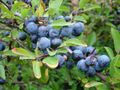 Sloe or blackthorn, Prunus spinosa
 -
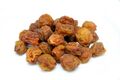 Dried yellow plums
 -
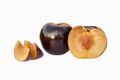 Black Amber Plum (Japanese or Chinese plum)
 -
Stanley plum variety


See also
- Cherry plum
- Fruit tree
- Fruit tree forms
- Fruit tree propagation
- Fruit tree pruning
- List of plum cultivars
- List of plum dishes
- Pluot
- Sugar plum
References
- ↑ 1.0 1.1 "Prune". Oxford Dictionaries, Oxford University Press. 2018. https://en.oxforddictionaries.com/definition/prune.
- ↑ Jules Janick, ed (1998). Horticultural Reviews (Volume 23). Wiley. ISBN 978-0471254454.
- ↑ Jules Janick (2005). "The origins of fruits, fruit growing and fruit breeding". Purdue University. http://www.hort.purdue.edu/NEWCROP/pdfs/origins-fruit-growing-breeding.pdf.
- ↑ Spangenberg (January 2006). "Chemical analyses of organic residues in archaeological pottery from Arbon Bleiche". Journal of Archaeological Science 33 (1): 1–13. doi:10.1016/j.jas.2005.05.013.
- ↑ Albala, Ken (2011) (in en). Food Cultures of the World Encyclopedia. ABC-CLIO. p. 240. ISBN 978-0-313-37626-9. https://books.google.com/books?id=NTo6c_PJWRgC&q=lavash+originated+iran&pg=PA240.
- ↑ Lyle, Katie Letcher (2010). The Complete Guide to Edible Wild Plants, Mushrooms, Fruits, and Nuts: How to Find, Identify, and Cook Them (2nd ed.). Guilford, CN: FalconGuides. pp. 107. ISBN 978-1-59921-887-8. OCLC 560560606.
- ↑ Ibn al-'Awwam, Yaḥyá (1864) (in fr). Le livre de l'agriculture d'Ibn-al-Awam (kitab-al-felahah). Paris: A. Franck. pp. 319–321 (ch. 7 - Article 42). OCLC 780050566. https://archive.org/details/lelivredelagric00algoog/page/n14/mode/2up. (pp. 319–321 (Article XLII)
- ↑ 8.0 8.1 8.2 Davidson, Alan (2014). Jaine, Tom. ed. The Oxford companion to food (3. ed. / ed. by Tom Jaine ed.). Oxford: Oxford Univ. Press. ISBN 978-0-19-967733-7.
- ↑ Ringe, Donald; Taylor, Ann (2014). The Development of Old English. A Linguistic History of English. 2. Oxford: Oxford University Press. p. 135. ISBN 9780199207848.
- ↑ prūnum. Charlton T. Lewis and Charles Short. A Latin Dictionary on Perseus Project.
- ↑ προῦμνον. Liddell, Henry George; Scott, Robert; A Greek–English Lexicon at the Perseus Project.
- ↑ 12.0 12.1 Harper, Douglas. "plum". Online Etymology Dictionary. https://www.etymonline.com/?term=plum.
- ↑ "Plum, prune, European type". Purdue University. 1999. http://www.hort.purdue.edu/newcrop/Crops/Plum_prune.html.
- ↑ "Prunus domestica Plum, European plum PFAF Plant Database". pfaf.org. http://www.pfaf.org/user/Plant.aspx?LatinName=Prunus+domestica.
- ↑ Clark, Larry. "Plums" (in en-US). https://magazine.wsu.edu/2017/08/07/plums/.
- ↑ Boonprakob, U.; Byrne, D.H. (2003). "Species composition of Japanese plum founding clones as revealed by RAPD markers". Acta Horticulturae (622): 473–476. doi:10.17660/actahortic.2003.622.51. ISSN 0567-7572. https://doi.org/10.17660/ActaHortic.2003.622.51.
- ↑ Eremin, G.V. (2006). "Prunus rossica (Rosaceae), a new hybridogenous species". Botanicheskii Zhurnal 91 (9): 1405–1410. https://www.elibrary.ru/item.asp?id=9274159.
- ↑ "Phenology of flowers". Ecologists Educators and Schools. 2004. http://www.bioed.org/ECOS/inquiries/inquiries/PhenologyofFlowers.pdf.
- ↑ Skinner (1984), Chinery (2007), and see references in Savela (2002)
- ↑ "Production of plums (and sloes) in 2023, Crops/Regions/World list/Production Quantity/Year (pick lists)". UN Food and Agriculture Organization, Corporate Statistical Database (FAOSTAT). 2025. https://www.fao.org/faostat/en/#data/QCL.
- ↑ Crowell and Guymon (1973). "Aroma Constituents of Plum Brandy". American Journal of Enology 24 (4): 159–165.
- ↑ Jan Velíšek; František Pudil; Jiří Davídek; Vladislav Kubelka (1982). "The neutral volatile components of Czechoslovak plum brandy". Zeitschrift für Lebensmittel-Untersuchung und -Forschung A 174 (6): 463–466. doi:10.1007/BF01042726.
- ↑ "România e cel mai mare producător de prune din UE. Cele mai multe fructe folosesc la ţuică și palincă". https://observator.tv/social/romanii-cei-mai-mari-producatori-de-prune-din-europa-insa-recolta-nu-ajunge-in-borcanele-cu-magiun-ci-in-cazanele-de-tuica-233725.html.
- ↑ Burrows, G.E.; Tyrl, R.J. (2012). "Rosaceae Juss.". Toxic Plants of North America. Wiley-Blackwell. pp. 1064–1094.
- ↑ "Plum". The Wood Database. http://www.wood-database.com/lumber-identification/hardwoods/plum/.
- ↑ 26.0 26.1 Shi, Shuo; Li, Jinlu; Sun, Jiahui; Yu, Jing; Zhou, Shiliang (2013). "Phylogeny and classification of Prunus sensu lato (Rosaceae)" (in en). Journal of Integrative Plant Biology 55 (11): 1069–1079. doi:10.1111/jipb.12095. ISSN 1744-7909. PMID 23945216. Bibcode: 2013JIPB...55.1069S. https://onlinelibrary.wiley.com/doi/abs/10.1111/jipb.12095.
- ↑ Bruce L. Topp; Dougal M. Russell; Michael Neumüller; Marco A. Dalbó; Weisheng Liu (2012). "Plum". Plum (Handbook of Plant Breeding). 8, part 3. Springer. pp. 571–621. doi:10.1007/978-1-4419-0763-9_15. ISBN 9781441907639.
- ↑ "Prunus simonii in Flora of China @ efloras.org". efloras.org. http://www.efloras.org/florataxon.aspx?flora_id=2&taxon_id=200011161.
- ↑ "Under-Utilized Tropical Fruits of Thailand (see Part 1, section 3)". FAO, United Nations. 2001. http://www.fao.org/docrep/004/ab777e/ab777e00.htm.
- ↑ "Japanese Plum - Loquat". University of Florida, Nassau County Extension, Horticulture. 2006. http://nassau.ifas.ufl.edu/horticulture/fruit/loquat.html.
- ↑ J. Morton (1987). "Loquat". University of Purdue. http://www.hort.purdue.edu/newcrop/morton/loquat.html.
- ↑ "Jambolan". Purdue University. 2006. http://www.hort.purdue.edu/newcrop/morton/jambolan.html.
External links
 Plum at the Wikibooks Cookbook subproject

 |  |


.JPG)