Biology:Proglucagon
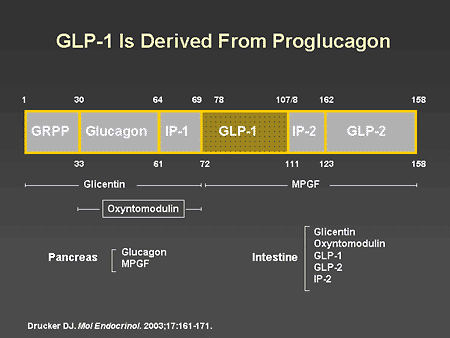
Proglucagon is a protein that is a precursor of glucagon and several other components. It is cleaved from preproglucagon. Proglucagon is generated in the alpha cells of the pancreas and in the intestinal L cells in the distal ileum and colon.
Preproglucagon in humans is encoded by the GCG gene and is composed of 180 amino-acid residues.[1][2]
Function and Terminology
The “pre-” prefix of preproglucagon indicates that it is composed of proglucagon together with a signal peptide. The signal peptide is a 20 amino acid fragment that signals that the protein needs to be secreted out of the cell. Proglucagon has the “pro-“ prefix because it is a prohormone, which means it is an inactivate precursor that needs to be further modified in order to produce active hormone(s). In particular, proglucagon is cleaved (cut) into different active hormones depending on the organ. Omitting various inactive fragments, preproglucagon is cleaved into the following:
Pancreas
- Signal peptide (1-20)
- Glicentin-related pancreatic polypeptide (GRPP, 21-50)
- Glucagon (53–81)
Gut and Brain
- Signal peptide (1-20)
- Glicentin (21–89)
- Oxyntomodulin (OXY or OXM, 53–89) – A further cleavage of Glicentin
- Glucagon-like peptide 1 (GLP-1, 92–128) – first seven residues further cleaved
- Glucagon-like peptide 2 (GLP-2, 146–178)[3][4]
References
- ↑ "Localization of the human glucagon gene (GCG) to chromosome segment 2q36–37". Cytogenetics and Cell Genetics 38 (1): 76–79. 1984. doi:10.1159/000132034. PMID 6546710.
- ↑ "Structure of the human glucagon gene". Nucleic Acids Research 14 (12): 4719–4730. June 1986. doi:10.1093/nar/14.12.4719. PMID 3725587.
- ↑ "Proglucagon-Derived Peptides as Therapeutics". Front. Endocrinol. 12. May 2021. doi:10.3389/fendo.2021.689678. ISSN 1664-2392. PMC 8171296. https://www.frontiersin.org/journals/endocrinology/articles/10.3389/fendo.2021.689678.
- ↑ "Isolation of peptide hormones from the pancreas of the bullfrog (Rana catesbeiana). Amino acid sequences of pancreatic polypeptide, oxyntomodulin, and two glucagon-like peptides". The Journal of Biological Chemistry 263 (20): 9746–9751. July 1988. doi:10.1016/S0021-9258(19)81581-8. PMID 3260236.
Further reading
- "Biologic actions and therapeutic potential of the proglucagon-derived peptides". Nature Clinical Practice. Endocrinology & Metabolism 1 (1): 22–31. November 2005. doi:10.1038/ncpendmet0017. PMID 16929363.
External links
- "Molecular and Cellular Mechanisms of Glucagon Synthesis and Secretion". lawsonimaging.ca. http://www.lawsonimaging.ca/investigators/sdhanvan/research2.htm.
- "PC1 Cleavage Sites". phoenixpeptide.com. http://www.phoenixpeptide.com/Catalog%20Files/GLP-1/ee0929017001.gif.
- "GLP-1 is Derived From Proglucagon". medscape.com. http://images.medscape.com/pi/editorial/cmecircle/2004/3418/images/slide037.gif.
- "Pro-glucagon". PDBe-KB Aggregated Views of Proteins. Wellcome Genome Campus, Hinxton, Cambridgeshire: EMBL-EBI. https://www.ebi.ac.uk/pdbe/pdbe-kb/proteins/P01275.
 |  |