Astronomy:11 Parthenope
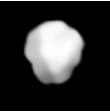 Deconvolved VLT-SPHERE image of Parthenope | |
| Discovery | |
|---|---|
| Discovered by | Annibale de Gasparis |
| Discovery site | Naples Obs. |
| Discovery date | 11 May 1850 |
| Designations | |
| (11) Parthenope | |
| Pronunciation | /pɑːrˈθɛnəpi/ parth-EN-ə-pee[1] |
| Named after | Parthenopē |
| Minor planet category | Main belt |
| Adjectives | Parthenopean (/ˌpɑːrθənəˈpiːən/ PARTH-ə-nə-PEE-ən) Parthenopian (/ˌpɑːrθəˈnoʊpiən/ PARTH-ə-NOH-pee-ən)[2] |
| Orbital characteristics[3] | |
| Epoch 17.0 October 2024 (JD 2460600.5) | |
| Uncertainty parameter 0 | |
| Observation arc | 63626 days (174.20 yr) |
| |{{{apsis}}}|helion}} | 2.69732 astronomical unit|AU (403.513 Gm) |
| |{{{apsis}}}|helion}} | 2.20942 AU (330.525 Gm) |
| 2.45337 AU (367.019 Gm) | |
| Eccentricity | 0.09943 |
| Orbital period | 3.84 yr (1403.6 d) |
| Average Orbital speed | 19.02 km/s |
| Mean anomaly | 71.503° |
| Mean motion | 0° 15m 23.342s / day |
| Inclination | 4.63153° |
| Longitude of ascending node | 125.506° |
| |{{{apsis}}}|helion}} | 2024-Jan-12 |
| 196.071° | |
| Earth MOID | 1.197 AU (179.1 Gm) |
| Jupiter MOID | 2.54059 AU (380.067 Gm) |
| TJupiter | 3.483 |
| Physical characteristics | |
| Dimensions | 156 × 152 × 138 ± 6 km[4] |
| Mean diameter | 149±2 km[4] 142.887±1.008 km[3] |
| Flattening | 0.12[lower-alpha 1] |
| Mass | (5.5±0.4)×1018 kg[4] 6.15×10¹⁸ kg[5] |
| Mean density | 3.20±0.27 g/cm3[4] 3.28±0.20 g/cm3[5] |
Equatorial surface gravity | 0.0578 m/s2 |
Equatorial escape velocity | 0.0941 km/s |
| Rotation period | 13.7204 h (0.57168 d)[3] 13.72204±0.00001 h[4] |
| Axial tilt | 73°[4] |
| Pole ecliptic latitude | 17°±4°[4] |
| Pole ecliptic longitude | 312°±2°[4] |
| Geometric albedo | 0.187 (calculated)[4] 0.191±0.021[3] |
| Physics | ~174 K |
| S-type asteroid[3] | |
| Apparent magnitude | 8.68[6] to 12.16 |
| Absolute magnitude (H) | 6.73[3] 6.55[4] |
| Angular diameter | 0.178" to 0.057" |
.svg)
.svg)
11 Parthenope (/pɑːrˈθɛnəpi/ parth-EN-ə-pee) is a large, bright asteroid located in the main asteroid belt.
History
Parthenope was discovered by Annibale de Gasparis on 11 May 1850, the second of his nine asteroid discoveries. It was named after Parthenopē, one of the Sirens in Greek mythology, said to have founded the city of Naples. De Gasparis "used his utmost endeavours to realise a 'Parthenope' in the heavens, such being the name suggested by Sir John Herschel on the occasion of the discovery of Hygiea in 1849".[7] Two symbols were proposed for Parthenope: a fish and a star (encoded in Unicode 17.0 as U+1CEC4 .svg) ) while such symbols were still in use, and later a lyre (encoded in Unicode 17.0 as U+1F77A
) while such symbols were still in use, and later a lyre (encoded in Unicode 17.0 as U+1F77A .svg) ) in lists of symbols. Both are obsolete.[8][9][10]
) in lists of symbols. Both are obsolete.[8][9][10]
In 1988 a search for satellites or dust orbiting this asteroid was performed using the UH88 telescope at the Mauna Kea Observatories, but the effort came up empty.[11]
Orbit

Parthenope orbits the Sun at an average distance (its semi-major axis) of 2.454 astronomical units (AU), with an orbital period of 3.845 years. Its distance from the Sun varies from 2.209 AU at its perihelion to 2.699 AU at its aphelion, indicated by its orbital eccentricity of 0.0998. Its orbit is inclined by 4.633° with respect to the ecliptic plane.[3] It is classified as a background asteroid, as it does not belong to any known asteroid family.[12]
Physical Characteristics
In 2007, Baer and Chesley calculated a higher mass and density for Parthenope based on perturbations by the 90 km asteroid 17 Thetis. Baer and Chesley calculated a mass of 6.3×10¹⁸ kg with a density of 3.3 g/cm3.[13] 2008 estimates by Baer suggest a mass of 6.15×10¹⁸ kg.[5] The 1997 and 2001 estimates by Viateau and Rapaport were closer to 5×10¹⁸ kg with a density of 2.7 g/cm3.[13]
Based upon a light curve that was generated from photometric observations of Parthenope at Pulkovo Observatory, it has a rotation period of 13.722 ± 0.001 hours and varies in brightness by 0.10 ± 0.0s in magnitude. The light curve displays three maxima and minima per cycle.[14]
See also
Notes
References
- ↑ Noah Webster (1884) A Practical Dictionary of the English Language
- ↑ Parthenopean (3rd ed.), Oxford University Press, September 2005, http://oed.com/search?searchType=dictionary&q=Parthenopean (Subscription or UK public library membership required.), Parthenopian (3rd ed.), Oxford University Press, September 2005, http://oed.com/search?searchType=dictionary&q=Parthenopian (Subscription or UK public library membership required.)
- ↑ 3.0 3.1 3.2 3.3 3.4 3.5 3.6 "JPL Small-Body Database Browser: 11 Parthenope". http://ssd.jpl.nasa.gov/sbdb.cgi?sstr=11. Retrieved 20 December 2024.
- ↑ 4.00 4.01 4.02 4.03 4.04 4.05 4.06 4.07 4.08 4.09 4.10 Vernazza, P. (October 2021). "VLT/SPHERE imaging survey of the largest main-belt asteroids: Final results and synthesis". Astronomy & Astrophysics 654: A56. doi:10.1051/0004-6361/202141781. Bibcode: 2021A&A...654A..56V.
- ↑ 5.0 5.1 5.2 Jim Baer (2008). "Recent Asteroid Mass Determinations". Personal Website. http://home.earthlink.net/~jimbaer1/astmass.txt. Retrieved 6 December 2008.
- ↑ "AstDys (11) Parthenope Ephemerides". Department of Mathematics, University of Pisa, Italy. https://newton.spacedys.com/astdys/index.php?pc=1.1.3.1&n=11&oc=500&y0=2031&m0=7&d0=29&h0=00&mi0=00&y1=2031&m1=7&d1=29&h1=00&mi1=00&ti=1.0&tiu=days. Retrieved 26 June 2010.
- ↑ De Gasparis, Annibale (May 1850). "The New Planet Parthenope". Monthly Notices of the Royal Astronomical Society 10: 144–147. doi:10.1093/mnras/10.7.144. Bibcode: 1850MNRAS..10..144D.
- ↑ Bala, Gavin Jared; Miller, Kirk (18 September 2023). "Unicode request for historical asteroid symbols". Unicode. https://www.unicode.org/L2/L2023/23207-historical-asteroids.pdf.
- ↑ "Miscellaneous Symbols Supplement". The Unicode Consortium. 2025. https://www.unicode.org/charts/PDF/U1CEC0.pdf.
- ↑ "Alchemical Symbols". The Unicode Consortium. 2025. https://www.unicode.org/charts/PDF/U1F700.pdf.
- ↑ Gradie, J.; Flynn, L. (March 1988), "A Search for Satellites and Dust Belts Around Asteroids: Negative Results", Abstracts of the Lunar and Planetary Science Conference 19: pp. 405–406, Bibcode: 1988LPI....19..405G.
- ↑ "(11) Parthenope – Proper Elements". Asteroids Dynamic Site. https://newton.spacedys.com/astdys/index.php?pc=1.1.6&n=11. Retrieved 24 January 2026.
- ↑ 13.0 13.1 Baer, James; Steven R. Chesley (2008). "Astrometric masses of 21 asteroids, and an integrated asteroid ephemeris". Celestial Mechanics and Dynamical Astronomy (Springer Science+Business Media B.V. 2007) 100 (2008): 27–42. doi:10.1007/s10569-007-9103-8. Bibcode: 2008CeMDA.100...27B.
- ↑ Pilcher, Frederick (October 2011), "Rotation Period Determinations for 11 Parthenope, 38 Leda, 111 Ate 194 Prokne, 217 Eudora, and 224 Oceana", The Minor Planet Bulletin 38 (4): pp. 183–185, Bibcode: 2011MPBu...38..183P.
External links
- Lightcurve plot of 11 Parthenope[Usurped!], Palmer Divide Observatory, B. D. Warner (2008)
- IOTA (International Occultation Timing Association) occultation database
- 2011-Jan-26 Occultation / (2011 Asteroidal Occultation Results for North America)
- 11 Parthenope at AstDyS-2, Asteroids—Dynamic Site
- 11 Parthenope at the JPL Small-Body Database
 |  |


