Engineering:Soyuz 7K-T-AF
 Crew and Soyuz 7K-T-AF on Soviet Stamp | |
| Manufacturer | Experimental Design Bureau (OKB-1) |
|---|---|
| Country of origin | Soviet Union |
| Operator | Soviet space program |
| Applications | Crewed spacecraft as Space Observatory Station |
| Specifications | |
| Design life | Up to 35 days, used for 7.87 days |
| Launch mass | 6,570 kilograms (14,480 lb) [1] |
| Dimensions |
|
| Power | Solar arrays output 1.3 kW from 10 square metres (110 sq ft) on 4-segments |
| Equipment | Orion 2 astrophysical camera |
| Regime | Low Earth orbit |
| Dimensions | |
| Production | |
| Status | No longer in service |
| Built | 1 |
| Launched | 1 |
| Maiden launch | Soyuz 13 18 December 1973 |
| Last launch | Soyuz 13 |
| Related spacecraft | |
| Derived from | Soyuz 7K-T |
 Vimpel Diamond for entrainment patch | |
Soyuz 7K-T-AF [2] is a version of the Soyuz spacecraft and was the first spacecraft designed for space station flights, a dedicated science mission. Its only crewed flight was conducted in 1973 with Soyuz 13 of the Soyuz programme.[3][2]
Design and flight
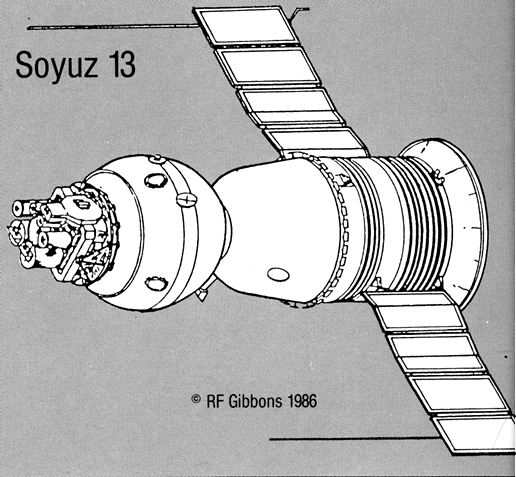
The one craft of the Soyuz 7K-T-AF was modified from the original Soyuz 7K-T with the addition of observatory and solar arrays. This was the second test flight of the redesigned Soyuz 7K-T, the second generation of the Soyuz spacecraft. The Soyuz 7K-T-AF flew once on Soyuz 13. The Soyuz 7K-T-AF was in the 7K-TM Configuration. Soyuz 7K-T-AF propulsion was from a KTDU-35, two liquid rocket engines. Soyuz 13/7K-T-AF was the first manned space observatory. Soyuz 7K-T-AF/Soyuz 13 housed the Orion 2 Space Observatory, operated by crew member Valentin Lebedev. Orion 2 Space Observatory was an Ultraviolet (UV) Telescope. The first Soviet UV Telescope was Orion 1 used on orbital station Salyut 1. The other crew member was Pyotr Klimuk.[2][4][5]
With the Orion 2 astrophysical telescope and camera, the crew made observations of stars in the ultraviolet light range. Also added to Soyuz 7K-T-AF was experiment that photographed spectrozonal areas of the earth's surface. Soyuz 7K-T-AF landed in snowstorm 200 kilometres (120 mi) Southwest Karaganda.[6] The observatory equipment was added to the top of nose cone of the spacecraft. The observatory equipment was mounted were the docking port is mounted on the Soyuz 7K-OKS version. [7][8] Soyuz 22/Soyuz 7K-MF6 spacecraft would be the next 7K-T with observatory equipment mounted at the craft's docking port.[9][5]
See also
References
- ↑ "Display: Soyuz 13 1973-103A". NASA. 14 May 2020. https://nssdc.gsfc.nasa.gov/nmc/spacecraft/display.action?id=1973-103A.
 This article incorporates text from this source, which is in the public domain.
- ↑ 2.0 2.1 2.2 "Soyuz 7KT-OK". Astronautix. Archived from the original. Error: If you specify
|archiveurl=, you must also specify|archivedate=. https://web.archive.org/web/20100103001120/http://astronautix.com/craft/soy7ktok.htm. - ↑ Soyuz 7K-T-AF
- ↑ Clark, Phillip (1988). The Soviet Manned Space Program. New York: Orion Books, a division of Crown Publishers, Inc.. ISBN 0-517-56954-X. https://archive.org/details/sovietmannedspac0000clar.
- ↑ 5.0 5.1 Newkirk, Dennis (1990). Almanac of Soviet Manned Space Flight. Houston, Texas: Gulf Publishing Company. ISBN 0-87201-848-2.
- ↑ Soyuz 13, astronautix.com
- ↑ Soyuz 7K-T-AF photo of observatory equipment
- ↑ Soyuz 7K-T-AF/Soyuz 13 photo
- ↑ "Baikonur LC1". Encyclopedia Astronautica. Archived from the original. Error: If you specify
|archiveurl=, you must also specify|archivedate=. https://web.archive.org/web/20090415160730/http://www.astronautix.com/sites/baiurlc1.htm.
External links
- RSC Energia: Concept Of Russian Manned Space Navigation Development
- Mir Hardware Heritage
- David S.F. Portree, Mir Hardware Heritage, NASA RP-1357, 1995
- Mir Hardware Heritage (wikisource)
- Information on Soyuz spacecraft
- OMWorld's ASTP Docking Trainer Page
- Space Adventures circum-lunar mission - details
| Early programme |  | |
|---|---|---|
| 7K series | ||
| Later series | ||
| Progress | ||
| Other derivatives | ||
| Main topics | | ||||||||||||||||||||||||||
|---|---|---|---|---|---|---|---|---|---|---|---|---|---|---|---|---|---|---|---|---|---|---|---|---|---|---|---|
| Past missions (by spacecraft type) |
| ||||||||||||||||||||||||||
| Current missions | |||||||||||||||||||||||||||
| Future missions |
| ||||||||||||||||||||||||||
Uncrewed missions are designated as Kosmos instead of Soyuz; exceptions are noted "(uncrewed)". The † sign designates failed missions. Italics designates cancelled missions. | |||||||||||||||||||||||||||
 |  |