Engineering:Soyuz TMA-04M
 Soyuz TMA-04M departs the ISS | |
| Operator | Roscosmos |
|---|---|
| COSPAR ID | 2012-022A |
| SATCAT no. | 38291 |
| Mission duration | 124 days, 23 hours, 51 minutes, 30 seconds |
| Orbits completed | ~1,945[1] |
| Spacecraft properties | |
| Spacecraft type | Soyuz-TMA 11F747 |
| Manufacturer | Energia |
| Crew | |
| Crew size | 3 |
| Members | Gennady Padalka Sergei Revin Joseph M. Acaba |
| Callsign | Altair |
| Start of mission | |
| Launch date | 15 May 2012, 03:01:23 UTC[2][3] |
| Rocket | Soyuz-FG |
| Launch site | Baikonur 1/5 |
| End of mission | |
| Landing date | 17 September 2012, 02:53 UTC[4] |
| Orbital parameters | |
| Reference system | Geocentric |
| Regime | Low Earth |
| Perigee altitude | 410 kilometres (250 mi) |
| Apogee altitude | 433 kilometres (269 mi) |
| Inclination | 51.64 degrees |
| Period | 92.86 minutes |
| Epoch | 17 September 2012, 01:22:43 UTC[1] |
| Docking with ISS | |
| Docking port | Poisk zenith |
| Docking date | 17 May 2012, 04:36 UTC |
| Undocking date | 16 September 2012, 23:09 UTC |
| Time docked | 4 months |
 (l-r) Acaba, Padalka and Revin Soyuz programme (Crewed missions) | |
Soyuz TMA-04M was a spaceflight to Low Earth orbit that transported three members of the Expedition 31 crew to the International Space Station (ISS), which was launched on 15 May 2012 and landed on 17 September 2012.[3] TMA-04M was the Soyuz spacecraft's 113th flight since its initial launch in 1967, and the fourth launch of the improved Soyuz TMA-M series (first launched 7 October 2010). As per the mission plan, the spacecraft remained docked to the space station to serve as an emergency escape vehicle during Expedition 31.
The mission was successfully launched to the International Space Station from the Baikonur Cosmodrome in Kazakhstan on Tuesday, 15 May 2012, at 3:01:23 UTC (9:01:23 local time).[5] The Soyuz docked successfully with the ISS on 17 May at 4:36 UTC.[6] The spacecraft carried to the ISS a three-person crew (Gennady Padalka, Russia; Sergei Revin, Russia; Joseph Acaba, United States).[5] The mission landed successfully in Kazakhstan on 17 September 2012, at 2:53 UTC.[4]
Crew
| Position[7][8] | Crew Member | |
|---|---|---|
| Commander |  Gennady Padalka, Roscosmos Gennady Padalka, RoscosmosExpedition 31 Fourth spaceflight | |
| Flight Engineer 1 | Sergei Revin, Roscosmos Expedition 31 Only spaceflight | |
| Flight Engineer 2 |  Joseph M. Acaba, NASA Joseph M. Acaba, NASAExpedition 31 Second spaceflight | |
Backup crew
| Position[9] | Crew Member[10] | |
|---|---|---|
| Commander | Oleg Novitskiy, Roscosmos
| |
| Flight Engineer 1 | Evgeny Tarelkin, Roscosmos
| |
| Flight Engineer 2 | Kevin A. Ford, NASA
| |
Spacecraft
Soyuz TMA-04M was the fourth mission using the upgraded Soyuz TMA-M spacecraft, which has a modernised flight control system and a reduced mass. The spacecraft was designed and manufactured by S.P. Korolev Rocket and Space Corporation Energia, the largest company of the Russian space industry.[11]
Mission highlights
Soyuz TMA-04M was successfully launched to the International Space Station from the Baikonur Cosmodrome in Kazakhstan on Tuesday, 15 May 2012, at 3:01:23 UTC (9:01:23 local Baikonur time).[5] The spacecraft docked with the International Space Station on Thursday, 17 May at 4:36 UTC, linking to the Poisk docking module.[6]
After the departure of Soyuz TMA-03M on 1 June the crew members of TMA-04M conducted the first portion of Expedition 32 until the commencement of the second portion with the arrival of the remaining crew members aboard Soyuz TMA-05M in mid-July.[6] The spacecraft undocked from the ISS at 23:09 UTC on 16 September and landed at 2:53 UTC on September 17 in Kazakhstan.[4][12]
Gallery
-
 The Soyuz TMA-04M spacecraft during pre-launch processing on 8 May 2012.
 -
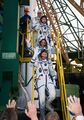 The TMA-04M crew wave to spectators before launch on May 15, 2012.
 -
 The Soyuz TMA-04M mission lifts-off to the ISS on 15 May 2012.


References
- ↑ 1.0 1.1 Peat, Chris (17 September 2012). "SOYUZ-TMA 4M - Orbit". Heavens Above. http://www.heavens-above.com/orbit.aspx?satid=38291.
- ↑ William Harwood (February 12, 2012). "Russia Orders Soyuz Delays In Wake Of Test Mishap". SpaceflightNow.com. http://www.spaceflightnow.com/station/exp30/120202/.
- ↑ 3.0 3.1 "Three New Crew Members En Route to Station". Latest News. NASA. http://www.nasa.gov/mission_pages/station/living/index.html.
- ↑ 4.0 4.1 4.2 "Expedition 32 Lands Safely in Kazakhstan". National Aeronautics and Space Administration. http://www.nasa.gov/mission_pages/station/living/index.html.
- ↑ 5.0 5.1 5.2 Harwood, William (May 18, 2012). "Latest manned space launch safely takes flight to orbit". Spaceflight Now. http://spaceflightnow.com/station/exp31/120514launch/.
- ↑ 6.0 6.1 6.2 Harwood, William (May 17, 2012). "Three-man crew docks at International Space Station". Spaceflight Now. http://www.spaceflightnow.com/station/exp31/120517dock/.
- ↑ NASA HQ (2009). "NASA and its International Partners Assign Space Station Crews". NASA. http://www.nasa.gov/home/hqnews/2009/oct/HQ_09-233_Space_Station_Crews.html.
- ↑ NASA HQ (2010). "NASA And Partners Assign Crews For Upcoming Space Station Missions". NASA. http://www.nasa.gov/home/hqnews/2010/jul/HQ_10-161_New_ISS_Crews.html.
- ↑ "Орбитальные полёты". 2012. http://www.astronaut.ru/register/or_flight.htm.
- ↑ NASA (2012). "Expedition 31 Backup Crew Members Field Questions from Roscosmos Officials". NASA. http://www.nasa.gov/mission_pages/station/multimedia/gallery/jsc2012e045628.html.
- ↑ Soyuz TMA-M manned transport vehicle of a new series Energia Corporation
- ↑ "Soyuz TMA-04M Spacecraft Undocks from Space Station". RIA Novosti. 16 September 2012. http://en.ria.ru/science/20120917/176000958.html.
| Main topics |  | ||||||||||||||||||||||||||
|---|---|---|---|---|---|---|---|---|---|---|---|---|---|---|---|---|---|---|---|---|---|---|---|---|---|---|---|
| Past missions (by spacecraft type) |
| ||||||||||||||||||||||||||
| Current missions | |||||||||||||||||||||||||||
| Future missions |
| ||||||||||||||||||||||||||
Uncrewed missions are designated as Kosmos instead of Soyuz; exceptions are noted "(uncrewed)". The † sign designates failed missions. Italics designates cancelled missions. | |||||||||||||||||||||||||||
| 1998–2004 |
|  | ||||||||||||||||||||||||||||||||||||||||||||||||||||||||
|---|---|---|---|---|---|---|---|---|---|---|---|---|---|---|---|---|---|---|---|---|---|---|---|---|---|---|---|---|---|---|---|---|---|---|---|---|---|---|---|---|---|---|---|---|---|---|---|---|---|---|---|---|---|---|---|---|---|---|
| 2005–2009 | ||||||||||||||||||||||||||||||||||||||||||||||||||||||||||
| 2010–2014 | ||||||||||||||||||||||||||||||||||||||||||||||||||||||||||
| 2015–2019 |
| |||||||||||||||||||||||||||||||||||||||||||||||||||||||||
| 2020–2024 | ||||||||||||||||||||||||||||||||||||||||||||||||||||||||||
| Individuals | ||||||||||||||||||||||||||||||||||||||||||||||||||||||||||
| Vehicles |
| |||||||||||||||||||||||||||||||||||||||||||||||||||||||||
Ongoing spaceflights in bold
! rowspan="3" colspan="2" width="14%" style="border-bottom:2px solid grey;" | Date/Time (UTC) ! Configuration ! Serial number ! Launch site ! Outcome |- |style="text-align:center;background-color:#e3e9e9;" | Payload |style="text-align:center;background-color:#e3e9e9;" | Separation orbit |style="text-align:center;background-color:#e3e9e9;" | Operator |style="text-align:center;background-color:#e3e9e9;" | Function |- | colspan="4" style="text-align:center;background-color:#e4dfdf;border-bottom:2px solid grey;" | Remarks |- Parameter 1=time required!
This is a navigational template created using {{navbox}}. It can be transcluded on pages by placing Initial visibilityThis template's initial visibility currently defaults to To change this template's initial visibility, the
Templates using the classes TemplateDataA navigational box that can be placed at the bottom of articles.
Template transclusions
 Not doneLatin pronunciation: [{{{1}}}] Not doneLatin pronunciation: [{{{1}}}]
| rowspan="1" colspan="2" style="border-top:2px solid #aabbcc;" | | style="border-top:2px solid #aabbcc;" | | style="border-top:2px solid #aabbcc;" | | style="border-top:2px solid #aabbcc;" | | style="border-top:2px solid #aabbcc;" | |- |- Vietnamese pronunciation: [{{{1}}}]-4500 — – -4000 — – -3500 — – -3000 — – -2500 — – -2000 — – -1500 — – -1000 — – -500 — – 0 —  Done Done To doRussian pronunciation: [{{{1}}}]Greek pronunciation: [{{{1}}}] To doRussian pronunciation: [{{{1}}}]Greek pronunciation: [{{{1}}}] Danish pronunciation: [{{{1}}}]Northern Sami pronunciation: [{{{1}}}]Mandarin pronunciation: [{{{ipa}}}]Cantonese pronunciation: [{{{1}}}]Entry from Soyuz TMA-04M from TCI Europe, retrieved on {{{Date}}} Danish pronunciation: [{{{1}}}]Northern Sami pronunciation: [{{{1}}}]Mandarin pronunciation: [{{{ipa}}}]Cantonese pronunciation: [{{{1}}}]Entry from Soyuz TMA-04M from TCI Europe, retrieved on {{{Date}}}
This is a navigational template created using {{navbox}}. It can be transcluded on pages by placing Initial visibilityThis template's initial visibility currently defaults to To change this template's initial visibility, the
Templates using the classes TemplateDataA navigational box that can be placed at the bottom of articles.
 In progressPalomares, M. L. D. and Pauly, D., eds. (2011). "{{{1}}} {{{2}}}" in SeaLifeBase. April 2011 version.Turkish pronunciation: [{{{1}}}]Finnish pronunciation: [{{{1}}}]Froese, Rainer and Pauly, Daniel, eds. (2006). "{{{1}}} {{{2}}}" in FishBase. April 2006 version. In progressPalomares, M. L. D. and Pauly, D., eds. (2011). "{{{1}}} {{{2}}}" in SeaLifeBase. April 2011 version.Turkish pronunciation: [{{{1}}}]Finnish pronunciation: [{{{1}}}]Froese, Rainer and Pauly, Daniel, eds. (2006). "{{{1}}} {{{2}}}" in FishBase. April 2006 version.
|- | ... | — | — | — | — | — | — |-Old Norse pronunciation: [{{{1}}}]Salish pronunciation: [{{{1}}}]Basque pronunciation: [{{{1}}}]{{{1}}}data-sort-value="" style="background: #ececec; color: #2C2C2C; vertical-align: middle; font-size: smaller; text-align: center; " class="table-na" | UnreleasedNorwegian pronunciation: [{{{1}}}] (aged {{{4}}})Hungarian pronunciation: [{{{1}}}]Quechua pronunciation: [{{{1}}}]Arabic pronunciation: [{{{1}}}]Punjabi pronunciation: [{{{1}}}]Afrikaans pronunciation: [{{{1}}}]Romanian pronunciation: [{{{1}}}]Hebrew pronunciation: [{{{1}}}][INVALID OR MISSING PARAMETER IN TEMPLATE Soyuz TMA-04M]Uto-Aztecan pronunciation: [{{{1}}}]Tamil pronunciation: [{{{1}}}]Hindustani pronunciation: [{{{1}}}]Swedish pronunciation: [{{{1}}}]Kazakh pronunciation: [{{{1}}}]Lao pronunciation: [{{{1}}}]Tibetan pronunciation: [{{{1}}}]Khmer pronunciation: [{{{1}}}]data-sort-value="" style="vertical-align:middle; text-align:center" class="table-na" | —{{{1}}}Welsh pronunciation: [{{{1}}}] Partially doneAthabaskan pronunciation: [{{{1}}}]Māori pronunciation: [{{{1}}}]IPA: [{{{1}}}]Bulgarian pronunciation: [{{{1}}}]Korean pronunciation: [{{{1}}}]Icelandic pronunciation: [{{{1}}}]Sanskrit pronunciation: [{{{1}}}]Bengali pronunciation: [{{{1}}}]Indonesian pronunciation: [{{{1}}}]Serbo-Croatian pronunciation: [{{{1}}}]CROSBI {{{1}}} Future spaceflights in italics Partially doneAthabaskan pronunciation: [{{{1}}}]Māori pronunciation: [{{{1}}}]IPA: [{{{1}}}]Bulgarian pronunciation: [{{{1}}}]Korean pronunciation: [{{{1}}}]Icelandic pronunciation: [{{{1}}}]Sanskrit pronunciation: [{{{1}}}]Bengali pronunciation: [{{{1}}}]Indonesian pronunciation: [{{{1}}}]Serbo-Croatian pronunciation: [{{{1}}}]CROSBI {{{1}}} Future spaceflights in italics
! rowspan="3" colspan="2" width="14%" style="border-bottom:2px solid grey;" | Date/Time (UTC) ! Configuration ! Serial number ! Launch site ! Outcome |- |style="text-align:center;background-color:#e3e9e9;" | Payload |style="text-align:center;background-color:#e3e9e9;" | Separation orbit |style="text-align:center;background-color:#e3e9e9;" | Operator |style="text-align:center;background-color:#e3e9e9;" | Function |- | colspan="4" style="text-align:center;background-color:#e4dfdf;border-bottom:2px solid grey;" | Remarks |- Parameter 1=time required!
This is a navigational template created using {{navbox}}. It can be transcluded on pages by placing Initial visibilityThis template's initial visibility currently defaults to To change this template's initial visibility, the
Templates using the classes TemplateDataA navigational box that can be placed at the bottom of articles.
Template transclusions
Not doneLatin pronunciation: [{{{1}}}]
| rowspan="1" colspan="2" style="border-top:2px solid #aabbcc;" | | style="border-top:2px solid #aabbcc;" | | style="border-top:2px solid #aabbcc;" | | style="border-top:2px solid #aabbcc;" | | style="border-top:2px solid #aabbcc;" | |- |- Vietnamese pronunciation: [{{{1}}}]-4500 — – -4000 — – -3500 — – -3000 — – -2500 — – -2000 — – -1500 — – -1000 — – -500 — – 0 — Done To doRussian pronunciation: [{{{1}}}]Greek pronunciation: [{{{1}}}]Danish pronunciation: [{{{1}}}]Northern Sami pronunciation: [{{{1}}}]Mandarin pronunciation: [{{{ipa}}}]Cantonese pronunciation: [{{{1}}}]Entry from Soyuz TMA-04M from TCI Europe, retrieved on {{{Date}}}
This is a navigational template created using {{navbox}}. It can be transcluded on pages by placing Initial visibilityThis template's initial visibility currently defaults to To change this template's initial visibility, the
Templates using the classes TemplateDataA navigational box that can be placed at the bottom of articles.
In progressPalomares, M. L. D. and Pauly, D., eds. (2011). "{{{1}}} {{{2}}}" in SeaLifeBase. April 2011 version.Turkish pronunciation: [{{{1}}}]Finnish pronunciation: [{{{1}}}]Froese, Rainer and Pauly, Daniel, eds. (2006). "{{{1}}} {{{2}}}" in FishBase. April 2006 version.
|- | ... | — | — | — | — | — | — |-Old Norse pronunciation: [{{{1}}}]Salish pronunciation: [{{{1}}}]Basque pronunciation: [{{{1}}}]{{{1}}}data-sort-value="" style="background: #ececec; color: #2C2C2C; vertical-align: middle; font-size: smaller; text-align: center; " class="table-na" | UnreleasedNorwegian pronunciation: [{{{1}}}] (aged {{{4}}})Hungarian pronunciation: [{{{1}}}]Quechua pronunciation: [{{{1}}}]Arabic pronunciation: [{{{1}}}]Punjabi pronunciation: [{{{1}}}]Afrikaans pronunciation: [{{{1}}}]Romanian pronunciation: [{{{1}}}]Hebrew pronunciation: [{{{1}}}][INVALID OR MISSING PARAMETER IN TEMPLATE Soyuz TMA-04M]Uto-Aztecan pronunciation: [{{{1}}}]Tamil pronunciation: [{{{1}}}]Hindustani pronunciation: [{{{1}}}]Swedish pronunciation: [{{{1}}}]Kazakh pronunciation: [{{{1}}}]Lao pronunciation: [{{{1}}}]Tibetan pronunciation: [{{{1}}}]Khmer pronunciation: [{{{1}}}]data-sort-value="" style="vertical-align:middle; text-align:center" class="table-na" | —{{{1}}}Welsh pronunciation: [{{{1}}}] Partially doneAthabaskan pronunciation: [{{{1}}}]Māori pronunciation: [{{{1}}}]IPA: [{{{1}}}]Bulgarian pronunciation: [{{{1}}}]Korean pronunciation: [{{{1}}}]Icelandic pronunciation: [{{{1}}}]Sanskrit pronunciation: [{{{1}}}]Bengali pronunciation: [{{{1}}}]Indonesian pronunciation: [{{{1}}}]Serbo-Croatian pronunciation: [{{{1}}}]CROSBI {{{1}}} † - mission failed to reach ISS | ||||||||||||||||||||||||||||||||||||||||||||||||||||||||||


 |  |


