Astronomy:Exploration of Titan

The exploration of Titan, the largest moon of Saturn, has been conducted through robotic spacecraft missions. It began with NASA's Pioneer 11 encounter with the Saturn system in 1979, followed by the Voyager 1 and Voyager 2 flybys in 1980 and 1981, which provided the first close observations of Titan. Titan has been studied through spacecraft flybys, orbital observations, and a surface landing mission. Exploration has been primarily conducted by NASA, with contributions from international space agencies. The study of Titan presents challenges due to its distance from Earth, low temperatures, dense atmosphere, and communication limitations across the outer Solar System.
The original missions determined that Titan has a thick atmosphere composed mainly of nitrogen, making it the only moon known to have a dense atmosphere. The Voyager 1 encounter provided measurements of Titan's atmospheric properties, although the moon's opaque haze limited visible-light observations of the surface.
The Cassini–Huygens mission conducted the most detailed investigation of Titan. The Cassini spacecraft entered orbit around Saturn in 2004 and completed numerous Titan flybys during its 13-year mission. Using radar and infrared instruments, Cassini mapped Titan's surface through its dense atmosphere and identified features including dunes, mountains, lakes, and seas containing liquid methane and ethane. The mission also provided evidence of a subsurface liquid water ocean beneath Titan's icy crust and revealed a complex organic chemistry environment.
In January 2005, the European Space Agency's (ESA) Huygens probe became the first and only spacecraft to land on Titan. It descended through the moon's atmosphere and collected measurements during descent and after reaching the surface. Huygens provided data on Titan's atmospheric composition, weather conditions, surface materials, and landscape features, including channels and other formations likely shaped by liquid methane and ethane.
Future exploration of Titan includes NASA's Dragonfly mission, a rotorcraft lander scheduled for launch in July 2028. Dragonfly will investigate Titan's surface, study its organic chemistry, and examine environments that may support prebiotic chemical processes through measurements conducted at multiple sites across the moon.
Technical requirements


A mission to Titan requires advanced technologies to address challenges in orbital transfer, atmospheric entry, power generation, and communication. Since Saturn is located approximately 9 AU (1.3×10⁹ km; 840,000,000 mi) from the Sun, reaching the Saturn system requires significant energy.[1] A direct Hohmann transfer from Earth to Saturn requires a total velocity change of about 10.4 km/s (6.5 mi/s).[1] To reduce launch energy requirements and increase payload capacity, spacecraft commonly use gravity-assist maneuvers involving planets such as Venus, Earth, or Jupiter during multi-year interplanetary journeys.[1][2]
Titan's dense nitrogen atmosphere provides opportunities for atmospheric braking techniques such as aerocapture and aerobraking. With a surface pressure approximately 1.5 times that of Earth, Titan's atmosphere can reduce spacecraft velocity before landing or orbital insertion. However, atmospheric entry at hypersonic speeds produces significant heating caused by compression and friction.[3] Simulations indicate that spacecraft may experience peak heat fluxes of approximately 145 W/cm2 (940 W/sq in) due to processes within the shock layer, including the formation of cyanogen (CN) molecules.[4] Thermal protection systems are required to withstand these conditions. The Huygens probe used silica-fiber phenolic resin materials for protection during entry, while newer spacecraft concepts, including NASA's Dragonfly mission, use advanced heat shield materials such as the phenolic-impregnated carbon ablator (PICA).[5]
After the heat shield is released, Titan's dense atmosphere slows spacecraft descent, resulting in an entry, descent, and landing sequence lasting nearly two hours. This contrasts with the shorter landing sequences used at Mars.[5] Although Titan's atmosphere supports parachute-based landing systems, its thick organic haze significantly reduces sunlight at the surface, leaving less than 1 percent of Earth's solar irradiance available.[6] As a result, solar power systems are not practical for long-duration missions.[7] Spacecraft operating on Titan use radioisotope thermoelectric generators (RTGs), which produce electricity and heat through the radioactive decay of plutonium-238.[8] The generated heat helps maintain spacecraft systems in Titan's surface environment, where temperatures reach approximately −179 °C (−290 °F).[8]
Communication with Titan also presents challenges because of its distance from Earth. Radio signals require a round-trip travel time of approximately 70 to 90 minutes, preventing real-time control of spacecraft operations. Missions must therefore rely on autonomous systems capable of performing navigation corrections, scientific observations, and operational adjustments without immediate instructions from Earth.[9] High-gain communication systems and onboard computers are used to manage spacecraft activities throughout the mission.[8]
Flyby missions
Pioneer 11 (1979)

The first spacecraft to explore Titan was Pioneer 11, which flew past the moon at a distance of approximately 354,000 km (220,000 mi) on 2 September 1979 during its encounter with Saturn.[10] Before the flyby, Earth-based observations had provided estimates of Titan's temperature and mass, and Pioneer 11 confirmed many of those measurements.[11] The spacecraft found that Titan was extremely cold, with an average surface temperature of approximately −193 °C (−315 °F),[12] indicating an environment unsuitable for known forms of life.[13]
Titan's dense atmosphere prevented direct observation of its surface, leading some scientists at the time to overestimate its size relative to other moons.[11] Images returned by Pioneer 11 showed Titan as a largely featureless orange world surrounded by a thick haze, with a maximum resolution of approximately 180 km (110 mi).[12] The observations also revealed evidence of a bluish haze in the upper atmosphere.[11]
Pioneer 11 obtained some of the first spacecraft images of Titan, including views showing both Titan and Saturn.[14] Although these observations provided important early information about the moon's atmosphere and physical properties, they were later surpassed in detail by the data collected during the Voyager missions.[15]
Voyager program (1980 and 1981)

Titan was investigated by both Voyager 1 and Voyager 2 during their encounters with Saturn in 1980 and 1981. Voyager 1 followed a trajectory designed for a close flyby of Titan, passing within approximately 6,400 km (4,000 mi) of the moon on 12 November 1980.[16] Voyager 2 passed Titan at a much greater distance of approximately 666,190 km (413,950 mi) on 24 August 1981.[17]
The close encounter of Voyager 1 enabled detailed measurements of Titan's mass, radius, atmospheric density, composition, temperature, and surface pressure.[16] These observations established that Titan is the second-largest moon in the Solar System, smaller than Ganymede but larger than Mercury. The spacecraft confirmed that Titan's atmosphere is composed primarily of nitrogen, with methane and smaller amounts of hydrocarbons, including acetylene, ethane, and propane.[11] The detection of these compounds indicated that complex chemical reactions could occur within Titan's atmosphere.[18] Voyager 1 also observed a north–south brightness difference, which was later identified as a seasonal phenomenon.[11]
The dense atmosphere prevented both Voyager spacecraft from directly observing Titan's surface. Images showed an orange globe completely obscured by atmospheric haze, although the spacecraft detected a bluish haze layer at higher altitudes. Prior to the flybys, some researchers had proposed that Titan might contain oceans of liquid hydrocarbons, but the opaque atmosphere prevented direct confirmation.[11] Decades later, advanced processing of Voyager 1 imagery revealed indications of bright and dark surface regions that were subsequently identified as areas now known as Xanadu and Shangri-La.[19]
Because Voyager 1 successfully completed the planned Titan flyby, Voyager 2 was not redirected for a similar encounter and instead continued its mission to Uranus and Neptune.[16] Following its Saturn encounter, Voyager 1 departed the plane of the Solar System on a trajectory toward interstellar space, a path determined by the requirements of the Titan flyby.[18]
Orbiter missions
Cassini (2004–2017)

The joint NASA, European Space Agency (ESA), and Italian Space Agency (ASI)[20] Cassini–Huygens mission arrived at Saturn on 1 July 2004, becoming the first spacecraft to enter orbit around the planet and beginning an extended investigation of Titan.[21] Cassini immediately began observing the moon using radar and infrared instruments capable of penetrating its dense atmospheric haze.[22] The spacecraft's first Titan flyby occurred on 2 July 2004 at a distance of approximately 339,000 km (211,000 mi), revealing methane-rich clouds near the south pole and surface regions with contrasting brightness.[23] On 26 October 2004, Cassini completed its first close flyby of Titan at a distance of about 1,200 km (750 mi). During this encounter, the spacecraft obtained the first radar images of Titan's surface, revealing a relatively young landscape and surface features hidden beneath the atmosphere.[24]
A major achievement of the mission occurred on 14 January 2005, when the European-built Huygens probe descended through Titan's atmosphere and landed on the surface. Huygens became the first spacecraft to land in the outer Solar System. During its 219.4-minute descent and surface mission, the probe collected images and measurements of Titan's atmosphere and surface environment, transmitting the data to Cassini for relay to Earth. These observations provided the first direct information about Titan's lower atmosphere and surface conditions.[11]
Over the following 13 years, Cassini conducted 127 close flybys of Titan,[11] including its closest encounter in 2010, when it passed about 880 km (550 mi) above Titan's surface.[25] Radar and infrared observations revealed clouds, precipitation, river channels, lakes, and seas composed primarily of liquid methane and ethane. These discoveries established Titan as the only known world besides Earth with stable liquid bodies on its surface.[11] Radar observations obtained in 2006 identified large hydrocarbon lakes in the northern polar region,[26] while subsequent analyses provided evidence for extensive methane and ethane seas.[27] The mission also detected evidence for a subsurface ocean of liquid water beneath Titan's icy crust.[11]
Cassini–Huygens produced the most detailed observations of Titan obtained to date. The mission revealed an active methane cycle, changing weather patterns, and surface processes that resemble some terrestrial geological and meteorological phenomena despite Titan's much colder environment. Cassini's final flyby of Titan took place on 22 April 2017,[28] several months before the spacecraft concluded its mission by entering Saturn's atmosphere in September 2017 to avoid the biological contamination of potentially habitable worlds.[29][30]
Lander missions
Huygens (2005)


The Huygens probe was a robotic lander carried by the Cassini–Huygens mission to study Titan. It separated from the Cassini orbiter on 25 December 2004 and spent 22 days traveling toward Titan before entering the moon's atmosphere.[31] On 14 January 2005, the probe descended by parachute and became the first and only spacecraft to land in the outer Solar System.[11] It is also the most distant spacecraft to achieve a landing on the surface of a planetary body.[32] During its 219.4-minute descent and surface mission, Huygens collected images and measurements of Titan's atmosphere and surface, transmitting the data to the Cassini spacecraft for relay to Earth.[11]
Huygens landed just east of the bright region later named Adiri. During its descent, the probe photographed bright, ice-rich highlands intersected by dark branching channels that extended onto a darker plain. These observations indicated that flowing liquids had shaped the landscape. Scientists concluded that the highlands are composed primarily of water ice, while darker organic materials produced in Titan's atmosphere accumulate on the surface and are redistributed by methane precipitation.[33]
After landing, Huygens returned the first images from Titan's surface, revealing a frozen plain covered with rounded pebbles and rocks composed largely of water ice.[33] The rounded shapes of the rocks and evidence of erosion suggested that they had been transported by flowing liquid, providing evidence for past fluvial activity. Measurements indicated that the surface consists of a mixture of water ice and hydrocarbon materials.[34]
Huygens also obtained the first direct measurements of Titan's lower atmosphere. The probe recorded a surface temperature of 93.8 K (−179.3 °C; −290.8 °F) and a surface pressure of 1,467.6 mbar (1.4484 atm). These observations confirmed that Titan has a dense nitrogen-rich atmosphere containing methane and demonstrated that its thick atmospheric haze greatly reduces the amount of sunlight reaching the surface, making it about 1,000 times dimmer than full solar illumination on Earth.[35] Combined with later observations from Cassini of methane and ethane lakes and seas, the Huygens mission showed that Titan possesses an active methane cycle involving rainfall, rivers, and stable surface liquids despite its extremely low temperatures.[36][37]
Future missions
Dragonfly (2028)

Dragonfly is an upcoming NASA mission that will send a robotic rotorcraft to Titan. Planned for launch in July 2028 and arrival in 2034, Dragonfly will become the first aircraft to operate on a natural satellite and will demonstrate the first powered, fully controlled atmospheric flight beyond Earth. Using vertical takeoff and landing (VTOL) capabilities, the rotorcraft will fly between multiple locations across Titan's surface, allowing it to collect samples and study a wide range of geological environments.[38][39]
The mission aims to investigate Titan's potential habitability and study its complex prebiotic chemistry.[38][39] Titan is a major astrobiological target because it contains abundant carbon-rich organic compounds, a nitrogen-rich atmosphere, surface lakes and rivers of liquid hydrocarbons, and possible subsurface liquid water mixed with ammonia.[40][41] These environments may resemble chemical conditions on the early Earth and could provide insight into how the building blocks of life form.[40] Previous observations from the Huygens probe detected tholins,[42] complex hydrocarbon materials produced in Titan's atmosphere,[37][43] but the composition of many surface materials remains unknown because Titan's thick haze blocks observations at many wavelengths.[44]
Dragonfly will analyze Titan's surface materials to determine how far prebiotic chemistry has progressed and search for possible biosignatures or chemical evidence related to habitability.[45][46] Particular interest will be given to regions where liquid water may have interacted with organic compounds, such as areas affected by impacts or possible cryovolcanic activity.[45][41] These locations could preserve evidence of chemical processes involving important molecules such as amino acids and other compounds associated with life.[46]
The rotorcraft is planned to land among dunes southeast of the Selk impact crater near the dark region of Shangri-La. It will conduct a series of flights of up to 8 km (5.0 mi), exploring different environments and collecting samples before traveling toward the Selk crater.[47][48] The 90 km (56 mi)-wide crater is a key scientific target because it contains evidence of past liquid water interactions, organic compounds such as tholins, and possible water-ice flows or cryovolcanic materials produced after the impact.[49][50][48] By studying this combination of organic materials and water-related geology, Dragonfly will investigate one of the most promising environments for understanding prebiotic chemistry and the potential for life beyond Earth.[42]
Proposed or conceptual missions
There have been several proposed missions to return robotic spacecraft to Titan following the success of Cassini–Huygens. NASA, the Jet Propulsion Laboratory (JPL), and ESA have completed conceptual studies for a range of orbital, aerial, and surface missions, although none of these proposals initially received funding for development.
One of the most ambitious concepts was the Titan Saturn System Mission (TSSM), a joint NASA–ESA proposal to explore Titan and other moons of Saturn.[51] The mission included a hot-air balloon designed to operate in Titan's atmosphere for up to six months. TSSM competed with the Europa Jupiter System Mission (EJSM) for funding, but in 2009 NASA and ESA selected EJSM as the higher-priority mission.[52]
Several concepts focused on exploring Titan's hydrocarbon lakes and seas. The Titan Mare Explorer (TiME) was proposed as a low-cost floating lander that would investigate the chemistry of Ligeia Mare, Titan's hydrocarbon cycle, and the moon's geological history.[53] TiME was selected for a Phase A design study under NASA's Discovery Program in 2011[54] but was not chosen for flight.[55] In 2012, the Spanish engineering company SENER and the Spanish Astrobiology Center proposed the Titan Lake In-situ Sampling Propelled Explorer (TALISE), a lake lander equipped with its own propulsion system, enabling it to navigate across Titan's lakes rather than drift passively.[56]
Other proposals emphasized aerial exploration. In 2012, Jason Barnes of the University of Idaho proposed the Aerial Vehicle for In-situ and Airborne Titan Reconnaissance (AVIATR), an uncrewed aircraft designed to fly through Titan's dense atmosphere while collecting high-resolution images and scientific data. The proposed mission was not approved for funding.[57][58]
Additional orbital concepts included Journey to Enceladus and Titan (JET), a proposed Saturn orbiter submitted to NASA's Discovery Program that would have investigated the habitability of both Titan and Enceladus.[59][60] In 2015, the NASA Innovative Advanced Concepts (NIAC) program also funded a Phase II design study[61] for the Titan Submarine, a concept intended to explore Titan's methane and ethane seas by operating beneath their surfaces.[62][63][64]
Human exploration
Human exploration of Titan has been proposed because of the moon's abundant resources and unique atmospheric properties, although no crewed missions are currently planned and such concepts remain speculative. Titan has a dense, nitrogen-rich atmosphere, extensive lakes and seas of liquid methane and ethane, and abundant organic compounds. Observations also indicate the possible presence of a subsurface ocean of liquid water mixed with ammonia, which could provide resources for any future human activity.[41]
Among those who have proposed human settlement of Titan, aerospace engineer Robert Zubrin has argued that the moon possesses many of the materials needed to support a long-term human presence.[65] In these proposals, atmospheric nitrogen could provide a habitat buffer gas, while methane and ammonia could be used for fuel production and other industrial processes.[41]
Any human presence on Titan would face substantial technical challenges. The average surface temperature is about −179 °C (−290 °F), requiring extensive thermal protection for habitats and equipment.[65] Titan's surface gravity is about 14 percent of Earth's gravity, which could create long-term health concerns related to reduced gravity exposure, including bone and muscle loss.[66] Conversely, its dense atmosphere and low gravity would make aerodynamic flight comparatively efficient, making aircraft and rotorcraft attractive concepts for exploration.[65][67] Proposed energy sources include chemical energy from local hydrocarbons, wind power, tidal power from Titan's methane seas, and nuclear power systems, though all remain conceptual.[68][69]
See also
References
- ↑ 1.0 1.1 1.2 Stewart, H. J. (December 1966). "New Possibilities for Solar-System Exploration". Astronautics & Aeronautics: 26–31. http://www.gravityassist.com/IAF4-2/Ref.%204-135.pdf. Retrieved 10 September 2014.
- ↑ JPL. "Cassini-Huygens Mission: Frequently Asked Questions". JPL, NASA. https://science.nasa.gov/mission/cassini/faq/.
- ↑ Girija, Athul Pradeepkumar (17 June 2023). "ADEPT Drag Modulation Aerocapture: Applications for Future Titan Exploration". arXiv:2306.10412 [astro-ph.EP].
- ↑ Brandis, Aaron; Saunders, David; Allen, Gary; Stern, Eric; Wright, Michael; Mahzari, Milad; Johnston, Chris; Hill, Jeff et al.. "Aerothermodynamics for Dragonfly's Titan Entry". https://ntrs.nasa.gov/api/citations/20180004050/downloads/20180004050.pdf.
- ↑ 5.0 5.1 Pensado, Alejandro R.; Robb, Caleb; Winski, Richard G.; Williams, James W.; Belair, Michael W.; Lorenz, Ralph D. (3 January 2025). "Assessing Huygens Probe Entry, Descent, and Landing at Titan Simulation Using Dragonfly Atmosphere Model". AIAA SCITECH 2025 Forum. doi:10.2514/6.2025-2238. ISBN 978-1-62410-723-8. https://doi.org/10.2514/6.2025-2238. Retrieved 25 June 2026.
- ↑ Nixon, Conor A. (21 March 2024). "The Composition and Chemistry of Titan's Atmosphere". ACS Earth and Space Chemistry 8 (3): 406–456. doi:10.1021/acsearthspacechem.2c00041. PMID 38533193. Bibcode: 2024ESC.....8..406N.
- ↑ Fletcher, L. (2013). "Future exploration of the outer solar system". Astronomy & Geophysics 54 (2): 2.18. doi:10.1093/astrogeo/att032.
- ↑ 8.0 8.1 8.2 Jet Propulsion Laboratory (JPL) (September 15, 2006). Solar System Exploration Roadmap. JPL, NASA. JPL D-35618. http://www.lpi.usra.edu/vexag/road_map_final.pdf. Retrieved September 9, 2014.
- ↑ Keiger, Dale (19 March 2020). "Destination Titan". https://hub.jhu.edu/magazine/2020/spring/dragonfly-mission-to-titan/.
- ↑ Fimmel, Richard O.; Van Allen, James Alfred; Burgess, Eric (1980). Pioneer, First to Jupiter, Saturn, and Beyond. Scientific and Technical Information Office, National Aeronautics and Space Administration. https://books.google.com/books?id=gL0MAQAAIAAJ. Retrieved 4 July 2026.
- ↑ 11.00 11.01 11.02 11.03 11.04 11.05 11.06 11.07 11.08 11.09 11.10 11.11 "Titan Exploration". 21 November 2017. https://science.nasa.gov/saturn/moons/titan/exploration/.
- ↑ 12.0 12.1 "Pioneer 11". 21 December 2017. https://science.nasa.gov/mission/pioneer-11/.
- ↑ "The Pioneer Missions". Pioneer Project. NASA, Jet Propulsion Laboratory. March 26, 2007. https://www.nasa.gov/centers/ames/missions/archive/pioneer.html.
- ↑ "40 Years Ago: Pioneer 11 First to Explore Saturn". NASA. September 3, 2019. https://www.nasa.gov/feature/40-years-ago-pioneer-11-first-to-explore-saturn.
- ↑ "Voyager Camera Desc". Planetary Data System. November 21, 2021. https://pds-rings.seti.org/voyager/iss/inst_cat_wa1.html.
- ↑ 16.0 16.1 16.2 Bell, Jim (February 24, 2015). The Interstellar Age: Inside the Forty-Year Voyager Mission. Penguin Publishing Group. p. 93. ISBN 978-0-698-18615-6. https://books.google.com/books?id=KXPoAwAAQBAJ&pg=PT93.
- ↑ "Ring-Moon Systems Node - Voyager Mission Description". https://pds-rings.seti.org/voyager/mission/.
- ↑ 18.0 18.1 "Voyager 1". 6 December 2017. https://science.nasa.gov/mission/voyager/voyager-1/.
- ↑ Richardson, J.; Lorenz, Ralph D.; McEwen, Alfred (2004). "Titan's Surface and Rotation: New Results from Voyager 1 Images". Icarus 170 (1): 113–124. doi:10.1016/j.icarus.2004.03.010. Bibcode: 2004Icar..170..113R.
- ↑ "Cassini-Huygens". October 15, 1997. https://www.jpl.nasa.gov/missions/cassini-huygens.
- ↑ "Approach and Arrival at Saturn". June 11, 2004. https://sci.esa.int/web/cassini-huygens/-/34955-approach-and-arrival.
- ↑ Rodriguez, S.; Crapeau, M.; Mouelic, S. Le; Paillou, P.; Sotin, C.; Wall, S.; Buratti, B.; Brown, R.H. et al. (March 11, 2007). "Cassini VIMS and Altimeter joint study of Titan surface". Lunar and Planetary Science Conference 38 (1338): 1679. Template:HAL archive link. https://hal.science/hal-00159586v1.

- ↑ "Titan Close-up". 3 July 2004. https://www.jpl.nasa.gov/images/pia06112-titan-close-up/.
- ↑ Talcott, Richard (28 October 2004). "Cassini reveals Titan". https://www.astronomy.com/science/cassini-reveals-titan/.
- ↑ "Cassini Equinox Mission: Titan Flyby (T-70) – June 21, 2010". NASA/JPL. https://saturn.jpl.nasa.gov/mission/flybys/titan20100621/.
- ↑ Cook, Jia-Rui; Brown, Dwayne, eds. (July 5, 2011). "Cassini Captures Images and Sounds of Saturn Storm" (Press release). NASA/JPL. 2011-203. Archived from the original on May 1, 2021. Retrieved August 20, 2011.
- ↑ Martinez, Carolina; Brown, Dwayne, eds. (March 13, 2007). "Cassini Spacecraft Images Seas on Saturn's Moon Titan" (Press release). NASA/JPL. 2007-026. Archived from the original on July 23, 2024. Retrieved August 20, 2011.
- ↑ Dyches, Preston; Brown, Dwayne; Cantillo, Laurie, eds. (April 26, 2017). "NASA Spacecraft Dives Between Saturn and Its Rings". science.nasa.gov (Press release). NASA. Archived from the original on August 9, 2025. Retrieved May 2, 2017.
- ↑ Brown, Dwayne; Cantillo, Laurie; Dyches, Preston (September 15, 2017). "NASA's Cassini Spacecraft Ends Its Historic Exploration of Saturn". NASA. https://www.jpl.nasa.gov/news/news.php?feature=6948.
- ↑ Blaber, Philippa; Verrecchia, Angélique (April 3, 2014). "Cassini–Huygens: Preventing Biological Contamination". Space Safety Magazine (International Association for the Advancement of Space Safety). https://www.spacesafetymagazine.com/space-exploration/extraterrestrial-life/cassini-huygens-preventing-biological-contamination/.
- ↑ "Huygens - NASA Science". 8 December 2017. https://science.nasa.gov/mission/cassini-huygens/.
- ↑ "Huygens Exposes Titan's Surface". Space Today. https://www.spacetoday.org/SolSys/Saturn/SaturnHuygens.html.
- ↑ 33.0 33.1 "Seeing, touching and smelling the extraordinarily Earth-like world of Titan". ESA News, European Space Agency. January 21, 2005. https://www.esa.int/SPECIALS/Cassini-Huygens/SEMHB881Y3E_0.html.
- ↑ "PIA07232: First Color View of Titan's Surface". NASA/JPL/ESA/University of Arizona. January 15, 2005. https://photojournal.jpl.nasa.gov/catalog/PIA07232.
- ↑ Tomasko, M. G. et al. (2005). "Rain, winds and haze during the Huygens probe's descent to Titan's surface". Nature 438 (7069): 765–778. doi:10.1038/nature04126. PMID 16319829. Bibcode: 2005Natur.438..765T.
- ↑ Lorenz, R.; Sotin, C. (2010). "The Moon That Would Be a Planet". Scientific American 302 (3): 36–43. doi:10.1038/scientificamerican0310-36. PMID 20184181. Bibcode: 2010SciAm.302c..36L.
- ↑ 37.0 37.1 "Tropical Methane Lakes on Saturn's Moon Titan". Saturn Today. 2012. http://www.saturntoday.com/news/viewpr.html?pid=37429.
- ↑ 38.0 38.1 Lorenz, R. D.; Turtle, E. P.; Barnes, J. W.; Trainer, M. G.; Adams, D. et al. (2018). "Dragonfly: A Rotorcraft Lander Concept for Scientific Exploration at Titan". Johns Hopkins APL Technical Digest (APL) 34 (3): 374–387. https://dragonfly.jhuapl.edu/News-and-Resources/docs/34_03-Lorenz.pdf.
- ↑ 39.0 39.1 "NASA Selects Johns Hopkins APL-Led Mission to Titan for Further Development". APL. 2017-12-21. http://www.jhuapl.edu/newscenter/pressreleases/2017/171221.asp.
- ↑ 40.0 40.1 Barnes, J. W.; Turtle, E. P.; Trainer, M. G.; Lorenz, R. D. (October 2017). "Dragonfly: Exploring Titan's Surface with a New Frontiers Relocatable Lander". 49th Division for Planetary Sciences Meeting Abstracts. American Astronomical Society. AAS-219.02. Bibcode: 2017DPS....4921902B.
- ↑ 41.0 41.1 41.2 41.3 Zubrin, R. (1996). The Case for Mars: The Plan to Settle the Red Planet and Why We Must. Simon & Schuster/Touchstone. p. 146. ISBN 978-0-684-83550-1. https://books.google.com/books?id=6HcN23RJ7L4C&pg=PP1.
- ↑ 42.0 42.1 Hörst, S. (2015-07-22). "What in the World(s) are Tholins?". https://planetary.org.
- ↑ Lakdawalla, E. (2005-01-15). "New Images from the Huygens Probe: Shorelines and Channels, But an Apparently Dry Surface". http://www.planetary.org/news/2005/0115_The_Planetary_Societys_Huygens_Weblog.html.
- ↑ Williams, M. (2017-08-25). "Dragonfly Proposed to NASA as Daring New Frontiers Mission to Titan". Universe Today. https://www.universetoday.com/136935/dragonfly-proposed-nasa-daring-new-frontiers-mission-titan/.
- ↑ 45.0 45.1 Turtle, E. P.; Barnes, J. W.; Trainer, M. G.; Lorenz, R. D.; MacKenzie, S. M.; Hibbard, K. E.; Adams, D.; Bedini, P. et al. (March 2017). "Dragonfly: Exploring Titan's Prebiotic Organic Chemistry and Habitability". 48th Lunar and Planetary Science Conference. Bibcode: 2017LPI....48.1958T. https://www.hou.usra.edu/meetings/lpsc2017/eposter/1958.pdf.
- ↑ 46.0 46.1 Kakaes, K. (2019-06-28). "NASA Announces Plans to Send a Drone to Explore Titan for Signs of Life". MIT Technology Review. https://www.technologyreview.com/2019/06/28/720/nasa-announces-plans-to-send-a-drone-to-explore-titan-for-signs-of-life/.
- ↑ Lorenz, R. D.; MacKenzie, S. M.; Neish, C. D.; Le Gall, A.; Turtle, E. P. et al. (2021). "Selection and Characteristics of the Dragonfly Landing Site near Selk Crater, Titan". Planetary Science Journal 2 (1): 24. doi:10.3847/PSJ/abd08f. Bibcode: 2021PSJ.....2...24L. https://hal-insu.archives-ouvertes.fr/insu-03135984/file/Lorenz_2021_Planet._Sci._J._2_24.pdf.
- ↑ 48.0 48.1 Hautaluoma, G.; Johnson, A., eds. (2019-06-27). "NASA's Dragonfly Will Fly Around Titan Looking for Origins, Signs of Life" (Press release). NASA. Archived from the original on 2024-03-01.
 This article incorporates text from this source, which is in the public domain.
- ↑ Soderblom, J. M.; Brown, R. H.; Soderblom, L. A.; Barnes, J. W.; Jaumann, R. et al. (2010). "Geology of the Selk Crater Region on Titan from Cassini VIMS Observations". Icarus 208 (2): 905–912. doi:10.1016/j.icarus.2010.03.001. Bibcode: 2009DPS....41.2112S. https://elib.dlr.de/67891/1/selk.pdf.
- ↑ Neish, C. D.; Kirk, R. L.; Lorenz, R. D.; Bray, V. J.; Schenk, P. et al. (2013). "Crater Topography on Titan: Implications for Landscape Evolution". Icarus 223 (1): 82–90. doi:10.1016/j.icarus.2012.11.030. Bibcode: 2012ttt..work...22N.
- ↑ "Mission Summary: TANDEM/TSSM Titan and Enceladus Mission". ESA. 2009. https://sci.esa.int/science-e/www/area/index.cfm?fareaid=106.
- ↑ Rincon, Paul (February 18, 2009). "Jupiter in space agencies' sights". BBC News. https://news.bbc.co.uk/2/hi/science/nature/7897585.stm.
- ↑ Stofan, Ellen (2010). "TiME: Titan Mare Explorer". Caltech. https://www.kiss.caltech.edu/workshops/titan2010/presentations/aharonson.pdf.
- ↑ "NASA Announces Three New Mission Candidates". May 5, 2011. https://discovery.msfc.nasa.gov/news/index.cfml?ID=1034.
- ↑ "Let's go sailing on lakes of Titan!". November 1, 2009. https://www.scientificamerican.com/article.cfm?id=lets-go-sailing-on-lakes-of-titan-2009-11.
- ↑ Urdampilleta, I.; Prieto-Ballesteros, O.; Rebolo, R. et al., eds (2012). "TALISE: Titan Lake In-situ Sampling Propelled Explorer". European Planetary Science Congress 2012. 7, EPSC2012-64 2012. EPSC Abstracts. https://meetingorganizer.copernicus.org/EPSC2012/EPSC2012-64.pdf. Retrieved October 10, 2012.
- ↑ "AVIATR: An Airplane Mission for Titan". Universetoday.com. January 2, 2012. https://www.universetoday.com/92286/aviatr-an-airplane-mission-for-titan/.
- ↑ "Soaring on Titan: Drone designed to scout Saturn's moon". NBC News. January 10, 2012. https://www.nbcnews.com/id/45946425/ns/technology_and_science-innovation/t/soaring-titan-drone-designed-scout-saturns-moon/#.USyd4VF3_qI.
- ↑ Sotin, C.; Altwegg, K.; Brown, R. H. (2011). "JET: Journey to Enceladus and Titan". 42nd Lunar and Planetary Science Conference. Lunar and Planetary Institute. https://www.lpi.usra.edu/meetings/lpsc2011/pdf/1326.pdf.
- ↑ Matousek, Steve; Sotin, Christophe; Goebel, Dan; Lang, Jared (June 18–21, 2013). "JET: Journey to Enceladus and Titan". Low Cost Planetary Missions Conference. California Institute of Technology. https://lcpm10.caltech.edu/pdf/session-5/3_JET-LCPM-130618-Matousek-final.pdf. Retrieved April 10, 2015.
- ↑ Hall, Loura (May 30, 2014). "Titan Submarine: Exploring the Depths of Kraken". https://www.nasa.gov/content/titan-submarine-exploring-the-depths-of-kraken/.
- ↑ Oleson, Steven R.; Lorenz, Ralph D.; Paul, Michael V. (July 1, 2015). "Phase I Final Report: Titan Submarine". NASA. https://ntrs.nasa.gov/citations/20150014581.
- ↑ Lorenz, R. D.; Oleson, S.; Woytach, J.; Jones, R.; Colozza, A.; Schmitz, P.; Landis, G.; Paul, M.; and Walsh, J. (March 16–20, 2015). "Titan Submarine: Vehicle Design and Operations Concept for the Exploration of the Hydrocarbon Seas of Saturn's Giant Moon", 46th Lunar and Planetary Science Conference, The Woodlands, Texas. LPI Contribution No. 1832, p.1259
- ↑ Hartwig, J., et al., (June 24–26, 2015). "Titan Submarine: Exploring the Depths of Kraken Mare", 26th Space Cryogenics Workshop, Phoenix, Arizona. link to NASA Report . Retrieved June 13, 2017.
- ↑ 65.0 65.1 65.2 Zubrin, Robert (1999). Entering Space: Creating a Spacefaring Civilization. Tarcher/Putnam. ISBN 978-1-58542-036-0.
- ↑ Di Filippo, Ester Sara; Chiappalupi, Sara; Falone, Stefano; Dolo, Vincenza; Amicarelli, Fernanda; Marchianò, Silvia; Carino, Adriana; Mascetti, Gabriele et al. (2024-10-03). "The MyoGravity project to study real microgravity effects on human muscle precursor cells and tissue" (in en). npj Microgravity 10 (1): 1–14. doi:10.1038/s41526-024-00432-1. ISSN 2373-8065. PMID 39362881. Bibcode: 2024npjMG..10...92D.
- ↑ Munroe, Randall (2013). "Interplanetary Cessna". xkcd. http://what-if.xkcd.com/30/.
- ↑ McKinnon, Mika (2017-07-07). "Titan's conditions could be just right to power US-sized colony" (in en-US). https://www.newscientist.com/article/2140048-titans-conditions-could-be-just-right-to-power-us-sized-colony/.
- ↑ Nield, David (2017-07-10). "Titan Has Enough Energy to Power a Colony The Size of The US" (in en-US). https://www.sciencealert.com/titan-has-enough-energy-to-power-a-colony-the-size-of-the-us.
| General | 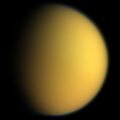 | ||||||||
|---|---|---|---|---|---|---|---|---|---|
| Lists | |||||||||
| Lakes and seas |
| ||||||||
| Features | |||||||||
| Exploration |
| ||||||||
| See also | |||||||||
| Other topics | |||||||||
| Past |
|   | |||||||
|---|---|---|---|---|---|---|---|---|---|
| Planned |
| ||||||||
| Proposed |
| ||||||||
| |||||||||
| Spacecraft |  | |
|---|---|---|
| Components examples | ||
| Work | ||
| Voyager team | ||
| Related | ||
| Observation Targets | ||
 |  |


