Astronomy:NGC 5466
| NGC 5466 | |
|---|---|
| File:275px NGC 5466 by Hubble Space Telescope; 3.5′ view | |
| Observation data (J2000 epoch) | |
| Class | XII[1] |
| Constellation | Boötes |
| Right ascension | 14h 05m 27.29s[2] |
| Declination | +28° 32′ 04.0″[2] |
| Distance | 52.2 ± 1.3 kly (16.0 ± 0.4 kpc)[3] |
| Apparent magnitude (V) | 9.2[4] |
| Apparent dimensions (V) | 9.0′[4] |
| Physical characteristics | |
| Absolute magnitude | −6.98[3] |
| Mass | 1.79×10⁵[5] M☉ |
| Tidal radius | 238.0 ly (72.98 pc)[3] |
| VHB | 16.47 |
| Metallicity | = –1.95±0.02[6] dex |
| Estimated age | 12.15±0.11 Gyr[6] |
| Notable features | Tidal stream |
| Other designations | NGC 5466, C 1403+287, GCl 27, GC 3776, h 1746, H 6[7] |
NGC 5466 is a globular cluster of stars in the constellation Boötes. It was discovered by German-British astronomer William Herschel on May 17, 1784, and catalogued as H VI.9.[8] This large, dim cluster has an apparent visual magnitude of 9.2 and spans an angular size of 9.0′.[4] It is relatively distant from the Sun,[3] about 52 thousand light-years (16.0 kpc) away,[3][9] and 53 thousand light-years (16.3 kpc) from the Galactic Center.[10]
Observations
The Shapley–Sawyer Concentration Class of NGC 5466 is XII.[1] This is a loose cluster with an unusually low central density compared to other globulars with similar luminosity.[11] It is located at a high galactic latitude and thus displays negligible reddening from interstellar dust.[11] The cluster has a core radius of 1.43′±0.10′ and a half-light radius of 2.3′±0.07′. The King tidal radius is 238.0 ly (72.98 pc).[3]
Observation of the distribution of stars in the cluster shows the impact of mass segregation, with heavier objects sinking toward the center. This is a dynamically young cluster that is just starting to evolve.[12] An isochrone fit to the cluster yields an age estimate of 12.15±0.11 billion years.[6] Other age estimates range from 12.2±0.9 to 13.57 Gyr, depending on the method.[9][13] It has an extremely low metallicity.[6]
In 2006, a long tidal stream was detected stretching from this cluster,[14] perhaps reaching as far as 45° to 60° across the sky.[15][16] It has a combined mass estimated as 4.0×10³ M☉.[3] The width dispersion of the stream is 1.31°±0.24°, corresponding to a physical width of 1,200 ± 220 ly (367 ± 67 pc) at the distance of the cluster.[3] The presence of a tidal tail suggests the cluster has been strongly disrupted due to gravitational interactions with the Milky Way galaxy.[11] At some point, this stream may have been tidally disrupted by the Large Magellanic Cloud.[16]
A total of 97 blue straggler stars have been identified in this cluster, which show a mild central peak in distribution.[17] In 2019, it was reported that a candidate hot white dwarf had been discovered orbiting a blue straggler star in the outskirts of NGC 5466. This was the second such pair discovered in a globular cluster.[18] Three short period eclipsing binaries have been found along with six SX Phoenicis variables.[19][20] This was the first globular where a blue straggler eclipsing variable was found.[12] The cluster is host to the brightest-known anomalous Cepheid variable, designated V19.[21][22]
Gallery
-
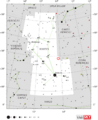 The location of NGC 5466 (circled in red)
 -
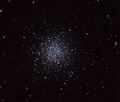 NGC 5466 imaged with a 32-inch telescope


See also
References
- ↑ 1.0 1.1 Shapley, Harlow; Sawyer, Helen B. (August 1927), "A Classification of Globular Clusters", Harvard College Observatory Bulletin 849 (849): 11–14, Bibcode: 1927BHarO.849...11S.
- ↑ 2.0 2.1 Goldsbury, Ryan et al. (December 2010), "The ACS Survey of Galactic Globular Clusters. X. New Determinations of Centers for 65 Clusters", The Astronomical Journal 140 (6): 1830–1837, doi:10.1088/0004-6256/140/6/1830, Bibcode: 2010AJ....140.1830G.
- ↑ 3.0 3.1 3.2 3.3 3.4 3.5 3.6 3.7 Jensen, Jaclyn et al. (October 2021), "Uncovering fossils of the distant Milky Way with UNIONS: NGC 5466 and its stellar stream", Monthly Notices of the Royal Astronomical Society 507 (2): 1923–1936, doi:10.1093/mnras/stab2325, Bibcode: 2021MNRAS.507.1923J.
- ↑ 4.0 4.1 4.2 Thompson, Robert Bruce; Thompson, Barbara (2007), Illustrated Guide to Astronomical Wonders: From Novice to Master Observer, DIY science, O'Reilly Media, Inc., p. 104, ISBN 9780596526856, https://books.google.com/books?id=ymt9nj_uPhwC&pg=PA104.
- ↑ Boyles, J. et al. (November 2011), "Young Radio Pulsars in Galactic Globular Clusters", The Astrophysical Journal 742 (1): 51, doi:10.1088/0004-637X/742/1/51, Bibcode: 2011ApJ...742...51B.
- ↑ 6.0 6.1 6.2 6.3 Gontcharov, G. A. et al. (June 2024), "Isochrone Fitting of Galactic Globular Clusters—VI. High-latitude Clusters NGC 5024 (M53), NGC 5053, NGC 5272 (M3), NGC 5466, and NGC 7099 (M30)", Research in Astronomy and Astrophysics 24 (6): id .065014, doi:10.1088/1674-4527/ad420f, Bibcode: 2024RAA....24f5014G.
- ↑ "NGC 5466". SIMBAD. Centre de données astronomiques de Strasbourg. http://simbad.u-strasbg.fr/simbad/sim-basic?Ident=NGC+5466.
- ↑ Steinicke, Wolfgang (2021), Wiliam Herschel: Discoverer of the Deep Sky, Books on Demand, p. 149, ISBN 9783754397374, https://books.google.com/books?id=8A5IEAAAQBAJ&pg=PA149.
- ↑ 9.0 9.1 Arellano Ferro, A. et al. (2008), "CCD photometry of the globular cluster NGC 5466. RR Lyrae light-curve decomposition and the distance scale", Monthly Notices of the Royal Astronomical Society 384 (4): 1444–1458, doi:10.1111/j.1365-2966.2007.12760.x, Bibcode: 2008MNRAS.384.1444A.
- ↑ Lux, H.; Read, J. I.; Lake, G.; Johnston, K. V. (July 2012), "NGC 5466: a unique probe of the Galactic halo shape", Monthly Notices of the Royal Astronomical Society: Letters 424 (1): L16–L20, doi:10.1111/j.1745-3933.2012.01276.x, Bibcode: 2012MNRAS.424L..16L.
- ↑ 11.0 11.1 11.2 Fekadu, Nassissie et al. (2007), "Photometry of the Globular Cluster NGC 5466: Red Giants and Blue Stragglers", The Astrophysical Journal 663 (1): 277–295, doi:10.1086/518637, Bibcode: 2007ApJ...663..277F.
- ↑ 12.0 12.1 Beccari, G. et al. (December 2015), "Deep Multi-telescope Photometry of NGC 5466. II. The Radial Behavior of the Mass Function Slope", The Astrophysical Journal 814 (2): id. 144, doi:10.1088/0004-637X/814/2/144, Bibcode: 2015ApJ...814..144B.
- ↑ Forbes, Duncan A.; Bridges, Terry (May 2010), "Accreted versus in situ Milky Way globular clusters", Monthly Notices of the Royal Astronomical Society 404 (3): 1203–1214, doi:10.1111/j.1365-2966.2010.16373.x, Bibcode: 2010MNRAS.404.1203F.
- ↑ Belokurov, V. et al. (2006), "The discovery of tidal tails around the globular cluster NGC 5466", The Astrophysical Journal 637 (1): L29–L32, doi:10.1086/500362, Bibcode: 2006ApJ...637L..29B.
- ↑ Grillmair, C. J.; Johnson, R. (2006), "The detection of a 45° tidal stream associated with the globular cluster NGC 5466", The Astrophysical Journal 639 (1): L17–L20, doi:10.1086/501439, Bibcode: 2006ApJ...639L..17G.
- ↑ 16.0 16.1 Yang, Yong et al. (June 2022), "Revisit NGC 5466 tidal stream with Gaia, SDSS/SEGUE, and LAMOST", Monthly Notices of the Royal Astronomical Society 513 (1): 853–863, doi:10.1093/mnras/stac860, Bibcode: 2022MNRAS.513..853Y.
- ↑ Beccari, G. et al. (October 2013), "Deep Multi-telescope Photometry of NGC 5466. I. Blue Stragglers and Binary Systems", The Astrophysical Journal 776 (1): id. 60, doi:10.1088/0004-637X/776/1/60, Bibcode: 2013ApJ...776...60B.
- ↑ Sahu, Snehalata et al. (May 2019), "Detection of a White Dwarf Companion to a Blue Straggler Star in the Outskirts of Globular Cluster NGC 5466 with the Ultraviolet Imaging Telescope (UVIT)", The Astrophysical Journal 876 (1): id. 34, doi:10.3847/1538-4357/ab11d0, Bibcode: 2019ApJ...876...34S.
- ↑ Mateo, Mario et al. (1990), "Blue stragglers as remnants of stellar mergers: the discovery of short-period eclipsing binaries in globular cluster NGC 5466", The Astrophysical Journal 100: 469–484, doi:10.1086/115530, Bibcode: 1990AJ....100..469M.
- ↑ Jeon, Young-Beom et al. (2004), "SX Phoenicis stars in the globular cluster NGC 5466", The Astronomical Journal 128 (1): 287–299, doi:10.1086/421735, Bibcode: 2004AJ....128..287J.
- ↑ McCarthy, James K.; Nemec, James M. (1997), "The chemical composition and period change rate of the anomalous cepheid V19 in NGC 5466", The Astrophysical Journal 482 (1): 203–229, doi:10.1086/304118, Bibcode: 1997ApJ...482..203M.
- ↑ Zinn, R.; King, C. R. (1982), "The mass of the anomalous Cepheid in the globular cluster NGC 5466", The Astrophysical Journal 262: 700–708, doi:10.1086/160462, Bibcode: 1982ApJ...262..700Z.
Further reading
- Rojas López, V. et al. (2006), Infante, L.; Rubio, M., eds., "Physical parameters of RR Lyrae stars in the globular cluster NGC 5466: The Oosterhoff dichotomy", XI IAU Regional Latin American Meeting of Astronomy, Revista Mexicana de Astronomía y Astrofísica (Serie de Conferencias) 26: p. 49, Bibcode: 2006RMxAC..26...49R.
- Buonanno, R. et al. (1985), "The giant, asymptotic and horizontal branches of globular clusters. II. Photographic of the metal-poor clusters M 15, M 92 and NGC 5466", Astronomy & Astrophysics 145: 97–117, Bibcode: 1985A&A...145...97B.
- R., Buonanno et al. (1984), "Positions, magnitudes and colors for stars in the globular cluster NGC 5466", Astronomy & Astrophysics 56: 79–86, Bibcode: 1984A&AS...56...79B.
- Brosche, P.; Geffert, M. (1983), "Membership of above horizontal branch stars in the globular cluster NGC 5466", Astronomy & Astrophysics 127: 415–416, Bibcode: 1983A&A...127..415B.
External links
- NGC 5466 on WikiSky: DSS2, SDSS, GALEX, IRAS, Hydrogen α, X-Ray, Astrophoto, Sky Map, Articles and images
- VizieR, NGC 5466
- SEDS, NGC 5466
- Aladin, Image NGC 5466
Template:NGC objects:5000-5499
Coordinates:  14h 05m 27.36s, +28° 32′ 04.2″
 |  |


