Astronomy:HD 126009
From HandWiki
Short description: Star in the constellation Boötes
250px The visual band light curve of HD 126009, plotted from data presented by Tabur et al. (2009)[1] | |
| Observation data Equinox J2000.0]] (ICRS) | |
|---|---|
| Constellation | Boötes |
| Right ascension | 14h 22m 14.00070s[2] |
| Declination | +29° 22′ 11.7179″[2] |
| Apparent magnitude (V) | 6.47 – 6.81[3] |
| Characteristics | |
| Spectral type | M3III[4] |
| U−B color index | +1.46[5] |
| B−V color index | +1.60[5] |
| Variable type | Irregular[6] |
| Astrometry | |
| Radial velocity (Rv) | −19.66±0.54[7] km/s |
| Proper motion (μ) | RA: −39.980[2] mas/yr Dec.: −26.201[2] mas/yr |
| Parallax (π) | 4.5229 ± 0.0973[2] mas |
| Distance | 720 ± 20 ly (221 ± 5 pc) |
| Absolute magnitude (MV) | −0.268[8] |
| Details | |
| Mass | 1.8[2] M☉ |
| Radius | 71[2] R☉ |
| Luminosity | 943[2] L☉ |
| Temperature | 3,227[9] K |
| Age | 1.6[2] Gyr |
| Other designations | |
CI Boötes, BD+30°2513, HD126009, HIP 70236, SAO 83312. | |
| Database references | |
| SIMBAD | data |
HD 126009 or CI Boötis is a variable star[4] in the northern constellation of Boötes. With an apparent magnitude of about 6.5, it would be difficult to see with the naked eye even under the very best observing conditions, but can easily be seen with binoculars.
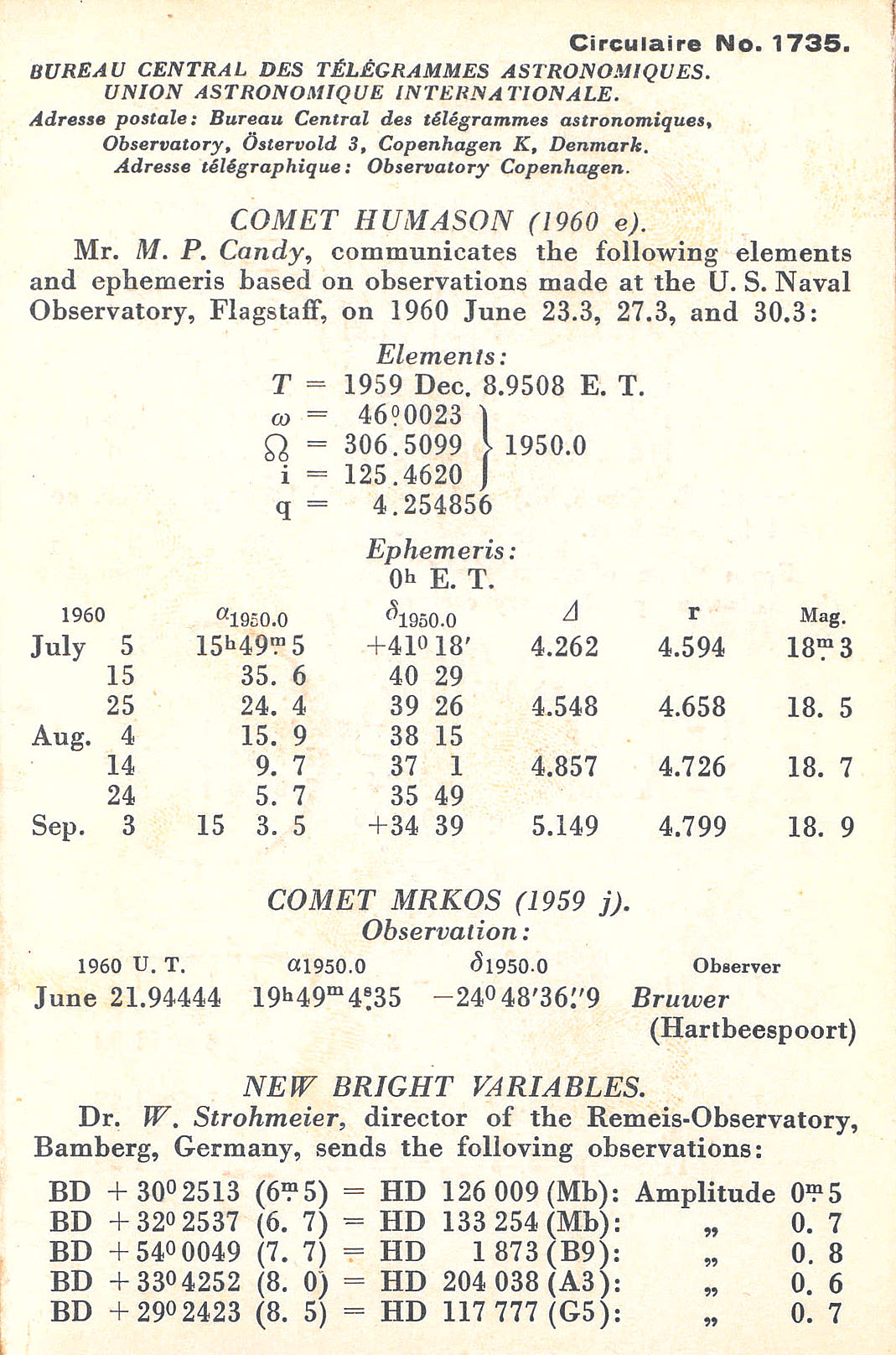
The German astronomer Wolfgang Strohmeier announced that HD 126009 is a variable star in 1960.[10] It was given its variable star designation, CI Boötis, in 1978.[11]
References
- ↑ Tabur, V.; Bedding, T. R.; Kiss, L. L.; Moon, T. T.; Szeidl, B.; Kjeldsen, H. (December 2009). "Long-term photometry and periods for 261 nearby pulsating M giants". Monthly Notices of the Royal Astronomical Society 400 (4): 1945–1961. doi:10.1111/j.1365-2966.2009.15588.x. Bibcode: 2009MNRAS.400.1945T.
- ↑ 2.0 2.1 2.2 2.3 2.4 2.5 2.6 2.7 2.8 Vallenari, A. et al. (2022). "Gaia Data Release 3. Summary of the content and survey properties". Astronomy & Astrophysics. doi:10.1051/0004-6361/202243940 Gaia DR3 record for this source at VizieR.
- ↑ "CI Boo". AAVSO. https://vsx.aavso.org/index.php?view=detail.top&oid=4413.
- ↑ 4.0 4.1 Tabur, V. (2009), "Long-term photometry and periods for 261 nearby pulsating M giants", Monthly Notices of the Royal Astronomical Society 400 (4): 1945–61, doi:10.1111/j.1365-2966.2009.15588.x, Bibcode: 2009MNRAS.400.1945T
- ↑ 5.0 5.1 Mermilliod, J.-C. (1986), "Compilation of Eggen's UBV data, transformed to UBV (unpublished)", Catalogue of Eggen's UBV Data. SIMBAD, Bibcode: 1986EgUBV........0M
- ↑ Mennessier, M. O. et al. (August 2001), "Long period variable stars: galactic populations and infrared luminosity calibrations", Astronomy and Astrophysics 374 (3): 968–979, doi:10.1051/0004-6361:20010764, Bibcode: 2001A&A...374..968M.
- ↑ Famaey, B. et al. (2009). "Spectroscopic binaries among Hipparcos M giants,. I. Data, orbits, and intrinsic variations". Astronomy and Astrophysics 498 (2): 627–640. doi:10.1051/0004-6361/200810698. Bibcode: 2009A&A...498..627F.
- ↑ Gontcharov, G. A. (2017). "VizieR Online Data Catalog: Tycho-2 red giant branch and carbon stars (Gontcharov, 2011)". VizieR On-line Data Catalog. Bibcode: 2017yCat..90370769G.
- ↑ Soubiran, Caroline; Le Campion, Jean-François; Brouillet, Nathalie; Chemin, Laurent (2016). "The PASTEL catalogue: 2016 version". Astronomy & Astrophysics 591: A118. doi:10.1051/0004-6361/201628497. Bibcode: 2016A&A...591A.118S.
- ↑ Strohmeier, W. (1960). "New Bright Variables". IAU Circular 1735. http://www.cbat.eps.harvard.edu/IAUCs/IAUC1735a.jpg. Retrieved 5 December 2024.
- ↑ Kholopov, P. N.; Kukarkina, N. P.; Perova, N. B. (April 1978). "63rd Name-List of Variable Stars". Information Bulletin on Variable Stars 1414: 1–10. Bibcode: 1978IBVS.1414....1K. https://ibvs.konkoly.hu/pub/ibvs/1401/1414.pdf. Retrieved 5 December 2024.
External links
 |  |