Astronomy:Mu1 Boötis


Mu1 Boötis is a binary star in the northern constellation of Boötes. Its name is a Bayer designation that is Latinized from μ1 Boötis, and abbreviated Mu1 Boo or μ1 Boo. This system had the traditional name Alkalurops, pronounced /ælkəˈljʊərɒps/.[8] Based on parallax measurements, the system is located at a distance of 123 light-years.
The components of the system have an angular separation of 0.10″.[9] They form a spectroscopic binary system with an orbital period of 3.75 years.[3] The visible component is a yellow-white F-type subgiant with an apparent magnitude of +4.31.
The system μ2 Boötis, separated by 109", makes an optical double with μ1, and even has a similar distance from Earth and comparable proper motions, but has a substantially different metallicity, and therefore is not a gravitationally bound companion.[3]
Nomenclature
μ1 Boötis (Latinised to Mu1 Boötis) is the star's Bayer designation.
The system's traditional name Alkalurops is from the Greek καλαύροψ kalaurops "a herdsman's crook or staff", with the Arabic prefix attached.[10] It has also been known as Inkalunis (from the Alfonsine tables), Clava (Latin 'the club') and Venabulum (Latin 'a hunting spear').[11] In 2016, the International Astronomical Union organized a Working Group on Star Names (WGSN)[12] to catalogue and standardize proper names for stars. The WGSN approved the name Alkalurops for μ1 Boötis on 21 August 2016 and it is now so entered in the IAU Catalog of Star Names.[8]
It is known as 七公六, Qī Gōng liù (the Sixth Star of the Seven Excellencies) in Chinese.[13]
Gallery
-
 Mu Bootis (Alkalurops) as seen in a small telescope
 -
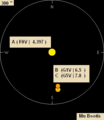 Illustration of Mu1,2 Boötis


References
- ↑ 1.0 1.1 1.2 1.3 1.4 Vallenari, A. et al. (2022). "Gaia Data Release 3. Summary of the content and survey properties". Astronomy & Astrophysics. doi:10.1051/0004-6361/202243940 Gaia DR3 record for this source at VizieR.
- ↑ 2.0 2.1 Malagnini, M. L.; Morossi, C. (November 1990), "Accurate absolute luminosities, effective temperatures, radii, masses and surface gravities for a selected sample of field stars", Astronomy and Astrophysics Supplement Series 85 (3): 1015–1019, Bibcode: 1990A&AS...85.1015M.
- ↑ 3.00 3.01 3.02 3.03 3.04 3.05 3.06 3.07 3.08 3.09 3.10 3.11 Kiyaeva, O. V. et al. (November 2014), "The multiple system ADS 9626: A quadruple star or an encounter of two binaries?", Astronomy Reports 58 (11): 835–848, doi:10.1134/S106377291411002X, Bibcode: 2014ARep...58..835K.
- ↑ 4.0 4.1 Johnson, H. L. et al. (1966), "UBVRIJKL photometry of the bright stars", Communications of the Lunar and Planetary Laboratory 4 (99): 99, Bibcode: 1966CoLPL...4...99J.
- ↑ Gontcharov, G. A. (November 2006), "Pulkovo Compilation of Radial Velocities for 35495 Hipparcos stars in a common system", Astronomy Letters 32 (11): 759–771, doi:10.1134/S1063773706110065, Bibcode: 2006AstL...32..759G.
- ↑ Anderson, E.; Francis, Ch. (2012), "XHIP: An extended hipparcos compilation", Astronomy Letters 38 (5): 331, doi:10.1134/S1063773712050015, Bibcode: 2012AstL...38..331A.
- ↑ Zorec, J.; Royer, F. (January 2012), "Rotational velocities of A-type stars. IV. Evolution of rotational velocities", Astronomy & Astrophysics 537: A120, doi:10.1051/0004-6361/201117691, Bibcode: 2012A&A...537A.120Z.
- ↑ 8.0 8.1 Mamajek, Eric (June 30, 2017), IAU Catalog of Star Names, IAU Division C Working Group on Star Names, http://www.pas.rochester.edu/~emamajek/WGSN/IAU-CSN.txt, retrieved 28 July 2016.
- ↑ Cite error: Invalid
<ref>tag; no text was provided for refs namedMason_et_al_2001 - ↑ Cite error: Invalid
<ref>tag; no text was provided for refs namedallen1963 - ↑ Cite error: Invalid
<ref>tag; no text was provided for refs namedallen1963-2 - ↑ IAU Working Group on Star Names (WGSN), International Astronomical Union, https://www.iau.org/science/scientific_bodies/working_groups/280/, retrieved 22 May 2016.
- ↑ Script error: The function "in_lang" does not exist. AEEA (Activities of Exhibition and Education in Astronomy) 天文教育資訊網 2006 年 6 月 26 日
External links
 |  |


