Astronomy:NGC 3675
| NGC 3675 | |
|---|---|
 NGC 3675 in Schulman telescope | |
| Observation data (J2000 epoch) | |
| Constellation | Ursa Major |
| Right ascension | 11h 26m 08.5689s[1] |
| Declination | +43° 35′ 09.696″[1] |
| Redshift | 0.002568[1] |
| Helio radial velocity | 770 ± 1 km/s[1] |
| Distance | 53 ± 10 Mly (16.2 ± 3.0 Mpc)[1] |
| Apparent magnitude (V) | 10.0 |
| Characteristics | |
| Type | SA(s)b [1] |
| Size | ~105,700 ly (32.41 kpc) (estimated)[1] |
| Apparent size (V) | 5.9′ × 3.1′[1] |
| Other designations | |
| IRAS 11234+4351, UGC 6439, MCG+07-24-004, PGC 35164[1] | |
NGC 3675 is a spiral galaxy located in the constellation Ursa Major. It is located at a distance of about 50 million light years from Earth, which, given its apparent dimensions, means that NGC 3675 is about 100,000 light years across. It was discovered by German-British astronomer William Herschel on 14 January 1788.[2] NGC 3675 belongs to the Ursa Major Cluster, part of the Virgo Supercluster.[3]
It hosts a low-ionization nuclear emission-line region (LINER).[4] In the nucleus there is a supermassive black hole with an estimated mass of 10-39 million M☉, based on the intrinsic velocity dispersion as measured by the Hubble Space Telescope.[5] Although the galaxy was reported to have a strong bar visible in infrared images, there has been no indication of a bar in further observations.[6] Its spiral disk is of type III and there is a dust structure which is more prominent to the east.[7] The galaxy features two ring structures, with diameter 1.62 and 2.42 arcminutes.[8] The spiral arms are tightly wound and form an inner pseudoring and they continue for one revolution outside the ring. The outer arms are very patchy and filamentary.[9]
One supernova has been observed in NGC 3675: SN 1984R (type unknown, mag. 13) was discovered by Kaoru Ikeya on 2 December 1984.[10][11]
Gallery
-
 NGC 3675 (SDSS DR14)
 -
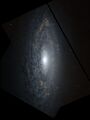 NGC 3675 (HST)


See also
References
- ↑ 1.0 1.1 1.2 1.3 1.4 1.5 1.6 1.7 1.8 "NASA/IPAC Extragalactic Database". Results for object NGC 3675. https://ned.ipac.caltech.edu/byname?objname=ngc+3675.
- ↑ Seligman, Courtney. "New General Catalogue Objects: NGC 3675". https://cseligman.com/text/atlas/ngc36a.htm#3675.
- ↑ "The Ursa Major Groups". http://www.atlasoftheuniverse.com/galgrps/uma.html.
- ↑ McKernan, B.; Ford, K. E. S.; Reynolds, C. S. (20 July 2010). "Black hole mass, host galaxy classification and AGN activity". Monthly Notices of the Royal Astronomical Society 407 (4): 2399–2410. doi:10.1111/j.1365-2966.2010.17068.x. Bibcode: 2010MNRAS.407.2399M.
- ↑ Beifiori, A.; Sarzi, M.; Corsini, E. M.; Bontà, E. Dalla; Pizzella, A.; Coccato, L.; Bertola, F. (10 February 2009). "Upper Limits on the Masses of 105 Supermassive Black Holes from Hubble Space Telescope/Space Telescope Imaging Spectrograph Archival Data". The Astrophysical Journal 692 (1): 856–868. doi:10.1088/0004-637X/692/1/856. Bibcode: 2009ApJ...692..856B.
- ↑ Möllenhoff, C.; Heidt, J. (15 March 2001). "Surface photometry of spiral galaxies in NIR:Structural parameters of disks and bulges". Astronomy & Astrophysics 368 (1): 16–37. doi:10.1051/0004-6361:20000335. Bibcode: 2001A&A...368...16M. https://www.aanda.org/articles/aa/full/2001/10/aa10227/aa10227.html.
- ↑ Gutiérrez, Leonel; Erwin, Peter; Aladro, Rebeca; Beckman, John E. (1 November 2011). "The Outer Disks of Early-type Galaxies. II. Surface-brightness Profiles of Unbarred Galaxies and Trends with Hubble Type". The Astronomical Journal 142 (5): 145. doi:10.1088/0004-6256/142/5/145. Bibcode: 2011AJ....142..145G.
- ↑ Comerón, S.; Salo, H.; Laurikainen, E.; Knapen, J. H.; Buta, R. J.; Herrera-Endoqui, M.; Laine, J.; Holwerda, B. W. et al. (19 February 2014). "ARRAKIS: atlas of resonance rings as known in the S4G". Astronomy & Astrophysics 562: A121. doi:10.1051/0004-6361/201321633. Bibcode: 2014A&A...562A.121C.
- ↑ Eskridge, Paul B.; Frogel, Jay A.; Pogge, Richard W.; Quillen, Alice C.; Berlind, Andreas A.; Davies, Roger L.; DePoy, D. L.; Gilbert, Karoline M. et al. (November 2002). "Near-Infrared and Optical Morphology of Spiral Galaxies". The Astrophysical Journal Supplement Series 143 (1): 73–111. doi:10.1086/342340. Bibcode: 2002ApJS..143...73E.
- ↑ Kosai, H.; Ikeya, K.; Shibasaki, H. (1984). "Possible Supernova in NGC 3675". International Astronomical Union Circular (4021): 1. Bibcode: 1984IAUC.4021....1K.
- ↑ "SN 1984R". IAU. https://www.wis-tns.org/object/1984R.
External links
- NGC 3675 on WikiSky: DSS2, SDSS, GALEX, IRAS, Hydrogen α, X-Ray, Astrophoto, Sky Map, Articles and images
 |  |


