Astronomy:NGC 3783
| NGC 3783 | |
|---|---|
| File:The eponymous NGC 3783 (potw2416a).jpg NGC 3783 imaged by the Hubble Space Telescope | |
| Observation data (J2000 epoch) | |
| Constellation | Centaurus |
| Right ascension | 11h 39m 01.721s[1] |
| Declination | –37° 44′ 18.60″[1] |
| Redshift | 0.008506 ± 0.000100[2] |
| Helio radial velocity | +2,817[3] km/s |
| Distance | 135.7 Mly (41.60[4] Mpc) |
| Group or cluster | NGC 3783 group |
| Apparent magnitude (V) | 13.43 |
| Characteristics | |
| Type | SBa[5] |
| Size | ~212,800 ly (65.25 kpc) (estimated)[6] |
| Apparent size (V) | 1′.9 × 1′.7[5] |
| Notable features | Seyfert 1 |
| Other designations | |
| ESO 378- G 014, IRAS 11365-3727, MCG-06-26-004, PGC 36101[7] | |
NGC 3783 is a barred spiral galaxy located about 135[4] million light years away in the constellation Centaurus.[8] Its velocity with respect to the cosmic microwave background is 3234 ± 22 km/s, which corresponds to a Hubble distance of 155.6 ± 10.9 Mly (47.70 ± 3.35 Mpc).[6] In addition, two non-redshift measurements give a distance of 155.74 ± 30.17 Mly (47.750 ± 9.250 Mpc).[9] It was discovered by British astronomer John Herschel on 21 April 1835.[10]
NGC 3783 is inclined by an angle of 23° to the line of sight from the Earth along a position angle of about 163°. The morphological classification of SBa[5] indicates a bar structure across the center (B) and tightly-wound spiral arms (a).[11] Although not shown by this classification, observers note the galaxy has a luminous inner ring surrounding the bar structure. The bright compact nucleus is active and categorized as a Seyfert 1 type. This nucleus is a strong source of X-ray emission and undergoes variations in emission across the electromagnetic spectrum.[5]

The source of the activity in this galaxy is a rapidly rotating supermassive black hole, which is located at the core and is surrounded by an accretion disk of dust.[12] The estimated mass of this black hole, from reverberation mapping, is about 2.8 million times the mass of the Sun.[13] Interferometric observations yield an inner radius of 0.52 ± 0.16 ly (0.16 ± 0.05 pc) for the orbiting torus of dust.[14]
This is a member of a loose association of 47 galaxies known as the NGC 3783 group. Located at a mean distance of 117 million light-years (36 Mpc), the group is centered at coordinates α = 11h 37m 12s, δ = –37° 30′ 57.6″: equivalent to about 870×103 ly (267 kpc) from NGC 3783. The NGC 3783 group has a mean velocity of 2,903 ± 26 km/s with respect to the Sun and a velocity dispersion of 190 ± 24 km/s. The diffuse X-ray emission of the group is roughly centered on the galaxy NGC 3783.[15] The NGC 3783 group is located in the Hydra-Antlia region of the Hydra-Centaurus Supercluster.[16][17]
Gallery
-
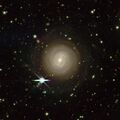 NGC 3783 as seen by the legacy surveys. The bright star on the lower left is HD 101274
 -
This video shows an artist's impression of the dusty wind emanating from the black hole at the centre of galaxy NGC 3783

References
- ↑ 1.0 1.1 Skrutskie, Michael F. et al. (February 1, 2006), "The Two Micron All Sky Survey (2MASS)", The Astronomical Journal 131 (2): 1163–1183, doi:10.1086/498708, ISSN 0004-6256, Bibcode: 2006AJ....131.1163S.
- ↑ Strauss, Michael A. et al. (November 1992), "A redshift survey of IRAS galaxies. VII - The infrared and redshift data for the 1.936 Jansky sample", Astrophysical Journal Supplement Series 83 (1): 29–63, doi:10.1086/191730, Bibcode: 1992ApJS...83...29S.
- ↑ Jones, D. Heath et al. (October 2009), "The 6dF Galaxy Survey: final redshift release (DR3) and southern large-scale structures", Monthly Notices of the Royal Astronomical Society 399 (2): 683–698, doi:10.1111/j.1365-2966.2009.15338.x, Bibcode: 2009MNRAS.399..683J.
- ↑ 4.0 4.1 Pereira-Santaella, Miguel et al. (December 2010), "The Mid-infrared High-ionization Lines from Active Galactic Nuclei and Star-forming Galaxies", The Astrophysical Journal 725 (2): 2270–2280, doi:10.1088/0004-637X/725/2/2270, Bibcode: 2010ApJ...725.2270P.
- ↑ 5.0 5.1 5.2 5.3 García-Barreto, J. A. et al. (August 1999), "HI spatial distribution in the galaxy NGC 3783", Astronomy and Astrophysics 348: 685–692, Bibcode: 1999A&A...348..685G.
- ↑ 6.0 6.1 "Results for object NGC 3783". NASA and Caltech. https://ned.ipac.caltech.edu/byname?objname=NGC+3783.
- ↑ "NGC 3783". SIMBAD. Centre de données astronomiques de Strasbourg. http://simbad.u-strasbg.fr/simbad/sim-basic?Ident=NGC+3783.
- ↑ "The active galaxy NGC 3783 in the constellation of Centaurus", European Southern Observatory, June 20, 2013, http://www.eso.org/public/images/eso1327c/, retrieved 2013-06-29.
- ↑ "Distance Results for NGC 3783". NASA. https://ned.ipac.caltech.edu/cgi-bin/nDistance?name=NGC+3783.
- ↑ Seligman, Courtney. "New General Catalogue Objects: NGC 3783". https://cseligman.com/text/atlas/ngc37a.htm#3783.
- ↑ Buta, Ronald J. et al. (2007), Atlas of Galaxies, Cambridge University Press, pp. 13–17, ISBN 978-0521820486, https://books.google.com/books?id=g-P7dCbB5MEC&pg=PA16.
- ↑ Brenneman, L. W. et al. (August 2011), "The Spin of the Supermassive Black Hole in NGC 3783", The Astrophysical Journal 736 (2): 103, doi:10.1088/0004-637X/736/2/103, Bibcode: 2011ApJ...736..103B.
- ↑ Bentz, Misty C. et al. (2021), "A Detailed View of the Broad-line Region in NGC 3783 from Velocity-resolved Reverberation Mapping", The Astrophysical Journal 920 (2): 112, doi:10.3847/1538-4357/ac19af, Bibcode: 2021ApJ...920..112B.
- ↑ Weigelt, G. et al. (May 2012), "VLTI/AMBER observations of the Seyfert nucleus of NGC 3783", Astronomy & Astrophysics 541: L9, doi:10.1051/0004-6361/201219213, Bibcode: 2012A&A...541L...9W.
- ↑ Kilborn, Virginia A. et al. (September 2006), "Gaseous tidal debris found in the NGC 3783 group", Monthly Notices of the Royal Astronomical Society 371 (2): 739–749, doi:10.1111/j.1365-2966.2006.10697.x, Bibcode: 2006MNRAS.371..739K.
- ↑ Tully, R. Brent (1988). Nearby galaxies catalog. Cambridge; New York: Cambridge University Press. ISBN 978-0-521-35299-4.
- ↑ Fouque, P.; Gourgoulhon, E.; Chamaraux, P.; Paturel, G. (1992-05-01). "Groups of galaxies within 80 Mpc. II. The catalogue of groups and group members.". Astronomy and Astrophysics Supplement Series 93: 211–233. ISSN 0365-0138. Bibcode: 1992A&AS...93..211F. https://ui.adsabs.harvard.edu/abs/1992A&AS...93..211F.
External links
- Roy, Steve et al. (May 25, 2000), "Chandra Clocks Million Mile Per Hour Wind Expanding From Vicinity of Giant Black Hole", Chandra Press Room: pp. 13, Bibcode: 2000cxo..pres...13., http://chandra.si.edu/press/00_releases/press_052500.html, retrieved June 29, 2013
- Hönig, Sebastian et al. (June 20, 2013), "Dusty Surprise Around Giant Black Hole", European Southern Observatory, http://www.eso.org/public/news/eso1327/, retrieved June 29, 2013
Coordinates:  11h 39m 01.721s, −-37° 44′ 18.60″
 |  |


.jpg)