Astronomy:NGC 5905
| NGC 5905 | |
|---|---|
 NGC 5905 imaged by SDSS | |
| Observation data (J2000 epoch) | |
| Constellation | Draco |
| Right ascension | 15h 15m 23.3243s[1] |
| Declination | +55° 31′ 01.995″[1] |
| Redshift | 0.011308±0.0000170[1] |
| Helio radial velocity | 3,390±5 km/s[1] |
| Distance | 119.16 ± 8.34 Mly (36.536 ± 2.556 Mpc)[1] |
| Group or cluster | NGC 5908 group (LGG 395) |
| Apparent magnitude (V) | 12.49[1] |
| Characteristics | |
| Type | SB(r)b[1] |
| Size | ~162,900 ly (49.95 kpc) (estimated)[1] |
| Apparent size (V) | 4.0′ × 2.6′[1] |
| Other designations | |
| IRAS 15140+5541, UGC 9797, MCG+09-25-038, PGC 54445[1] | |
NGC 5905 is a barred spiral galaxy in the constellation of Draco. Its velocity with respect to the cosmic microwave background is 3,454±7 km/s, which corresponds to a Hubble distance of 166.2 ± 11.6 Mly (50.95 ± 3.57 Mpc).[1] However, 14 non-redshift measurements give a much closer mean distance of 119.16 ± 8.34 Mly (36.536 ± 2.556 Mpc).[2] It was discovered by German-British astronomer William Herschel on 5 May 1788.[3][4]
NGC 5905 has an active galactic nucleus, i.e. it has a compact region at the center of a galaxy that emits a significant amount of energy across the electromagnetic spectrum, with characteristics indicating that this luminosity is not produced by the stars.[5][6]
NGC 5905 is also a Seyfert I galaxy, i.e. it has a quasar-like nucleus with very high surface brightnesses whose spectra reveal strong, high-ionisation emission lines, but unlike quasars, the host galaxy is clearly detectable.[1]
NGC 5908 group
According to A.M. Garcia, NGC 5905 is part of the NGC 5908 group (also known as LGG 395) which has at least seven members, including NGC 5820, NGC 5821, NGC 5874, NGC 5876, NGC 5908, and UGC 9759.[7][8]
Supernova
One supernova has been observed in NGC 5905:
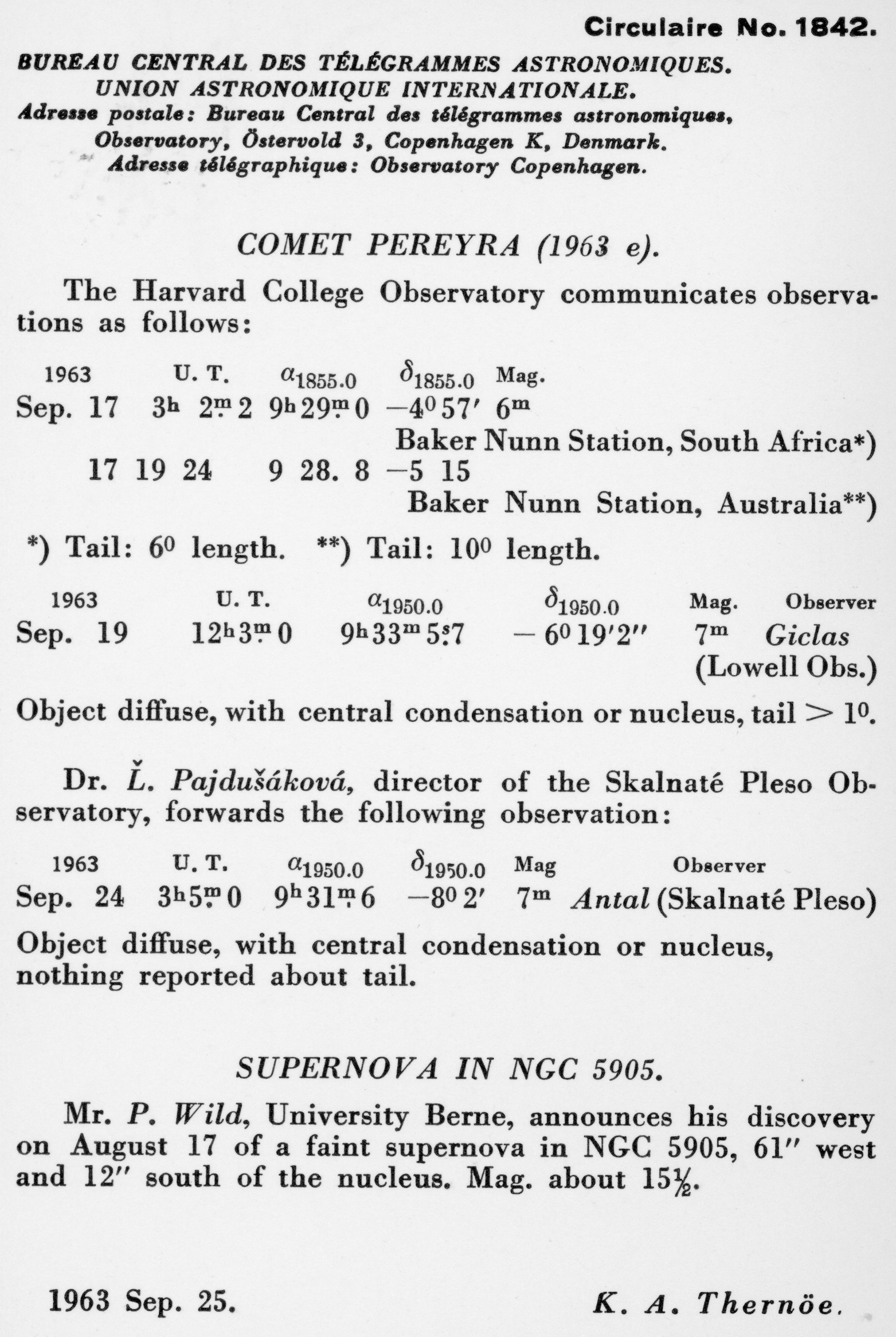
- SN 1963O (type unknown, mag. 16) was discovered by Swiss astronomer Paul Wild on 17 August 1963.[9][10]
See also
References
- ↑ 1.00 1.01 1.02 1.03 1.04 1.05 1.06 1.07 1.08 1.09 1.10 1.11 "Results for object NGC 5905". NASA and Caltech. https://ned.ipac.caltech.edu/byname?objname=NGC+5905.
- ↑ "Distance Results for NGC 5905". NASA. https://ned.ipac.caltech.edu/cgi-bin/nDistance?name=NGC+5905.
- ↑ Herschel, William (1789). "Catalogue of a Second Thousand of New Nebulae and Clusters of Stars; with a Few Introductory Remarks on the Construction of the Heavens". Philosophical Transactions of the Royal Society of London 79: 212–255. doi:10.1098/rstl.1789.0021. Bibcode: 1789RSPT...79..212H.
- ↑ Seligman, Courtney. "New General Catalogue Objects: NGC 5905". https://cseligman.com/text/atlas/ngc59.htm#5905.
- ↑ Véron-Cetty, M.-P.; Véron, P. (2010). "A catalogue of quasars and active nuclei: 13th edition". Astronomy and Astrophysics 518: A10. doi:10.1051/0004-6361/201014188. Bibcode: 2010A&A...518A..10V.
- ↑ "NGC 5905". SIMBAD. Centre de données astronomiques de Strasbourg. http://simbad.u-strasbg.fr/simbad/sim-basic?Ident=NGC+5905.
- ↑ Garcia, A. M. (1993). "General study of group membership. II. Determination of nearby groups". Astronomy and Astrophysics Supplement Series 100: 47. Bibcode: 1993A&AS..100...47G.
- ↑ "LGG 395". SIMBAD. Centre de données astronomiques de Strasbourg. http://simbad.u-strasbg.fr/simbad/sim-basic?Ident=LGG+395.
- ↑ Wild, Paul (25 September 1963). "SUPERNOVA IN NGC 5905". Central Bureau for Astronomical Telegrams (IAU) (1842): 1. http://www.cbat.eps.harvard.edu/IAUCs/IAUC1842.jpg. Retrieved 11 December 2025.
- ↑ "SN 1963O". IAU. https://www.wis-tns.org/object/1963O.
External links
- NGC 5905 on WikiSky: DSS2, SDSS, GALEX, IRAS, Hydrogen α, X-Ray, Astrophoto, Sky Map, Articles and images
Coordinates:  15h 15m 23.3243s, +55° 31′ 01.995″
 |  |