Astronomy:NGC 3938
| NGC 3938 | |
|---|---|
 NGC 3938 imaged by Mount Lemmon SkyCenter of the University of Arizona | |
| Observation data (J2000 epoch) | |
| Constellation | Ursa Major[1] |
| Right ascension | 11h 52m 49.4319s[2][1] |
| Declination | +44° 07′ 14.840″[2] |
| Redshift | 0.002695[2] |
| Helio radial velocity | 808±2 km/s[2] |
| Distance | 41.40 ± 9.00 Mly (12.694 ± 2.760 Mpc)[2] |
| Apparent magnitude (V) | 10.9[1] |
| Characteristics | |
| Type | SA(s)c[2] |
| Size | ~76,400 ly (23.42 kpc) (estimated)[2] |
| Apparent size (V) | 5.4′ × 4.9′[1] |
| Other designations | |
| IRAS 11502+4423, UGC 6856, MCG+07-25-001, PGC 37229[2] | |
NGC 3938 is an unbarred spiral galaxy in the Ursa Major constellation. It was discovered by German-British astronomer William Herschel on 6 February 1788.[3] It is one of the brightest spiral galaxies in the Ursa Major South galaxy group and is roughly 76,000 light years in diameter.[2][4] It is approximately 41.4 million light years away from Earth.[1] NGC 3938 is classified as type Sc under the Hubble sequence, a loosely wound spiral galaxy with a smaller and dimmer bulge.[5] The spiral arms of the galaxy contain many areas of ionized atomic hydrogen gas, more so towards the center.[6]
NGC 3938 is a member of the NGC 4111 Group,[7] which is part of the Ursa Major Cloud and is the second largest group in the cloud after the NGC 3992 Group.[8][9][10]
Supernovae and Luminous Red Nova

Five supernovae have been identified within NGC 3938:
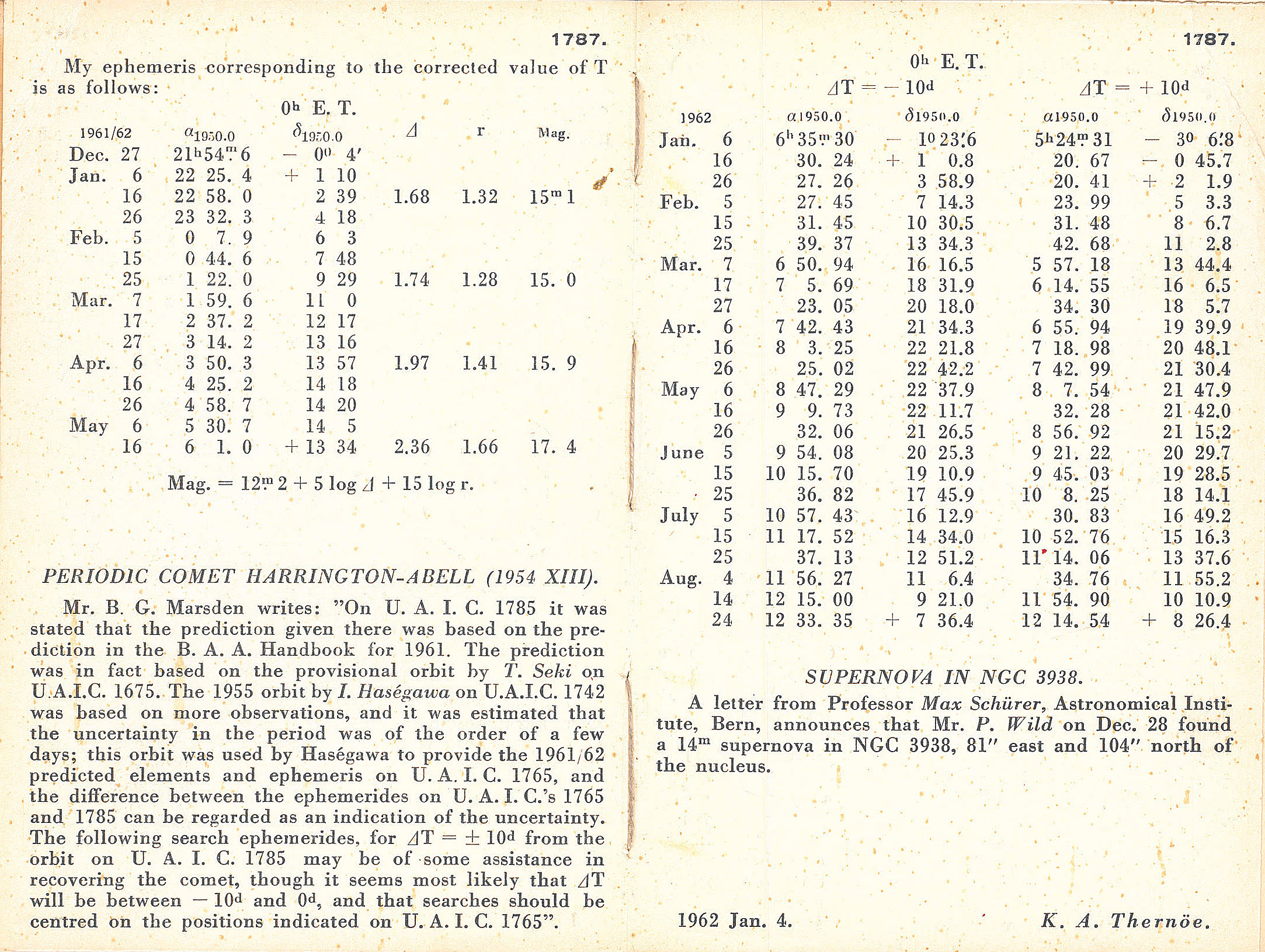
- SN 1961U (Type II, mag. 13.7) was discovered by Paul Wild on 28 December 1961.[11][12][lower-alpha 1]
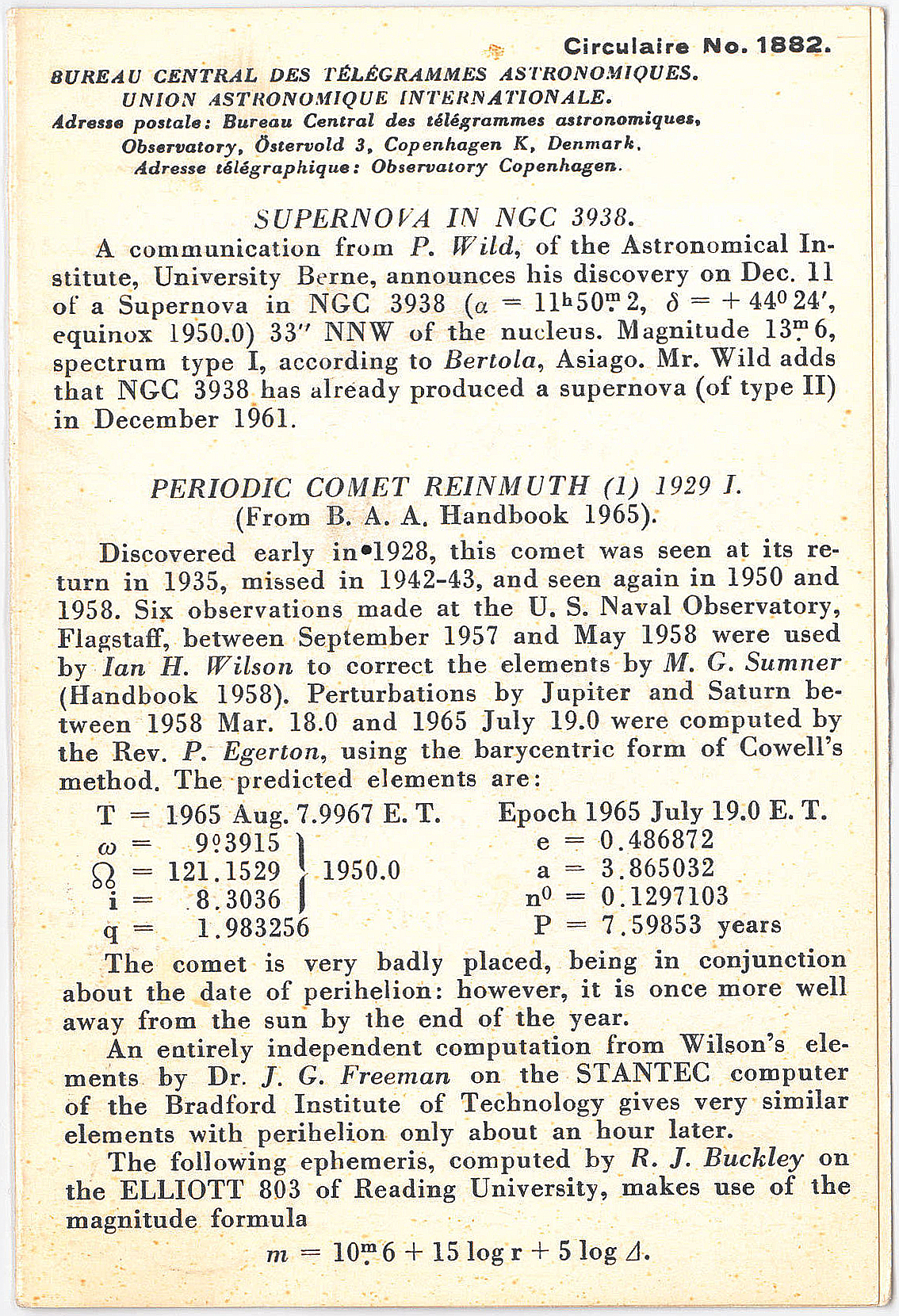
- SN 1964L (Type Ic, mag. 13.3) was discovered by Paul Wild on 11 December 1964.[13][14]
- SN 2005ay (Type II, mag. 15.6) was discovered by Doug Rich on 27 March 2005.[15][16][17]
- SN 2017ein (Type Ic, mag. 17.6) was discovered by Ron Arbour on 25 May 2017 and peaked at magnitude 14.9.[18][19] Images taken before the explosion point to a progenitor mass between ~47-48M☉, if it was in a single star system, and ~60-80M☉, if it was in a binary star system.[20]
- SN 2022xlp (Type Ia, mag. 17) was discovered by Kōichi Itagaki on 13 October 2022.[21]
One luminous red nova has been observed in NGC 3938:
- AT 2022ckk (type LRN, mag. 19.6766) was discovered by the Automatic Learning for the Rapid Classification of Events (ALeRCE) on 13 February 2022.[22]
Gallery
-
![Artist's impression of progenitor star to a type Ic supernova SN 2017ein in NGC 3938.[23]](/wiki/images/thumb/6/60/Artist%27s_impression_of_progenitor_star_to_a_type_Ic_supernova.jpg/120px-Artist%27s_impression_of_progenitor_star_to_a_type_Ic_supernova.jpg) Artist's impression of progenitor star to a type Ic supernova SN 2017ein in NGC 3938.[23]
Artist's impression of progenitor star to a type Ic supernova SN 2017ein in NGC 3938.[23] -
 Spiral galaxy NGC 3938, by HST. Location of SN 2005ay remnant is marked.
 -
 The location of SN 2017ein, by HST.
 -
 NGC 3938 by the Sloan Digital Sky Survey
 -
The luminous red nova AT 2022ckk with James Webb Space Telescope MIRI
![Artist's impression of progenitor star to a type Ic supernova SN 2017ein in NGC 3938.[23]](/wiki/File:Artist%27s_impression_of_progenitor_star_to_a_type_Ic_supernova.jpg)


.jpg)
See also
Notes
- ↑ Some sources incorrectly list the discovery date as 2 January 1962.
References
- ↑ 1.0 1.1 1.2 1.3 1.4 George Normandin (5 May 2005). "Spiral Galaxy NGC 3839". kopernik.org. https://www.kopernik.org/images/archive/n3938.htm.
- ↑ 2.0 2.1 2.2 2.3 2.4 2.5 2.6 2.7 2.8 "Results for object NGC 3938". NASA and Caltech. https://ned.ipac.caltech.edu/byname?objname=NGC+3938. Retrieved 2021-02-28.
- ↑ Seligman, Courtney. "New General Catalogue Objects: NGC 3938". https://cseligman.com/text/atlas/ngc39.htm#3938.
- ↑ "The Ursa Major Groups". Atlas of the Universe. http://www.atlasoftheuniverse.com/galgrps/uma.html.
- ↑ van der Kruit, P.C.; Shostak, G.S. (1982). "Studies of Nearly Face-on Spiral Galaxies". Astronomy and Astrophysics 105: 351–358. Bibcode: 1982A&A...105..351V. https://articles.adsabs.harvard.edu/cgi-bin/nph-iarticle_query?1982A%26A...105..351V&data_type=PDF_HIGH&whole_paper=YES&type=PRINTER&filetype=.pdf. Retrieved 25 June 2014.
- ↑ Jiménez-Vicente, J.; E. Battaner; M. Rozas; H. Castañeda et al. (1999). "Fabry-Perot observations of the ionized gas in NGC 3938". Astronomy and Astrophysics 342: 417–425. Bibcode: 1999A&A...342..417J. https://articles.adsabs.harvard.edu/cgi-bin/nph-iarticle_query?1999A%26A...342..417J&data_type=PDF_HIGH&whole_paper=YES&type=PRINTER&filetype=.pdf.
- ↑ Makarov, Dmitry; Karachentsev, Igor (2011-04-21). "Galaxy groups and clouds in the local (z∼ 0.01) Universe: Galaxy groups in the local Universe" (in en). Monthly Notices of the Royal Astronomical Society 412 (4): 2498–2520. doi:10.1111/j.1365-2966.2010.18071.x.
- ↑ Karachentsev, I. D.; Nasonova, O. G.; Courtois, H. M. (2013-03-01). "Anatomy of Ursa Majoris" (in en). Monthly Notices of the Royal Astronomical Society 429 (3): 2264–2273. doi:10.1093/mnras/sts494. ISSN 1365-2966. http://academic.oup.com/mnras/article/429/3/2264/1004796/Anatomy-of-Ursa-Majoris.
- ↑ Pak, Mina; Rey, Soo-Chang; Lisker, Thorsten; Lee, Youngdae; Kim, Suk; Sung, Eon-Chang; Jerjen, Helmut; Chung, Jiwon (2014-09-29). "The properties of early-type galaxies in the Ursa Major cluster" (in en). Monthly Notices of the Royal Astronomical Society 445 (1): 630–647. doi:10.1093/mnras/stu1722. ISSN 0035-8711. http://academic.oup.com/mnras/article/445/1/630/986927/The-properties-of-earlytype-galaxies-in-the-Ursa.
- ↑ Ai, Mei; Zhu, Ming; Yu, Nai-ping; Xu, Jin-long; Liu, Xiao-lan; Jing, Yingjie; Jiao, Qian; Liu, Yao et al. (2025-04-01). "Formation of the Dark Matter–Deficient S0 Galaxy NGC 4111 under the Tidal Interactions". The Astrophysical Journal Letters 982 (2): L52. doi:10.3847/2041-8213/adbeee. ISSN 2041-8205. Bibcode: 2025ApJ...982L..52A.
- ↑ Schürer, Max; Wild, P. (4 January 1962). Thernöe, K. A.. ed. "SUPERNOVA IN NGC 3938". Central Bureau for Astronomical Telegrams (Observatory Copenhagen, IAU) 1787: 3. http://www.cbat.eps.harvard.edu/IAUCs/IAUC1787b.jpg. Retrieved 27 November 2024.
- ↑ "SN 1961U". IAU. https://www.wis-tns.org/object/1961U.
- ↑ Wild, P.; Bertola (29 December 1964). Thernöe, K. A.. ed. SUPERNOVA IN NGC 3938. 1882. Observatory Copenhagen, IAU. pp. 1. http://www.cbat.eps.harvard.edu/IAUCs/IAUC1882a.jpg. Retrieved 27 November 2024.
- ↑ "SN 1964L". IAU. https://www.wis-tns.org/object/1964L.
- ↑ Rich, D. (2005). "Supernova 2005ay in NGC 3938". Central Bureau Electronic Telegrams (128): 1. Bibcode: 2005CBET..128....1R. http://www.cbat.eps.harvard.edu/iau/cbet/000100/CBET000128.txt.
- ↑ Bishop, David. "Supernova 2005ay in NGC 3938". Rochester Astronomy. https://www.rochesterastronomy.org/sn2005/sn2005ay.html.
- ↑ "SN 2005ay". IAU. https://www.wis-tns.org/object/2005ay.
- ↑ "SN 2017ein". IAU. https://www.wis-tns.org/object/2017ein.
- ↑ Bishop, David. "Supernovae 2017ein in NGC 3938" (in en). https://www.rochesterastronomy.org/sn2017/sn2017ein.html.
- ↑ Van Dyk, Schuyler (2018-07-15). "SN 2017ein and the Possible First Identification of a Type Ic Supernova Progenitor". The Astrophysical Journal 860 (2): 90. doi:10.3847/1538-4357/aac32c. Bibcode: 2018ApJ...860...90V.
- ↑ "SN 2022xlp". IAU. https://www.wis-tns.org/object/2022xlp.
- ↑ "AT 2022ckk". IAU. https://www.wis-tns.org/object/2022ckk.
- ↑ "Artist's impression of progenitor star to a type Ic supernova". https://www.spacetelescope.org/images/opo1847a/.
External links
Template:NGC objects:3001-4000
Coordinates:  11h 52m 49.4319s, +44° 07′ 14.840″
 |  |