Astronomy:2012 VP113
 2012 VP113 imaged by the Canada–France–Hawaii Telescope on 9 October 2021 | |
| Discovery[1] | |
|---|---|
| Discovered by | |
| Discovery site | Cerro Tololo Obs. |
| Discovery date | 5 November 2012 |
| Designations | |
| 2012 VP113 | |
| "Biden" (nickname) | |
| Minor planet category | |
| Orbital characteristics[4] | |
| Epoch 5 May 2025 (JD 2460800.5) | |
| Uncertainty parameter 3[2] | |
| Observation arc | 16.94 yr (6,187 d) |
| Earliest precovery date | 19 September 2007 |
| |{{{apsis}}}|helion}} | 444.1 astronomical unit|AU |
| |{{{apsis}}}|helion}} | 80.52 AU |
| 262.3 AU | |
| Eccentricity | 0.6931 |
| Orbital period | 4,246 yr[4] |
| Mean anomaly | 24.05° |
| Mean motion | 0° 0m 0.836s / day |
| Inclination | 24.0563°±0.006° |
| Longitude of ascending node | 90.80° |
| |{{{apsis}}}|helion}} | ≈ September 1979[5] |
| 293.90° | |
| Known satellites | 0 |
| Physical characteristics | |
| Mean diameter | 450 km (for an assumed albedo of 0.15)[6] |
| |
| Apparent magnitude | 23.5[7] |
| Absolute magnitude (H) | 4.05[2] |
2012 VP113 is a trans-Neptunian object (TNO) orbiting the Sun on an extremely distant and markedly elliptical orbit. It is classified as a sednoid because its orbit never comes closer than 80.5 astronomical unit|AU (12.04 billion km; 7.48 billion mi) from the Sun, which is far enough away from the giant planets that their gravitational influence cannot affect the object's orbit noticeably. It was discovered on 5 November 2012 at Cerro Tololo Inter-American Observatory in Chile, by American astronomers Scott Sheppard and Chad Trujillo, who nicknamed the object "Biden" after the "VP" in its designation.[8] The discovery was announced on 26 March 2014.[6][8] The object's size has not been measured, but its brightness suggests that it is around 450 km (280 mi) in diameter.[6][9] 2012 VP113 has a reddish color similar to many other TNOs.[6]
2012 VP113 has not yet been imaged by high-resolution telescopes, so it has no known moons.[10] The Hubble Space Telescope is planned to image 2012 VP113 in 2026, which should determine if it has significantly sized moons.[10]
History
Discovery

2012 VP113 was first reported to have been observed on 5 November 2012[1] with NOAO's 4-meter Víctor M. Blanco Telescope at the Cerro Tololo Inter-American Observatory.[11] Carnegie's 6.5-meter Magellan telescope at Las Campanas Observatory in Chile was used to determine its orbit and surface properties.[11]
Before being announced to the public, 2012 VP113 was only tracked by Cerro Tololo Inter-American Observatory (807) and Las Campanas Observatory (304).[12]
2012 VP113 has been found in precovery images as early as September 2007.[12]
Nickname
2012 VP113 was abbreviated "VP" and nicknamed "Biden" by the discovery team, after Joe Biden who was then the vice president ("VP") of the United States.[8]
Physical characteristics
2012 VP113 has an absolute magnitude of 4.05,[2][12] which means it may be large enough to be a dwarf planet.[13] The diameter and geometric albedo of 2012 VP113 has not been measured yet.[6][9] Under the assumption that 2012 VP113 has a moderate geometric albedo of 0.15 (typical of TNOs), its diameter would be around 450 km (280 mi).[6] A wider range of albedos gives a possible diameter range of 300–1,000 km (190–620 mi).[9] It is expected to be about half the size of Sedna and similar in size to Huya.[9] Its surface is moderately red in color, resulting from chemical changes produced by the effect of radiation on frozen water, methane, and carbon dioxide.[14] This optical color is consistent with formation in the gas-giant region and not the classical Kuiper belt, which is dominated by ultra-red colored objects.[6]
Orbit and classification

2012 VP113 has the farthest perihelion (closest approach to the Sun) of all known minor planets and all known objects in the Solar System as of 2025[update], greater than Sedna's.[15] Though its perihelion is farther, 2012 VP113 has an aphelion only about half of Sedna's. It is the second discovered sednoid, with a semi-major axis beyond 150 astronomical unit|AU and a perihelion greater than 50 AU. The similarity of the orbit of 2012 VP113 to other known extreme trans-Neptunian objects led Scott Sheppard and Chad Trujillo to suggest that an undiscovered object, Planet Nine, in the outer Solar System is shepherding these distant objects into similar type orbits.[6]
Its last perihelion was within a couple months of September 1979.[5] The paucity of bodies with perihelia at 50–75 AU appears not to be an observational artifact and is known as the Kuiper cliff.[6]
2012 VP113 is possibly a member of a hypothesized Hills cloud.[9][11][16] It has a perihelion, argument of perihelion, and current position in the sky similar to those of Sedna.[9] In fact, all known Solar System bodies with semi-major axes over 150 AU and perihelia greater than Neptune's have arguments of perihelion clustered near 340°±55°.[6] This could indicate a similar formation mechanism for these bodies.[6] (148209) 2000 CR105 was the first such object to be discovered.
It is currently unknown how 2012 VP113 acquired a perihelion distance beyond the Kuiper belt. The characteristics of its orbit, like those of Sedna's, have been explained as possibly created by a passing star or a trans-Neptunian planet of several Earth masses hundreds of astronomical units from the Sun.[17] The orbital architecture of the trans-Plutonian region may signal the presence of more than one planet.[18][19] 2012 VP113 could even be captured from another planetary system.[13] However, it is considered more likely that the perihelion of 2012 VP113 was raised by multiple interactions within the crowded confines of the open star cluster in which the Sun formed.[9]
-
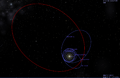 Simulated view showing the orbit of 2012 VP113
 -
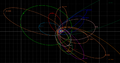 2012 VP113 orbit in white with hypothetical Planet Nine
 -
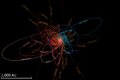 The orbits of known distant objects with large aphelion distances over 200 AU


See also
- List of Solar System objects most distant from the Sun
- 90377 Sedna – first sednoid discovered
- 541132 Leleākūhonua – third sednoid discovered
- List of hyperbolic comets
- List of possible dwarf planets
- Other large aphelion objects
- (668643) 2012 DR30 (15–2880 AU)
- 2005 VX3 (4–1630 AU)
- (709487) 2013 BL76 (8–1870 AU)
- 2014 FE72 (36–2680 AU)
References
- ↑ 1.0 1.1 "MPEC 2014-F40 : 2012 VP113". IAU Minor Planet Center. 26 March 2014. http://www.minorplanetcenter.net/mpec/K14/K14F40.html. (K12VB3P)
- ↑ 2.0 2.1 2.2 2.3 "JPL Small-Body Database Browser: (2012 VP113)". Jet Propulsion Laboratory. https://ssd.jpl.nasa.gov/sbdb.cgi?sstr=3666493.
- ↑ Johnston, Wm. Robert (7 October 2018). "List of Known Trans-Neptunian Objects". Johnston's Archive. http://www.johnstonsarchive.net/astro/tnoslist.html.
- ↑ 4.0 4.1 "JPL Horizons On-Line Ephemeris for (2012 VP113) at epoch JD 2460800.5". JPL Horizons On-Line Ephemeris System. Jet Propulsion Laboratory. https://ssd.jpl.nasa.gov/horizons_batch.cgi?batch=1&COMMAND='2012%20VP113'&TABLE_TYPE='ELEMENTS'&START_TIME='JD2460800.5'&STOP_TIME='JD2460801.5'&STEP_SIZE='1y'&CENTER='@0'&OUT_UNITS='AU-D'. Retrieved 2025-07-15. Solution using the Solar System Barycenter. Ephemeris Type: Elements and Center: @0)
- ↑ 5.0 5.1 "Horizons Batch for 2012 VP113 on 1979-Sep-28". JPL Horizons. https://ssd.jpl.nasa.gov/horizons_batch.cgi?batch=1&COMMAND=%272012+VP113%27&START_TIME=%271979-Sep-01%27&STOP_TIME=%271979-Oct-31%27&STEP_SIZE=%276%20hours%27&QUANTITIES=%2719%27. Retrieved 2022-06-21. (JPL#9, Soln.date: 3 December 2021)
- ↑ 6.00 6.01 6.02 6.03 6.04 6.05 6.06 6.07 6.08 6.09 6.10 6.11 6.12 Trujillo, Chadwick A.; Sheppard, Scott S. (March 2014). "A Sedna-like body with a perihelion of 80 astronomical units". Nature 507 (7493): 471–474. doi:10.3847/2041-8213/ad2686. PMID 24670765. Bibcode: 2014Natur.507..471T. https://www.lpl.arizona.edu/sites/default/files/journal-club/Trujillo_and_Sheppard_2014.pdf.
- ↑ "2012 VP113 – Summary". AstDyS-2, Asteroids – Dynamic Site. https://newton.spacedys.com/astdys/index.php?pc=1.1.0&n=2012VP113.
- ↑ 8.0 8.1 8.2 Witze, Alexandra (26 March 2014). "Dwarf planet stretches Solar System's edge". Nature. doi:10.1038/nature.2014.14921.
- ↑ 9.0 9.1 9.2 9.3 9.4 9.5 9.6 "A second Sedna! What does it mean?". Planetary Society blogs. The Planetary Society. 26 March 2014. http://www.planetary.org/blogs/emily-lakdawalla/2014/03261345-a-second-sedna-what-does-it-mean.html.
- ↑ 10.0 10.1 Proudfoot, Benjamin (August 2025). "A Search For The Moons of Mid-Sized TNOs". Mikulski Archive for Space Telescopes (Space Telescope Science Institute): HST Proposal 18010. Cycle 33. Bibcode: 2025hst..prop18010P. https://www.stsci.edu/hst-program-info/download/hst/pdf/18010/. Retrieved 2025-08-17.
- ↑ 11.0 11.1 11.2 "NASA Supported Research Helps Redefine Solar System's Edge". NASA. 26 March 2014. http://www.nasa.gov/content/nasa-supported-research-helps-redefine-solar-systems-edge/.
- ↑ 12.0 12.1 12.2 "2012 VP113". Minor Planet Center. https://www.minorplanetcenter.net/db_search/show_object?object_id=2012+VP113.
- ↑ 13.0 13.1 Sheppard, Scott S.. "Beyond the Edge of the Solar System: The Inner Oort Cloud Population". Department of Terrestrial Magnetism, Carnegie Institution for Science. http://home.dtm.ciw.edu/users/sheppard/inner_oort_cloud/.
- ↑ Sample, Ian (26 March 2014). "Dwarf planet discovery hints at a hidden Super Earth in solar system". The Guardian. https://www.theguardian.com/science/2014/mar/26/dwarf-planet-super-earth-solar-system-2012-vp113.
- ↑ Chang, Kenneth (26 March 2014). "A New Planetoid Reported in Far Reaches of Solar System". The New York Times. https://www.nytimes.com/2014/03/27/science/space/a-new-planetoid-reported-in-far-reaches-of-solar-system.html.
- ↑ Wall, Mike (26 March 2014). "New Dwarf Planet Found at Solar System's Edge, Hints at Possible Faraway 'Planet X'". Space.com web site. TechMediaNetwork. http://www.space.com/25218-dwarf-planet-discovery-solar-system-edge.html.
- ↑ "A new object at the edge of our Solar System discovered". Physorg.com. 26 March 2014. http://phys.org/news/2014-03-edge-solar.html.
- ↑ de la Fuente Marcos, Carlos; de la Fuente Marcos, Raúl (1 September 2014). "Extreme trans-Neptunian objects and the Kozai mechanism: signalling the presence of trans-Plutonian planets". Monthly Notices of the Royal Astronomical Society: Letters 443 (1): L59–L63. doi:10.1093/mnrasl/slu084. Bibcode: 2014MNRAS.443L..59D.
- ↑ de la Fuente Marcos, Carlos; de la Fuente Marcos, Raúl; Aarseth, S. J. (11 January 2015). "Flipping minor bodies: what comet 96P/Machholz 1 can tell us about the orbital evolution of extreme trans-Neptunian objects and the production of near-Earth objects on retrograde orbits". Monthly Notices of the Royal Astronomical Society 446 (2): 1867–1873. doi:10.1093/mnras/stu2230. Bibcode: 2015MNRAS.446.1867D.
External links
- 2012 VP113 Inner Oort Cloud Object Discovery Images from Scott S. Sheppard/Carnegie Institution for Science.
- 2012 VP113 has Q=460 ± 30 (mpml: CFHT 2011-Oct-22 precovery)
- List of Known Trans-Neptunian Objects, Johnston's Archive
- List Of Centaurs and Scattered-Disk Objects, Minor Planet Center
- 2012 VP113 at the JPL Small-Body Database
2014 in space | ||
|---|---|---|
| Space probes launches |
|    |
| Impact events | ||
| Supernovae | ||
| Notable comets |
| |
| NEOs | ||
| Exoplanets | ||
| Discoveries |
| |
| Space exploration |
| |

| ||||||
| Asteroid belt |
| _(cropped).jpg)  | ||||
| Centaurs |
| |||||
| Plutinos |
| |||||
| Twotinos |
| |||||
| Cubewanos |
| |||||
| Scattered disc |
| |||||
| Detached objects |
| |||||
| Sednoids |
| |||||
| Other / unknown resonances |
| |||||
 |  |


