3C 66B is an elliptical radio galaxy[6][9] located in the constellation Andromeda. With an estimated redshift of 0.021258,[2] the galaxy is about 240.7 Mly (73.79 Mpc) away.[3] It has an angular separation of 6′ from the blazar 3C 66A,[9] but the two are most likely unrelated.[10] 3C 66B is an outlying member of Abell 347, which is part of the Perseus–Pisces Supercluster.[11]
Observations
This is a giant elliptical galaxy that is classified as a low-luminosity Fanaroff and Riley class 1 radio galaxy. Maps of the radio structure suggested that the emission is being shaped by the motion of the galaxy through an ambient medium.[12] A strong jet and counter-jet extend about 330 thousand light-years (100 kpc) from the nucleus.[13][14] These jets have been observed in radio,[15] infrared,[16] optical,[12] ultraviolet,[17] and X-ray bands.[18] Gamma ray emission has been detected coming from the direction of this galaxy, which were most likely emitted from the core region.[19]
Observations with the Hubble Space Telescope in 1990 showed that the jet has a filamentary, double-stranded structure.[12][20] When viewed in the optical, the northern jet shows four knots along its length, all of which are polarized, thus indicating a synchrotron basis.[21]
Very-long-baseline interferometry measurements of the galaxy's radio-emitting core demonstrated elliptical motion with a period of 1.05±0.03 years. This strongly suggested that a supermassive black hole binary (SMBHB) was located at the center of 3C 66B.[22] This motion was expected to emit gravitational waves that would cause fluctuations in the pulse arrival times from the pulsar PSR B1855+09. However, no such signature was found.[23] Numerical simulations indicated this detection method may only be valid for an orbital eccentricity below 0.03.[24]
Messier 87 (M87), about 55 million light-years away, is the largest giant elliptical galaxy near the Earth, and also contains an active galactic nucleus. The smooth jet of 3C 66B rivals that of M87.[25]
Gallery
References
- ↑ 1.0 1.1 Charlot, P. et al. (2020). "The third realization of the International Celestial Reference Frame by very long baseline interferometry". Astronomy and Astrophysics 644: A159. doi:10.1051/0004-6361/202038368. Bibcode: 2020A&A...644A.159C.
- ↑ 2.0 2.1 2.2 2.3 2.4 Hudson, Michael J. et al. (October 2001). "Streaming motions of galaxy clusters within 12 000 km s-1 - III. A standardized catalogue of Fundamental Plane data". Monthly Notices of the Royal Astronomical Society 327 (1): 265–295. doi:10.1046/j.1365-8711.2001.04786.x. Bibcode: 2001MNRAS.327..265H.
- ↑ 3.0 3.1 Tully, R. Brent et al. (October 2013). "Cosmicflows-2: The Data". The Astronomical Journal 146 (4): 25. doi:10.1088/0004-6256/146/4/86. 86. Bibcode: 2013AJ....146...86T.
- ↑ Trussoni, E. et al. (2001). "X-ray observations of 3C 66B and 3C 346". Memorie della Societa Astronomica Italiana 72: 111–113. Bibcode: 2001MmSAI..72..111T.
- ↑ Huchra, John P. et al. (April 1999). "The CFA Redshift Survey: Data for the South Galactic CAP". The Astrophysical Journal Supplement Series 121 (2): 287–368. doi:10.1086/313194. Bibcode: 1999ApJS..121..287H.
- ↑ 6.0 6.1 "3C 66B". XJET: X-Ray Emission from Extragalactic Radio Jets. 2009-04-16. http://hea-www.harvard.edu/XJET/source-d.cgi?3C_66B.
- ↑ 7.0 7.1 Errando, Manel; et al. (July 2009). "A TeV source in the 3C 66A/B region". arXiv:0907.0994 [astro-ph.HE].
- ↑ "UGC 1841". SIMBAD. Centre de données astronomiques de Strasbourg. http://simbad.u-strasbg.fr/simbad/sim-basic?Ident=UGC+1841.
- ↑ 9.0 9.1 Aleksić, J. (January 2011). "Observations of the Blazar 3C 66A with the Magic Telescopes in Stereoscopic Mode". The Astrophysical Journal 726 (2): id. 58. doi:10.1088/0004-637X/726/2/58. Bibcode: 2011ApJ...726...58A.
- ↑ Northover, K. J. E. (1973). "The radio galaxy 3C 66". Monthly Notices of the Royal Astronomical Society 165 (4): 369. doi:10.1093/mnras/165.4.369. Bibcode: 1973MNRAS.165..369N.
- ↑ Fanti, C. et al. (1982-01-01). "Radio and optical observations of 9 nearby Abell clusters - A262, A347, A569, A576, A779, A1213, A1228, A2162, A2666". Astronomy and Astrophysics 105: 200–218. ISSN 0004-6361. Bibcode: 1982A&A...105..200F.
- ↑ 12.0 12.1 12.2 Macchetto, F. (June 1991). "HST Observations of 3C 66B: A Double-stranded Optical Jet". Astrophysical Journal Letters 373: L55. doi:10.1086/186050. Bibcode: 1991ApJ...373L..55M.
- ↑ Iguchi, Satoru et al. (December 2010). "A Very Close Binary Black Hole in a Giant Elliptical Galaxy 3C 66B and its Black Hole Merger". The Astrophysical Journal Letters 724 (2): L166–L170. doi:10.1088/2041-8205/724/2/L166. Bibcode: 2010ApJ...724L.166I.
- ↑ Fraix-Burnet, D. (February 1997). "An optical counterjet in 3C 66B?". Monthly Notices of the Royal Astronomical Society 284 (4): 911–914. doi:10.1093/mnras/284.4.911. Bibcode: 1997MNRAS.284..911F.
- ↑ Jackson, N. et al. (March 1993). "The radio and optical structure of 3C 66B". Astronomy and Astrophysics 269: 128–134. Bibcode: 1993A&A...269..128J.
- ↑ Tansley, D. et al. (September 2000). "The infrared jet in 3C 66B". Monthly Notices of the Royal Astronomical Society 317 (3): 623–629. doi:10.1046/j.1365-8711.2000.03657.x. Bibcode: 2000MNRAS.317..623T.
- ↑ Fraix-Burnet, D. et al. (January 1989). "Near-Ultraviolet Emission from 3C 66B and Its Jet". Astrophysical Journal 336: 121. doi:10.1086/166999. Bibcode: 1989ApJ...336..121F.
- ↑ Hardcastle, M. J. et al. (October 2001). "Chandra observations of the X-ray jet in 3C 66B". Monthly Notices of the Royal Astronomical Society 326 (4): 1499–1507. doi:10.1111/j.1365-2966.2001.04699.x. Bibcode: 2001MNRAS.326.1499H.
- ↑ Aliu, E. (February 2009). "Discovery of a Very High Energy Gamma-Ray Signal from the 3C 66A/B Region". The Astrophysical Journal Letters 692 (1): L29–L33. doi:10.1088/0004-637X/692/1/L29. Bibcode: 2009ApJ...692L..29A.
- ↑ Sparks, W. B.; Macchetto, F.; Jackson, N. J.; Miley, G. K. (May 1992). "High resolution observation of 3C 66B". Testing the AGN Paradigm. 254. pp. 415–418. doi:10.1063/1.42261. Bibcode: 1992AIPC..254..415S.
- ↑ Fraix-Burnet, D. et al. (August 1991). "An Optical Study of 3C31, 3C66B, 3C120 and their Jets". Astronomical Journal 102: 562. doi:10.1086/115893. Bibcode: 1991AJ....102..562F.
- ↑ Sudou, H. et al. (2003). "Orbital Motion in the Radio Galaxy 3C 66B: Evidence for a Supermassive Black Hole Binary". Science 300 (5623): 1263–1265. doi:10.1126/science.1082817. PMID 12764190. Bibcode: 2003Sci...300.1263S.
- ↑ Jenet, F. et al. (2004). "Constraining the Properties of Supermassive Black Hole Systems Using Pulsar Timing: Application to 3C 66B". The Astrophysical Journal 606 (2): 799–803. doi:10.1086/383020. Bibcode: 2004ApJ...606..799J.
- ↑ De Paolis, F.; Ingrosso, G. (November 2004). "A super massive black hole binary in 3C 66B: Future observational perspectives". Astronomy and Astrophysics 426 (2): 379–385. doi:10.1051/0004-6361:20040314. Bibcode: 2004A&A...426..379D.
- ↑ Perlman, Eric S. et al. (2006). "Optical Polarimetry of the Jets of Nearby Radio Galaxies. I. The Data". The Astrophysical Journal 651 (2): 735–748. doi:10.1086/506587. Bibcode: 2006ApJ...651..735P.
Further reading
External links
 | Original source: https://en.wikipedia.org/wiki/3C 66B. Read more |

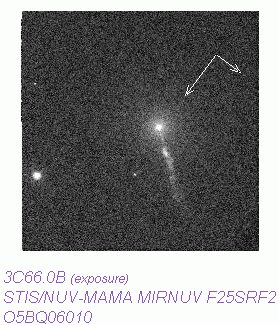 Hubble Near-UV image of the jet coming out of 3C 66B
 NRAO VLA image of 3C 66B


