Astronomy:NGC 1003
| NGC 1003 | |
|---|---|
 NGC 1003 from the Hubble Space Telescope | |
| Observation data (J2000[1] epoch) | |
| Constellation | Perseus |
| Right ascension | 02h 39m 16.893s[2] |
| Declination | +40° 52′ 20.25″[2] |
| Redshift | 0.002090[3] |
| Helio radial velocity | 624 km/s[4] |
| Distance | 30.94 ± 1.40 Mly (9.486 ± 0.429 Mpc)[5] |
| Group or cluster | NGC 1023 group[6] |
| Apparent magnitude (B) | 12.1[3] |
| Characteristics | |
| Type | SAcd[7] |
| Mass | 299+28 −26×1010[8] M☉ |
| Mass/Light ratio | 0.70+0.16 −0.15[8] M☉/L☉ |
| Size | ~63,000 ly (19.32 kpc) (estimated)[5] |
| Notable features | Warped disk[7] |
| Other designations | |
| IRAS 02360+4039, UGC 2137, MCG+07-06-051, PGC 10052[3] | |
NGC 1003 is a spiral galaxy at the western edge of the Perseus constellation.[9] It is located at a distance of about 36 million light years from the Milky Way and is receding with a heliocentric radial velocity of 624 km/s.[4] This galaxy was discovered by the Anglo-German astronomer William Herschel on October 6, 1784, who described it as "pretty faint, large, extended 90°±, much brighter middle, mottled but not resolved".[10] It is a member of the NGC 1023 group of galaxies.[6]
The morphological class of NGC 1003 is SAcd, which means it is an unbarred spiral galaxy (SA) with somewhat loosely-wound spiral arms (cd). It is inclined by an angle of 70° to the line of sight from the Earth, with the major axis aligned along a position angle of 276°. The visual disk of the galaxy shows a substantial warping in the eastern side, turning it almost face on. The estimated star formation rate is 0.40 M☉·yr−1.[7] It has a virial mass of 3×10¹² M☉ and a mass-to-light ratio of 0.7.[8]
Supernova
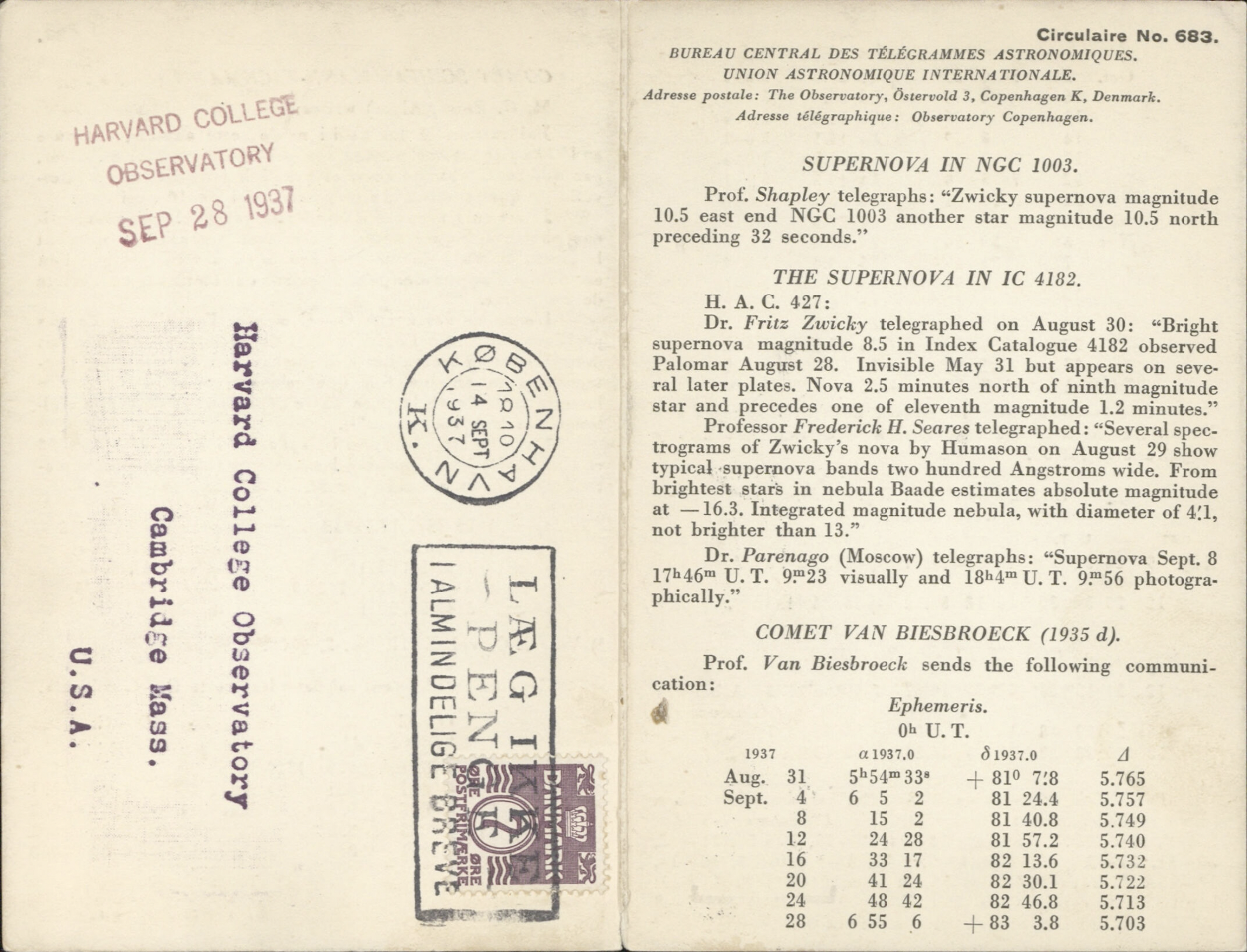
One supernova has been observed in NGC 1003: SN 1937D (Type Ia, mag. 10.5) was discovered by Fritz Zwicky on 9 September 1937.[11][12][13][14]
Gallery
![NGC 1003 taken from the Nicholas U. Mayall Telescope at Kitt Peak National Observatory.[15]](/wiki/File:Deep_Dive_into_a_Galaxy_Cluster.jpg)
See also
References
- ↑ "NGC 1003, Spiral Galaxy". http://www.kopernik.org/images/archive/n1003.htm.
- ↑ 2.0 2.1 Skrutskie, Michael F. et al. (February 1, 2006). "The Two Micron All Sky Survey (2MASS)". The Astronomical Journal 131 (2): 1163–1183. doi:10.1086/498708. ISSN 0004-6256. Bibcode: 2006AJ....131.1163S.
- ↑ 3.0 3.1 3.2 "NGC 1003". SIMBAD. Centre de données astronomiques de Strasbourg. http://simbad.u-strasbg.fr/simbad/sim-basic?Ident=NGC+1003.
- ↑ 4.0 4.1 Tully, R. Brent et al. (August 2016). "Cosmicflows-3". The Astronomical Journal 152 (2): 21. doi:10.3847/0004-6256/152/2/50. 50. Bibcode: 2016AJ....152...50T.
- ↑ 5.0 5.1 "Results for object NGC 1003". NASA and Caltech. http://ned.ipac.caltech.edu/byname?objname=NGC+1003.
- ↑ 6.0 6.1 Trentham, Neil; Tully, R. Brent (2009). "Dwarf galaxies in the NGC 1023 Group". Monthly Notices of the Royal Astronomical Society 398 (2): 722. doi:10.1111/j.1365-2966.2009.15189.x. Bibcode: 2009MNRAS.398..722T.
- ↑ 7.0 7.1 7.2 Marasco, A. et al. (November 2019). "HALOGAS: the properties of extraplanar HI in disc galaxies". Astronomy & Astrophysics 631: 27. doi:10.1051/0004-6361/201936338. A50. Bibcode: 2019A&A...631A..50M.
- ↑ 8.0 8.1 8.2 Haghi, Hosein et al. (July 2018). "Rotation curves of galaxies and the stellar mass-to-light ratio". Monthly Notices of the Royal Astronomical Society 477 (3): 4187–4199. doi:10.1093/mnras/sty523. Bibcode: 2018MNRAS.477.4187H.
- ↑ Sinnott, Roger W.; Perryman, Michael A. C. (1997). Millennium Star Atlas. 1. Sky Publishing Corporation and the European Space Agency. p. 100. ISBN 0-933346-84-0.
- ↑ Seligman, Courtney. "NGC 1003 (= PGC 10052)". Celestial Atlas. https://cseligman.com/text/atlas/ngc10.htm#1003.
- ↑ Shapley (14 September 1937). "Circular No. 683 : Supernova in NGC 1003.". Central Bureau for Astronomical Telegrams (Observatory Copenhagen, IAU) 683: 1. http://www.cbat.eps.harvard.edu/IAUCs/IAUC0683a.png. Retrieved 14 August 2025.
- ↑ "SN 1937D". IAU. https://www.wis-tns.org/object/1937D.
- ↑ Baade, W.; Zwicky, F. (November 1938). "Photographic Light-Curves of the Two Supernovae in IC 4182 and NGC 1003". Astrophysical Journal 88: 411. doi:10.1086/143996. Bibcode: 1938ApJ....88..411B.
- ↑ "NGC 1003" (in en). https://noirlab.edu/public/images/noirlab2101a/.
External links
- "Revised NGC Data for NGC 1003". http://spider.seds.org/ngc/revngcic.cgi?NGC1003.
- "Your NED Search Results". http://nedwww.ipac.caltech.edu/cgi-bin/nph-objsearch?objname=NGC+1003&extend=no.
 |  |