Astronomy:NGC 1090
From HandWiki
| NGC 1090 | |
|---|---|
 NGC 1090 imaged by SDSS | |
| Observation data (J2000 epoch) | |
| Constellation | Cetus |
| Right ascension | 02h 46m 33.9s[1] |
| Declination | −00° 14′ 49″[1] |
| Redshift | 2760 ± 4 km/s[1] |
| Distance | 124 million light-years[2] |
| Apparent magnitude (V) | 12.5[1] |
| Characteristics | |
| Type | SB(rs)bc[1] |
| Apparent size (V) | 4.0′ × 1.7′[1] |
| Other designations | |
| UGC 2247,[1] PGC 10507[1] | |
NGC 1090 is a barred spiral galaxy located in the constellation Cetus.
NGC 1090 has a pseudo inner ring. The disc has a very low surface brightness.
NGC 1090 is not part of a galaxy group, even though it appears close to NGC 1087, M-77 (NGC 1068), NGC 1055, NGC 1073, and five other small irregular galaxies.
The distance to NGC 1090 is approximately 124 million light years and its diameter is about 144,000 light years.[2]
Supernovae
Two supernovae have been observed in NGC 1090:
- SN 1962K (type unknown, mag. 18.2) was discovered by Konrad Rudnicki on 3 August 1962.[3][4]
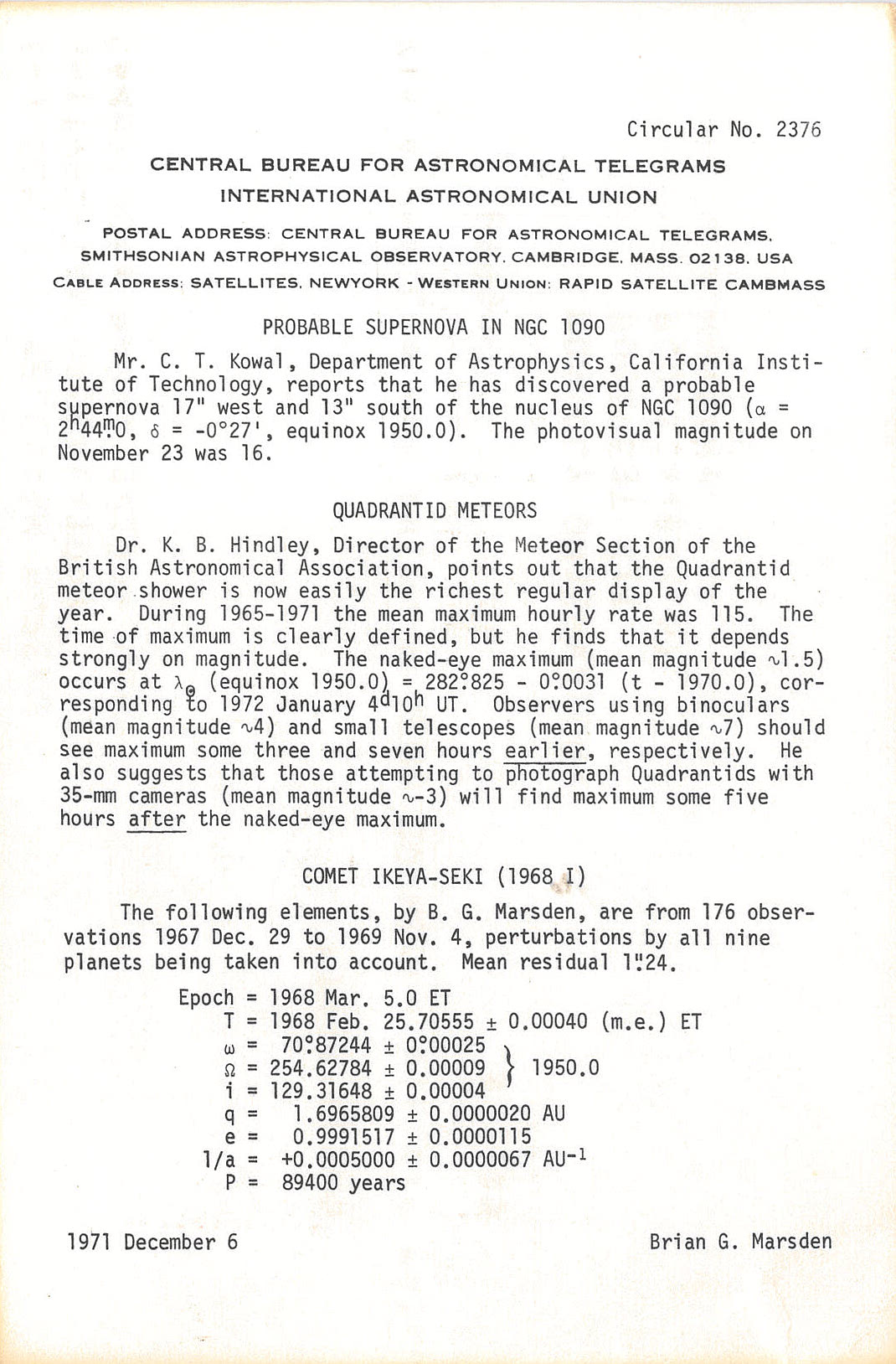
- SN 1971T (type unknown, mag. 16) was discovered by Charles Kowal on 23 November 1971.[5][6][7]
References
- ↑ 1.0 1.1 1.2 1.3 1.4 1.5 1.6 1.7 "NASA/IPAC Extragalactic Database". Results for NGC 1090. http://nedwww.ipac.caltech.edu/.
- ↑ 2.0 2.1 Bratton, Mark (2011). The Complete Guide to the Herschel Objects. Cambridge University Press. p. 166. ISBN 978-0-521-76892-4. https://archive.org/details/completeguidetoh00brat.
- ↑ Zwicky, F.; Berger, J.; Gates, H. S.; Rudnicki, K. (1963). "The 1962 Palomar Supernova Search". Publications of the Astronomical Society of the Pacific 75: 236. doi:10.1086/127940.
- ↑ "SN 1962K". IAU. https://www.wis-tns.org/object/1962K.
- ↑ Kowal, C. T. (6 December 1971). "Probable Supernova in NGC 1090". Central Bureau for Astronomical Telegrams (Smithsonian Astrophysical Observatory, IAU) 2376: 1. http://www.cbat.eps.harvard.edu/IAUCs/IAUC2376.jpg. Retrieved 15 August 2025.
- ↑ "SN 1971T". IAU. https://www.wis-tns.org/object/1971T.
- ↑ "List of Supernovae". Central Bureau for Astronomical Telegrams. Harvard University. http://www.cbat.eps.harvard.edu/lists/Supernovae.html.
External links
- NGC 1090 on WikiSky: DSS2, SDSS, GALEX, IRAS, Hydrogen α, X-Ray, Astrophoto, Sky Map, Articles and images
Coordinates:  02h 46m 33.9s, −00° 14′ 49″
 |  |