Astronomy:NGC 1275
| NGC 1275 | |
|---|---|
 NGC 1275 imaged by the Hubble Space Telescope | |
| Observation data (J2000 epoch) | |
| Constellation | Perseus |
| Right ascension | 03h 19m 48.1601s[1] |
| Declination | +41° 30′ 42.103″[1] |
| Redshift | 0.017670±0.00003[1] |
| Helio radial velocity | 5,264±11 km/s[1] |
| Distance | 225.19 ± 10.29 Mly (69.044 ± 3.154 Mpc)[2] |
| Group or cluster | Perseus Cluster |
| Apparent magnitude (V) | 12.6[1] |
| Characteristics | |
| Type | cD;pec;NLRG[1] |
| Size | ~295,000 ly (90.45 kpc) (estimated)[1] |
| Apparent size (V) | 2.2′ × 1.7′[1] |
| Other designations | |
| Perseus A, QSO B0316+413, 3C 84, IRAS 03164+4119, UGC 2669, MCG+07-07-063, PGC 12429[1] | |
NGC 1275 (also known as Perseus A or Caldwell 24) is a type 1.5 Seyfert galaxy[3] located around 225 million light-years away from Earth[2] in the direction of the constellation of Perseus. NGC 1275 is a member of the large Perseus Cluster of galaxies. It was discovered by German-British astronomer William Herschel on 17 October 1786.[4]
Properties
 | This section may be too technical for most readers to understand. Please help improve it to make it understandable to non-experts, without removing the technical details. (March 2022) (Learn how and when to remove this template message) |
NGC 1275 consists of two galaxies, a central type-cD galaxy in the Perseus Cluster, and a so-called high velocity system (HVS) which lies in front of it. The HVS is moving at 3000 km/s[5] towards the dominant system, and is believed to be merging with the Perseus Cluster. The HVS is not affecting the cD galaxy as it lies at least 200 thousand light years from it.[6] However tidal interactions are disrupting it and the ram pressure produced by its interaction with the intracluster medium of Perseus is stripping its gas as well as producing large amounts of star formation within it.[7]

The central cluster galaxy contains a massive network of spectral line emitting filaments,[8] which apparently are being dragged out by rising bubbles of relativistic plasma generated by the central active galactic nucleus.[9] Long gaseous filaments made up of threads of gas stretch out beyond the galaxy, into the multimillion-degree, X-ray–emitting gas that fills the cluster. The amount of gas contained in a typical thread is approximately one million times the mass of the Sun. They are only 200 light-years wide, are often very straight, and extend for up to 20,000 light-years.[10]
The existence of the filaments poses a problem. As they are much cooler than the surrounding intergalactic cloud, it is unclear how they have existed for such a long time, or why they have not warmed, dissipated or collapsed to form stars.[11][12] One possibility is that weak magnetic fields (about one-ten-thousandth the strength of Earth's field) exert enough force on the ions within the threads to keep them together.[11][12]


NGC 1275 contains 13 billion solar masses of molecular hydrogen that seems to be infalling from Perseus' intracluster medium in a cooling flow, both feeding its active nucleus[13] and fueling significant amounts of star formation[14]
The presence of an active nucleus demonstrates that a supermassive black hole is present in NGC 1275's center. The black hole is surrounded by a rotating disk of molecular gas.[15] High-resolution observations of the rotation of this disk obtained using adaptive optics at the Gemini North telescope indicate a central mass of approximately 800 million solar masses, including both the mass of the black hole and of the inner core of the gas disk.[16]
Supernovae
Three supernovae have so far been observed in NGC 1275:
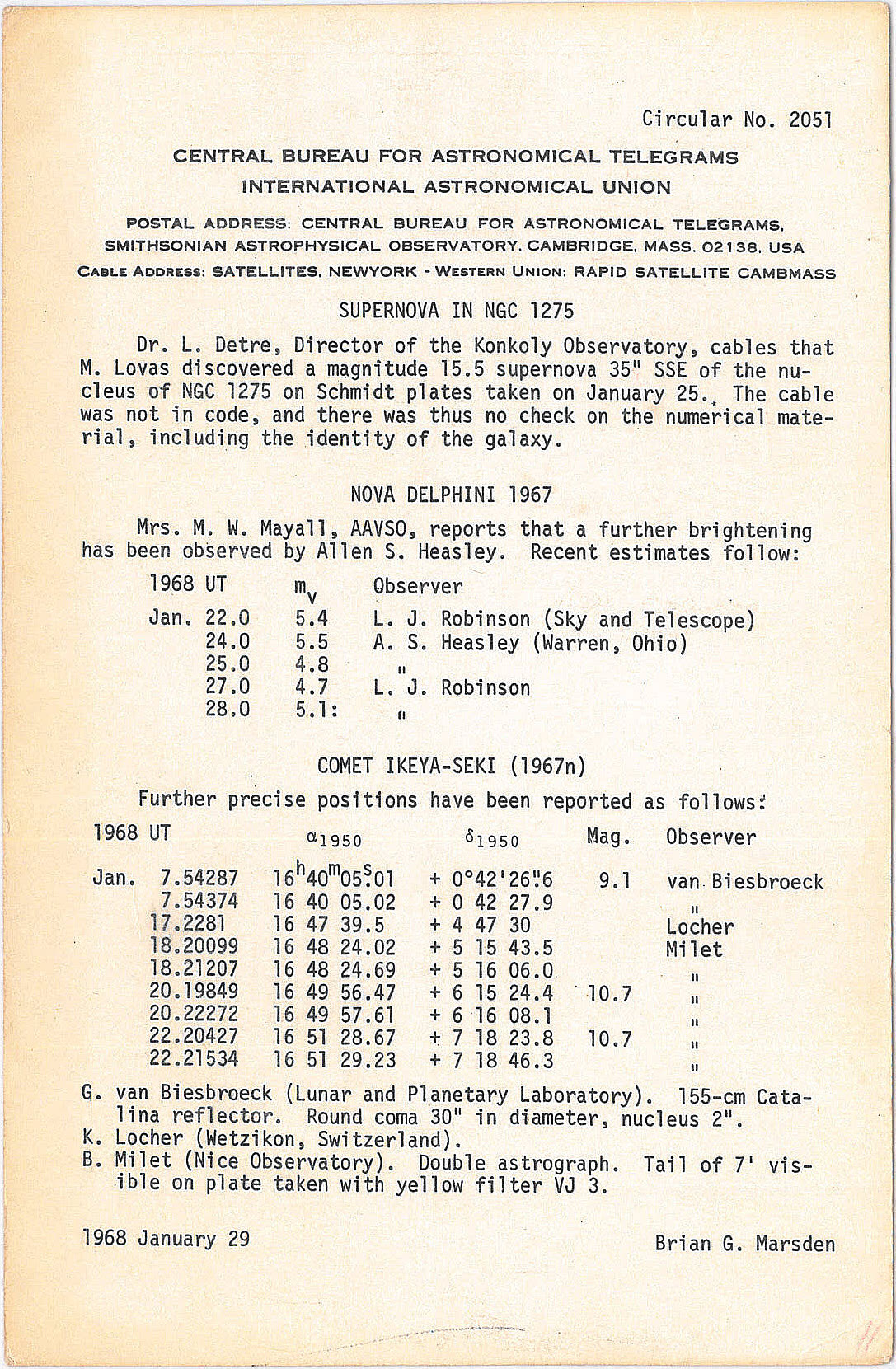
- SN 1968A (type unknown, mag. 15.5) was discovered by Miklós Lovas on 25 January 1968.[17][18]
- SN 2005mz (Type Ia, mag. 18.2) was discovered by Jack Newton, Mike Peoples, and Tim Puckett on 31 December 2005.[19][20]
- SN 2024xav (Type II-P, mag. 18.63) was discovered by GOTO on 2 October 2024.[21]
See also
References

- ↑ 1.0 1.1 1.2 1.3 1.4 1.5 1.6 1.7 1.8 "NASA/IPAC Extragalactic Database". http://nedwww.ipac.caltech.edu/cgi-bin/nph-objsearch?objname=NGC+1275&img_stamp=yes&extend=no.
- ↑ 2.0 2.1 "Distance Results for NGC 1275". http://nedwww.ipac.caltech.edu/cgi-bin/nDistance?name=NGC+1275.
- ↑ Ho, Luis C.; Filippenko, Alex V.; Sargent, Wallace L. W. (October 1997). "A Search for "Dwarf" Seyfert Nuclei. III. Spectroscopic Parameters and Properties of the Host Galaxies". Astrophysical Journal Supplement 112 (2): 315–390. doi:10.1086/313041. Bibcode: 1997ApJS..112..315H.
- ↑ Seligman, Courtney. "New General Catalogue Objects: NGC 1275". https://cseligman.com/text/atlas/ngc12a.htm#1275.
- ↑ Minkowski, R. (1957). "Optical investigations of radio sources (Introductory Lecture)". Radio Astronomy 4: 107. Bibcode: 1957IAUS....4..107M.
- ↑ Gillmon, K.; Sanders, J. S.; Fabian, A. C. (2003). "An X-ray absorption analysis of the high-velocity system in NGC 1275" (in en). Monthly Notices of the Royal Astronomical Society 348: 159–164. doi:10.1111/j.1365-2966.2004.07336.x.
- ↑ Gallagher, John S. III; Lee, M.; Canning, R.; Fabian, A.; O'Connell, R. W.; Sanders, J.; Zweibel, E. (2010). "Dusty Gas and New Stars: Disruption of the High Velocity Intruder Galaxy Falling Towards NGC 1275". Bulletin of the American Astronomical Society 42: 552. Bibcode: 2010AAS...21536308G.
- ↑ Lynds, R. (March 1970). "Improved Photographs of the NGC 1275 Phenomenon" (in en). The Astrophysical Journal 159: L151. doi:10.1086/180500. ISSN 0004-637X. Bibcode: 1970ApJ...159L.151L. http://adsabs.harvard.edu/doi/10.1086/180500.
- ↑ Hatch, N. A.; Crawford, C. S.; Fabian, A. C.; Johnstone, R. M. (2005). "On the origin and excitation of the extended nebula surrounding NGC 1275" (in en). Monthly Notices of the Royal Astronomical Society 367 (2): 433–448. doi:10.1111/j.1365-2966.2006.09970.x. ISSN 0035-8711.
- ↑ "Hubble Sees Magnetic Monster in Erupting Galaxy" (in en). 20 August 2008. https://d.newswise.com/articles/view/543637/.
- ↑ 11.0 11.1 Fabian, A. C.; Johnstone, R. M.; Sanders, J. S.; Conselice, C. J.; Crawford, C. S.; Gallagher, J. S. III; Zweibel, E. (2008-08-21). "Magnetic support of the optical emission line filaments in NGC 1275". Nature 454 (7207): 968–970. doi:10.1038/nature07169. PMID 18719583. Bibcode: 2008Natur.454..968F.
- ↑ 12.0 12.1 Chang, Kenneth (2008-08-21). "Hubble Images Solve Galactic Filament Mystery". The New York Times. https://www.nytimes.com/2008/08/26/science/space/26galaxy.html.
- ↑ Lim, Jeremy; Ao, Yi Ping; Dinh-v-Trung, Dinh-V-Trung (2008). "Radially Inflowing Molecular Gas in NGC 1275 Deposited by an X-Ray Cooling Flow in the Perseus Cluster". The Astrophysical Journal 672 (1): 252–265. doi:10.1086/523664. Bibcode: 2008ApJ...672..252L.
- ↑ O'Connell, Robert (2007). "Star Formation in the Perseus Cluster Cooling Flow". HST Proposal ID #11207. Cycle 16: 11207. Bibcode: 2007hst..prop11207O.
- ↑ Wilman, R. J.; Edge, A. C.; Johnstone, R. M. (2005). "The nature of the molecular gas system in the core of NGC 1275". Monthly Notices of the Royal Astronomical Society 359 (2): 755–764. doi:10.1111/j.1365-2966.2005.08956.x. Bibcode: 2005MNRAS.359..755W.
- ↑ Scharwächter, J.; McGregor, P. J.; Dopita, M. A.; Beck, T. L. (2013). "Kinematics and excitation of the molecular hydrogen accretion disc in NGC 1275". Monthly Notices of the Royal Astronomical Society 429 (3): 2315. doi:10.1093/mnras/sts502. Bibcode: 2013MNRAS.429.2315S.
- ↑ Detre, Dr. L.; Lovas, M. (29 January 1968). Marsden, Brian G.. ed. "SUPERNOVA IN NGC 1275". International Astronomical Union Circular (Smithsonian Astrophysical Observatory) 2051: 1. http://www.cbat.eps.harvard.edu/IAUCs/IAUC2051.jpg. Retrieved 2 December 2024.
- ↑ "SN 1968A". IAU. https://www.wis-tns.org/object/1968A.
- ↑ Luckas, P.; Trondal, O.; Schwartz, M.; Newton, J.; Puckett, T.; Peoples, M.; Ceravolo, D. (2006). "Supernovae 2005my, 2005mz, 2005na". International Astronomical Union Circular (8655): 1. Bibcode: 2006IAUC.8655....1L. http://www.cbat.eps.harvard.edu/iauc/08600/08655.html#Item1.
- ↑ "SN 2005mz". IAU. https://www.wis-tns.org/object/2005mz.
- ↑ "SN 2024xav". IAU. https://www.wis-tns.org/object/2024xav.
External links
- NGC 1275 on WikiSky: DSS2, SDSS, GALEX, IRAS, Hydrogen α, X-Ray, Astrophoto, Sky Map, Articles and images
- APOD (2003-05-05) – NASA image & description
- APOD (2005-07-25) – NASA image showing unusual gas filaments
- Fabian, A.C., et al. "A deep Chandra observation of the Perseus cluster: shocks and ripples". Monthly Notices of the Royal Astronomical Society. Vol. 344 (2003): L43 (arXiv:astro-ph/0306036v2).
- Fabian, A.C. Nature 454, 968–970.
- Gabany, R. Jay. cosmotography.com – An image made with a 20" telescope, which displays the unusual gas filaments
Coordinates:  03h 19m 48.1601s, +41° 30′ 42.103″
| List |
|
|---|---|
| See also | |


 |  |