Astronomy:NGC 3916
| NGC 3916 | |
|---|---|
 NGC 3916 imaged by SDSS | |
| Observation data (J2000 epoch) | |
| Constellation | Ursa Major |
| Right ascension | 11h 50m 51.0192s[1] |
| Declination | +55° 08′ 37.290″[1] |
| Redshift | 0.019185±0.00000309[1] |
| Helio radial velocity | 5,751±1 km/s[1] |
| Distance | 284.9 ± 20.0 Mly (87.34 ± 6.12 Mpc)[1] |
| Group or cluster | [CHM2007] LDC 846 |
| Apparent magnitude (V) | 14.2g[1] |
| Characteristics | |
| Type | SAb edge-on[1] |
| Size | ~137,900 ly (42.28 kpc) (estimated)[1] |
| Apparent size (V) | 1.47′ × 0.48′[1] |
| Other designations | |
| IRAS 11481+5525, UGC 6819, MCG+09-20-005, PGC 037047[1] | |
NGC 3916 is a spiral galaxy in the constellation of Ursa Major. Its velocity with respect to the cosmic microwave background is 5,922±12 km/s, which corresponds to a Hubble distance of 284.9 ± 20.0 Mly (87.34 ± 6.12 Mpc).[1] It was discovered by German-British astronomer William Herschel on 14 April 1789.[2][3]
NGC 3916 is a LINER galaxy, i.e. a galaxy whose nucleus has an emission spectrum characterized by broad lines of weakly ionized atoms.[4][5] NGC 3916 is also a radio galaxy, i.e. it has giant regions of radio emission extending well beyond its visible structure.[6][5]
Galaxy group
NGC 3916 belongs to a small galaxy group known as [CHM2007] LDC 846.[7][8] The other two galaxies in the group are NGC 3921 and NGC 3977.[7][8]
Supernova
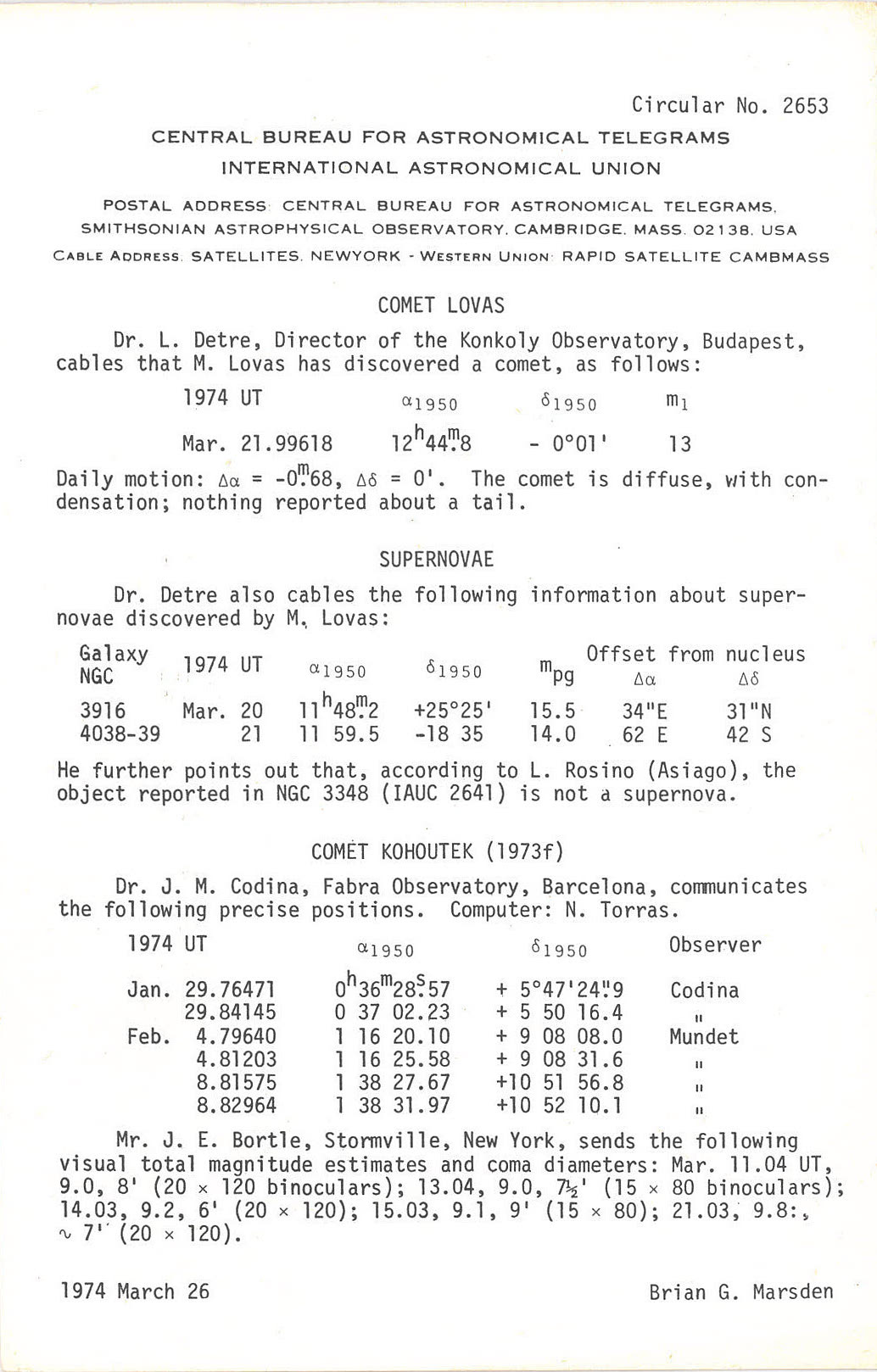
One supernova has been observed in NGC 3916:
See also
References
- ↑ 1.00 1.01 1.02 1.03 1.04 1.05 1.06 1.07 1.08 1.09 1.10 "Results for object NGC 3916". NASA and Caltech. https://ned.ipac.caltech.edu/byname?objname=NGC+3916.
- ↑ Herschel, William (1802). "Catalogue of 500 New Nebulae, Nebulous Stars, Planetary Nebulae, and Clusters of Stars; with Remarks on the Construction of the Heavens". Philosophical Transactions of the Royal Society of London 92: 477–528. doi:10.1098/rstl.1802.0021. Bibcode: 1802RSPT...92..477H.
- ↑ Seligman, Courtney. "New General Catalogue Objects: NGC 3916". https://cseligman.com/text/atlas/ngc39.htm#3916.
- ↑ Nisbet, D. M.; Best, P. N. (2016). "The mass fraction of AGN and the Fundamental Plane of black hole activity from a large X-ray-selected sample of LINERs". Monthly Notices of the Royal Astronomical Society 455 (3): 2551. doi:10.1093/mnras/stv2450. Bibcode: 2016MNRAS.455.2551N.
- ↑ 5.0 5.1 "NGC 3916". SIMBAD. Centre de données astronomiques de Strasbourg. http://simbad.u-strasbg.fr/simbad/sim-basic?Ident=NGC+3916.
- ↑ Best, P. N.; Heckman, T. M. (2012). "On the fundamental dichotomy in the local radio-AGN population: Accretion, evolution and host galaxy properties". Monthly Notices of the Royal Astronomical Society 421 (2): 1569. doi:10.1111/j.1365-2966.2012.20414.x. Bibcode: 2012MNRAS.421.1569B.
- ↑ 7.0 7.1 Crook, Aidan C.; Huchra, John P.; Martimbeau, Nathalie; Masters, Karen L.; Jarrett, Tom; Macri, Lucas M. (2007). "Groups of Galaxies in the Two Micron All Sky Redshift Survey". The Astrophysical Journal 655 (2): 790. doi:10.1086/510201. Bibcode: 2007ApJ...655..790C.
- ↑ 8.0 8.1 "[CHM2007 LDC 846"]. SIMBAD. Centre de données astronomiques de Strasbourg. http://simbad.u-strasbg.fr/simbad/sim-basic?Ident=%5BCHM2007%5D+LDC+846.
- ↑ Detre; Lovas, M. (26 March 1974). "SUPERNOVAE". Central Bureau for Astronomical Telegrams (IAU) 2653: 1. http://www.cbat.eps.harvard.edu/IAUCs/IAUC2653.jpg. Retrieved 24 January 2026.
- ↑ "SN 1974D". IAU. https://www.wis-tns.org/object/1974D.
External links
- NGC 3916 on WikiSky: DSS2, SDSS, GALEX, IRAS, Hydrogen α, X-Ray, Astrophoto, Sky Map, Articles and images
Coordinates:  11h 50m 51.0192s, +55° 08′ 37.290″
 |  |