Astronomy:NGC 2775
| NGC 2775 | |
|---|---|
.jpg) NGC 2775 imaged by the Hubble Space Telescope | |
| Observation data (J2000 epoch) | |
| Constellation | Cancer |
| Right ascension | 09h 10m 20.112s[1] |
| Declination | +07° 02′ 16.53″[1] |
| Redshift | 0.004500±0.00000334[2] |
| Helio radial velocity | 1,316.4±13.4 km/s[3] |
| Distance | 67 Mly (20.5 Mpc)[4] |
| Apparent magnitude (V) | 10.4[5] |
| Characteristics | |
| Type | SAa[6] or SA(r)ab[7] |
| Size | ~79,000 ly (24.23 kpc) (estimated)[2] |
| Apparent size (V) | 4.3′ × 3.3′[7] |
| Other designations | |
| IRAS 09076+0714, UGC 4820, MCG+01-24-005, PGC 25861[8][2] | |
NGC 2775, also known as Caldwell 48, is a spiral galaxy in the constellation Cancer. It is 67 million light-years (20.5 megaparsecs)[4] away from the Milky Way. It was discovered by German-British astronomer William Herschel on 19 December 1783.[9][10]
This object has a morphological classification of SA(r)ab,[7] which indicates an unbarred spiral galaxy (SA) with a prominent ring structure (r) and flocculent,[11] tightly wound spiral arms (ab).[12] The galaxy is inclined by an angle of 44° to the line of sight from the Earth.[7] The galactic nucleus is not active[3] and the large nuclear bulge, which extends out to an angular radius of 0.4′,[12] is relatively gas free.[11] An explanation for the latter could be a high supernova rate.[7] Although star formation is taking place in the dusty outer ring,[12] NGC 2775 does not display any current starburst activity,[13] and the galactic nucleus is virtually free of any star formation whatsoever.[11]
The galaxy's hydrogen tail feature indicates a past interaction with a faint companion.[7] A satellite galaxy appears to have orbited NGC 2775 multiple times, losing mass as it did so and creating faint, shell-like structures.[12] Nearby irregular galaxy NGC 2777 displays a tidal tail of hydrogen gas that points back to NGC 2775, suggesting the two may be linked.[14]
Cluster and group membership
NGC 2775 belongs to the Antlia-Hydra Cluster[15] of galaxies and is the most prominent member of the NGC 2775 Group (also known as LGG 169), a small galaxy group in the Virgo Super-cluster, along with the Local Group. Other members of the NGC 2775 Group include NGC 2777 and UGC 4781.[16][17]
Supernova
One supernova has been observed in NGC 2775. SN 1993Z (Type Ia, mag. 13.9) was discovered by the Leuschner Observatory Supernova Search (LOSS) on 23 September 1993.[18][19] By September 25, spectral analysis showed that it had peaked about four weeks earlier.[18]
Gallery
-
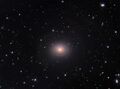 NGC 2775 imaged with a 32-inch telescope.
 -
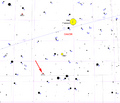 Map showing the location of NGC 2775.
 -
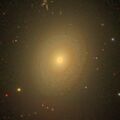 NGC 2775 (SDSS DR14)
 -
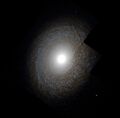 NGC 2775 from the Hubble Space Telescope


See also
References
- ↑ 1.0 1.1 Skrutskie, Michael F.; Cutri, Roc M.; Stiening, Rae; Weinberg, Martin D.; Schneider, Stephen E.; Carpenter, John M.; Beichman, Charles A.; Capps, Richard W. et al. (1 February 2006). "The Two Micron All Sky Survey (2MASS)". The Astronomical Journal 131 (2): 1163–1183. doi:10.1086/498708. ISSN 0004-6256. Bibcode: 2006AJ....131.1163S.
- ↑ 2.0 2.1 2.2 "Results for object NGC 2775". NASA and Caltech. https://ned.ipac.caltech.edu/byname?objname=NGC+2775.
- ↑ 3.0 3.1 van den Bosch, Remco C. E. et al. (May 2015). "Hunting for Supermassive Black Holes in Nearby Galaxies With the Hobby-Eberly Telescope". The Astrophysical Journal Supplement Series 218 (1): 13. doi:10.1088/0067-0049/218/1/10. 10. Bibcode: 2015ApJS..218...10V.
- ↑ 4.0 4.1 Cappellari, Michele et al. (May 2011). "The ATLAS3D project - I. A volume-limited sample of 260 nearby early-type galaxies: science goals and selection criteria". Monthly Notices of the Royal Astronomical Society 413 (2): 813–836. doi:10.1111/j.1365-2966.2010.18174.x. Bibcode: 2011MNRAS.413..813C.
- ↑ Finlay, Warren H. (2014). Concise Catalog of Deep-sky Objects. The Patrick Moore Practical Astronomy Series (2nd ed.). Springer Science & Business Media. p. 227. ISBN 978-3-319-03169-9.
- ↑ Ann, H. B. et al. (2015). "A Catalog of Visually Classified Galaxies in the Local (z ~ 0.01) Universe". The Astrophysical Journal Supplement Series 217 (2): 27–49. doi:10.1088/0067-0049/217/2/27. Bibcode: 2015ApJS..217...27A.
- ↑ 7.0 7.1 7.2 7.3 7.4 7.5 Hogg, David E. et al. (March 2001). "Hot and Cold Gas in Early-Type Spirals: NGC 3623, NGC 2775, and NGC 1291". The Astronomical Journal 121 (3): 1336–1357. doi:10.1086/319400. Bibcode: 2001AJ....121.1336H.
- ↑ "NGC 2775". SIMBAD. Centre de données astronomiques de Strasbourg. http://simbad.u-strasbg.fr/simbad/sim-basic?Ident=NGC+2775.
- ↑ Herschel, William (1786). "Catalogue of One Thousand New Nebulae and Clusters of Stars". Philosophical Transactions of the Royal Society of London 76: 457–499. doi:10.1098/rstl.1786.0027. Bibcode: 1786RSPT...76..457H. https://zenodo.org/record/1432282/files/article.pdf.
- ↑ Seligman, Courtney. "New General Catalogue Objects: NGC 2775". https://cseligman.com/text/atlas/ngc27a.htm#2775.
- ↑ 11.0 11.1 11.2 "Hubble Spots Feathered Spiral". NASA. 2020-07-02. https://www.nasa.gov/image-feature/goddard/2020/hubble-spots-feathered-spiral.
- ↑ 12.0 12.1 12.2 12.3 König, Michael; Binnewies, Stefan (2017). The Cambridge Photographic Atlas of Galaxies. Cambridge University Press. p. 35. ISBN 978-1107189485. https://books.google.com/books?id=JY0wDwAAQBAJ&pg=PA35.
- ↑ Shapiro, Kristen L. et al. (December 2003). "Observational Constraints on Disk Heating as a Function of Hubble Type". The Astronomical Journal 126 (6): 2707–2716. doi:10.1086/379306. Bibcode: 2003AJ....126.2707S.
- ↑ Arp, Halton; Sulentic, Jack W. (July 1991). "The Properties of NGC 2777: Are Companion Galaxies Young?". Astrophysical Journal 375: 569. doi:10.1086/170218. Bibcode: 1991ApJ...375..569A.
- ↑ O'Meara, Stephen James; Moore, Patrick (2002). The Caldwell objects (2nd ed.). Sky Publishing Corporation. p. 192. ISBN 0521827965. https://books.google.com/books?id=3Hg6YHgx9nAC&pg=PA192.
- ↑ "A List of Nearby Galaxy Groups". Atlas of the Universe. http://www.atlasoftheuniverse.com/galaclus.html.
- ↑ Garcia, A. M. (1993). "General study of group membership. II. Determination of nearby groups". Astronomy and Astrophysics Supplement Series 100: 47. Bibcode: 1993A&AS..100...47G.
- ↑ 18.0 18.1 Treffers, R. R.; Filippenko, A. V.; Leibundgut, B.; Paik, Y.; Lee, L. F. M.; Richmond, M. W. (1993). "Supernova 1993Z in NGC 2775". International Astronomical Union Circular (5870): 3. Bibcode: 1993IAUC.5870....3T. http://www.cbat.eps.harvard.edu/iauc/05800/05870.html#Item3.
- ↑ "SN 1993Z". IAU. https://www.wis-tns.org/object/1993Z.
External links
- NGC 2775 on WikiSky: DSS2, SDSS, GALEX, IRAS, Hydrogen α, X-Ray, Astrophoto, Sky Map, Articles and images
- NGC 2775 at Deepskypedia
| List |
|
|---|---|
| See also | |


Template:NGC objects:2001-3000
 |  |


