Astronomy:AB Aurigae
| Observation data Equinox J2000.0]] (ICRS) | |
|---|---|
| Constellation | Auriga |
| Right ascension | 04h 55m 45.84589s[1] |
| Declination | +30° 33′ 04.2921″[1] |
| Apparent magnitude (V) | 7.05[2] |
| Characteristics | |
| Evolutionary stage | Pre-main-sequence[3] |
| Spectral type | A0Ve[4] |
| U−B color index | +0.04[5] |
| B−V color index | +0.11[5] |
| Variable type | INA (Herbig Ae)[3][6] |
| Astrometry | |
| Radial velocity (Rv) | +8.9±0.9[7] km/s |
| Proper motion (μ) | RA: +4.018[1] mas/yr Dec.: –24.027[1] mas/yr |
| Parallax (π) | 6.4127 ± 0.0372[1] mas |
| Distance | 509 ± 3 ly (155.9 ± 0.9 pc) |
| Details | |
| Mass | 2.4±0.2[8] M☉ |
| Radius | 2.5[9] R☉ |
| Luminosity | ~38[8] L☉ |
| Temperature | 9,772[10] K |
| Age | 4±1[8] Myr |
| Other designations | |
| Database references | |
| SIMBAD | data |
AB Aurigae is a young Herbig Ae star[3] in the Auriga constellation. It is located at a distance of approximately 509 light years from the Sun based on stellar parallax.[1] This pre-main-sequence star has a stellar classification of A0Ve,[4] matching an A-type main-sequence star with emission lines in the spectrum. It has 2.4 times the mass of the Sun and is radiating 38[8] times the Sun's luminosity from its photosphere at an effective temperature of 9,772 K.[10] The radio emission from the system suggests the presence of a thermal jet originating from the star with a velocity of 300 km s−1. This is causing an estimated mass loss of 1.7×10⁻⁸ M☉ yr−1.[8]
Mary Doris Applegate Beach discovered that AB Aurigae is a variable star by examining 150 photographic plates taken between 1914 and 1921. Her discovery was announced in 1921.[12]
This star is known for hosting a dust disk that harbour a massive protoplanet or proto-brown dwarf. The star is part of the young Taurus-Auriga association,[4] which is located in the Taurus Molecular Cloud.[13] It may recently have encountered a dense cloudlet, which disrupted its debris disk and produced an additional reflection nebula.[14]
Substellar companion
_(eso2008c).jpg)
In 2017 scientists used the Atacama Large Millimeter/submillimeter Array (ALMA) to take an image of the protoplanetary disk around AB Aurigae. The image showed a dusty disk which has a radius of about 120 astronomical units and a distinct "gap". Inside this gap gaseous spiral arms are detected in CO.[15][3]
Observations with ALMA found two gaseous spiral arms inside the disk. These are best explained by an unseen planet with a semimajor axis of about 60–80 au. An additional planet with a semimajor axis of 30 au and with a large pitch angle compared to the disk (likely higher inclination) could explain the emptiness of the inner dusty disk.[3] The outer planet was still not detected as in 2022, putting an upper limit on is mass at 3–4 MJ, inconsistent with the spiral structures observed in the disk.[16] The planet-like clump observed in April 2022 at projected separation 93 AU from star, may be either an accretion disk around newly formed planet or the unstable disk region currently transforming into the planet.[17] Evidence for unstable disk regions transforming into companions, possibly supporting such a formation of AB Aurigae b was reported in a Nature paper published in September 2024.[18] The planet was independently detected in July 2022.[19]
| Companion (in order from star) |
Mass | Semimajor axis (AU) |
Orbital period (years) |
Eccentricity | Inclination | Radius |
|---|---|---|---|---|---|---|
| protoplanetary disk | 43–430[14] AU | — | — | |||
| b[17] | 9–20[17][21] MJ | 93[17] | ? | 0.19–0.60 | 27.1–58.2° | 2.75 RJ |
Gallery
-
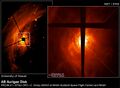 AB Aurigae and its dust disk seen by Hubble
 -
![A light curve for AB Aurigae from MOST satellite data, adapted from Cody et al. (2013)[22]](/wiki/images/thumb/5/5a/ABAurLightCurve.png/120px-ABAurLightCurve.png)
-
 Hubble Space Telescope images of protoplanet AB Aurigae b.

![A light curve for AB Aurigae from MOST satellite data, adapted from Cody et al. (2013)[22]](/wiki/File:ABAurLightCurve.png)

References
- ↑ 1.0 1.1 1.2 1.3 1.4 Vallenari, A. et al. (2022). "Gaia Data Release 3. Summary of the content and survey properties". Astronomy & Astrophysics. doi:10.1051/0004-6361/202243940 Gaia DR3 record for this source at VizieR.
- ↑ Ducati, J. R. (2002). "VizieR Online Data Catalog: Catalogue of Stellar Photometry in Johnson's 11-color system". CDS/ADC Collection of Electronic Catalogues 2237. Bibcode: 2002yCat.2237....0D.
- ↑ 3.0 3.1 3.2 3.3 3.4 Tang, Ya-Wen et al. (May 2017). "Planet Formation in AB Aurigae: Imaging of the Inner Gaseous Spirals Observed inside the Dust Cavity" (in en). The Astrophysical Journal 840 (1): 32. doi:10.3847/1538-4357/aa6af7. ISSN 0004-637X. Bibcode: 2017ApJ...840...32T.
- ↑ 4.0 4.1 4.2 Mooley, Kunal et al. (July 2013). "B- and A-type Stars in the Taurus-Auriga Star-forming Region". The Astrophysical Journal 771 (2): 24. doi:10.1088/0004-637X/771/2/110. 110. Bibcode: 2013ApJ...771..110M.
- ↑ 5.0 5.1 Nicolet, B. (1964). "Catalogue of homogeneous data in the UBV photoelectric photometric system". Astronomy and Astrophysics Supplement Series 34: 1–49. Bibcode: 1978A&AS...34....1N.
- ↑ Samus', N. N. et al. (January 2017). "General catalogue of variable stars: Version GCVS 5.1" (in en). Astronomy Reports 61 (1): 80–88. doi:10.1134/S1063772917010085. ISSN 1063-7729. Bibcode: 2017ARep...61...80S.
- ↑ Gontcharov, G. A. (2006). "Pulkovo Compilation of Radial Velocities for 35 495 Hipparcos stars in a common system". Astronomy Letters 32 (11): 759–771. doi:10.1134/S1063773706110065. Bibcode: 2006AstL...32..759G.
- ↑ 8.0 8.1 8.2 8.3 8.4 Rodríguez, Luis F. et al. (September 2014). "An Ionized Outflow from AB Aur, a Herbig Ae Star with a Transitional Disk". The Astrophysical Journal Letters 793 (1): 4. doi:10.1088/2041-8205/793/1/L21. L21. Bibcode: 2014ApJ...793L..21R.
- ↑ Li, Dan et al. (2016). "An Ordered Magnetic Field in the Protoplanetary Disk of AB Aur Revealed by Mid-infrared Polarimetry". The Astrophysical Journal 832 (1): 18. doi:10.3847/0004-637X/832/1/18. Bibcode: 2016ApJ...832...18L.
- ↑ 10.0 10.1 Tannirkulam, A. et al. (2008). "A Tale of Two Herbig Ae Stars, MWC 275 and AB Aurigae: Comprehensive Models for Spectral Energy Distribution and Interferometry". The Astrophysical Journal 689 (1): 513–531. doi:10.1086/592346. Bibcode: 2008ApJ...689..513T.
- ↑ "AB Aur". SIMBAD. Centre de données astronomiques de Strasbourg. http://simbad.u-strasbg.fr/simbad/sim-basic?Ident=AB+Aur.
- ↑ Cannon, A. J.; Leavitt, H. S.; Bailey, S. I. (May 2, 1921). "Fifty-One New Variable Stars". Harvard College Observatory Circular 225: 1–3. Bibcode: 1921HarCi.225....1C. https://articles.adsabs.harvard.edu/full/1921HarCi.225....1C. Retrieved 28 November 2024.
- ↑ Gagné, Jonathan et al. (March 2018). "BANYAN. XI. The BANYAN Σ Multivariate Bayesian Algorithm to Identify Members of Young Associations with 150 pc" (in en). Astrophysical Journal 856 (1): 23. doi:10.3847/1538-4357/aaae09. ISSN 0004-637X. Bibcode: 2018ApJ...856...23G.
- ↑ 14.0 14.1 Kuffmeier, M.; Goicovic, F. G.; Dullemond, C. P. (2020), "Late encounter events as source of disks and spiral structures", Astronomy & Astrophysics 633: A3, doi:10.1051/0004-6361/201936820
- ↑ "Astronomers Found Spirals Inside a Dust Gap of a Young Star Forming Disk". https://www.almaobservatory.org/en/press-release/astronomers-found-spirals-inside-a-dust-gap-of-a-young-star-forming-disk/.
- ↑ Jorquera, Sebastián et al. (2022), "Large Binocular Telescope Search for Companions and Substructures in the (Pre)transitional Disk of AB Aurigae", The Astrophysical Journal 926 (1): 71, doi:10.3847/1538-4357/ac4be4, Bibcode: 2022ApJ...926...71J
- ↑ 17.0 17.1 17.2 17.3 Currie, Thayne et al. (4 April 2022). "Images of embedded Jovian planet formation at a wide separation around AB Aurigae". Nature Astronomy (Springer Science and Business Media LLC) 6 (6): 751–759. doi:10.1038/s41550-022-01634-x. ISSN 2397-3366. Bibcode: 2022NatAs...6..751C.
- ↑ Speedie, Jessica; Dong, Ruobing; Hall, Cassandra; Longarini, Cristiano; Veronesi, Benedetta; Paneque-Carreño, Teresa; Lodato, Giuseppe; Tang, Ya-Wen et al. (2024-09-05). "Gravitational instability in a planet-forming disk" (in en). Nature 633 (8028): 58–62. doi:10.1038/s41586-024-07877-0. ISSN 1476-4687. PMID 39232150. Bibcode: 2024Natur.633...58S. https://www.nature.com/articles/s41586-024-07877-0.
- ↑ Zhou, Yifan; Sanghi, Aniket; Bowler, Brendan P.; Wu, Ya-Lin; Close, Laird M.; Long, Feng; Ward-Duong, Kimberly; Zhu, Zhaohuan et al. (2022), "HST/WFC3 Hα Direct-imaging Detection of a Pointlike Source in the Disk Cavity of AB Aur", The Astrophysical Journal Letters 934 (1): L13, doi:10.3847/2041-8213/ac7fef, Bibcode: 2022ApJ...934L..13Z
- ↑ Oppenheimer, Ben R. et al. (2008). "The Solar-System-Scale Disk around AB Aurigae". The Astrophysical Journal 679 (2): 1574–1581. doi:10.1086/587778. Bibcode: 2008ApJ...679.1574O.
- ↑ Shibaike, Yuhito; Hashimoto, Jun; Dong, Ruobing; Mordasini, Christoph; Fukagawa, Misato; Muto, Takayuki (2025-01-20). "Predictions of Dust Continuum Emission from a Potential Circumplanetary Disk: A Case Study of the Planet Candidate AB Aurigae b". The Astrophysical Journal 979 (1): 24. doi:10.3847/1538-4357/ad9b21. ISSN 0004-637X. Bibcode: 2025ApJ...979...24S.
- ↑ Cody, Ann Marie; Tayar, Jamie; Hillenbrand, Lynne A.; Matthews, Jaymie M.; Kallinger, Thomas (March 2013). "Precise High-cadence Time Series Observations of Five Variable Young Stars in Auriga with MOST". The Astronomical Journal 145 (3): 79. doi:10.1088/0004-6256/145/3/79. Bibcode: 2013AJ....145...79C. https://ui.adsabs.harvard.edu/abs/2013AJ....145...79C. Retrieved 29 October 2021.
Further reading
- Telleschi, A. et al. (2007). "The first high-resolution X-ray spectrum of a Herbig star: AB Aurigae". Astronomy and Astrophysics 468 (2): 541–556. doi:10.1051/0004-6361:20065422. Bibcode: 2007A&A...468..541T.
- Bitner, Martin A. et al. (2007). "TEXES Observations of Pure Rotational H2 Emission from AB Aurigae". The Astrophysical Journal 661 (1): L69–L72. doi:10.1086/518717. Bibcode: 2007ApJ...661L..69B.
- Fukagawa, Misato et al. (2004). "Spiral Structure in the Circumstellar Disk around AB Aurigae". The Astrophysical Journal 605 (1): L53–L56. doi:10.1086/420699. Bibcode: 2004ApJ...605L..53F.
- Keller, L. P. et al. (2002). "Identification of iron sulphide grains in protoplanetary disks". Nature 417 (6885): 148–150. doi:10.1038/417148a. PMID 12000914. Bibcode: 2002Natur.417..148K. https://zenodo.org/record/1233219.
External links
- Overbye, Dennis (26 March 2008). "Star's Dust May Hold Clue to New Planet". New York Times. https://www.nytimes.com/2008/03/26/science/space/26planet.html.
- Image AB Aurigae
- "Image AB Aurigae". SIMBAD. http://aladin.u-strasbg.fr/AladinPreview?-c=04+55+45.8445%2B30+33+04.292&ident=V*+AB+Aur&submit=Aladin+previewer.
- "AB Aurigae". jumk.de. http://jumk.de/astronomie/exoplanets/ab-aurigae.shtml.
- "Spiral Dance in a Planetary Nursery". Subaru Telescope. http://subarutelescope.org/Pressrelease/2004/04/18/index.html.
- "The Source of Stellar Magnetism". news.softpedia.com. 26 February 2007. http://news.softpedia.com/news/The-Source-of-Stelar-Magnetism-48006.shtml.
- "XMM-Newton unlocks magnetic mystery". iTWire. https://www.itwire.com/space/9860-xmm-newton-unlocks-magnetic-mystery.html.
- "Silicate Stardust in Meteorites". Planetary science research. http://www.psrd.hawaii.edu/June04/silicatesMeteorites.html.
- "Image Multimedia Gallery ESA". ESA. http://www.esa.int/esa-mmg/mmg.pl?b=b&type=I&mission=XMM-Newton&single=y&start=23.
- "ESO Telescope Sees Signs of Planet Birth". European Southern Observatory. https://www.eso.org/public/news/eso2008/.
Archived:
- Overbye, Dennis (2008-03-26). "Star's Dust May Hold Clue to New Planet". www.nytimes.com. https://www.nytimes.com/2008/03/26/science/space/26planet.html.
- "AB Aurigae: How To Make Planets". NASA. http://apod.nasa.gov/apod/ap030208.html.
- "Planet in Progress? Evidence Of A Huge Planet Forming In Star System". Science News. https://www.sciencedaily.com/releases/2008/03/080326123135.htm.
 |  |


