Chemistry:Methyl vinyl ketone

| |

| |
| Names | |
|---|---|
| Preferred IUPAC name
But-3-en-2-one | |
| Other names
MVK
Methylene acetone | |
| Identifiers | |
3D model (JSmol)
|
|
| ChEBI | |
| ChemSpider | |
PubChem CID
|
|
| UNII | |
| |
| |
| Properties | |
| C4H6O | |
| Molar mass | 70.09 g/mol |
| Density | 0.8407 g/cm3 |
| Melting point | −7 °C (19 °F; 266 K) |
| Boiling point | 81.4 °C (178.5 °F; 354.5 K) |
| Hazards | |
| Safety data sheet | Fisher Scientific |
| GHS pictograms |     
|
| GHS Signal word | Danger |
| NFPA 704 (fire diamond) | |
| Flash point | −7 °C (19 °F; 266 K) |
| 370 °C (698 °F; 643 K) | |
| Explosive limits | 2.1% v/v (lower), 15.6% v/v (higher) |
Except where otherwise noted, data are given for materials in their standard state (at 25 °C [77 °F], 100 kPa). | |
 verify (what is verify (what is   ?) ?)
| |
| Infobox references | |

Methyl vinyl ketone (MVK, IUPAC name: butenone) is the organic compound with the formula CH3C(O)CH=CH2. It is a highly reactive compound. It is the simplest enone. It is a colorless, flammable, highly toxic liquid with a pungent odor. It is soluble in water and polar organic solvents. It is a useful intermediate in the synthesis of organic compounds.[2][3]
Production
MVK has been prepared industrially by the condensation of acetone and formaldehyde, followed by dehydration. Similarly it is prepared by the Mannich reaction involving diethylammonium chloride and acetone, which produces the Mannich adduct:[2][4]
- CH3C(O)CH3 + CH2O + [H2NEt2]Cl → [CH3C(O)CH2CH2N(H)Et2]Cl + H2O
Heating this ammonium salt releases the ammonium chloride and the MVK:[4]
- [CH3C(O)CH2CH2N(H)Et2]Cl → CH3C(O)CH=CH2 + [H2NEt2]Cl
Reactivity and applications
MVK can act as an alkylating agent because it is an effective Michael acceptor. It gained early attention for its use in the Robinson annulation, a method useful in the preparation of steroids:
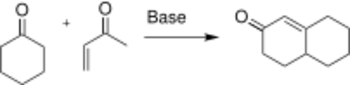
Robinson annulation reaction

Its alkylating ability is both the source of its high toxicity and the feature that makes it a useful intermediate in organic synthesis. MVK will polymerize spontaneously. The compound is typically stored with hydroquinone, which inhibits polymerization.

Vinclozolin is a commercial fungicide prepared using MVK.

As an electrophilic alkene, it forms an adduct with cyclopentadiene. The resulting norbornene derivative is an intermediate in the synthesis of the anticholinergic drug biperiden. Via its cyanohydrin is also a precursor to vinclozolin. It is also a precursor to synthetic vitamin A.[2] MVK is used in the synthesis of Wieland–Miescher ketone.
Safety
MVK is extremely hazardous upon inhalation with an LD50 (rats) on the order of milligrams per cubic meter.[2]
References
- ↑ Merck Index, 11th Edition, 6052.
- ↑ 2.0 2.1 2.2 2.3 Siegel, H.; Eggersdorfer, M.. "Ullmann's Encyclopedia of Industrial Chemistry". Ullmann's Encyclopedia of Industrial Chemistry. Weinheim: Wiley-VCH. doi:10.1002/14356007.a15_077.
- ↑ Colapret, John A.; Buonora, Paul T.; Inomata, Kohei (2008). "Methyl Vinyl Ketone". Encyclopedia of Reagents for Organic Synthesis. doi:10.1002/047084289X.rm276.pub2. ISBN 978-0-471-93623-7.
- ↑ 4.0 4.1 L. Wilds, Alfred; Nowak, Robert M.; McCaleb, Kirtland E. (1957). "1-Diethylamino-3-butanone". Organic Syntheses 37: 18. doi:10.15227/orgsyn.037.0018.
External links
- NJ Hazardous Substance Factsheet for methyl vinyl ketone
- MSDS for methyl vinyl ketone
- Compilation of Henry's law constants for inorganic and organic species of potential importance in environmental chemistry. Sander, R. 1999-04-08.
 |  |


