Injective function: Difference between revisions
Steve Marsio (talk | contribs) update |
DanMescoff (talk | contribs) fixing |
||
| Line 1: | Line 1: | ||
{{ | {{short description|Function that preserves distinctness}} | ||
{{ | {{redirect|Injective|other uses|Injective module|and|Injective object}} | ||
{{ | {{functions}} | ||
In [[Mathematics|mathematics]], an '''injective function''' (also known as '''injection''', or '''one-to-one function'''<ref>Sometimes ''one-one function'' | In [[Mathematics|mathematics]], an '''injective function''' (also known as '''injection''', or '''one-to-one function'''<ref>Sometimes '''one-one function''' in Indian mathematical education. {{cite web |title=Chapter 1: Relations and functions |url=https://ncert.nic.in/ncerts/l/lemh101.pdf |via=NCERT |url-status=live |archive-url=https://web.archive.org/web/20231226194119/https://ncert.nic.in/ncerts/l/lemh101.pdf |archive-date= December 26, 2023 }}</ref>) is a [[Function (mathematics)|function]] {{math|''f''}} that maps [[Distinct (mathematics)|distinct]] elements of its domain to distinct elements of its codomain; that is, {{math|1=''x''<sub>1</sub> ≠ ''x''<sub>2</sub>}} implies {{math|''f''(''x''<sub>1</sub>) {{≠}} ''f''(''x''<sub>2</sub>)}} (equivalently by [[Contraposition|contraposition]], {{math|''f''(''x''<sub>1</sub>) {{=}} ''f''(''x''<sub>2</sub>)}} implies {{math|1=''x''<sub>1</sub> = ''x''<sub>2</sub>}}). In other words, every element of the function's [[Codomain|codomain]] is the [[Image (mathematics)|image]] of {{em|at most}} one element of its [[Domain of a function|domain]].<ref name=":0">{{cite web |url=https://www.mathsisfun.com/sets/injective-surjective-bijective.html |title=Injective, Surjective and Bijective |website=Math is Fun |access-date=2019-12-07 }}</ref> The term {{em|one-to-one function}} must not be confused with {{em|one-to-one correspondence}} that refers to bijective functions, which are functions such that each element in the codomain is an image of ''exactly one'' element in the domain. | ||
A [[Homomorphism|homomorphism]] between [[Algebraic structure|algebraic structure]]s is a function that is compatible with the operations of the structures. For all common algebraic structures, and, in particular for [[Vector space|vector space]]s, an {{em|injective homomorphism}} is also called a {{em|[[Monomorphism|monomorphism]]}}. However, in the more general context of [[Category theory|category theory]], the definition of a monomorphism differs from that of an injective homomorphism.<ref>{{ | A [[Homomorphism|homomorphism]] between [[Algebraic structure|algebraic structure]]s is a function that is compatible with the operations of the structures. For all common algebraic structures, and, in particular for [[Vector space|vector space]]s, an {{em|injective homomorphism}} is also called a {{em|[[Monomorphism|monomorphism]]}}. However, in the more general context of [[Category theory|category theory]], the definition of a monomorphism differs from that of an injective homomorphism.<ref>{{cite web |url=https://stacks.math.columbia.edu/tag/00V5 |title=Section 7.3 (00V5): Injective and surjective maps of presheaves |website=The Stacks project |access-date=2019-12-07 }}</ref> This is thus a theorem that they are equivalent for algebraic structures; see ''{{slink|Homomorphism|Monomorphism}}'' for more details. | ||
A function <math>f</math> that is not injective is sometimes called many-to-one.<ref name=":0" /> | A function <math>f</math> that is not injective is sometimes called many-to-one.<ref name=":0" /> | ||
== Definition == | == Definition == | ||
{{ | {{dark mode invert|[[file:Injection.svg|thumb|alt=The sets X = {1, 2, 3} and Y = {A, B, C, D}, and a function mapping 1 to D, 2 to B, and 3 to A.|An injective function, which is not also [[Surjective function|surjective]]]]}} | ||
Let <math>f</math> be a function whose domain is a set | Let <math>f</math> be a function whose domain is a set {{tmath| X }}. The function <math>f</math> is said to be '''injective''' provided that for all <math>a</math> and <math>b</math> in <math>X,</math> if {{tmath|1= f(a) = f(b)}}, then {{tmath|1= a = b }}; that is, <math>f(a) = f(b)</math> implies {{tmath|1= a = b}}. Equivalently, if {{tmath| a \neq b }}, then <math>f(a) \neq f(b)</math> in the [[Contraposition|contrapositive]] statement. | ||
Symbolically,<math display="block">\forall a,b \in X, \;\; f(a)=f(b) \Rightarrow a=b,</math> | Symbolically,<math display="block">\forall a,b \in X, \;\; f(a)=f(b) \Rightarrow a=b,</math> | ||
which is logically equivalent to the [[Contraposition|contrapositive]],<ref>{{ | which is logically equivalent to the [[Contraposition|contrapositive]],<ref>{{cite web |url=http://www.math.umaine.edu/~farlow/sec42.pdf |title=Section 4.2 Injections, Surjections, and Bijections |last=Farlow |first=S. J. |website=Mathematics & Statistics - University of Maine |access-date=2019-12-06 |url-status=dead |archive-url= https://web.archive.org/web/20191207035302/http://www.math.umaine.edu/~farlow/sec42.pdf |archive-date= Dec 7, 2019 }}</ref><math display="block">\forall a, b \in X, \;\; a \neq b \Rightarrow f(a) \neq f(b).</math>An injective function (or, more generally, a monomorphism) is often denoted by using the specialized arrows ↣ or ↪ (for example, <math>f:A\rightarrowtail B</math> or {{tmath| f:A\hookrightarrow B}}), although some authors specifically reserve ↪ for an [[Inclusion map|inclusion map]].<ref>{{cite web |title=What are usual notations for surjective, injective and bijective functions? |url=https://math.stackexchange.com/questions/46678/what-are-usual-notations-for-surjective-injective-and-bijective-functions |access-date=2024-11-24 |website=Mathematics Stack Exchange |language=en}}</ref> | ||
== Examples == | == Examples == | ||
''For visual examples, readers are directed to the gallery section.'' | ''For visual examples, readers are directed to the gallery section.'' | ||
* For any set <math>X</math> and any subset | * For any set <math>X</math> and any subset {{tmath| S \subseteq X }}, the [[Inclusion map|inclusion map]] <math>S \to X</math> (which sends any element <math>s \in S</math> to itself) is injective. In particular, the [[Identity function|identity function]] <math>X \to X</math> is always injective (and in fact bijective). | ||
* If the domain of a function is the [[Empty set|empty set]], then the function is the empty function, which is injective. | * If the domain of a function is the [[Empty set|empty set]], then the function is the empty function, which is injective. | ||
* If the domain of a function has one element (that is, it is a singleton set), then the function is always injective. | * If the domain of a function has one element (that is, it is a singleton set), then the function is always injective. | ||
* The function <math>f : \R \to \R</math> defined by <math>f(x) = 2 x + 1</math> is injective. | * The function <math>f : \R \to \R</math> defined by <math>f(x) = 2 x + 1</math> is injective. | ||
* The function <math>g : \R \to \R</math> defined by <math>g(x) = x^2</math> is {{em|not}} injective, because (for example) <math>g(1) = 1 = g(-1).</math> However, if <math>g</math> is redefined so that its domain is the non-negative real numbers | * The function <math>g : \R \to \R</math> defined by <math>g(x) = x^2</math> is {{em|not}} injective, because (for example) <math>g(1) = 1 = g(-1).</math> However, if <math>g</math> is redefined so that its domain is the non-negative real numbers {{math|[0, +∞)}}, then <math>g</math> is injective. | ||
* The [[Exponential function|exponential function]] <math>\exp : \R \to \R</math> defined by <math>\exp(x) = e^x</math> is injective (but not [[Surjective function|surjective]], as no real value maps to a negative number). | * The [[Exponential function|exponential function]] <math>\exp : \R \to \R</math> defined by <math>\exp(x) = e^x</math> is injective (but not [[Surjective function|surjective]], as no real value maps to a negative number). | ||
* The [[Natural logarithm|natural logarithm]] function <math>\ln : (0, \infty) \to \R</math> defined by <math>x \mapsto \ln x</math> is injective. | * The [[Natural logarithm|natural logarithm]] function <math>\ln : (0, \infty) \to \R</math> defined by <math>x \mapsto \ln x</math> is injective. | ||
* The function <math>g : \R \to \R</math> defined by <math>g(x) = x^n - x</math> is not injective, since, for example, | * The function <math>g : \R \to \R</math> defined by <math>g(x) = x^n - x</math> is not injective, since, for example, {{tmath|1= g(0) = g(1) = 0}}. | ||
More generally, when <math>X</math> and <math>Y</math> are both the [[Real line|real line]] | More generally, when <math>X</math> and <math>Y</math> are both the [[Real line|real line]] {{tmath| \R }}, then an injective function <math>f : \R \to \R</math> is one whose graph is never intersected by any horizontal line more than once. This principle is referred to as the {{em|[[Horizontal line test|horizontal line test]]}}.<ref name=":0" /> | ||
== Injections can be undone == | == Injections can be undone == | ||
Functions with [[Inverse function#Left and right inverses|left inverses]] are always injections. That is, given | Functions with [[Inverse function#Left and right inverses|left inverses]] are always injections. That is, given {{tmath| f : X \to Y }}, if there is a function <math>g : Y \to X</math> such that for every {{tmath| x \in X }}, {{tmath|1= g(f(x)) = x }}, then <math>f</math> is injective. The proof is that | ||
<math display="block">f(a) = f(b) \rightarrow g(f(a))=g(f(b)) \rightarrow a = b.</math> | <math display="block">f(a) = f(b) \rightarrow g(f(a))=g(f(b)) \rightarrow a = b.</math> | ||
In this case, <math>g</math> is called a retraction of | In this case, <math>g</math> is called a retraction of {{tmath| f }}. Conversely, <math>f</math> is called a section of {{tmath| g }}. | ||
For example: <math>f:\R\rightarrow\R^2,x\mapsto(1,m)^\intercal x</math> is retracted by | For example: <math>f:\R\rightarrow\R^2,x\mapsto(1,m)^\intercal x</math> is retracted by {{tmath| g:y\mapsto\frac{(1,m)}{1+m^2}y }}. | ||
Conversely, every injection <math>f</math> with a non-empty domain has a left inverse <math>g</math>. It can be defined by choosing an element <math>a</math> in the domain of <math>f</math> and setting <math>g(y)</math> to the unique element of the pre-image <math>f^{-1}[y]</math> (if it is non-empty) or to <math>a</math> (otherwise).{{refn|Unlike the corresponding statement that every surjective function has a right inverse, this does not require the [[Axiom of choice|axiom of choice]], as the existence of <math>a</math> is implied by the non-emptiness of the domain. However, this statement may fail in less conventional mathematics such as constructive mathematics. In constructive mathematics, the inclusion <math>\{ 0, 1 \} \to \R</math> of the two-element set in the reals cannot have a left inverse, as it would violate indecomposability, by giving a retraction of the real line to the set {0,1}.}} | Conversely, every injection <math>f</math> with a non-empty domain has a left inverse <math>g</math>. It can be defined by choosing an element <math>a</math> in the domain of <math>f</math> and setting <math>g(y)</math> to the unique element of the pre-image <math>f^{-1}[y]</math> (if it is non-empty) or to <math>a</math> (otherwise).{{refn|Unlike the corresponding statement that every surjective function has a right inverse, this does not require the [[Axiom of choice|axiom of choice]], as the existence of <math>a</math> is implied by the non-emptiness of the domain. However, this statement may fail in less conventional mathematics such as [[Constructive mathematics|constructive mathematics]]. In constructive mathematics, the inclusion <math>\{ 0, 1 \} \to \R</math> of the two-element set in the reals cannot have a left inverse, as it would violate indecomposability, by giving a retraction of the real line to the set {0,1}.}} | ||
The left inverse <math>g</math> is not necessarily an [[Inverse function|inverse]] of <math>f,</math> because the composition in the other order, | The left inverse <math>g</math> is not necessarily an [[Inverse function|inverse]] of <math>f,</math> because the composition in the other order, {{tmath| f \circ g }}, may differ from the identity on {{tmath| Y }}. In other words, an injective function can be "reversed" by a left inverse, but is not necessarily [[Inverse function|invertible]], which requires that the function is bijective. | ||
== Injections may be made invertible == | == Injections may be made invertible == | ||
In fact, to turn an injective function <math>f : X \to Y</math> into a bijective (hence invertible) function, it suffices to replace its codomain <math>Y</math> by its actual image <math>J = f(X).</math> That is, let <math>g : X \to J</math> such that <math>g(x) = f(x)</math> for all | In fact, to turn an injective function <math>f : X \to Y</math> into a bijective (hence invertible) function, it suffices to replace its codomain <math>Y</math> by its actual image <math>J = f(X).</math> That is, let <math>g : X \to J</math> such that <math>g(x) = f(x)</math> for all {{tmath| x \in X }}; then <math>g</math> is bijective. Indeed, <math>f</math> can be factored as {{tmath| \operatorname{In}_{J,Y} \circ g }}, where <math>\operatorname{In}_{J,Y}</math> is the inclusion function from <math>J</math> into {{tmath| Y }}. | ||
More generally, injective [[Partial function|partial function]]s are called partial bijections. | More generally, injective [[Partial function|partial function]]s are called partial bijections. | ||
| Line 52: | Line 51: | ||
* If <math>f</math> and <math>g</math> are both injective then <math>f \circ g</math> is injective. | * If <math>f</math> and <math>g</math> are both injective then <math>f \circ g</math> is injective. | ||
* If <math>g \circ f</math> is injective, then <math>f</math> is injective (but <math>g</math> need not be). | * If <math>g \circ f</math> is injective, then <math>f</math> is injective (but <math>g</math> need not be). | ||
* <math>f : X \to Y</math> is injective if and only if, given any functions | * <math>f : X \to Y</math> is injective if and only if, given any functions {{tmath| g }}, <math>h : W \to X</math> whenever {{tmath|1= f \circ g = f \circ h }}, then {{tmath|1= g = h }}. In other words, injective functions are precisely the [[Monomorphism|monomorphism]]s in the [[Category theory|category]] '''[[Category of sets|Set]]''' of sets. | ||
* If <math>f : X \to Y</math> is injective and <math>A</math> is a [[Subset|subset]] of | * If <math>f : X \to Y</math> is injective and <math>A</math> is a [[Subset|subset]] of {{tmath| X }}, then {{tmath|1= f^{-1}(f(A)) = A }}. Thus, <math>A</math> can be recovered from its image {{tmath| f(A) }}. | ||
* If <math>f : X \to Y</math> is injective and <math>A</math> and <math>B</math> are both subsets of | * If <math>f : X \to Y</math> is injective and <math>A</math> and <math>B</math> are both subsets of {{tmath| X }}, then {{tmath|1= f(A \cap B) = f(A) \cap f(B) }}. | ||
* Every function <math>h : W \to Y</math> can be decomposed as <math>h = f \circ g</math> for a suitable injection <math>f</math> and surjection | * Every function <math>h : W \to Y</math> can be decomposed as <math>h = f \circ g</math> for a suitable injection <math>f</math> and surjection {{tmath| g }}. This decomposition is unique up to isomorphism, and <math>f</math> may be thought of as the inclusion function of the range <math>h(W)</math> of <math>h</math> as a subset of the codomain <math>Y</math> of {{tmath| h }}. | ||
* If <math>f : X \to Y</math> is an injective function, then <math>Y</math> has at least as many elements as <math>X,</math> in the sense of [[Cardinal number|cardinal number]]s. In particular, if, in addition, there is an injection from | * If <math>f : X \to Y</math> is an injective function, then <math>Y</math> has at least as many elements as <math>X,</math> in the sense of [[Cardinal number|cardinal number]]s. In particular, if, in addition, there is an injection from {{tmath| Y }} to {{tmath| X }}, then <math>X</math> and <math>Y</math> have the same cardinal number. (This is known as the Cantor–Bernstein–Schroeder theorem.) | ||
* If both <math>X</math> and <math>Y</math> are [[Finite set|finite]] with the same number of elements, then <math>f : X \to Y</math> is injective if and only if <math>f</math> is surjective (in which case <math>f</math> is bijective). | * If both <math>X</math> and <math>Y</math> are [[Finite set|finite]] with the same number of elements, then <math>f : X \to Y</math> is injective if and only if <math>f</math> is surjective (in which case <math>f</math> is bijective). | ||
* An injective function which is a homomorphism between two algebraic structures is an [[Embedding|embedding]]. | * An injective function which is a homomorphism between two algebraic structures is an [[Embedding|embedding]]. | ||
* Unlike surjectivity, which is a relation between the graph of a function and its codomain, injectivity is a property of the graph of the function alone; that is, whether a function <math>f</math> is injective can be decided by only considering the graph (and not the codomain) of | * Unlike surjectivity, which is a relation between the graph of a function and its codomain, injectivity is a property of the graph of the function alone; that is, whether a function <math>f</math> is injective can be decided by only considering the graph (and not the codomain) of {{tmath| f }}. | ||
== Proving that functions are injective == | == Proving that functions are injective == | ||
A proof that a function <math>f</math> is injective depends on how the function is presented and what properties the function holds. | A proof that a function <math>f</math> is injective depends on how the function is presented and what properties the function holds. | ||
For functions that are given by some formula there is a basic idea. We use the definition of injectivity, namely that if | For functions that are given by some formula there is a basic idea. We use the definition of injectivity, namely that if {{tmath|1= f(x) = f(y) }}, then {{tmath|1= x = y }}.<ref>{{cite web |last=Williams |first=Peter |title=Proving Functions One-to-One |url=http://www.math.csusb.edu/notes/proofs/bpf/node4.html |date=Aug 21, 1996 |website=Department of Mathematics at CSU San Bernardino Reference Notes Page |archive-date= 4 June 2017 |archive-url=https://web.archive.org/web/20170604162511/http://www.math.csusb.edu/notes/proofs/bpf/node4.html }}</ref> | ||
Here is an example: | Here is an example: | ||
<math display="block">f(x) = 2 x + 3</math> | <math display="block">f(x) = 2 x + 3</math> | ||
Proof: Let | Proof: Let {{tmath| f : X \to Y }}. Suppose {{tmath|1= f(x) = f(y) }}. So <math>2 x + 3 = 2 y + 3</math> implies {{tmath|1= 2 x = 2 y }}, which implies {{tmath|1= x = y }}. Therefore, it follows from the definition that <math>f</math> is injective. | ||
There are multiple other methods of proving that a function is injective. For example, in calculus if <math>f</math> is a differentiable function defined on some interval, then it is sufficient to show that the derivative is always positive or always negative on that interval. In linear algebra, if <math>f</math> is a linear transformation it is sufficient to show that the kernel of <math>f</math> contains only the zero vector. If <math>f</math> is a function with finite domain it is sufficient to look through the list of images of each domain element and check that no image occurs twice on the list. | There are multiple other methods of proving that a function is injective. For example, in calculus if <math>f</math> is a differentiable function defined on some interval, then it is sufficient to show that the derivative is always positive or always negative on that interval. In linear algebra, if <math>f</math> is a linear transformation it is sufficient to show that the kernel of <math>f</math> contains only the zero vector. If <math>f</math> is a function with finite domain it is sufficient to look through the list of images of each domain element and check that no image occurs twice on the list. | ||
| Line 75: | Line 74: | ||
A graphical approach for a real-valued function <math>f</math> of a real variable <math>x</math> is the [[Horizontal line test|horizontal line test]]. If every horizontal line intersects the curve of <math>f(x)</math> in at most one point, then <math>f</math> is injective or one-to-one. | A graphical approach for a real-valued function <math>f</math> of a real variable <math>x</math> is the [[Horizontal line test|horizontal line test]]. If every horizontal line intersects the curve of <math>f(x)</math> in at most one point, then <math>f</math> is injective or one-to-one. | ||
==Gallery== | == Gallery == | ||
{{ | {{gallery | ||
|perrow=4 | |perrow=4 | ||
|align=center | |align=center | ||
| | |File:Injection.svg|alt1=The sets X = {1, 2, 3} and Y = {A, B, C, D}, and a function mapping 1 to D, 2 to B, and 3 to A.|An '''injective''' non-surjective function (injection, not a bijection) | ||
| | |File:Bijection.svg|alt2=The sets X = {1, 2, 3, 4} and Y = {A, B, C, D}, and a function mapping 1 to D, 2 to B, 3 to C, and 4 to A.|An '''injective''' surjective function (bijection) | ||
| | |File:Surjection.svg|alt3=The sets X = {1, 2, 3, 4} and Y = {B, C, D}, and a function mapping 1 to D, 2 to B, 3 to C, and 4 to C.|A non-injective surjective function (surjection, not a bijection) | ||
| | |File:Not-Injection-Surjection.svg|alt4=The sets X = {1, 2, 3, 4} and Y = {A, B, C, D}, and a function mapping 1 to D, 2 to B, 3 to C, and 4 to C.|A non-injective non-surjective function (also not a bijection) | ||
}} | }} | ||
{{ | {{gallery | ||
|perrow=3 | |perrow=3 | ||
|align=center | |align=center | ||
| | |File:Non-injective function1.svg|Not an injective function. Here <math>X_1</math> and <math>X_2</math> are subsets of <math>X, Y_1</math> and <math>Y_2</math> are subsets of {{tmath| Y }}: for two regions where the function is not injective because more than one domain [[Element (mathematics)|element]] can map to a single range element. That is, it is possible for {{em|more than one}} <math>x</math> in <math>X</math> to map to the {{em|same}} <math>y</math> in {{tmath| Y }}. | ||
| | |File:Non-injective function2.svg|Making functions injective. The previous function <math>f : X \to Y</math> can be reduced to one or more injective functions (say) <math>f : X_1 \to Y_1</math> and {{tmath| f : X_2 \to Y_2 }}, shown by solid curves (long-dash parts of initial curve are not mapped to anymore). Notice how the rule <math>f</math> has not changed – only the domain and range. <math>X_1</math> and <math>X_2</math> are subsets of <math>X, Y_1</math> and <math>Y_2</math> are subsets of {{tmath| Y }}: for two regions where the initial function can be made injective so that one domain element can map to a single range element. That is, only one <math>x</math> in <math>X</math> maps to one <math>y</math> in {{tmath| Y }}. | ||
| | |File:Injective function.svg|Injective functions. Diagramatic interpretation in the Cartesian plane, defined by the [[Map (mathematics)|mapping]] {{tmath| f : X \to Y }}, where {{tmath|1= y = f(x) }}, {{nowrap|<math>X =</math> domain of function}}, {{nowrap|<math>Y = </math> [[Range of a function|range of function]]}}, and <math>\operatorname{im}(f)</math> denotes image of {{tmath| f }}. Every one <math>x</math> in <math>X</math> maps to exactly one unique <math>y</math> in {{tmath| Y }}. The circled parts of the axes represent domain and range sets — in accordance with the standard diagrams above | ||
}} | }} | ||
== See also == | == See also == | ||
* {{ | * {{annotated link|Bijection, injection and surjection}} | ||
* {{ | * {{annotated link|Injective metric space}} | ||
* {{ | * {{annotated link|Monotonic function}} | ||
* {{ | * {{annotated link|Univalent function}} | ||
== Notes == | == Notes == | ||
{{ | {{reflist|group=note}} | ||
{{ | {{reflist}} | ||
== References == | == References == | ||
* {{ | * {{citation |last1=Bartle |first1=Robert G. |title=The Elements of Real Analysis |publisher=[[Company:John Wiley & Sons|John Wiley & Sons]] |location=New York |edition=2nd |isbn=978-0-471-05464-1 |year=1976 }}, p. 17 ''ff''. | ||
* {{ | * {{citation |last1=Halmos |first1=Paul R. |title=Naive Set Theory |isbn=978-0-387-90092-6 |year=1974 |publisher=Springer |location=New York }}, p. 38 ''ff''. | ||
== External links == | == External links == | ||
| Line 115: | Line 114: | ||
* [http://www.khanacademy.org/math/linear-algebra/v/surjective--onto--and-injective--one-to-one--functions Khan Academy – Surjective (onto) and Injective (one-to-one) functions: Introduction to surjective and injective functions] | * [http://www.khanacademy.org/math/linear-algebra/v/surjective--onto--and-injective--one-to-one--functions Khan Academy – Surjective (onto) and Injective (one-to-one) functions: Introduction to surjective and injective functions] | ||
{{ | {{mathematical logic}} | ||
[[Category:Functions and mappings]] | [[Category:Functions and mappings]] | ||
Latest revision as of 01:17, 16 April 2026
| Function | |||||||||||||||||||||||||||||||||
|---|---|---|---|---|---|---|---|---|---|---|---|---|---|---|---|---|---|---|---|---|---|---|---|---|---|---|---|---|---|---|---|---|---|
| x ↦ f (x) | |||||||||||||||||||||||||||||||||
| Examples by domain and codomain | |||||||||||||||||||||||||||||||||
|
|||||||||||||||||||||||||||||||||
| Classes/properties | |||||||||||||||||||||||||||||||||
| Constant · Identity · Linear · Polynomial · Rational · Algebraic · Analytic · Smooth · Continuous · Measurable · Injective · Surjective · Bijective | |||||||||||||||||||||||||||||||||
| Constructions | |||||||||||||||||||||||||||||||||
| Restriction · Composition · λ · Inverse | |||||||||||||||||||||||||||||||||
| Generalizations | |||||||||||||||||||||||||||||||||
| Partial · Multivalued · Implicit | |||||||||||||||||||||||||||||||||
In mathematics, an injective function (also known as injection, or one-to-one function[1]) is a function f that maps distinct elements of its domain to distinct elements of its codomain; that is, x1 ≠ x2 implies f(x1) Template:≠ f(x2) (equivalently by contraposition, f(x1) = f(x2) implies x1 = x2). In other words, every element of the function's codomain is the image of at most one element of its domain.[2] The term one-to-one function must not be confused with one-to-one correspondence that refers to bijective functions, which are functions such that each element in the codomain is an image of exactly one element in the domain.
A homomorphism between algebraic structures is a function that is compatible with the operations of the structures. For all common algebraic structures, and, in particular for vector spaces, an injective homomorphism is also called a monomorphism. However, in the more general context of category theory, the definition of a monomorphism differs from that of an injective homomorphism.[3] This is thus a theorem that they are equivalent for algebraic structures; see Homomorphism § Monomorphism for more details.
A function that is not injective is sometimes called many-to-one.[2]
Definition
Template:Dark mode invert Let be a function whose domain is a set . The function is said to be injective provided that for all and in if , then ; that is, implies . Equivalently, if , then in the contrapositive statement.
Symbolically, which is logically equivalent to the contrapositive,[4]An injective function (or, more generally, a monomorphism) is often denoted by using the specialized arrows ↣ or ↪ (for example, or ), although some authors specifically reserve ↪ for an inclusion map.[5]
Examples
For visual examples, readers are directed to the gallery section.
- For any set and any subset , the inclusion map (which sends any element to itself) is injective. In particular, the identity function is always injective (and in fact bijective).
- If the domain of a function is the empty set, then the function is the empty function, which is injective.
- If the domain of a function has one element (that is, it is a singleton set), then the function is always injective.
- The function defined by is injective.
- The function defined by is not injective, because (for example) However, if is redefined so that its domain is the non-negative real numbers [0, +∞), then is injective.
- The exponential function defined by is injective (but not surjective, as no real value maps to a negative number).
- The natural logarithm function defined by is injective.
- The function defined by is not injective, since, for example, .
More generally, when and are both the real line , then an injective function is one whose graph is never intersected by any horizontal line more than once. This principle is referred to as the horizontal line test.[2]
Injections can be undone
Functions with left inverses are always injections. That is, given , if there is a function such that for every , , then is injective. The proof is that
In this case, is called a retraction of . Conversely, is called a section of . For example: is retracted by .
Conversely, every injection with a non-empty domain has a left inverse . It can be defined by choosing an element in the domain of and setting to the unique element of the pre-image (if it is non-empty) or to (otherwise).[6]
The left inverse is not necessarily an inverse of because the composition in the other order, , may differ from the identity on . In other words, an injective function can be "reversed" by a left inverse, but is not necessarily invertible, which requires that the function is bijective.
Injections may be made invertible
In fact, to turn an injective function into a bijective (hence invertible) function, it suffices to replace its codomain by its actual image That is, let such that for all ; then is bijective. Indeed, can be factored as , where is the inclusion function from into .
More generally, injective partial functions are called partial bijections.
Other properties
- If and are both injective then is injective.
- If is injective, then is injective (but need not be).
- is injective if and only if, given any functions , whenever , then . In other words, injective functions are precisely the monomorphisms in the category Set of sets.
- If is injective and is a subset of , then . Thus, can be recovered from its image .
- If is injective and and are both subsets of , then .
- Every function can be decomposed as for a suitable injection and surjection . This decomposition is unique up to isomorphism, and may be thought of as the inclusion function of the range of as a subset of the codomain of .
- If is an injective function, then has at least as many elements as in the sense of cardinal numbers. In particular, if, in addition, there is an injection from to , then and have the same cardinal number. (This is known as the Cantor–Bernstein–Schroeder theorem.)
- If both and are finite with the same number of elements, then is injective if and only if is surjective (in which case is bijective).
- An injective function which is a homomorphism between two algebraic structures is an embedding.
- Unlike surjectivity, which is a relation between the graph of a function and its codomain, injectivity is a property of the graph of the function alone; that is, whether a function is injective can be decided by only considering the graph (and not the codomain) of .
Proving that functions are injective
A proof that a function is injective depends on how the function is presented and what properties the function holds. For functions that are given by some formula there is a basic idea. We use the definition of injectivity, namely that if , then .[7]
Here is an example:
Proof: Let . Suppose . So implies , which implies . Therefore, it follows from the definition that is injective.
There are multiple other methods of proving that a function is injective. For example, in calculus if is a differentiable function defined on some interval, then it is sufficient to show that the derivative is always positive or always negative on that interval. In linear algebra, if is a linear transformation it is sufficient to show that the kernel of contains only the zero vector. If is a function with finite domain it is sufficient to look through the list of images of each domain element and check that no image occurs twice on the list.
A graphical approach for a real-valued function of a real variable is the horizontal line test. If every horizontal line intersects the curve of in at most one point, then is injective or one-to-one.
Gallery
-
 An injective non-surjective function (injection, not a bijection)
 -
 An injective surjective function (bijection)
 -
 A non-injective surjective function (surjection, not a bijection)
 -
 A non-injective non-surjective function (also not a bijection)


-
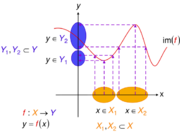 Not an injective function. Here and are subsets of and are subsets of : for two regions where the function is not injective because more than one domain element can map to a single range element. That is, it is possible for more than one in to map to the same in .
 -
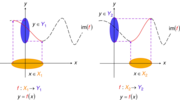 Making functions injective. The previous function can be reduced to one or more injective functions (say) and , shown by solid curves (long-dash parts of initial curve are not mapped to anymore). Notice how the rule has not changed – only the domain and range. and are subsets of and are subsets of : for two regions where the initial function can be made injective so that one domain element can map to a single range element. That is, only one in maps to one in .
 -
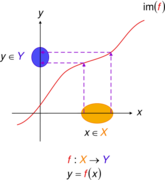 Injective functions. Diagramatic interpretation in the Cartesian plane, defined by the mapping , where , domain of function, range of function, and denotes image of . Every one in maps to exactly one unique in . The circled parts of the axes represent domain and range sets — in accordance with the standard diagrams above


See also
- Bijection, injection and surjection – Properties of mathematical functions
- Injective metric space – Type of metric space
- Monotonic function – Order-preserving mathematical function
- Univalent function – Mathematical concept
Notes
- ↑ Sometimes one-one function in Indian mathematical education. "Chapter 1: Relations and functions". https://ncert.nic.in/ncerts/l/lemh101.pdf.
- ↑ 2.0 2.1 2.2 "Injective, Surjective and Bijective". https://www.mathsisfun.com/sets/injective-surjective-bijective.html.
- ↑ "Section 7.3 (00V5): Injective and surjective maps of presheaves". https://stacks.math.columbia.edu/tag/00V5.
- ↑ Farlow, S. J.. "Section 4.2 Injections, Surjections, and Bijections". http://www.math.umaine.edu/~farlow/sec42.pdf.
- ↑ "What are usual notations for surjective, injective and bijective functions?" (in en). https://math.stackexchange.com/questions/46678/what-are-usual-notations-for-surjective-injective-and-bijective-functions.
- ↑ Unlike the corresponding statement that every surjective function has a right inverse, this does not require the axiom of choice, as the existence of is implied by the non-emptiness of the domain. However, this statement may fail in less conventional mathematics such as constructive mathematics. In constructive mathematics, the inclusion of the two-element set in the reals cannot have a left inverse, as it would violate indecomposability, by giving a retraction of the real line to the set {0,1}.
- ↑ Williams, Peter (Aug 21, 1996). "Proving Functions One-to-One". http://www.math.csusb.edu/notes/proofs/bpf/node4.html.
References
- Bartle, Robert G. (1976), The Elements of Real Analysis (2nd ed.), New York: John Wiley & Sons, ISBN 978-0-471-05464-1, p. 17 ff.
- Halmos, Paul R. (1974), Naive Set Theory, New York: Springer, ISBN 978-0-387-90092-6, p. 38 ff.
External links
- Earliest Uses of Some of the Words of Mathematics: entry on Injection, Surjection and Bijection has the history of Injection and related terms.
- Khan Academy – Surjective (onto) and Injective (one-to-one) functions: Introduction to surjective and injective functions
 |  |


