Chemistry:Hydrazone
Hydrazones are a class of organic compounds with the structure R1
R2
C=N–NH
2.[1] They are related to ketones and aldehydes by the replacement of the oxygen =O with the =N–NH
2 functional group. They are formed usually by the action of hydrazine on ketones or aldehydes.[2][3]
Synthesis
Hydrazine, its hydrate,[4][5] and various organohydrazines react with aldehydes and ketones to give hydrazones:

Phenylhydrazine reacts with reducing sugars to form hydrazones known as osazones, which was developed by German chemist Emil Fischer as a test to differentiate monosaccharides.[6][7] Hydrazones having 1,3-diketomoiety are also known in literature.[8]
More generally, diazonium ions react with carbon acids in the Japp-Klingemann reaction to give hydrazones via tautomeric rearrangement of a diazo intermediate.[9]
Uses
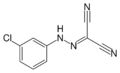
The compound carbonyl cyanide-p-trifluoromethoxyphenylhydrazone (abbreviated as FCCP) is used to uncouple ATP synthesis and reduction of oxygen in oxidative phosphorylation in molecular biology.
Hydrazones are the basis of bioconjugation strategies.[11][12] Hydrazone-based coupling methods are used in medical biotechnology to couple drugs to targeted antibodies (see ADC), e.g. antibodies against a certain type of cancer cell. The hydrazone-based bond is stable at neutral pH (in the blood), but is rapidly destroyed in the acidic environment of lysosomes of the cell. The drug is thereby released in the cell, where it exerts its function.[13]
Reactions
Hydrazones carry two heteroatoms: a double-bonded "imine nitrogen", and a single-bonded "amine nitrogen". Reactivity arises predominantly from the amine nitrogen, which is basic and nucleophilic. When the amine nitrogen is unsubstituted, the hydrazone can condense with a second equivalent of a carbonyl to give azines, e.g.:[14][15]
700px
The nitrogen atom also stabilizes the development of negative charge at the double-bonded carbon atom, umpoling the carbonyl. Aldehydic hydrazones undergo electrophilic substitution there; for example benzylium cations react to give the corresponding ketonic hydrazone.[16] In base, they simply deprotonate: similar to oxime dehydration, they eliminate the amine nitrogen to give a nitrile.[17]
The behavior of ketonic hydrazones in base is more complicated, as they have no aldehydic proton to lose. If the amine nitrogen is unsubstituted, then the molecule can undergo the Wolff–Kishner reduction: first, it deprotonates at the amine nitrogen and then reprotonates at the carbon. The resulting hydrazo compound is unstable and decomposes to an alkane,[18] but can be intercepted to perform a Grignard-like addition.[19]

If the amine nitrogen is instead fully substituted, then the next proton to leave is α to the double-bonded carbon, restoring conventional carbonyl polarity.[20] As such, the amine nitrogen is a convenient location for a chiral auxiliary.[21] This idea is the Enders SAMP/RAMP alkylation and its descendants.[22]
Hydrolysis, which would require another umpolung, is generally a difficult reaction for hydrazones. Nevertheless, alkyl hydrazones are 102- to 103-fold more susceptible to hydrolysis than analogous oximes.[23] The reaction can be performed reliably with BiCl3 acid catalysis.[17] Alternatively, acylation of the amine nitrogen, which reduces its basicity, makes hydrolysis possible with tosylic acid.[24]
Other reactions exploit hydrazones' similarity to the diazo and alkene functionalities. In the Shapiro reaction and descendants (hydrazone iodination and the Bamford–Stevens reaction), α elimination converts a sulfonamidrazone to the diazo, which then decomposes to vinyl compounds.[25] In variants on the Lemieux–Johnson oxidation, strong oxidants peroxidize the imine nitrogen's double-bond to carbon, recovering the carbonyl and a nitrosamine.[17]
Some reductants cleave the nitrogen-nitrogen bond.[17]
Gallery
- Hydrazones
-
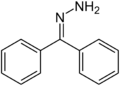 Benzophenone hydrazone, an illustrative hydrazone
 -
-
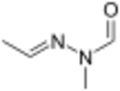 Gyromitrin (acetaldehyde methylformylhydrazone), a toxin
 -
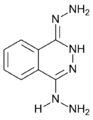 Dihydralazine, an antihypertensive drug
 -
![X-ray structure of DNP-derived hydrazone of benzophenone. Selected parameters: C=N, 128 pm; N-N, 138 pm, N-N-C(Ar), 119 pm[26]](/wiki/images/thumb/3/39/NERYOZ.png/120px-NERYOZ.png) X-ray structure of DNP-derived hydrazone of benzophenone. Selected parameters: C=N, 128 pm; N-N, 138 pm, N-N-C(Ar), 119 pm[26]
X-ray structure of DNP-derived hydrazone of benzophenone. Selected parameters: C=N, 128 pm; N-N, 138 pm, N-N-C(Ar), 119 pm[26]


![X-ray structure of DNP-derived hydrazone of benzophenone. Selected parameters: C=N, 128 pm; N-N, 138 pm, N-N-C(Ar), 119 pm[26]](/wiki/File:NERYOZ.png)
See also
References
- ↑ March, Jerry (1985), Advanced Organic Chemistry: Reactions, Mechanisms, and Structure (3rd ed.), New York: Wiley, ISBN 0-471-85472-7
- ↑ Stork, G.; Benaim, J. (1977). "Monoalkylation of α,β-Unsaturated Ketones via Metalloenamines: 1-butyl-10-methyl-Δ1(9)-2-octalone". Organic Syntheses 57: 69. http://www.orgsyn.org/demo.aspx?prep=cv6p0242.; Collective Volume, 6, pp. 242
- ↑ Day, A. C.; Whiting, M. C. (1970). "Acetone hydrazone". Organic Syntheses 50: 3. http://www.orgsyn.org/demo.aspx?prep=cv6p0010.; Collective Volume, 6, pp. 10
- ↑ Outirite, Moha; Lebrini, Mounim; Lagrenée, Michel; Bentiss, Fouad (2008). "New one step synthesis of 3,5-disubstituted pyrazoles under microwave irradiation and classical heating". Journal of Heterocyclic Chemistry 45 (2): 503–505. doi:10.1002/jhet.5570450231.
- ↑ Zhang, Ze; Tan, Ya-Jun; Wang, Chun-Shan; Wu, Hao-Hao (2014). "One-pot synthesis of 3,5-diphenyl-1H-pyrazoles from chalcones and hydrazine under mechanochemical ball milling". Heterocycles 89 (1): 103–112. doi:10.3987/COM-13-12867.
- ↑ Fischer, Emil (1908). "Schmelzpunkt des Phenylhydrazins und einiger Osazone". Berichte der Deutschen Chemischen Gesellschaft 41: 73–77. doi:10.1002/cber.19080410120. https://zenodo.org/record/1426269.
- ↑ Fischer, Emil (1894). "Ueber einige Osazone und Hydrazone der Zuckergruppe". Berichte der Deutschen Chemischen Gesellschaft 27 (2): 2486–2492. doi:10.1002/cber.189402702249. https://zenodo.org/record/1425750.
- ↑ Singh, Raman; Halve, Anand K. (2025-06-28). "Synthesis of New Hydrazones Containing 1,3-Diketo Moiety" (in en). RSYN Chemical Sciences 2 (1): 1–6. doi:10.70130/RCS.2025.0201001. https://pubs.rsyn.org/rcs/article/view/96.
- ↑ Parmerter, Stanley M. (1959). Organic Reactions. 10. doi:10.1002/0471264180.or010.01.
- ↑ Christie, R.; Hill, J.; Rosair, G. (2006). "The crystal structure of CI Pigment Yellow 97, a superior performance Hansa yellow pigment". Dyes and Pigments 71 (3): 194–198. doi:10.1016/j.dyepig.2005.07.001.
- ↑ Kölmel, Dominik K.; Kool, Eric T. (2017). "Oximes and Hydrazones in Bioconjugation: Mechanism and Catalysis". Chemical Reviews 117 (15): 10358–10376. doi:10.1021/acs.chemrev.7b00090. PMID 28640998.
- ↑ Algar, W. Russ; Prasuhn, Duane E.; Stewart, Michael H.; Jennings, Travis L.; Blanco-Canosa, Juan B.; Dawson, Philip E.; Medintz, Igor L. (2011). "The Controlled Display of Biomolecules on Nanoparticles: A Challenge Suited to Bioorthogonal Chemistry". Bioconjugate Chemistry 22 (5): 825–858. doi:10.1021/bc200065z. PMID 21585205.
- ↑ Wu, Anna M.; Senter, Peter D. (7 September 2005). "Arming antibodies: prospects and challenges for immunoconjugates". Nature Biotechnology 23 (9): 1137–46. doi:10.1038/nbt1141. PMID 16151407.
- ↑ Day, A. C.; Whiting, M. C. (1970). "Acetone Hydrazone". Organic Syntheses 50: 3. doi:10.15227/orgsyn.050.0003.
- ↑ Lasri, Jamal; Ismail, Ali I. (2018). "Metal-free and FeCl3-catalyzed synthesis of azines and 3,5-diphenyl-1H-pyrazole from hydrazones and/or ketones monitored by high resolution ESI+-MS". Indian Journal of Chemistry, Section B 57B (3): 362–373. http://nopr.niscair.res.in/handle/123456789/43824.
- ↑ Maji, Biplab; Troshin, Konstantin; Mayr, Herbert (2013-11-04). "Ambident Reactivities of Formaldehyde N , N ‐Dialkylhydrazones" (in en). Angewandte Chemie International Edition 52 (45): 11900–11904. doi:10.1002/anie.201305092. ISSN 1433-7851. https://onlinelibrary.wiley.com/doi/10.1002/anie.201305092.
- ↑ 17.0 17.1 17.2 17.3 Enders, Dieter; Wortmann, Lars; Peters, René (2000). "Recovery of Carbonyl Compounds from N,N-Dialkylhydrazones". Accounts of Chemical Research 33 (3): 157–169. doi:10.1021/ar990062y. PMID 10727205. https://pubs.acs.org/doi/10.1021/ar990062y.
- ↑ Szmant, H. H. (1968). "The Mechanism of the Wolff-Kishner Reduction, Elimination, and Isomerization Reactions". Angewandte Chemie International Edition in English 7 (2): 120–128. doi:10.1002/anie.196801201.
- ↑ Wang, H; Dai, X.-J.; Li, C.-J. (2017). "Aldehydes as alkyl carbanion equivalents for additions to carbonyl compounds". Nature Chemistry 9 (4): 374–378. doi:10.1038/nchem.2677. PMID 28338683.
- ↑ Enders, Dieter; Reinhold, Ulrich (1997). "Asymmetric synthesis of amines by nucleophilic 1,2-addition of organometallic reagents to the CN-double bond". Tetrahedron: Asymmetry 8 (12): 1895–1946. doi:10.1016/S0957-4166(97)00208-5.
- ↑ Lazny, R.; Nodzewska, A. (2010). "N,N-dialkylhydrazones in organic synthesis. From simple N,N-dimethylhydrazones to supported chiral auxiliaries". Chemical Reviews 110 (3): 1386–1434. doi:10.1021/cr900067y. PMID 20000672.
- ↑ Enders, Dieter; Kipphardt, Helmut; Fey, Peter (1987). "Asymmetric Syntheses Using the SAMP-/RAMP-Hydrazone Method: (S)-(+)-4-methyl-3-heptanone". Organic Syntheses 65: 183. doi:10.15227/orgsyn.065.0183.
- ↑ Kalia, J.; Raines, R. T. (2008). "Hydrolytic stability of hydrazones and oximes". Angew. Chem. Int. Ed. 47 (39): 7523–6. doi:10.1002/anie.200802651. PMID 18712739.
- ↑ Wengryniuk, S. E.; Lim, D.; Coltart, D. M. (2011). "Regioselective Asymmetric α,α-Bisalkylation of Ketones via Complex-Induced Syn-Deprotonation of Chiral N-Amino Cyclic Carbamate Hydrazones". Journal of the American Chemical Society 133 (22): 8714–8720. doi:10.1021/ja202267k. PMID 21510644.
- ↑ 吕, 萍 (2022) (in Chinese). 中级有机化学--反应与机理 (2nd ed.). 高等教育出版社. pp. 279–280. ISBN 978-7-04-058063-1.
- ↑ Tameem, Abdassalam Abdelhafiz; Salhin, Abdussalam; Saad, Bahruddin; Rahman, Ismail Ab.; Saleh, Muhammad Idiris; Ng, Shea-Lin; Fun, Hoong-Kun (2006). "Benzophenone 2,4-dinitrophenylhydrazone". Acta Crystallographica Section E 62 (12): o5686–o5688. doi:10.1107/S1600536806048112.
 |  |


