Physics:Quantum Matter Elements and Particles
This page offers a guide to the different types of matter in the universe. From chemical elements to fundamental particles. It gives an overview of atoms, subatomic particles, and composite particles. The building blocks of matter and how they combine to form everything. It shows chemical elements and its arrangement in the periodic table.[1] Describes the Standard Model, and list the fundamental particles and the forces they have.[2] Composite particles like protons, neutrons, and mesons show how quarks form larger structures.[3] Visual aids, tables, and formulas help illustrate particle types and their relationships. This resource is intended for students, educators, and anyone curious about the structure of matter.

How many different Elements and Particles Exist?

The universe is made of tiny building blocks, known as particles. These particles combine to form atoms, molecules, and matter. Elements contain only one type of atom. There are 118 known chemical elements, each with properties and atomic structure.[1] Atoms are made of subatomic particles: protons, neutrons, and electrons.[4] Protons and neutrons are made of quarks, which are matter particles.[3] The Standard Model of physics includes all known fundamental particles and the forces between them.[2] Composite particles, such as hadrons and mesons, are formed from combinations of quarks.[3] By studying these particles scientists find the structure, behavior, and evolution of the universe.
The following diagram illustrates the tri-partite metaphysical scheme for analyzing parts of material nature.
![tri-partite metaphysical scheme]](/wiki/File:Tri-partite_meta_scheme.svg)
This diagram also illustrates the power of visualization to communicate information between human minds, especially about objects and relationships. There is limited use of language (only verbal ‘tags’), no mathematics while the figures could be any shape or color.
1. Overview
| Level | Count | Description |
|---|---|---|
| Chemical elements | 118 | Periodic table atoms[1] |
| Fundamental particles | 31–32 | Standard Model building blocks[2] |
| Common subatomic particles | Dozens | Electrons, protons, neutrons, etc.[4] |
| Composite particles | 400+ | Hadrons, mesons, exotic states[3] |
2. Chemical Elements (Periodic Table)
There are 118 confirmed elements.[1]
Gallery
Alternative periodic table expressions
-
 ADOMAH (long)
 -
 Curled ribbon (continuous)
 -
 Four loops (continuous)
 -
 Partially disordered (unclassified)
 -
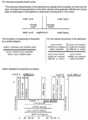 Short (9/11 columns) notes
 -
 Spiral
 -
 Ziggurat (unclassified)
 -
 Ziggurat notes
 -
 4D Stowe-Scerri (spatial)
.svg)


.png)
.SVG)


2.1 All known elements
| Part of a series on |
| Quantum mechanics |
|---|
Hydrogen, Helium, Lithium, Beryllium, Boron, Carbon, Nitrogen, Oxygen, Fluorine, Neon, Sodium, Magnesium, Aluminum, Silicon, Phosphorus, Sulfur, Chlorine, Argon, Potassium, Calcium, Scandium, Titanium, Vanadium, Chromium, Manganese, Iron, Cobalt, Nickel, Copper, Zinc, Gallium, Germanium, Arsenic, Selenium, Bromine, Krypton, Rubidium, Strontium, Yttrium, Zirconium, Niobium, Molybdenum, Technetium, Ruthenium, Rhodium, Palladium, Silver, Cadmium, Indium, Tin, Antimony, Tellurium, Iodine, Xenon, Cesium, Barium, Lanthanides, Hafnium, Tantalum, Tungsten, Rhenium, Osmium, Iridium, Platinum, Gold, Mercury, Thallium, Lead, Bismuth, Polonium, Astatine, Radon, Francium, Radium, Actinides, Rutherfordium, Dubnium, Seaborgium, Bohrium, Hassium, Meitnerium, Darmstadtium, Roentgenium, Copernicium, Nihonium, Flerovium, Moscovium, Livermorium, Tennessine, Oganesson[1]
3. Subatomic Particles
| Particle | Type | Notes |
|---|---|---|
| Electron | Lepton | Fundamental[5] |
| Proton | Baryon | Composed of quarks[6] |
| Neutron | Baryon | Composed of quarks[7] |
| Photon | Boson | Force carrier (electromagnetism)[8] |
| Neutrinos | Lepton | Three flavors[9] |
| Muon | Lepton | Heavier electron[10] |
| Tau | Lepton | Heaviest lepton[11] |
| Quarks | Fermion | Six flavours (u, d, s, c, t, b)[12] |
In 1985, Alan Chodos [13]
proposed that neutrinos can have a tachyonic nature.[14] The possibility of standard model particles moving at faster-than-light speeds can be modeled using Lorentz invariance violating terms, for example in the Standard-Model Extension.[15][16] In this framework, neutrinos experience Lorentz-violating oscillations and can travel faster than light at high energies. This proposal was strongly criticized.[17]
3.1 Symbols
| Symbol | Description | Symbol | Description | |
|---|---|---|---|---|
| Coherent state amplitude | Force | |||
| Vector notation | Conductance or Gain | |||
| Dispersive frequency shift | Planck constant | |||
| Tunneling rate or Detuning | Electrical current | |||
| Dirac or Kronecker delta function | Inductance | |||
| Energy asymmetry | Number of Cooper pairs | |||
| Efficiency | Probability or Probability density | |||
| Rate | Measurement result | |||
| Reduced Planck constant | Resistance quantum | |||
| Generalized eigenvalue or Cavity escape rate | Noise spectral density or Scattering matrix | |||
| Eigenvalue or Wavelength or Coupling constant | Duration of time | |||
| Magnetic moment | Voltage or Potential | |||
| Frequency | Wiener random variable | |||
| Magnetic flux | Bloch coordinates | |||
| Phase | Spherical harmonic | |||
| Magnetic flux quantum | Impedance or Partition function | |||
| Projection operator | Average of A | |||
| Quantum state | Stochastic Hamiltonian | |||
| Correlation time | Lindbladian or Lagrangian density | |||
| Characteristic measurement time | Purity | |||
| Temperature | Wigner-Smith time delay matrix | |||
| Langevin random variable | Accumulated charge | |||
| Complex conjugate | Signal-to-noise ratio | |||
| Hermitian conjugate | Stochastic action | |||
| Amplitude | Time-ordering operator or Transmission | |||
| Magnetic field | Kraus (or measurement) operator | |||
| Inverse temperature or Bhattacharyya coefficient or Concurrence | Density operator | |||
| Speed of light in a vacuum | Unnormalized density operator or Pauli operator | |||
| Displacement operator or Bhattacharyya distance | Time-reversal operator | |||
| Degree of decoherence | Bosonic annihilation operators | |||
| Wiener increment | Hamiltonian operator | |||
| POVM element or Electric field | Lindblad operator | |||
| Electron charge or Euler's number | Unitary operator | |||
| Charging energy | Quadrature operators | |||
| Fermi energy | Operator or Observable | |||
| Josephson energy |
4. Fundamental Particles (Standard Model)

The Standard Model of particle physics is the theory describing three of the four known fundamental forces (electromagnetic, weak and strong interactions – excluding gravity) in the universe and classifying all known elementary particles. It was developed in stages throughout the latter half of the 20th century, through the work of many scientists worldwide.with the current formulation being finalized in the mid-1970s upon experimental confirmation of the existence of quarks. Since then, proof of the top quark (1995), the tau neutrino (2000), and the Higgs boson (2012) have added further credence to the Standard Model. In addition, the Standard Model has predicted various properties of weak neutral currents and the W and Z bosons with great accuracy.
| Category | Particles | Count |
|---|---|---|
| Quarks | up, down, charm, strange, top, bottom | 6[3] |
| Antiquarks | anti‑up, anti‑down, anti‑charm, anti‑strange, anti‑top, anti‑bottom | 6[3] |
| Leptons | electron, muon, tau, neutrinos | 6[4] |
| Antileptons | positron, anti‑muon, anti‑tau, anti‑neutrinos | 6[4] |
| Total fermions | 24[3] | |
| Bosons | photon, gluon, W+, W−, Z0, Higgs | 6[2] |
| Gravity (theoretical) | graviton | 1[2] |
| Total bosons | 7[2] | |
| Grand total | 31–32[2] |
4.1 Key Formulas
- Fermions: [3]
- Standard Model total: [2]
- Baryon structure: [3]
- Meson structure: [3]
5. Composite Particles (Hadron Zoo)
| Type | Examples | Notes |
|---|---|---|
| Baryons | proton, neutron, Δ, Σ, Ξ, Ω | 3 quarks [1] |
| Mesons | π, K, η, ρ | 1 quark + 1 antiquark [2] |
| Exotic | tetraquarks, pentaquarks | 4 or 5 quark states [3] |
| Resonances | many | short-lived states[4] |
5.1 Quarks
| Spin, S |
Orbital angular momentum, L |
Total angular momentum, J |
Parity, P |
Condensed notation, JP |
|---|---|---|---|---|
| 1/2 | 0 | 1/2 | + | 1/2+ |
| 1 | 3/2, 1/2 | − | 3/2−, 1/2− | |
| 2 | 5/2, 3/2 | + | 5/2+, 3/2+ | |
| 3 | 7/2, 5/2 | − | 7/2−, 5/2− | |
| 3/2 | 0 | 3/2 | + | 3/2+ |
| 1 | 5/2, 3/2, 1/2 | − | 5/2−, 3/2−, 1/2− | |
| 2 | 7/2, 5/2, 3/2, 1/2 | + | 7/2+, 5/2+, 3/2+, 1/2+ | |
| 3 | 9/2, 7/2, 5/2, 3/2 | − | 9/2−, 7/2−, 5/2−, 3/2− |
| S | L | P | J | JP |
|---|---|---|---|---|
| 0 | 0 | − | 0 | 0− |
| 1 | + | 1 | 1+ | |
| 2 | − | 2 | 2− | |
| 3 | + | 3 | 3+ | |
| 1 | 0 | − | 1 | 1− |
| 1 | + | 2, 0 | 2+, 0+ | |
| 2 | − | 3, 1 | 3−, 1− | |
| 3 | + | 4, 2 | 4+, 2+ |
A tetraquark is an exotic meson composed of four valence quarks. A tetraquark state has long been suspected to be allowed by quantum chromodynamics,[18] the modern theory of strong interactions. A tetraquark state is an example of an exotic hadron that lies outside the conventional quark model classification. A number of different types of tetraquark have been observed.
Several tetraquark candidates have been reported by particle physics experiments in the 21st century. The quark contents of these states are almost all qqQQ, where q represents a light (up, down or strange) quark, Q represents a heavy (charm or bottom) quark, and antiquarks are denoted with an overline. The existence and stability of tetraquark states with the qqQQ (or qqQQ) have been discussed by theoretical physicists for a long time, however these are yet to be reported by experiments.[19]
A particle temporarily called X(3872), by the Belle experiment in Japan, was proposed to be a tetraquark candidate,[20] as originally theorized.[21]
The name X is a temporary name, indicating that there are still some questions about its properties to be tested. The number following is the mass of the particle in MeV/c²

A pentaquark is a subatomic particle, consisting of four quarks and one antiquark bound together. Evidence for the existence of pentaquarks has been found. As quarks have a baryon number of ++1/3, and antiquarks of −+1/3, the pentaquark would have a total baryon number of 1, and thus would be a baryon. Further, because it has five quarks instead of the usual three found in regular baryons (A.k.a. "triquarks"), it is classified as an exotic baryon. The name pentaquark was coined by Claude Gignoux et al. (1987)[23] and Harry J. Lipkin in 1987; however, the possibility of five-quark particles was identified as early as 1964 when Murray Gell-Mann first postulated the existence of quarks. Although predicted for decades, pentaquarks proved surprisingly difficult to discover and some physicists were beginning to suspect that an unknown law of nature prevented their production.
5.2 Tachyon

- This section is about hypothetical faster-than-light particles. For quantum fields with imaginary mass, see tachyonic fields.
A tachyon (or tachyonic particle) is a hypothetical type of particle that would move only at speeds faster than light. Modern physics, however, rules out the existence of such faster-than-light particles because they conflict with established physical laws. Relativity rules out speeds faster than light.[24][25] If tachyons were real, they might allow information to be transmitted faster than light, possibly even backward in time, That would violate causality and create logical contradictions such as the grandfather paradox.[26]
In theory, tachyons would behave weird: their speed would increase as their energy decreased, and bringing them down to the speed of light would require infinite energy, effectively making them the “inverse” of the usual relationship. No experiment has ever produced reliable evidence for their existence.
The name tachyon originates from a 1967 paper by Gerald Feinberg, who studied quantum-field excitations with an imaginary mass. Later research showed that these excitations do not correspond to real faster-than-light particles, though physicists still use the term “tachyon” in contexts such as tachyon condensation, where it refers to unstable or imaginary-mass fields rather than actual particles.
As noted by Albert Einstein, Richard C. Tolman, special relativity implies that faster-than-light particles, if they existed, could be used to communicate backwards in time.[27]
6. Graph Example
The Standard Model of particle physics is describing a part of the known fundamental forces (Weak and strong interactions electromagnetic– not including gravity in the universe and containing all known elementary particles.[2] Developed in the second half of the 20th century, by many scientists worldwide, with the current formulas finalized in the middle of 1970. Experiments proof of the existence of quarks. Proof of the top quark (1994), the tau neutrino (2001), and the Higgs boson (2013) have added to the Standard Model.[3] The Standard Model predicted various properties of weak currents and the W and Z bosons.[2]
Standard Model is theoretically self-consistent and has some success in providing predictions, Some unexplained physical phenomena make it to fall short of being a complete theory of fundamental interactions. It does not explain why there is more matter than anti-matter. The full theory of gravitation as per general relativity, account for the universe's expansion as may be described by dark energy. This model not contains any viable dark matter particle that has all of the properties found from observational cosmology. It also does not has neutrino oscillations and their masses.[3]
The Standard Model is used by theoretical and experimental particle physicists. The Standard Model is basis of a quantum field theory, exhibiting lots of phenomena, including symmetry breaking, anomalies, and different behavior. It is a basis for more exotic models for hypothetical particles, Multidimensional scaling, and symmetries and supersymmetry, to see results at with the Standard Model, such neutrino oscillations and dark matter.[2]
7. Simple Explanation for Kids
Everything around us your toys, the air, even you, is made of tiny building blocks called **particles**.[4] At the smallest level, these particles combine in fun ways to form atoms, molecules, and more.[1]
| Image | What It Means |
|---|---|
 |
This shows an atom with a nucleus in the center and electrons around it. Atoms are like LEGO bricks of the universe. |
 |
A proton has three quarks: two "up" quarks (u) and one "down" quark (d). The colors of the quarks in the diagram help show that up and down quarks are different types. In real physics, quarks also have a property called “color charge” (red, green, blue) that keeps them stuck together.[3] |
 |
A neutron has one "up" quark and two "down" quarks. Again, the color coding shows the difference between the types of quarks, and each quark also has a color charge that helps hold the neutron together.[3] |
Here’s how to think about it:
- Atoms are like tiny LEGO bricks.
- Inside protons and neutrons are quarks, even smaller building blocks.[3]
- Quarks are glued together by the strong force.[3]
- Diagrams use colors to show different quark types (up vs down) and their “color charge” (red, green, blue).
- Protons and neutrons stick together in the nucleus, while electrons orbit around it.
- Molecules form when atoms join, making everything you see.
- Learning about these tiny pieces helps us understand why matter behaves the way it does and how the universe is built.
8. Advanced Explanation
| Particle | Field |
|---|---|
| Electron | electron field[4] |
| Up quark | up‑quark field[3] |
| Photon | electromagnetic field[2] |
| Higgs boson | Higgs field[2] |
8.1 Electron

The electron , or in nuclear reactions is a negatively charged subatomic particle and an elementary particle that, with up quarks and down quarks, forms ordinary matter.
Electrons are very light and occupy orbitals around a atomic nucleus. Their arrangement defines an atom’s chemical properties, with outer valence electron forming chemical bonds and driving chemical reactions, while inner electrons make up the atomic core.
In metals, delocalised electrons allow high electrical and thermal conductivity. In semiconductors, electron and hole numbers can be tuned by doping, temperature, voltage, or radiation, enabling electronics.
Free electrons in vacuums can be accelerated and focused for applications like cathode ray tubes, electron microscopes, electron beam welding, lithography, and particle accelerators producing synchrotron radiation.
8.2 Up quark

The up quark (symbol: 𝑢) is the lightest quark and one of the basic building blocks of matter. Together with the down quark, it makes up protons and neutrons:
It belongs to the first and lightest family of quarks. It has an electric charge of (twice the charge of a down quark, but only 2/3 of an electron’s charge) a very tiny mass, about (roughly 1/2000 the mass of a proton). Like all quarks, it has spin (making it a fermion) and experiences all four fundamental forces: gravitation, electromagnetism, the weak force, and the strong nuclear force. Its antiparticle is the anti-up quark; it has the same properties except that its charge is and a few other properties are reversed. The existence of the up quark (along with down and strange quarks) was proposed in 1964 by Murray Gell-Mann and George Zweig to explain observed patterns in subatomic particles. It was first directly observed in experiments at Stanford Linear Accelerator Center in 1968.
8.3 Photon

A photon (Greek φωτός), light is an elementary particle that is a quantum of the electromagnetic field, including electromagnetic radiation such as light and radio waves, and the force carrier for the electromagnetic force.
Photons are massless and can move only at one speed: the , the speed of light in vacuum. The photon belongs to the class of boson particles.
The photon has no electric charge,[28][29] is generally considered to have zero rest mass,[30] and is a stable particle. The experimental upper limit on the photon mass[31][32] is very small, on the order of 10−53 g; its lifetime would be more than 1018 years.[33]
8.4 Higgs field

The Higgs field is an invisible field that permeates all of space, giving mass to elementary particles that interact with it. Particles gain mass by interacting with the field, much like a person moving through mud. The more a particle interacts with the Higgs field, the more mass it has. The existence of this field was confirmed by the discovery of the Higgs boson, which is an excitation or ripple in the field.
- Mass: The Higgs field is a medium that particles move through: Particles that interact strongly with the Higgs field are “slowed down” → they behave as if they have larger mass. Particles that interact weakly get small mass. Particles that do not interact at all (like photons) remain massless.This interaction is not friction; it’s a fundamental quantum interaction.
- The Higgs boson: Is a ripple (excitation) in the Higgs field. Discovered in 2012 at CERN. Its existence confirmed the mechanism that gives particles mass.
- Mechanism: The interaction between a particle and the field is what gives the particle its mass. It is a fundamental concept in the Standard Model of particle physics that explains why some particles have mass and others do not.
Gauge symmetries:
Electromagnetism[2]
- Weak force[2]
- Strong force[2]
9. Summary Table
| Category | Count | Notes |
|---|---|---|
| Chemical elements | 118 | Periodic table[1] |
| Fundamental particles | 31–32 | Standard Model[2] |
| Subatomic particles | Dozens | Commonly observed[4] |
| Composite particles | 400+ | Hadrons, mesons, exotic states[3] |
| Bosons | 6 confirmed | Photon, gluon, W+, W−, Z0, Higgs[2] |
| Fermions | 24 | Quarks + leptons + antiparticles[3] |
External links
- Particle Data Group – Particle Listings [3]
- CERN – Standard Model overview [2]
- IUPAC – Periodic Table of Elements [1]
- Fermilab – Quarks and Leptons [4]
See also
Table of contents (185 articles)
Index
Full contents


References
- ↑ 1.0 1.1 1.2 1.3 1.4 1.5 1.6 1.7 1.8 IUPAC. "Periodic Table of Elements." https://iupac.org/what-we-do/periodic-table-of-elements/
- ↑ 2.00 2.01 2.02 2.03 2.04 2.05 2.06 2.07 2.08 2.09 2.10 2.11 2.12 2.13 2.14 2.15 2.16 2.17 2.18 2.19 CERN. "The Standard Model of Particle Physics." https://home.cern/science/physics/standard-model
- ↑ 3.00 3.01 3.02 3.03 3.04 3.05 3.06 3.07 3.08 3.09 3.10 3.11 3.12 3.13 3.14 3.15 3.16 3.17 3.18 3.19 3.20 Particle Data Group. "Particle Listings." https://pdg.lbl.gov
- ↑ 4.0 4.1 4.2 4.3 4.4 4.5 4.6 4.7 4.8 Fermilab. "Quarks and Leptons." https://www.fnal.gov
- ↑ Fermilab. "Electron." Fermilab Particle Data. https://www.fnal.gov/
- ↑ Particle Data Group (PDG). "Proton." *Review of Particle Physics*, 2022. https://pdg.lbl.gov/
- ↑ Particle Data Group (PDG). "Neutron." *Review of Particle Physics*, 2022. https://pdg.lbl.gov/
- ↑ CERN. "Photon." CERN Document Server. https://home.cern/science/physics/photon
- ↑ Particle Data Group (PDG). "Neutrinos." *Review of Particle Physics*, 2022. https://pdg.lbl.gov/
- ↑ Fermilab. "Muon." Fermilab Particle Data. https://www.fnal.gov/
- ↑ Fermilab. "Tau." Fermilab Particle Data. https://www.fnal.gov/
- ↑ Particle Data Group (PDG). "Quarks." *Review of Particle Physics*, 2022. https://pdg.lbl.gov/
- ↑ Chodos, Alan. "Reference Paper." *SCIRP References*. Accessed 27 November 2025. https://www.scirp.org/reference/referencespapers?referenceid=3609068
- ↑ Chodos, A. (1985). "The neutrino as a tachyon." *Physics Letters B*, 150(6), 431–435. doi:10.1016/0370-2693(85)90460-5
- ↑ Colladay, D.; Kostelecky, V. A. (1998). "Lorentz-Violating Extension of the Standard Model." *Physical Review D*, 58(11), 116002. doi:10.1103/PhysRevD.58.116002. arXiv:hep-ph/9809521
- ↑ Kostelecky, V. A. (2004). "Gravity, Lorentz Violation, and the Standard Model." *Physical Review D*, 69(10), 105009. doi:10.1103/PhysRevD.69.105009. arXiv:hep-th/0312310
- ↑ Hughes, Richard J.; Stephenson, G. J. (1990). "Against Tachyonic Neutrinos." *Physics Letters B*, 244(1), 95–100. doi:10.1016/0370-2693(90)90275-B. https://zenodo.org/record/1258487
- ↑ U. Kulshreshtha; D. S. Kulshreshtha; J. P. Vary (2015). "Hamiltonian, path integral and BRST formulations of large N scalar QCD2 on the light-front and spontaneous symmetry breaking". European Physical Journal C 75 (4): 1. doi:10.1140/epjc/s10052-015-3377-x. Bibcode: 2015EPJC...75..174K.
- ↑ Si-Qiang, Luo; Kan, Chen; Xiang, Liu; Yan-Rui, Liu; Shi-Lin, Zhu (25 October 2017). "Exotic tetraquark states with the qqQQ configuration". European Physical Journal C 77:709 (10). doi:10.1140/epjc/s10052-017-5297-4. https://link.springer.com/content/pdf/10.1140%2Fepjc%2Fs10052-017-5297-4.pdf. Retrieved 26 November 2017.
- ↑ D. Harris (13 April 2008). "The charming case of X(3872)". Symmetry Magazine. http://www.symmetrymagazine.org/breaking/2008/04/13/the-charming-case-of-x3872/.
- ↑ L. Maiani; F. Piccinini; V. Riquer; A.D. Polosa (2005). "Diquark-antidiquarks with hidden or open charm and the nature of X(3872)". Physical Review D 71 (1). doi:10.1103/PhysRevD.71.014028. Bibcode: 2005PhRvD..71a4028M.
- ↑ "The charming case of X(3872) (APS April 2008) | symmetry magazine" (in en). 2008-04-13. https://www.symmetrymagazine.org/breaking/2008/04/13/the-charming-case-of-x3872?language_content_entity=und.
- ↑ Gignoux, C.; Silvestre-Brac, B.; Richard, J.M. (1987-07-16). "Possibility of stable multiquark baryons". Physics Letters B 193 (2): 323–326. doi:10.1016/0370-2693(87)91244-5. Bibcode: 1987PhLB..193..323G.
- ↑ Tipler, Frank J. (2008). Modern Physics, 5th edition. W.H. Freeman & Co., New York, NY, p. 54. ISBN 978-0-7167-7550-8. Quote: "...so existence of particles v > c ... Called 'tachyons' ... would present relativity with serious ... problems of infinite creation energies and causality paradoxes."
- ↑ Randall, Lisa (2005). Warped Passages: Unraveling the Mysteries of the Universe's Hidden Dimensions. Harper Collins, p. 286. ISBN 978-0-06-053108-9. Quote: "People initially thought of tachyons as particles traveling faster than the speed of light ... But we now know that a tachyon indicates an instability in a theory that contains it. Regrettably, for science fiction fans, tachyons are not real physical particles that appear in nature."
- ↑ Tipler, Frank J. (2008). Modern Physics, 5th edition. W.H. Freeman & Co., New York, NY, p. 54.
- ↑ Benford, G.; Book, D.; Newcomb, W. (1970). "The Tachyonic Antitelephone". *Physical Review D*, 2(2): 263–265. doi:10.1103/PhysRevD.2.263.
- ↑ Frisch, David H.; Thorndike, Alan M. (1964) (in en-us). Elementary Particles. Princeton, New Jersey: David Van Nostrand. p. 22.
- ↑ Kobychev, V. V.; Popov, S. B. (2005). "Constraints on the photon charge from observations of extragalactic sources". Astronomy Letters 31 (3): 147–151. doi:10.1134/1.1883345. Bibcode: 2005AstL...31..147K.
- ↑ Baez, John. "What is the mass of a photon?". U.C. Riverside. http://math.ucr.edu/home/baez/physics/ParticleAndNuclear/photon_mass.html.
- ↑ Tu, Liang-Cheng; Luo, Jun; Gillies, George T (2005-01-01). "The mass of the photon". Reports on Progress in Physics 68 (1): 77–130. doi:10.1088/0034-4885/68/1/R02. ISSN 0034-4885. Bibcode: 2005RPPh...68...77T. https://iopscience.iop.org/article/10.1088/0034-4885/68/1/R02.
- ↑ Goldhaber, Alfred Scharff; Nieto, Michael Martin (2010-03-23). "Photon and graviton mass limits" (in en). Reviews of Modern Physics 82 (1): 939–979. doi:10.1103/RevModPhys.82.939. ISSN 0034-6861. Bibcode: 2010RvMP...82..939G. https://link.aps.org/doi/10.1103/RevModPhys.82.939. Retrieved 2024-02-01.
- ↑ Heeck, Julian (2013-07-11). "How Stable is the Photon?" (in en). Physical Review Letters 111 (2). doi:10.1103/PhysRevLett.111.021801. ISSN 0031-9007. PMID 23889385. Bibcode: 2013PhRvL.111b1801H. https://link.aps.org/doi/10.1103/PhysRevLett.111.021801. Retrieved 2024-02-01.
Navigation Box
 |


