Physics:Quantum Thermodynamics
Quantum thermodynamics[1][2] is the study of the relations between thermodynamics and quantum mechanics. It investigates how thermodynamic concepts such as heat, work, entropy, irreversibility, and equilibrium emerge from quantum dynamics, especially in systems far from equilibrium and in individual quantum systems.
In 1905, Albert Einstein argued that consistency between thermodynamics and electromagnetism[3] leads to the conclusion that light is quantized, obtaining the relation . This paper is often regarded as one of the starting points of quantum theory. In the following decades, quantum theory developed into an independent framework with its own mathematical foundations.[4]
Currently, quantum thermodynamics addresses the emergence of thermodynamic laws from quantum mechanics. It differs from quantum statistical mechanics in its stronger emphasis on dynamical processes out of equilibrium and on the behavior of individual quantum systems.[5] The first university course titled "Quantum Thermodynamics" was offered at MIT in the spring of 1971 by George Hatsopoulos and Elias Gyftopoulos.[6]

| Thermodynamics |
|---|
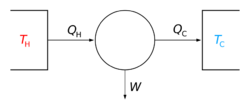 |


| Part of a series on |
| Quantum mechanics |
|---|
Dynamical view
There is an intimate connection between quantum thermodynamics and the theory of open quantum systems.[5] In this framework, the entire world is regarded as a large closed system evolving unitarily under a global Hamiltonian. For a system coupled to a bath, the global Hamiltonian is written as where is the system Hamiltonian, is the bath Hamiltonian, and is the interaction Hamiltonian.
The state of the system is obtained from the combined state by tracing over the bath degrees of freedom:
Assuming Markovian dynamics, the reduced state of the system is commonly described by the Lindblad or GKLS equation:[7][8]
Here, the first term generates unitary evolution, while the dissipator describes the influence of the environment through the system operators . The Markov approximation assumes that the system and bath remain uncorrelated, , and leads to a steady-state solution satisfying .[5]
In the Heisenberg picture, the evolution of an observable is given by
First law
When , the dynamical form of the first law of thermodynamics emerges:
The first term is interpreted as power, while the second is the heat current,[9][10][11]
To remain consistent with thermodynamics, the dissipator must satisfy additional constraints. In particular, the invariant state should become an equilibrium Gibbs state, and a unique consistent generator can be obtained in the weak system–bath coupling limit.[5][12] This issue is especially important in periodically driven systems such as quantum heat engines and quantum refrigerators. Reexaminations of time-dependent heat currents and extensions beyond weak coupling have also been proposed.[13][14]
Second law and entropy
The second law of thermodynamics expresses the irreversibility of dynamics and the breaking of time-reversal symmetry. In a static viewpoint for a closed quantum system, it can be understood as a consequence of unitary evolution applied to the whole system.[15] Dynamically, the second law can be formulated through local entropy balances and entropy production in the baths.
In thermodynamics, entropy is related to the amount of energy that can be converted into work in a given process.[16] In quantum theory, entropy can also be associated with measurement outcomes. If the observable has the spectral decomposition with outcome probabilities , the entropy of that observable is the Shannon entropy
The most informative entropy measure is the von Neumann entropy, introduced by John von Neumann. It is the minimum entropy over all possible observables and satisfies . At thermal equilibrium, the energy entropy equals the von Neumann entropy.[17]
A well-known illustration of the link between information and thermodynamics is Maxwell's demon, whose resolution connects entropy, information, and measurement.[18][19][20]
A Clausius-type formulation for several coupled heat baths in steady state is A dynamical version can be proven using Spohn's inequality: valid for any GKLS generator with stationary state .[9]
These thermodynamic constraints are also used to test quantum transport models. Some local master-equation models appeared to violate the second law,[21] but later work showed that, when all energy and work contributions are accounted for, local master equations can be fully reconciled with thermodynamics.[22]
Adiabatic conditions and quantum friction
Thermodynamic adiabatic processes involve no entropy change. In quantum mechanics, an externally driven isolated system evolves unitarily under a time-dependent Hamiltonian , so remains constant. A quantum adiabatic process is often defined by the constancy of the energy entropy , which implies no net change in the populations of the instantaneous energy levels.[5]
When the adiabatic condition is not satisfied, extra work is required. In an isolated system, this work is, in principle, recoverable because the dynamics is unitary and reversible. In practice, interactions with a bath destroy the coherence stored in the off-diagonal terms of the density matrix, and the additional energy cost is lost as a quantum analog of friction.[23][24] Such friction can be reduced by shortcuts to adiabaticity, which have been demonstrated experimentally in a unitary Fermi gas.[25]
Third law
There are two common formulations of the third law of thermodynamics, both associated with Walther Nernst. The first is the Nernst heat theorem, which states that the entropy of a pure substance in thermodynamic equilibrium approaches zero as the temperature approaches zero. The second is the unattainability principle:[26] no finite procedure can cool a system to absolute zero.
For a cooling process, the dynamics may be written as where is the heat capacity of the cold bath. If the heat current scales as , then the third law imposes restrictions on , ensuring that entropy production at the cold bath vanishes as .[27]
Typicality and emergence
One explanation for the emergence of thermodynamic behavior in quantum mechanics is quantum typicality. The basic idea is that, in high-dimensional Hilbert spaces, the overwhelming majority of pure states with the same initial expectation value of a generic observable will display very similar future expectation values. As a result, the dynamics of a single pure state is often well described by an ensemble average.[28]
The von Neumann quantum ergodic theorem gives a mathematically precise formulation of this idea, stating that for typical large systems, most wave functions in an energy shell evolve so that, for most times, they are macroscopically equivalent to the microcanonical state.[29]
Resource theory
In modern formulations, the second law can be interpreted as constraining which state transformations are physically possible. Quantum thermodynamic resource theory studies these constraints for small systems interacting with a heat bath. Instead of a single macroscopic entropy inequality, microscopic systems are governed by a family of second laws, often expressed in terms of monotonicity of generalized free energies under thermal operations.[30][31]
Noncommuting conserved charges
Thermodynamic systems typically conserve charges such as energy and particle number, and these charges are often assumed to commute. Quantum theory raises the question of what happens when conserved charges do not commute. This issue has become an active subject in quantum thermodynamics.[32]
Noncommuting charges can alter the form of thermal states,[33] increase entanglement,[34] modify entropy production and transport,[35] and even challenge the eigenstate thermalization hypothesis.[36] Recent work suggests that noncommuting charges may either hinder or enhance thermalization depending on the setting.[37]
Engineered reservoirs
At the nanoscale, quantum systems can be prepared in states with no classical analog, and the surrounding reservoirs can also be engineered. Such reservoirs may involve coherence, squeezing, or other nonequilibrium features that strongly modify thermodynamic behavior.[38][39][40]
These reservoirs can generate effects such as efficiencies beyond the standard Otto bound, apparent violations of Clausius inequalities, or simultaneous extraction of heat and work from a reservoir.[41]
See also
Table of contents (185 articles)
Index
Full contents


References
- ↑ Deffner, Sebastian; Campbell, Steve (2019). Quantum Thermodynamics: An introduction to the thermodynamics of quantum information. San Rafael, CA: Morgan & Claypool Publishers. doi:10.1088/2053-2571/ab21c6. ISBN 978-1-64327-658-8. Bibcode: 2019qtit.book.....D. https://iopscience.iop.org/book/mono/978-1-64327-658-8.
- ↑ Adesso, Gerardo, ed (2018). Thermodynamics in the Quantum Regime: Fundamental Aspects and New Directions. Fundamental Theories of Physics (1st ed.). Cham: Springer Publishing. ISBN 978-3-319-99046-0.
- ↑ Einstein, A. (1905). "Über einen die Erzeugung und Verwandlung des Lichtes betreffenden heuristischen Gesichtspunkt" (in de). Annalen der Physik 322 (6): 132–148. doi:10.1002/andp.19053220607. ISSN 0003-3804. Bibcode: 1905AnP...322..132E.
- ↑ Neumann, John von; Von Neumann, John (1955) (in en). Mathematical Foundations of Quantum Mechanics. Princeton landmarks in mathematics and physics. Princeton Chichester: Princeton University Press. ISBN 978-0-691-02893-4. https://books.google.com/books?id=JLyCo3RO4qUC.
- ↑ 5.0 5.1 5.2 5.3 5.4 Kosloff, Ronnie (2013-05-29). "Quantum Thermodynamics: A Dynamical Viewpoint". Entropy 15 (12): 2100–2128. doi:10.3390/e15062100. ISSN 1099-4300. Bibcode: 2013Entrp..15.2100K.
- ↑ MIT Bulletin 1970-71.
- ↑ Lindblad, G. (1976). "On the generators of quantum dynamical semigroups". Communications in Mathematical Physics 48 (2): 119–130. doi:10.1007/bf01608499. ISSN 0010-3616. Bibcode: 1976CMaPh..48..119L. http://projecteuclid.org/euclid.cmp/1103899849.
- ↑ Gorini, Vittorio (1976). "Completely positive dynamical semigroups of N-level systems". Journal of Mathematical Physics 17 (5): 821–825. doi:10.1063/1.522979. ISSN 0022-2488. Bibcode: 1976JMP....17..821G.
- ↑ 9.0 9.1 Spohn, Herbert; Lebowitz, Joel L. (1978). Rice, Stuart A.. ed (in en). Irreversible Thermodynamics for Quantum Systems Weakly Coupled to Thermal Reservoirs. 38. Wiley. pp. 109–142. doi:10.1002/9780470142578.ch2. ISBN 978-0-471-03883-2. https://cmsr.rutgers.edu/images/people/lebowitz_joel/publications/1978spohn_leb.pdf.
- ↑ Alicki, R (1979). "The quantum open system as a model of the heat engine". Journal of Physics A: Mathematical and General 12 (5): L103–L107. doi:10.1088/0305-4470/12/5/007. ISSN 0305-4470. Bibcode: 1979JPhA...12L.103A.
- ↑ Kosloff, Ronnie (1984-02-15). "A quantum mechanical open system as a model of a heat engine". The Journal of Chemical Physics 80 (4): 1625–1631. doi:10.1063/1.446862. ISSN 0021-9606. Bibcode: 1984JChPh..80.1625K.
- ↑ Davies, E. B. (1974). "Markovian master equations". Communications in Mathematical Physics 39 (2): 91–110. doi:10.1007/bf01608389. ISSN 0010-3616. Bibcode: 1974CMaPh..39...91D. http://projecteuclid.org/euclid.cmp/1103860160.
- ↑ Ludovico, María Florencia; Lim, Jong Soo; Moskalets, Michael; Arrachea, Liliana; Sánchez, David (2014-04-21). "Dynamical energy transfer in ac-driven quantum systems". Physical Review B 89 (16): 161306(R). doi:10.1103/physrevb.89.161306. ISSN 1098-0121. Bibcode: 2014PhRvB..89p1306L.
- ↑ Esposito, Massimiliano; Ochoa, Maicol A.; Galperin, Michael (2015-02-25). "Quantum Thermodynamics: A Nonequilibrium Green's Function Approach". Physical Review Letters 114 (8). doi:10.1103/physrevlett.114.080602. ISSN 0031-9007. PMID 25768745. Bibcode: 2015PhRvL.114h0602E.
- ↑ Lieb, Elliott H.; Yngvason, Jakob (1999). "The physics and mathematics of the second law of thermodynamics". Physics Reports 310 (1): 1–96. doi:10.1016/s0370-1573(98)00082-9. ISSN 0370-1573. Bibcode: 1999PhR...310....1L.
- ↑ Gyftopoulos, E. P.; Beretta, G. P. (2005). Thermodynamics: Foundations and Applications. Mineola (New York): Dover Publications. https://books.google.com/books?id=ISBN9780486439327.
- ↑ Polkovnikov, Anatoli (2011). "Microscopic diagonal entropy and its connection to basic thermodynamic relations". Annals of Physics 326 (2): 486–499. doi:10.1016/j.aop.2010.08.004. ISSN 0003-4916. Bibcode: 2011AnPhy.326..486P.
- ↑ Szilard, L. (1929). "Über die Entropieverminderung in einem thermodynamischen System bei Eingriffen intelligenter Wesen" (in de). Zeitschrift für Physik 53 (11–12): 840–856. doi:10.1007/bf01341281. ISSN 1434-6001. Bibcode: 1929ZPhy...53..840S.
- ↑ Brillouin, Léon (1956). Science and information theory. New York: Academic Press. p. 107. https://archive.org/details/scienceinformati0000bril.
- ↑ Maruyama, Koji; Nori, Franco; Vedral, Vlatko (2009-01-06). "Colloquium: The physics of Maxwell's demon and information". Reviews of Modern Physics 81 (1): 1–23. doi:10.1103/revmodphys.81.1. ISSN 0034-6861. Bibcode: 2009RvMP...81....1M.
- ↑ Levy, Amikam; Kosloff, Ronnie (2014-07-01). "The local approach to quantum transport may violate the second law of thermodynamics". Europhysics Letters 107 (2). doi:10.1209/0295-5075/107/20004. ISSN 0295-5075. Bibcode: 2014EL....10720004L.
- ↑ De Chiara, Gabriele; Landi, Gabriel; Hewgill, Adam; Reid, Brendan; Ferraro, Alessandro; Roncaglia, Augusto J; Antezza, Mauro (2018-11-16). "Reconciliation of quantum local master equations with thermodynamics". New Journal of Physics 20 (11): 113024. doi:10.1088/1367-2630/aaecee. ISSN 1367-2630. Bibcode: 2018NJPh...20k3024D. https://iopscience.iop.org/article/10.1088/1367-2630/aaecee.
- ↑ Kosloff, Ronnie; Feldmann, Tova (2002-05-16). "Discrete four-stroke quantum heat engine exploring the origin of friction". Physical Review E 65 (5): 055102(R). doi:10.1103/physreve.65.055102. ISSN 1063-651X. PMID 12059626. Bibcode: 2002PhRvE..65e5102K.
- ↑ Plastina, F.; Alecce, A.; Apollaro, T. J. G.; Falcone, G.; Francica, G. et al. (2014-12-31). "Irreversible Work and Inner Friction in Quantum Thermodynamic Processes". Physical Review Letters 113 (26). doi:10.1103/physrevlett.113.260601. ISSN 0031-9007. PMID 25615295. Bibcode: 2014PhRvL.113z0601P.
- ↑ Deng, S.; Chenu, A.; Diao, P.; Li, F.; Yu, S.; Coulamy, I.; del Campo, A; Wu, H. (2018). "Superadiabatic quantum friction suppression in finite-time thermodynamics". Science Advances 4 (4). doi:10.1126/sciadv.aar5909. PMID 29719865. Bibcode: 2018SciA....4.5909D.
- ↑ Landsberg, P. T. (1956-10-01). "Foundations of Thermodynamics". Reviews of Modern Physics 28 (4): 363–392. doi:10.1103/revmodphys.28.363. ISSN 0034-6861. Bibcode: 1956RvMP...28..363L.
- ↑ Levy, Amikam; Alicki, Robert; Kosloff, Ronnie (2012-06-26). "Quantum refrigerators and the third law of thermodynamics". Physical Review E 85 (6). doi:10.1103/physreve.85.061126. ISSN 1539-3755. PMID 23005070. Bibcode: 2012PhRvE..85f1126L.
- ↑ Bartsch, Christian; Gemmer, Jochen (2009-03-19). "Dynamical Typicality of Quantum Expectation Values". Physical Review Letters 102 (11). doi:10.1103/physrevlett.102.110403. ISSN 0031-9007. PMID 19392176. Bibcode: 2009PhRvL.102k0403B.
- ↑ Goldstein, Sheldon; Lebowitz, Joel L.; Mastrodonato, Christian; Tumulka, Roderich; Zanghì, Nino (2010-05-20). "Normal typicality and von Neumann's quantum ergodic theorem". Proceedings of the Royal Society A: Mathematical, Physical and Engineering Sciences 466 (2123): 3203–3224. doi:10.1098/rspa.2009.0635. ISSN 1364-5021. Bibcode: 2010RSPSA.466.3203G.
- ↑ Brandão, Fernando; Horodecki, Michał; Ng, Nelly; Oppenheim, Jonathan; Wehner, Stephanie (2015-02-09). "The second laws of quantum thermodynamics". Proceedings of the National Academy of Sciences 112 (11): 3275–3279. doi:10.1073/pnas.1411728112. ISSN 0027-8424. PMID 25675476. Bibcode: 2015PNAS..112.3275B.
- ↑ Goold, John; Huber, Marcus; Riera, Arnau; Rio, Lídia del; Skrzypczyk, Paul (2016-02-23). "The role of quantum information in thermodynamics—a topical review". Journal of Physics A: Mathematical and Theoretical 49 (14). doi:10.1088/1751-8113/49/14/143001. ISSN 1751-8113. Bibcode: 2016JPhA...49n3001G.
- ↑ Majidy, Shayan; Braasch, William F.; Lasek, Aleksander; Upadhyaya, Twesh; Kalev, Amir; Yunger Halpern, Nicole (2023). "Noncommuting conserved charges in quantum thermodynamics and beyond" (in en). Nature Reviews Physics 5 (11): 689–698. doi:10.1038/s42254-023-00641-9. ISSN 2522-5820. Bibcode: 2023NatRP...5..689M. https://www.nature.com/articles/s42254-023-00641-9.
- ↑ Yunger Halpern, Nicole; Faist, Philippe; Oppenheim, Jonathan; Winter, Andreas (2016-07-07). "Microcanonical and resource-theoretic derivations of the thermal state of a quantum system with noncommuting charges" (in en). Nature Communications 7 (1). doi:10.1038/ncomms12051. ISSN 2041-1723. PMID 27384494. Bibcode: 2016NatCo...712051Y.
- ↑ Majidy, Shayan; Lasek, Aleksander; Huse, David A.; Yunger Halpern, Nicole (2023-01-03). "Non-Abelian symmetry can increase entanglement entropy". Physical Review B 107 (4). doi:10.1103/PhysRevB.107.045102. Bibcode: 2023PhRvB.107d5102M. https://journals.aps.org/prb/abstract/10.1103/PhysRevB.107.045102.
- ↑ Manzano, Gonzalo; Parrondo, Juan M.R.; Landi, Gabriel T. (2022-01-06). "Non-Abelian Quantum Transport and Thermosqueezing Effects". PRX Quantum 3 (1). doi:10.1103/PRXQuantum.3.010304. Bibcode: 2022PRXQ....3a0304M. https://journals.aps.org/prxquantum/abstract/10.1103/PRXQuantum.3.010304.
- ↑ Murthy, Chaitanya; Babakhani, Arman; Iniguez, Fernando; Srednicki, Mark; Yunger Halpern, Nicole (2023-04-06). "Non-Abelian Eigenstate Thermalization Hypothesis". Physical Review Letters 130 (14). doi:10.1103/PhysRevLett.130.140402. PMID 37084457. Bibcode: 2023PhRvL.130n0402M. https://journals.aps.org/prl/abstract/10.1103/PhysRevLett.130.140402.
- ↑ Majidy, Shayan (2024-09-20). "Noncommuting charges can remove non-stationary quantum many-body dynamics" (in en). Nature Communications 15 (1). doi:10.1038/s41467-024-52588-9. ISSN 2041-1723. PMID 39304665. Bibcode: 2024NatCo..15.8246M.
- ↑ Scully, Marlan O.; Zubairy, M. Suhail; Agarwal, Girish S.; Walther, Herbert (2003-02-07). "Extracting Work from a Single Heat Bath via Vanishing Quantum Coherence" (in en). Science 299 (5608): 862–864. doi:10.1126/science.1078955. ISSN 0036-8075. PMID 12511655. Bibcode: 2003Sci...299..862S. https://www.science.org/doi/10.1126/science.1078955.
- ↑ Manzano, Gonzalo; Galve, Fernando; Zambrini, Roberta; Parrondo, Juan M. R. (2016-05-10). "Entropy production and thermodynamic power of the squeezed thermal reservoir" (in en). Physical Review E 93 (5). doi:10.1103/PhysRevE.93.052120. ISSN 2470-0045. PMID 27300843. Bibcode: 2016PhRvE..93e2120M. https://link.aps.org/doi/10.1103/PhysRevE.93.052120.
- ↑ de Assis, Rogério J.; de Mendonça, Taysa M.; Villas-Boas, Celso J.; de Souza, Alexandre M.; Sarthour, Roberto S.; Oliveira, Ivan S.; de Almeida, Norton G. (2019-06-19). "Efficiency of a Quantum Otto Heat Engine Operating under a Reservoir at Effective Negative Temperatures" (in en). Physical Review Letters 122 (24). doi:10.1103/PhysRevLett.122.240602. ISSN 0031-9007. PMID 31322364. Bibcode: 2019PhRvL.122x0602D. https://link.aps.org/doi/10.1103/PhysRevLett.122.240602.
- ↑ Sánchez, Rafael; Splettstoesser, Janine; Whitney, Robert S. (2019). "Nonequilibrium System as a Demon" (in en). Physical Review Letters 123 (21). doi:10.1103/PhysRevLett.123.216801. ISSN 0031-9007. PMID 31809128. Bibcode: 2019PhRvL.123u6801S.
 |


