Astronomy:Cosmic shoreline
From HandWiki
Short description: Planetary atmosphere boundary
.jpg)
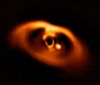
The cosmic shoreline is a concept in planetary science that describes an empirical boundary between planetary bodies that are able to retain significant atmosphere and those that cannot. The concept compares a planet's escape velocity with its insolation (energy received by the planet from its local star). When planets and moons in our Solar System are plotted in accordance with these two parameters, objects with thick atmospheres (such as Saturn and Jupiter) appear on one side, while airless planets with no (or very little) atmosphere appear on the other, forming a rough dividing line known as the "shoreline".[1][2][3][4]
References
- ↑ Zahnle, K. J.; Catling, D. C. (March 2013). "The Cosmic Shoreline". 44th Lunar and Planetary Science Conference. https://www.lpi.usra.edu/meetings/lpsc2013/pdf/2787.pdf.
- ↑ "Oceans, Beaches, Cosmic Shorelines: Our Changing Views of Habitable Planets - NASA Science" (in en-US). 2019-06-18. https://science.nasa.gov/universe/exoplanets/oceans-beaches-cosmic-shorelines-our-changing-views-of-habitable-planets/.
- ↑ Zahnle, Kevin J.; Catling, David C. (2017-07-10). "The Cosmic Shoreline: The Evidence that Escape Determines which Planets Have Atmospheres, and what this May Mean for Proxima Centauri B". The Astrophysical Journal 843 (2): 122. doi:10.3847/1538-4357/aa7846. ISSN 0004-637X.
- ↑ Ji, Xuan; Chatterjee, Richard D.; Coy, Brandon Park; Kite, Edwin S. (2025-10-15), "The Cosmic Shoreline Revisited: A Metric for Atmospheric Retention Informed by Hydrodynamic Escape", The Astrophysical Journal 992 (2): 198, doi:10.3847/1538-4357/adfe69, http://arxiv.org/abs/2504.19872, retrieved 2026-03-11
See also
 |  |


