Astronomy:List of exoplanet extremes
The following are lists of extremes among the known exoplanets. The properties listed here are those for which values are known reliably. The study of exoplanets is one of the most dynamic emerging fields of science, thus these values may change as new discoveries are made.
Extremes from Earth's viewpoint
| Title | Planet(s) | Star | Data | Notes |
|---|---|---|---|---|
| Most distant discovered | SWEEPS-11 / SWEEPS-04 | SWEEPS J175902.67−291153.5 / SWEEPS J175853.92−291120.6 | 27700 light-years[1] | Assuming the largest distance from the microlensing light-curve, the planet OGLE-2017-BLG-0364Lb might be more distant, at around 32600 light-years (10000 pc).[2]
PSR J0738-4042 at 37000 light-years was shown to be affected by a disk of asteroids, but no planets have been detected yet.[3] The most distant potentially habitable planet confirmed is Kepler-1606b, at 2870 light-years distant,[4] although the unconfirmed planet KOI-5889.01 is over 5000 light-years distant. On 31 March 2022, K2-2016-BLG-0005Lb was reported to be the most distant exoplanet discovered by the Kepler telescope, at 16960 light-years away.[5] Among rogue planets, the furthest are very likely extragalactic planets within the lensing system SDSS J1004+4112 at 6.3 billion light-years.[6] |
| Least distant | Proxima Centauri b Proxima Centauri d |
Proxima Centauri | 4.25 light-years | Proxima Centauri b is the closest potentially habitable exoplanet known. As Proxima Centauri is the closest star to the Sun (and will stay so for the next Template:Va years), this is an absolute record, unless a closer brown dwarf/compact object with a planet is discovered.
In about 25 000 years Alpha Centauri AB will be closer to the Sun than its companion Proxima Centauri. If no companion is confirmed around these two stars, no closer brown dwarf/compact object with a planet is found and no planet is found around either Ross 248 or Gliese 445, the least distant record will change in a bit less than 80 000 years from now, making Ross 128 b, a "temperate exoplanet in the inner edge of the habitable zone"[7] the least distant one. |
| Most distant directly visible | CT Chamaeleontis b | CT Chamaeleontis | 622 light-years[1] | The resolved likely close to equal mass binary brown dwarf NIRISS-NGC1333-10 AB, the mass of NIRISS-NGC1333-10 B is slightly higher than the deuterium burning limit, is more distant at 978 light-years.[8]
The disputed planet CVSO 30 c may be more distant, at 1165 light-years away.[9] The candidate planet AT Pyxidis b may also be more distant, at ~1207 light-years away.[10] Among rogue planets, o005 s41280 is the most distant at 17300 light-years; followed by A2744-BD-1 and o006 s00089, at 15520 and 6520 light-years away, respectively.[11][12] As free-floating objects, all of them might not be considered as planets, although their masses might be below 13 MJ.[13] |
| Closest directly visible | Epsilon Indi Ab | Epsilon Indi | 12.05 light-years | COCONUTS-2b at 35.5 light-years is the next closest directly visible.[1]
WISE 0855-0714 is closer, at about 7.4 light-years away. As a free-floating object, it might not be considered as planet, although its mass is below 13 MJ.[13] The planet Alpha Centauri Ab is also closer (4.34 light-years) and might have been directly imaged.[14] |
| Closest Hot Jupiter type exoplanet to Earth | Upsilon Andromedae b | Upsilon Andromedae A | 44.0±0.1 ly | |
| Closest Super Jupiter type exoplanet to Earth | Epsilon Indi Ab | Epsilon Indi | 11.867±0.004 ly | |
| Closest Super Earth type exoplanet to Earth | Proxima Centauri b | Proxima Centauri | 4.2465±0.0003 ly | |
| Star with the brightest apparent magnitude (in visible) with a planet | Alpha Arietis b | Hamal[1][lower-alpha 1] | Apparent magnitude is 2.005 | Alpha Centauri A (apparent magnitude 0.01) has a directly imaged candidate planet.[14] The evidence of planets around Vega with an apparent magnitude of 0.03 is strongly suggested by circumstellar disks surrounding it.[15] As of 2021[update], a candidate planet around Vega has been detected.[16]
Aldebaran (apparent magnitude varies between 0.75 and 0.95) was thought to have a candidate planet, however later studies found the existence of the planet dubious.[17][18] Similarly, Pollux (apparent magnitude = 1.14) and Mirfak (apparent magnitude = 1.806) were claimed to have orbiting planets, all of which have been either questioned or disproved.[19][20][21][22][23] An Earth-mass planet claimed to orbit Alpha Centauri B (apparent magnitude = 1.33) was subsequently refuted.[24] A 2023 study detected 10 luminous point sources around the primary star of Fomalhaut system (apparent magnitude = 1.16), of which the last source may or may not be a planetary-mass companion.[25] This star was previously thought to harbour a directly imaged planet named Fomalhaut b, before the realization of object as an expanding debris cloud from a planetesimal collision.[26] |
| Star with the faintest apparent magnitude (in visible) with a planet | MOA-bin-29Lb | MOA-bin-29L | Apparent magnitude is 44.61[1] | |
| Closest planet to the celestial north pole (i.e. highest declination) | TOI-1691 b | TOI-1691 | Declination of +86° 51′ 37.23″[1] | |
| Closest planet to the celestial south pole (i.e. lowest declination) | HD 110082 b | HD 110082 | Declination of −88° 07′ 16″[1] | |
| Star with the highest apparent motion (i.e. proper motion) with a planet | Barnard planets[27] | Barnard's Star | 10.358 arcsec/yr[28] |
As Barnard's Star has the highest apparent motion in the sky,[28] this is currently an absolute record. |
| Largest angular distance separation from its host star | COCONUTS-2b | COCONUTS-2 | 594 arcseconds[29] | A candidate planet or brown dwarf around BD+29 5007 has an even larger angular separation of about 935 arcseconds.[30] |
| Smallest resolved angular distance separation from its parent star | Beta Pictoris c | Beta Pictoris | 0.138 arcseconds | Derived from its separation of ~2.68 AU[31] and its distance of 63.4 light-years (19.4 parsecs). |
| Smallest angular distance separation from its parent star | NGC 6440 X-2 b | NGC 6440 X-2 | 0.31 microarcseconds | Derived from its separation of 0.00255 AU and its distance of ~27070 light-years (8300 parsecs).[32] |
| Star with the largest apparent size (angular diameter) | Alpha Arietis b | Hamal | 7.006±0.027 mas | Accounted for the limb darkening effect.[33]
The star Mirach (β Andromedae) has larger angular diameter at 13.749±0.137 mas[34] and has either a brown dwarf or a gas giant companion.[35] Several stars have a larger angular diameter and were claimed to have candidate planets: Aldebaran (20.58±0.03 mas),[36][17] L2 Puppis (17.9±1.6 mas)[37][38] and Alpha Centauri A (8.314±0.016 mas).[39][14] |
Planetary characteristics
| Title | Planet | Star | Data | Notes |
|---|---|---|---|---|
| Most massive | ||||
| Most massive in proportion to the mass of the star(s) it revolves around | Delorme 1 b | Delorme 1 | Mass ratio is ~0.034 | 2M1207 b has a larger ratio to 2M1207 of ~0.2, but the host is a brown dwarf. 2M1207 b may be a sub-brown dwarf instead of a planetary-mass companion.[40]
The planet candidate NSV 1440 b has a higher mass ratio at 0.045 ± 0.002 to its host star, which is a white dwarf. However, with a mass near 30 MJ, it is likely a companion star that was stripped down to a substellar-mass object.[41] |
| Most massive in proportion to the mass of the host object it revolves around | CFHTWIR-Oph 98 b | CFHTWIR-Oph 98 A | Mass ratio is ~0.51[lower-alpha 2] | Both, this object[42] and (DRS2009) 1996[43] with a mass ratio of ~0.35[lower-alpha 3] may be sub-brown dwarfs instead of a planetary companion. |
| Least massive | PSR J0337+1715 (AB) b | PSR J0337+1715 | 0.0041±0.003 M🜨[44] | A 2025 study cast doubt on the existence of the planet, instead attributing it to "red noise", variability within the pulsar itself, which can appear as a planet.[45]
The extrasolar planetesimal WD 1145+017 b is less massive, at 0.00067 M⊕.[29] As a reference, the mass of Earth's moon is 0.012 M🜨.[46] |
| Largest radius | DH Tauri b | DH Tauri | 2.7±0.8 RJ[47] | Proplyd 133-353 is larger at up to 7.4±0.3 – 8.0±1.1 RJ.[48][lower-alpha 4] It might be considered as a sub-brown dwarf or a rogue planet, with a photoevaporating disk.
The largest transiting planet known is HAT-P-67 b at 2.140±0.025 RJ.[49] |
| Smallest radius | Kepler-37b | Kepler-37 | 0.296±0.037 R🜨[1] | The extrasolar planetesimal WD 1145+017 b is smaller. |
| Smallest radius with a confirmed atmosphere | TOI-561 b | TOI-561 | 1.39 R🜨[1] | [50] The planet LHS 1478 b is smaller (at 1.17 R🜨) and might have an atmosphere.[51] |
| Most dense | GP Comae Berenices b | GP Comae Berenices | ≥185 g/cm3[52] | According to the IAU working definition of exoplanets GP Comae Berenices b, being 10 times more massive than Jupiter, is a planet, despite that it might have formed as a white dwarf that was stripped down to a planetary-mass object. For reference, it is a lot denser than osmium at 293 K, the densest naturally occurring stable element on Earth. It is suspected that GP Comae Berenices b might be composed of strange matter based on its density.[52]
TOI-4603 b is the densest planet which orbits a normal star and is not a potential brown dwarf, with 14.1+1.7 |
| Least dense | Kepler-51d | Kepler-51[54] | 0.0381±0.0085 g/cm3[55] | Next least dense are the super-Neptune planet WASP-193b with 0.059±0.014 g/cm3[56] and the hot Jupiter HAT-P-67b with 0.060+0.020 −0.021 g/cm3,[57] tied with Kepler-51 b with 0.060±0.037 g/cm3.[55] A predicted highly evaporating planet was proposed to orbit the star FU Orionis with a density of about 0.0042 g/cm3.[lower-alpha 5] |
| Highest planetary rotation rate | Beta Pictoris b | Beta Pictoris | 19.9±1.0 km/s | Value measured at the planetary equator.[59] |
| Hottest (irradiated planet) | KELT-9b | KELT-9 | 4050±180 K[1] (3777 °C) | The candidate planets OGLE-TR-1001b and KOI-2093.03 are hotter, at 4200 K and 6285 K, respectively.[60][61]
A candidate planet was suggested to orbit WD 2226-210, the central star of the Helix Nebula, with an equilibrium temperature of 4970 K.[62] Kepler-70b and Kepler-70c are often described as the hottest known exoplanets, both at >6800 K (assuming an albedo of 0.1 for both),[63] but their existences are highly doubtful.[64][65] |
| Hottest (self-luminous) | GQ Lupi b | GQ Lupi | 2650±100 K[66] (2377 °C) |
GQ Lupi b may be either a massive planet or a brown dwarf.[66] |
| Coldest | OGLE-2005-BLG-390Lb | OGLE-2005-BLG-390L | 50 K (−223.2 °C)[67][lower-alpha 6] | The disputed planet Proxima Centauri c may be cooler, at 39 K (−234.2 °C).[68] |
| Fastest jetstream wind | WASP-127b | WASP-127 | 33000 km/h (9200 m/s)[69] |
|
| Strongest magnetic field | Tau Boötis b | Tau Boötis | 117±38 G[lower-alpha 7] | For comparison, the field strength of Jupiter is 4.17 G.[71]
The magnetic field of SIMP J013656.5+093347 is stronger at ~3200 G.[72] As a free-floating object, it might not be considered a planet.[13] |
| Highest albedo | LTT 9779 b | LTT 9779 | 0.79±0.15[73] | This is value for the western dayside region, with the overall albedo of dayside being 0.50±0.07.[73]
For comparison, the albedo values of Earth and Venus are 0.3 and 0.76, respectively. |
| Lowest albedo | TrES-2b | GSC 03549-02811 | Geometric albedo < 1%[74] | Best-fit model for albedo gives 0.04% (0.0004).[63] |
| Youngest | DH Tauri b | DH Tauri | 0.7+0.3 −0.2 Myr[75] |
The free-floating planet or sub-brown dwarf Proplyd 133-353 is younger, at 0.5 Myr.[48][76] However, as a free-floating planet, it does not meet the IAU's working definition of a planet.[77]
2MASS J04414489+2301513 b is listed as the youngest planet in the NASA Exoplanet Archive, at an age of 1 Myr,[1] but fails the mass ratio criterion of the IAU working definition of an exoplanet; the mass ratio with the primary is larger than the L4/L5 limit of stability ≈ 1/25[77] and the companion is 'more likely to have been produced by cloud core fragmentation' (which is similar to a star).[78] Two planetary candidates proposed to orbit IRS 63 might be younger at ≲0.5 Myr.[79] IRAS 04125+2902 b is the youngest transiting planet at an age of ~3 Myr.[80] HD 114082b is the youngest radial velocity planet at an age of 15±6 Myr.[81][82] CI Tauri c would be the youngest radial velocity planet at an age of 2–3 Myr, if confirmed.[83][lower-alpha 8] |
| Oldest | TOI-157 b | TOI-157 | 12.82+0.73 −1.40 Gyr[86] |
The currently accepted age of the universe is around 13.8 billion years. Could alternatively be PSR B1620-26 b with 11.2–12.7 Gyr.[87]
Two disproven planets had been thought to orbit the star HIP 11952,[88] whose age is 12.8±2.6 Gyr.[89] The star HE 1523-0901 might be older at 13.2 Gyr[90] and has a candidate planet or brown dwarf.[91] |
Orbital characteristics
| Title | Planet | Star | Data | Notes | |
|---|---|---|---|---|---|
| Longest orbital period (Longest year) |
Gliese 900 b (CW2335+0142) | Gliese 900 | 1.27 million years[92][1][lower-alpha 9] | COCONUTS-2b previously held this record at 1.1 million years.[lower-alpha 9] | |
| Shortest orbital period (Shortest year) |
GALEX 0718+3731 b | GALEX 0718+3731 | 0.187 h (11.2 minutes)[1] | KOI 1843.03 has the shortest orbit around a main-sequence star (an M dwarf) at 4.25 hours.[93] | |
| Largest orbital separation | Gliese 900 b (CW2335+0142) | Gliese 900 | 12000 astronomical unit|AU[94][1] | UCAC4 328-061594 b has an even larger orbital separation (19000 astronomical unit|AU), although its mass (21 [[Astronomy:Jupiter mass | J}}}}}}]])[1][94] is higher than the deuterium burning limit (13 MJ).
Another candidate around BD+29 5007 has an even larger orbit of about 22100 AU. There is no consensus about its age and the resulting mass, and it could be a field brown dwarf. The companion of ASASSN-21js has an orbit of about 13000 AU, but it is unknown if it is a brown dwarf or a planet due to its unknown mass.[95] |
| Smallest orbital separation (smallest semi-major axis) | GALEX 0718+3731 b | GALEX 0718+3731 | 0.000834 AU[1] | TOI-6324 b has the smallest orbital separation from a main-sequence star (an M dwarf) at ~0.0043 AU.[96] | |
| Most eccentric orbit | HD 20782 b | HD 20782 | 0.950[1] | Could alternatively be HD 28254 b with an eccentricity at 0.95+0.03 −0.04.[1] The possible planets HD 205577 b, SGR 1935+2154 b and SGR 1806-20 b have even higher eccentricities at 0.972+0.08 The disproven planet candidate at VB 10 was thought to have a higher eccentricity of 0.98.[99] | |
| Highest orbital inclination | HD 204313 e | HD 204313 | 176.092°+0.963° −2.122°[1] |
[100][101] | |
| Lowest orbital inclination | HD 331093 b | HD 331093 | >0.3704°[1] | [102][101] HD 43197 c has the lowest orbital inclination that is not a lower limit, of 11.42°+5.388° −3.07°.[101] | |
| Largest semi-amplitude | WASP-18b | WASP-18 | 1814+23 −24 m/s |
[103] The planetary-mass objects CoRoT-3b, GPX-1 b and KELT-1Ab have larger semi-amplitudes at 2173±25 m/s,[104] 2310±180 m/s[105] and 4239±52 m/s,[106] respectively; however they are likely brown dwarfs rather than planets.[107] | |
| Smallest semi-amplitude | Barnard's Star e | Barnard's Star | 0.221±0.038 m/s | [27] | |
| Largest orbit around a single star | COCONUTS-2b | L 34-26 | 7506 AU[1] | Next largest are 2MASS J2126–8140 with 6900 AU and WD 0806-661 b[108] with ~2500 AU.
UCAC4 328-061594 b has a significantly larger orbital separation (about 19000 AU), although its mass (21 |♃|J}}}}}})[1][94] is higher than the deuterium burning limit (13 |♃|J}}}}}}). | |
| Smallest orbit around binary star | Kepler-47b | Kepler-47 | 0.2877+0.0014 −0.0011 AU[1] |
[109]
Kepler-1521 b has a smaller orbit with semi-major axis at 0.2347±0.0011 AU.[1] The planet might be circumbinary, as the binarity of host star is suggested but not confirmed.[110] | |
| Smallest ratio of semi-major axis of binary star orbit to a planet orbiting one of the stars (S-type planet) | Nu Octantis Ab | Nu Octantis | 2.06 | [111] | |
| Largest orbit around binary star | SR 12 c | SR 12 | ≈1100 AU[112] | SR 12 c has a mass of 0.013±0.007 M☉.[112]
DT Virginis c, also known as Ross 458 c, at a projected separation of ≈1200 AU, with several mass estimates below the deuterium burning limit, has a latest mass determination of 27±4 MJ.[113] The binary 2MASS J0249-0557 AB has a planetary-mass companion less massive than 13 MJ at a larger separation of 1950±200 AU, although this companion might have formed as a brown dwarf based on the mass ratio to the host stars.[114] | |
| Largest orbit around a single star in a multiple star system | DH Tauri b | DH Tauri | ≈330 AU[115] | ||
| Largest separation between binary stars with a circumbinary planet | SR 12 c | SR 12 | ≈26 AU[112] | SR 12 c has a mass of 0.013±0.007 M☉ at a projected separation of ≈1100 AU.[112] FW Tauri b orbits at a projected separation of 330±30 astronomical unit|AU around a ≈11 AU separated binary.[116] It was shown to be likely a 0.1 M☉ star surrounded by a protoplanetary disk rather than a planetary-mass companion.[117] | |
| Largest orbit around three stars | Gliese 900 b (CW2335+0142) | Gliese 900 | 12000 AU[94][1] | ||
| Closest orbit between stars with a planet orbiting one of the stars (S-type planet) | DMPP-3 Ab | HD 42936 | 1.139 AU[118][119] | DMPP-3 Ab's semi-major axis is around 0.067 AU. | |
| Closest orbit between stars with planets orbiting both the stars | Struve 2398 Ab and Struve 2398 Bc | Struve 2398 A and Struve 2398 B | 63±1 AU | The only known planet of Struve 2398 A has a semi-major axis of 0.068 AU while the confirmed planet of Struve 2398 B has a semi-major axis of 0.139 AU.[120][121] | |
| Smallest semi-major axis ratio between consecutive planets | Kepler-36b and Kepler-36c | Kepler-36 | 1.11 | Kepler-36b and c have semi-major axes of 0.1153 AU and 0.1283 AU, respectively; hence the planet c is 1.11 times further from star than b.
2MASS J1657-5343 b and 2MASS J1657-5343 c have semi-major axes of 165 AU and 180 AU, resulting in the planet c being ~1.09 times further from star than b.[122][123] Despite being listed in Extrasolar Planets Encyclopaedia as planets, these companions are most likely brown dwarfs based on the mass. There have been unconfirmed detections of co-orbital pairs of exoplanet, each of which has a semi-major axis ratio of almost 1. | |
| Largest semi-major axis ratio between consecutive planets | WASP-4b and WASP-4c | WASP-4 | 347.1 | WASP-4b and c have semi-major axes of 0.0229 AU and ≈7.95 AU,[124] respectively; hence the planet c is about 347.1 times further from star than b.
The disputed planets CVSO 30 b and CVSO 30 c[125] have semi-major axes of 0.0084 AU and 662±96 AU,[126] respectively. This might result in a larger ratio at 67380:1 – 90240:1. |
Stellar characteristics
| Title | Planet | Star | Data | Notes | |
|---|---|---|---|---|---|
| Highest metallicity | HD 126614 Ab | HD 126614 A | +0.56 dex | Located in a triple star system. | |
| Lowest metallicity | K2-344b | K2-344 | −0.95±0.02 dex[1] | BD+20 2457 may be the lowest-metallicity planet host ([Fe/H]=-1.00); however, the proposed planetary system is dynamically unstable.[127][lower-alpha 10]
Planets were announced around even the extremely low-metallicity stars HIP 13044 and HIP 11952; however, these claims have since been disproven.[88] A brown dwarf or planetary-mass companion was announced around the population II star HE 1523-0901, whose metallicity is −2.65±0.22 dex.[129] While the inclination of the companion is not known, if its orbit is nearly face-on, it would be sufficiently massive to be a red dwarf instead.[91] A disputed substellar companion, possibly a Jovian planet, was announced to orbit[130] the B-type subdwarf star HD 149382 with a metallicity of -1.30 dex.[131] | |
| Lowest color index | b Centauri b | b Centauri | −0.157±0.002[132] | The subgiant star Pipirima has a lower B-V color index at -0.219,[133] however its planetary-mass companions Mu2 Scorpii b and (the candidate) Mu2 Scorpii c might be either brown dwarfs or planets.[134] | |
| Highest color index | GJ 3512 b and GJ 3512 c | GJ 3512 | +1.904±0.046[135] | For reference, the Sun with its eight confirmed planets has a B-V color index of +0.656.[136]
A candidate planet was reported around the carbon star V Hydrae,[137] whose B-V color index is higher at +5.43.[138] | |
| Highest stellar mass | b Centauri b | b Centauri | 5–6 M☉ | The subgiant star Pipirima has a higher mass of 9.1±0.3 M☉,[139] but its planetary-mass companions Mu2 Scorpii b and (the candidate) c might be either brown dwarfs or planets.[134]
The candidate planemo IGR J12580+0134 b might be a blanet, whose host has a mass of 300 000-18 000 000 M☉.[140] The candidate exoplanet M51-ULS-1 b orbits two objects, a B-type supergiant with a mass of 20 M☉,[141] and a neutron star or black hole with a mass of 1.4 to 10 M☉.[142][lower-alpha 11] The star Mirfak (at 7.3±0.3 M☉)[143] has disproved orbiting planets.[23] The stars R126 (HD 37974), R66 (HD 268835) and HH 1177 in the Large Magellanic Cloud have masses of 70, 30 and 12 M☉ and have dust discs[144] but no planets have been detected yet. | |
| Lowest stellar mass (main- sequence) | KMT-2021-BLG-1554Lb | KMT-2021-BLG-1554L | 0.08+0.013 −0.014 M☉[101] |
The mass of this star is near the hydrogen burning limit.
KMT-2016-BLG-2142L has a lower mass of 0.073+0.117 | |
| Largest stellar radius | HD 220074 b | HD 220074 | 59.60+5.85 −6.31 R☉[145] |
Other stars, such as HD 18438, Mirach and Delta Virginis are larger, but their substellar companions are more massive than the deuterium burning limit at about 13 [[Astronomy:Jupiter mass | J}}}}}}]], and thus might be brown dwarfs rather than exoplanets.[1]
Candidate planets were reported around the red giants V Camelopardalis (716±185 R☉),[146][147] R Fornacis (585 R☉[lower-alpha 12]),[148][149] V Hydrae (430 R☉),[137] R Leonis (320−350 R☉)[146][150] and L2 Puppis (123±14 R☉).[38] The stars R126 and R66 in the Large Magellanic Cloud have radii of 78 R☉ and 131 R☉[151] and have dust discs but no planets have been detected yet. |
| Smallest stellar radius | PSR J1211-0633 b | PSR J1211-0633 | 0.0000143 R☉ (9.9 km)[152] |
A hypothetical planet was proposed to orbit SGR 1935+2154, whose radius is smaller at 4.35 km (6.25×10⁻⁶ R☉).[153][154] | |
| Smallest stellar radius (brown dwarf) | TVLM 513-46546b | TVLM 513-46546 | 0.097–0.109 R☉[155] | Lower than that of any brown dwarf in the NASA Exoplanet Archive.[101] | |
| Smallest stellar radius (main-sequence star) | TRAPPIST-1 planets | TRAPPIST-1 | 0.1192±0.0013 R☉[156] | VB 10 (at 0.102 R☉)[157] has a disproven planet candidate. | |
| Highest stellar luminosity | HD 158996 b | HD 158996 | 849.2 L☉[145][lower-alpha 13] | This is the most luminous star to host a confirmed planet that is not a potential brown dwarf.[101]
The star Mirfak, whose luminosity is 3780 L☉,[158] was claimed to have an orbiting planet with a minimum mass of 6.6±0.2 MJ. However, the existence of the planet is doubtful.[22] Candidate planets were reported around the red giants V Hydrae (at 18000 L☉),[159][137] U Equulei (at ~6000 L☉),[160][161] R Fornacis (at 5800 L☉),[148] R Leonis (at 3537 L☉),[150] L2 Puppis (at 1490±150 L☉)[162][38] and BD+20 2457 (at 1479 L☉).[163][164] The host star system of the unconfirmed planet M51-ULS-1 b has a luminosity of ≈260 000 L☉.[142][lower-alpha 14] The stars R126, R66 and HH 1177 in the Large Magellanic Cloud have luminosities of 1400000 L☉, 320000 L☉ and 19000 L☉[151][144] and have dust discs but no planets have been detected yet. | |
| Lowest stellar luminosity (main-sequence star) | TRAPPIST-1 planets | TRAPPIST-1 | 0.0005495 L☉ | [165][101] | |
| Highest stellar rotational velocity | Kappa Andromedae b | Kappa Andromedae | ~176 km/s [166] | The star HIP 64892 rotates slightly faster at projective velocity 178 km/s; however its orbiting companion, which weighs at ~29–37 MJ and is listed as a planet by EPE,[167] might be most likely a brown dwarf.[168]
The stars 51 Ophiuchi, HD 38056 and Phi Leonis rotate at 267±5 km/s,[169] ~195 km/s[170] and ~254 km/s[171] (respectively) and have dust discs but no planets have been detected yet. | |
| Hottest star with a planet | SWIFT J1756.9−2508 b | SWIFT J1756.9−2508 | 4640000 K | [lower-alpha 15] | |
| Hottest non-compact star with a planet | NSVS 14256825 planets | NSVS 14256825 | 40000 K (primary)[173] | NN Serpentis is hotter, with a temperature of 57000 K for the primary star,[1] but the existence of its planets is disputed.[174]
A candidate planet was found orbiting the O-type subdwarf TOI-709, whose effective temperature is higher at 50000 K.[175] | |
| Hottest main-sequence star with a planet | b Centauri b | b Centauri | 18310±320 K[176] | ||
| Coolest star with a planet | TRAPPIST-1 planets | TRAPPIST-1 | 2511 K | Technically the primary components of Oph 162225-240515, CFBDSIR 1458+10, WISE J0336−0143 and WISE 1217+1626 are cooler, but are classified as brown dwarfs.
The cooler stars R Fornacis at 2100 K[177] and V Camelopardalis at 2414±86 K[147] were both claimed to have a planet candidate.[149][146] A gas giant planet was found orbiting TVLM 513-46546,[178] which is an ultracool star (2242 K) located close to the brown dwarf/red dwarf mass boundary.[179] |
System characteristics
| Title | System(s) | Planet(s) (in order from star) | Star(s) | Notes |
|---|---|---|---|---|
| System with most planets | Kepler-90 | 8 (b, c, i, d, e, f, g, h) |
1
HD 10180 has six confirmed planets and potentially three more planets.[180] As a reference, the Solar System has eight verified major planets, alongside multiple dwarf planets (the existence of Planet Nine and Planet Ten is yet unconfirmed).[181][lower-alpha 16][185] | |
| System with most planets in habitable zone | TRAPPIST-1 | 4 (b, c, d, e, f, g, h) |
1 | Four planets in this system (d, e, f and g) orbit within the circumstellar habitable zone.[186] |
| System with most planets in exact orbital resonance | HD 110067 | 6 (b, c, d, e, f, g) |
3 | Each consecutive pair of the planets b, c, d, e, f and g is locked in the resonance of 3:2, 3:2, 3:2, 4:3 and 4:3, respectively.[187] |
| System with most stars | Kepler-64 | b | 4 | PH1b (Kepler-64b) has a circumbinary orbit.
30 Arietis Bb was believed to be either brown dwarf or a massive gas giant in a quadruple star system before later studies revealing a true mass well above the red dwarf-mass limit of 80 |♃|J}}}}}}.[188] The planetary mass-companion HIP 81208 Cb will be potentially located in a quadruple star system, if the star Gaia DR3 6020420074469092608 is confirmed to be gravitationally bound to the system.[189] The quintuple and quadruple star systems GG Tauri and HD 98800 both have several protoplanetary disks but no planets have been detected yet.[190][191] Similarly, the star β3 Tucanae A, located in a sextuple star system, was suggested to have a debris disk with no planets having been found.[192] |
| System with most stellar-like objects | Kepler-64 | b | 4 | PH1b (Kepler-64b) has a circumbinary orbit.
The polar circumbinary planet 2M1510 b is located in either a tertiary or a quadruple system of brown dwarfs.[193] The planetary-mass object 2MASS J04414489+2301513 b is within a quadruple system with one star and two brown dwarfs. |
| Multiplanetary system with smallest mean semi-major axis (planets are nearest to their star) | Kepler-42 | b, c, d | 1 | Kepler-42 b, c and d have a semi-major axis of 0.0116, 0.006 and 0.0154 AU, respectively.
Kepler-70 b, c and d (all unconfirmed and disputed) have a semi-major axis of only 0.006, 0.0076 and ~0.0065 AU, respectively. |
| Multiplanetary system with largest mean semi-major axis (planets are farthest from their star) | YSES 1 | b, c | 1 | YSES 1 b and c have a semi-major axis of ~162 and ~320 AU, respectively.[1] |
| Multiplanetary system with smallest range of semi-major axis (smallest difference between the star's nearest planet and its farthest planet) | Kepler-42 | b, c, d | 1 | Kepler-42 b, c and d have a semi-major axis of 0.0116, 0.006 and 0.0154 AU, respectively. The separation between closest and furthest is therefore 0.0094 AU.
Kepler-70 b, c and d (all unconfirmed and disputed) have a semi-major axis of only 0.006, 0.0076 and ~0.0065 AU, respectively. The separation between closest and furthest is therefore shorter at 0.0016 AU (240,000 km). |
| Multiplanetary system with largest range of semi-major axis (largest difference between the star's nearest planet and its farthest planet) | AB Pictoris | c, b | 1 | AB Pictoris b and c have semi-major axes of ~190 and ~4 AU,[194] respectively. The separation between closest and furthest is thus around 186 AU.
Two planetary-mass objects with masses slightly above the deuterium limit Mu2 Scorpii b and c (the later is unconfirmed) have semi-major axes of ~19 and ~242 AU, respectively; hence the range of semi-major axis is about 223 AU.[134] |
| System with smallest total planetary mass | Barnard's Star | d, b, c, e | 1 | The planets d, b, c and e have minimum masses of 0.263, 0.299, 0.335 and 0.193 Earth masses, respectively.[27]
For comparison, Mars has a mass of 0.105 Earth masses. |
| System with largest total planetary mass | HR 8799 | e, d, c, b | 1 | Four planets each having masses within the range 6.0 – 9.6 MJ. The total mass might be larger as there might be an additional planet orbiting HR 8799 with a mass of 4 – 7 MJ.[195] Nu Ophiuchi b and c have minimum masses of 22.206 and 24.662 Jupiter masses, respectively.[1] They are likely brown dwarfs. HD 81817 b and c have masses of 24.1 and ≥22.6 Jupiter masses, respectively.[31] These companions are also likely brown dwarfs. |
| Multiplanetary system with smallest mean planetary mass | Barnard's Star | d, b, c, e | 1 | The planets d, b, c and e have minimum masses of 0.263, 0.299, 0.335 and 0.193 Earth masses, respectively.[27]
For comparison, Mars has a mass of 0.105 Earth masses. |
| Multiplanetary system with largest mean planetary mass | Titawin | b, c, d | 2 | The three planets b, c and d have masses of 1.70+0.33 −0.24, 14.0+2.3 −5.3 and 10.2+0.7 −3.3 Jupiter masses, respectively. This results in a mean planetary mass of 5.7 – 9.7 MJ.[196][197] Could alternatively be the system of HR 8799, in which four planets each have masses within the range 5.7 – 9.1 MJ. Nu Ophiuchi b and c have minimum masses of 22.206 and 24.662 Jupiter masses, respectively.[1] They are likely brown dwarfs. HD 81817 b and c have masses of 24.1 and ≥22.6 Jupiter masses, respectively.[31] These companions are also likely brown dwarfs. |
| Exo-multiplanetary system with smallest range in planetary mass, log scale (smallest proportional difference between the most and least massive planets) | HD 37124 | b, c, d | 1 | HD 37124 c and d are estimated to have masses of 0.652 and 0.69 Jupiter masses, respectively (hence a ratio of about 1.058 to 1).[198] |
| Exo-multiplanetary system with largest range in planetary mass, log scale (largest proportional difference between the most and least massive planets) | Gliese 676A | d, e, b, c | 2 | Gliese 676A c and d have a mass ratio of about 975 to 1.[lower-alpha 17] For comparison, Mercury and Jupiter have a mass ratio of 5780 to 1.
The planet KMT-2020-BLG-0414Lc and the super-Earth KMT-2020-BLG-0414Lb have a mass ratio of about 4590 to 1,[lower-alpha 18] although at 27.0+4.0 |
See also
- Extremes on Earth
- Lists of exoplanets
- List of exoplanet firsts
- List of stars with proplyds
- Methods of detecting exoplanets
- List of potentially habitable exoplanets
Notes and references
- ↑ 1.00 1.01 1.02 1.03 1.04 1.05 1.06 1.07 1.08 1.09 1.10 1.11 1.12 1.13 1.14 1.15 1.16 1.17 1.18 1.19 1.20 1.21 1.22 1.23 1.24 1.25 1.26 1.27 1.28 1.29 1.30 "Planetary Systems Composite Data". https://exoplanetarchive.ipac.caltech.edu/cgi-bin/TblView/nph-tblView?app=ExoTbls&config=PSCompPars.
- ↑ Gui, Yuqian; Zang, Weicheng; Zhai, Ruocheng; Ryu, Yoon-Hyun; Udalski, Andrzej; Yang, Hongjing; Han, Cheongho; Mao, Shude et al. (July 2024). "Systematic KMTNet Planetary Anomaly Search. XII. Complete Sample of 2017 Subprime Field Planets" (in en). The Astronomical Journal 168 (2): 49. doi:10.3847/1538-3881/ad4ce5. ISSN 1538-3881. Bibcode: 2024AJ....168...49G.
- ↑ "Rocks Around The Clock: Star PSR J0738-4042 Is Constantly Pummelled By Asteroids". Science 2.0. 2014-02-20. http://www.science20.com/news_articles/rocks_around_clock_star_psr_j07384042_constantly_pummelled_asteroids-130121.
- ↑ "Exoplanet-catalog-Exoplanet exploration-Kepler-1606b". 10 May 2016. https://exoplanets.nasa.gov/exoplanet-catalog/2252/kepler-1606-b/.
- ↑ Specht, D. (2023). "Kepler K2Campaign 9 – II. First space-based discovery of an exoplanet using microlensing". Monthly Notices of the Royal Astronomical Society 520 (4): 6350–6366. doi:10.1093/mnras/stad212.
- ↑ Bhatiani, Saloni; Dai, Xinyu; Guerras, Eduardo (November 2019). "Confirmation of Planet-mass Objects in Extragalactic Systems" (in en). The Astrophysical Journal 885 (1): 77. doi:10.3847/1538-4357/ab46ac. ISSN 0004-637X. Bibcode: 2019ApJ...885...77B.
- ↑ Souto, Diogo; Unterborn, Cayman T.; Smith, Verne V.; Cunha, Katia; Teske, Johanna; Covey, Kevin; Rojas-Ayala, Bárbara; García-Hernández, D. A. et al. (2018-06-10). "Stellar and Planetary Characterization of the Ross 128 Exoplanetary System from APOGEE Spectra". The Astrophysical Journal Letters 860 (1): L15. doi:10.3847/2041-8213/aac896. ISSN 2041-8205. Bibcode: 2018ApJ...860L..15S.
- ↑ Langeveld, Adam; Scholz, Aleks; Mužić, Koraljka; Jayawardhana, Ray; Capela, Daniel; Albert, Loïc; Doyon, René; Flagg, Laura et al. (2024-08-22). "The JWST/NIRISS Deep Spectroscopic Survey for Young Brown Dwarfs and Free-Floating Planets". AJ 168 (4): 179. doi:10.3847/1538-3881/ad6f0c. Bibcode: 2024AJ....168..179L.
- ↑ Schmidt, T. O. B.; Neuhäuser, R.; Briceño, C.; Vogt, N.; Raetz, St.; Seifahrt, A.; Ginski, C.; Mugrauer, M. et al. (September 2016). "Direct Imaging discovery of a second planet candidate around the possibly transiting planet host CVSO 30". Astronomy & Astrophysics 593: A75. doi:10.1051/0004-6361/201526326. ISSN 0004-6361. Bibcode: 2016A&A...593A..75S. http://www.aanda.org/10.1051/0004-6361/201526326.
- ↑ "The Extrasolar Planet Encyclopaedia — AT Pyx b.". Extrasolar Planets Encyclopaedia. 2025. https://exoplanet.eu/catalog/at_pyx_b--10507/.
- ↑ Tu, Zhijun; Wang, Shu; Chen, Xiaodian; Liu, Jifeng (2025). "Three Brown Dwarfs Masquerading as High-Redshift Galaxies in JWST Observations". The Astrophysical Journal 980 (2): 230. doi:10.3847/1538-4357/adaf9f. Bibcode: 2025ApJ...980..230T.
- ↑ Langeroodi, Daniel; Hjorth, Jens (November 2023). "Little Red Dots or Brown Dwarfs? NIRSpec Discovery of Three Distant Brown Dwarfs Masquerading as NIRCam-selected Highly Reddened Active Galactic Nuclei". The Astrophysical Journal 957 (2): L27. doi:10.3847/2041-8213/acfeec. Bibcode: 2023ApJ...957L..27L.
- ↑ 13.0 13.1 13.2 Basri, Gibor; Brown, E. M. (May 2006). "Planetesimals to Brown Dwarfs: What is a Planet?". Annual Review of Earth and Planetary Sciences 34: 193–216. doi:10.1146/annurev.earth.34.031405.125058. Bibcode: 2006AREPS..34..193B.
- ↑ 14.0 14.1 14.2 Wagner, K.; Boehle, A.; Pathak, P.; Kasper, M.; Arsenault, R.; Jakob, G. et al. (10 February 2021). "Imaging low-mass planets within the habitable zone of α Centauri". Nature Communications 12 (1): 922. doi:10.1038/s41467-021-21176-6. PMID 33568657. Bibcode: 2021NatCo..12..922W. Kevin Wagner's (lead author of paper?) video of discovery
- ↑ "NASA, ESA Telescopes Find Evidence for Asteroid Belt Around Vega" (Press release). Whitney Clavin, NASA. 8 January 2013. Retrieved 4 March 2013.
- ↑ Hurt, Spencer A.; Quinn, Samuel N.; Latham, David W.; Vanderburg, Andrew; Esquerdo, Gilbert A.; Calkins, Michael L.; Berlind, Perry; Angus, Ruth et al. (21 January 2021). "A Decade of Radial-velocity Monitoring of Vega and New Limits on the Presence of Planets". The Astronomical Journal 161 (4): 157. doi:10.3847/1538-3881/abdec8. Bibcode: 2021AJ....161..157H.
- ↑ 17.0 17.1 Reichert, Katja (25 March 2019). "Precise radial velocities of giant stars XII. Evidence against the proposed planet Aldebaran b". Astronomy & Astrophysics A22: 625. doi:10.1051/0004-6361/201834028. Bibcode: 2019A&A...625A..22R.
- ↑ Spaeth, Dane et al. (March 2025). "Precise radial velocities of giant stars. XVII. Distinguishing planets from intrinsically induced radial velocity signals in evolved stars". Astronomy & Astrophysics 697: A32. doi:10.1051/0004-6361/202453500. Bibcode: 2025A&A...697A..32S.
- ↑ Ducati, J. R. (2002), "VizieR Online Data Catalog: Catalogue of Stellar Photometry in Johnson's 11-color system", CDS/ADC Collection of Electronic Catalogues 2237: 0, doi:10.26093/cds/vizier, VizieR Cat. II/237/colors, Bibcode: 2002yCat.2237....0D.
- ↑ Aurière, Michel; Konstantinova-Antova, Renada (August 2014). "Pollux: a stable weak dipolar magnetic field but no planet?". Magnetic Fields throughout Stellar Evolution. 302. pp. 359–362. doi:10.1017/S1743921314002476. Bibcode: 2014IAUS..302..359A.
- ↑ Aurière, M. et al. (February 2021). "Pollux: A weak dynamo-driven dipolar magnetic field and implications for its probable planet". Astronomy & Astrophysics 646: A130. doi:10.1051/0004-6361/202039573. Bibcode: 2021A&A...646A.130A.
- ↑ 22.0 22.1 Lee, B. -C; Han, I.; Park, M. -G.; Kim, K. -M.; Mkrtichian, D. E. (2012). "Detection of the 128-day radial velocity variations in the supergiant α Persei. Rotational modulations, pulsations, or a planet?". Astronomy and Astrophysics 543: A37. doi:10.1051/0004-6361/201118539. Bibcode: 2012A&A...543A..37L.
- ↑ 23.0 23.1 Bang, Tae-Yang; Lee, Byeong-Cheol; Choi, Yeon-Ho; Han, Inwoo; Park, Myeong-Gu (May 2025). "Periodic Low-amplitude Radial Velocity Variations in the Supergiant α Persei" (in en). The Astrophysical Journal 985 (2): 176. doi:10.3847/1538-4357/adcc13. ISSN 0004-637X. Bibcode: 2025ApJ...985..176B.
- ↑ Rajpaul, Vinesh (19 October 2015). "Ghost in the time series: no planet for Alpha Cen B". Monthly Notices of the Royal Astronomical Society: Letters 456 (1): L6–L10. doi:10.1093/mnrasl/slv164. Bibcode: 2016MNRAS.456L...6R.
- ↑ Ygouf, Marie et al. (October 2023). "Searching for Planets Orbiting Fomalhaut with JWST/NIRCam". The Astronomical Journal 167 (1): 26. doi:10.3847/1538-3881/ad08c8. Bibcode: 2024AJ....167...26Y.
- ↑ Gáspár, András; Rieke, George H. (April 20, 2020). "New HST data and modeling reveal a massive planetesimal collision around Fomalhaut". PNAS 117 (18): 9712–9722. doi:10.1073/pnas.1912506117. PMID 32312810. Bibcode: 2020PNAS..117.9712G.
- ↑ 27.0 27.1 27.2 27.3 Basant, Ritvik et al. (March 2025). "Four Sub-Earth Planets Orbiting Barnard's Star from MAROON-X and ESPRESSO". The Astrophysical Journal Letters 982 (1): L1. doi:10.3847/2041-8213/adb8d5. Bibcode: 2025ApJ...982L...1B.
- ↑ 28.0 28.1 "The Top 20 High Proper Motion - Hipparcos - Cosmos". https://www.cosmos.esa.int/web/hipparcos/high-proper-motion.
- ↑ 29.0 29.1 "The Extrasolar Planet Encyclopaedia — Catalog Listing". Extrasolar Planets Encyclopaedia. 11 January 1995. https://exoplanet.eu/catalog/. Retrieved 2019-05-04.
- ↑ Baig, Sayan (August 2024). "The Ultracool Dwarf Companion catalouge". Zenodo. doi:10.5281/zenodo.13312178. https://zenodo.org/records/13312178.
- ↑ 31.0 31.1 31.2 31.3 Feng, Fabo et al. (August 2022). "3D Selection of 167 Substellar Companions to Nearby Stars". The Astrophysical Journal Supplement Series 262 (21): 21. doi:10.3847/1538-4365/ac7e57. Bibcode: 2022ApJS..262...21F.
- ↑ "The Extrasolar Planet Encyclopaedia — NGC 6440 X-2 b.". Extrasolar Planets Encyclopaedia. 2025. https://exoplanet.eu/catalog/ngc_6440_x_2_b--612/.
- ↑ Baines, Ellyn K.; Clark III, James H.; Schmitt, Henrique R.; Stone, Jordan M.; von Braun, Kaspar (November 2023). "33 New Stellar Angular Diameters from the NPOI, and Nearly 180 NPOI Diameters as an Ensemble" (in en). The Astronomical Journal 166 (6): 268. doi:10.3847/1538-3881/ad08be. ISSN 1538-3881. Bibcode: 2023AJ....166..268B.
- ↑ Mozurkewich, D. (November 2003). "Angular Diameters of Stars from the Mark III Optical Interferometer". The Astronomical Journal 126 (5): 2502–2520. doi:10.1086/378596.
- ↑ Lee, Byeong-Cheol et al. (October 2023). "Long-period radial velocity variations of nine M red giants: The detection of sub-stellar companions around HD 6860 and HD 112300". Astronomy & Astrophysics 678: A106. doi:10.1051/0004-6361/202243725. Bibcode: 2023A&A...678A.106L.
- ↑ Heiter, U.; Jofré, P.; Gustafsson, B.; Korn, A. J.; Soubiran, C.; Thévenin, F. (2015). "GaiaFGK benchmark stars: Effective temperatures and surface gravities". Astronomy & Astrophysics 582: A49. doi:10.1051/0004-6361/201526319. Bibcode: 2015A&A...582A..49H.
- ↑ Kervella, P.; Montargès, M.; Ridgway, S. T.; Perrin, G.; Chesneau, O.; Lacour, S.; Chiavassa, A.; Haubois, X. et al. (2014-04-01). "An edge-on translucent dust disk around the nearest AGB star, L2 Puppis - VLT/NACO spectro-imaging from 1.04 to 4.05 μm and VLTI interferometry". Astronomy & Astrophysics 564: A88. doi:10.1051/0004-6361/201323273. ISSN 0004-6361. https://www.aanda.org/articles/aa/abs/2014/04/aa23273-13/aa23273-13.html.
- ↑ 38.0 38.1 38.2 Kervella, P.; Homan, W.; Richards, A. M. S.; Decin, L.; McDonald, I.; Montargès, M.; Ohnaka, K. (2016). "ALMA observations of the nearby AGB star L2 Puppis - I. Mass of the central star and detection of a candidate planet". Astronomy & Astrophysics 596: A92. doi:10.1051/0004-6361/201629877. Bibcode: 2016A&A...596A..92K.
- ↑ Kervella, P.; Thévenin, F.; Ségransan, D.; Berthomieu, G.; Lopez, B.; Morel, P.; Provost, J. (June 2003). "The diameters of alpha Centauri A and B. A comparison of the asteroseismic and VINCI/VLTI views". Astronomy and Astrophysics 404: 1087–1097. doi:10.1051/0004-6361:20030570. ISSN 0004-6361. Bibcode: 2003A&A...404.1087K. https://ui.adsabs.harvard.edu/abs/2003A&A...404.1087K/abstract.
- ↑ Luhman, K. L.; Tremblin, P.; Birkmann, S. M.; Manjavacas, E.; Valenti, J.; Alves de Oliveira, C.; Beck, T. L.; Giardino, G. et al. (2023-06-01). "JWST/NIRSpec Observations of the Planetary Mass Companion TWA 27B". The Astrophysical Journal 949 (2): L36. doi:10.3847/2041-8213/acd635. ISSN 0004-637X. Bibcode: 2023ApJ...949L..36L.
- ↑ "The Extrasolar Planet Encyclopaedia — NSV 1440 b.". Extrasolar Planets Encyclopaedia. 2025. https://exoplanet.eu/catalog/nsv_1440_b--7307/.
- ↑ Fontanive, Clémence; Allers, Katelyn N.; Pantoja, Blake; Biller, Beth; Dubber, Sophie; Zhang, Zhoujian; Dupuy, Trent; Liu, Michael C. et al. (2020-12-01). "A Wide Planetary-mass Companion to a Young Low-mass Brown Dwarf in Ophiuchus". The Astrophysical Journal Letters 905 (2): L14. doi:10.3847/2041-8213/abcaf8. ISSN 2041-8205. Bibcode: 2020ApJ...905L..14F.
- ↑ Strampelli, Giovanni M. (2020). "HST Survey of the Orion Nebula Cluster in the H2O 1.4 μm Absorption Band. III. The Population of Substellar Binary Companions". The Astrophysical Journal 896 (1): 81. doi:10.3847/1538-4357/ab8eb3. Bibcode: 2020ApJ...896...81S.
- ↑ Template:Cite EPE
- ↑ Laycock, Silas G. T.; Christodoulou, Dimitris M. (March 2025). "On the Number of Confirmed Pulsar Planets: The Rule of Six" (in en). The Astrophysical Journal 982 (1): 63. doi:10.3847/1538-4357/adb1a8. ISSN 0004-637X. Bibcode: 2025ApJ...982...63L.
- ↑ "Moon". 2025. https://www1.grc.nasa.gov/beginners-guide-to-aeronautics/moon/.
- ↑ Zhou, Yifan; Herczeg, Gregory J.; Kraus, Adam L.; Metchev, Stanimir; Cruz, Kelle L. (2014-02-18). "Accretion Onto Planetary Mass Companions of Low-Mass Young Stars". The Astrophysical Journal 783 (1): L17. doi:10.1088/2041-8205/783/1/L17. ISSN 2041-8205. Bibcode: 2014ApJ...783L..17Z. https://iopscience.iop.org/article/10.1088/2041-8205/783/1/L17.
- ↑ 48.0 48.1 Fang, Min; Kim, Jinyoung Serena; Pascucci, Ilaria; Apai, Dániel; Manara, Carlo Felice (2016-12-12). "A candidate planetary-mass object with a photoevaporating disk in Orion". The Astrophysical Journal 833 (2): L16. doi:10.3847/2041-8213/833/2/L16. ISSN 2041-8213. Bibcode: 2016ApJ...833L..16F.
- ↑ Wang, Gavin; Balmer, William O.; Pueyo, Laurent; Thorngren, Daniel; Schmidt, Stephen P.; Wang, Le-Chris; Schlaufman, Kevin C.; Stefánsson, Guðmundur et al. (2025). "A Revised Density Estimate for the Largest Known Exoplanet, HAT-P-67 B". The Astronomical Journal 169 (6): 336. doi:10.3847/1538-3881/adcec9. Bibcode: 2025AJ....169..336W.
- ↑ Teske, Johanna K.; Wallack, Nicole L.; Piette, Anjali A. A.; Dang, Lisa; Lichtenberg, Tim; Plotnykov, Mykhaylo; Pierrehumbert, Raymond T.; Postolec, Emma et al. (2025). "A Thick Volatile Atmosphere on the Ultrahot Super-Earth TOI-561 b". The Astrophysical Journal 995 (2): L39. doi:10.3847/2041-8213/ae0a4c. Bibcode: 2025ApJ...995L..39T.
- ↑ August, P. C.; Buchhave, L. A.; Diamond-Lowe, H.; Mendonça, J. M.; Gressier, A.; Rathcke, A. D.; Allen, N. H.; Fortune, M. et al. (2025). "Hot Rocks Survey I: A possible shallow eclipse for LHS 1478 B". Astronomy & Astrophysics 695: A171. doi:10.1051/0004-6361/202452611. Bibcode: 2025A&A...695A.171A.
- ↑ 52.0 52.1 Kuerban, Abudushataer; Geng, Jin-Jun; Huang, Yong-Feng; Zong, Hong-Shi; Gong, Hang (2020), "Close-in Exoplanets as Candidates for Strange Quark Matter Objects", The Astrophysical Journal 890 (1): 41, doi:10.3847/1538-4357/ab698b, Bibcode: 2020ApJ...890...41K
- ↑ Khandelwal, Akanksha; Sharma, Rishikesh; Chakraborty, Abhijit; Chaturvedi, Priyanka; Ulmer-Moll, Solène; Ciardi, David R.; Boyle, Andrew W.; Baliwal, Sanjay et al. (2023-04-14). "Discovery of a massive giant planet with extreme density around the sub-giant star TOI-4603". Astronomy & Astrophysics 672: L7. doi:10.1051/0004-6361/202245608. ISSN 0004-6361. Bibcode: 2023A&A...672L...7K. https://www.aanda.org/10.1051/0004-6361/202245608.
- ↑ Very Low-Density Planets around Kepler-51 Revealed with Transit Timing Variations and an Anomaly Similar to a Planet-Planet Eclipse Event: Kento Masuda
- ↑ 55.0 55.1 Masuda, Kento; Libby-Roberts, Jessica E.; Livingston, John H.; Stevenson, Kevin B.; Gao, Peter; Vissapragada, Shreyas; Fu, Guangwei; Han, Te et al. (December 2024). "A Fourth Planet in the Kepler-51 System Revealed by Transit Timing Variations" (in en). The Astronomical Journal 168 (6): 294. doi:10.3847/1538-3881/ad83d3. ISSN 1538-3881. Bibcode: 2024AJ....168..294M.
- ↑ Asmelash, Leah (2024-05-16). "Unusual giant planet as fluffy as cotton candy spotted by astronomers". CNN. https://edition.cnn.com/2024/05/16/world/cotton-candy-exoplanet-discovery-wasp-193b-scn/index.html.
- ↑ Wang, Gavin; Balmer, William O.; Pueyo, Laurent; Thorngren, Daniel; Schmidt, Stephen P.; Wang, Le-Chris; Schlaufman, Kevin C.; Stefánsson, Guðmundur et al. (2025). "A Revised Density Estimate for the Largest Known Exoplanet, HAT-P-67 B". The Astronomical Journal 169 (6): 336. doi:10.3847/1538-3881/adcec9. Bibcode: 2025AJ....169..336W.
- ↑ 58.0 58.1 Nayakshin, Sergei; Elbakyan, Vardan (February 2024). "On the origin of accretion bursts in FU Ori". Monthly Notices of the Royal Astronomical Society 528 (2): 2182–2198. doi:10.1093/mnras/stae049. Bibcode: 2024MNRAS.528.2182N.
- ↑ Landman, R. et al. (February 2024). "β Pictoris b through the eyes of the upgraded CRIRES+. Atmospheric composition, spin rotation, and radial velocity". Astronomy & Astrophysics 682: A48. doi:10.1051/0004-6361/202347846. Bibcode: 2024A&A...682A..48L.
- ↑ Mróz, M.; Pietrukowicz, P.; Poleski, R.; Udalski, A.; Szymański, M.K.; Gromadzki, M.; Ulaczyk, K.; Kozłowski, S. et al. (2023). "Candidates for Transiting Planets in OGLE-IV Galactic Bulge Fields". Acta Astronomica 73 (2): 127. doi:10.32023/0001-5237/73.2.2. Bibcode: 2023AcA....73..127M.
- ↑ "Kepler Objects of Interest" (in en). https://exoplanetarchive.ipac.caltech.edu/cgi-bin/TblView/nph-tblView?app=ExoTbls&config=cumulative&constraint=koi_disposition+like+'CAN%25'.
- ↑ Iskandarli, Leyla et al. (October 2024). "Novel Constraints on Companions to the Helix Nebula Central Star". Monthly Notices of the Royal Astronomical Society 534 (4): 3498–3505. doi:10.1093/mnras/stae2286. Bibcode: 2024MNRAS.534.3498I.
- ↑ 63.0 63.1 Charpinet, S. et al. (21 December 2011). "A compact system of small planets around a former red-giant star". Nature 480 (7378): 496–499. doi:10.1038/nature10631. ISSN 1476-4687. PMID 22193103. Bibcode: 2011Natur.480..496C.
- ↑ Krzesinski, J. (August 25, 2015), "Planetary candidates around the pulsating sdB star KIC 5807616 considered doubtful", Astronomy & Astrophysics 581: A7, doi:10.1051/0004-6361/201526346, Bibcode: 2015A&A...581A...7K
- ↑ Blokesz, A.; Krzesinski, J.; Kedziora-Chudczer, L. (4 July 2019), "Analysis of putative exoplanetary signatures found in light curves of two sdBV stars observed by Kepler", Astronomy & Astrophysics 627: A86, doi:10.1051/0004-6361/201835003, Bibcode: 2019A&A...627A..86B
- ↑ 66.0 66.1 Neuhäuser, R.; Mugrauer, M.; Seifahrt, A.; Schmidt, T. O. B.; Vogt, N. (June 2008). "Astrometric and photometric monitoring of GQ Lupi and its sub-stellar companion". Astronomy & Astrophysics 484 (1): 281–291. doi:10.1051/0004-6361:20078493. ISSN 0004-6361. Bibcode: 2008A&A...484..281N. http://www.aanda.org/10.1051/0004-6361:20078493.
- ↑ Beaulieu, J. -P.; Bennett, D. P.; Fouqué, P.; Williams, A.; Dominik, M.; Jørgensen, U. G.; Kubas, D.; Cassan, A. et al. (2006-01-01). "Discovery of a cool planet of 5.5 Earth masses through gravitational microlensing". Nature 439 (7075): 437–440. doi:10.1038/nature04441. ISSN 0028-0836. PMID 16437108. Bibcode: 2006Natur.439..437B.
- ↑ Damasso, Mario; Del Sordo, Fabio; Anglada-Escudé, Guillem; Giacobbe, Paolo; Sozzetti, Alessandro; Morbidelli, Alessandro; Pojmanski, Grzegorz; Barbato, Domenico et al. (2020-01-01). "A low-mass planet candidate orbiting Proxima Centauri at a distance of 1.5 AU". Science Advances 6 (3). doi:10.1126/sciadv.aax7467. PMID 31998838. Bibcode: 2020SciA....6.7467D.
- ↑ "Detection of the resolved signatures of a supersonic equatorial jet and cool poles in a hot planet". 2024-10-01. https://www.eso.org/public/archives/releases/sciencepapers/eso2502/eso2502a.pdf.
- ↑ Cauley, P. Wilson; Shkolnik, Evgenya L.; Llama, Joe; Lanza, Antonino F. (Dec 2019). "Magnetic field strengths of hot Jupiters from signals of star-planet interactions". Nature Astronomy 3 (12): 1128–1134. doi:10.1038/s41550-019-0840-x. ISSN 2397-3366. Bibcode: 2019NatAs...3.1128C.
- ↑ Connerney, J. E. P.; Kotsiaros, S.; Oliversen, R. J.; Espley, J. R.; Joergensen, J. L.; Joergensen, P. S.; Merayo, J. M. G.; Herceg, M. et al. (May 26, 2017). "A New Model of Jupiter's Magnetic Field From Juno's First Nine Orbits" (in en). Geophysical Research Letters 45 (6): 2590–2596. doi:10.1002/2018GL077312. Bibcode: 2018GeoRL..45.2590C. http://orbit.dtu.dk/ws/files/147221632/Connerney_et_al_2018_Geophysical_Research_Letters.pdf.
- ↑ Kao, Melodie M.; Hallinan, Gregg; Pineda, J. Sebastian; Stevenson, David; Burgasser, Adam (August 2018). "The Strongest Magnetic Fields on the Coolest Brown Dwarfs" (in en). Astrophysical Journal Supplement Series 237 (2): 25. doi:10.3847/1538-4365/aac2d5. ISSN 0067-0049. Bibcode: 2018ApJS..237...25K.
- ↑ 73.0 73.1 "Highly Reflective White Clouds On The Western Dayside Of An Exo-Neptune". 28 January 2025. https://astrobiology.com/2025/01/highly-reflective-white-clouds-on-the-western-dayside-of-an-exo-neptune.html.
- ↑ David M. Kipping (2011). "Detection of visible light from the darkest world". Monthly Notices of the Royal Astronomical Society 417 (1): L88–L92. doi:10.1111/j.1745-3933.2011.01127.x. Bibcode: 2011MNRAS.417L..88K.
- ↑ Xuan, Jerry W.; Hsu, Chih-Chun; Finnerty, Luke; Wang, Jason; Ruffio, Jean-Baptiste; Zhang, Yapeng; Knutson, Heather A.; Mawet, Dimitri et al. (2024-07-01). "Are These Planets or Brown Dwarfs? Broadly Solar Compositions from High-resolution Atmospheric Retrievals of ~10–30 M Jup Companions". The Astrophysical Journal 970 (1): 71. doi:10.3847/1538-4357/ad4796. ISSN 0004-637X. Bibcode: 2024ApJ...970...71X.
- ↑ "The Extrasolar Planet Encyclopaedia — Proplyd 133-353". Extrasolar Planets Encyclopaedia. https://exoplanet.eu/catalog/proplyd_133_353--4078/. Retrieved 2019-03-30.
- ↑ 77.0 77.1 Lecavelier des Etangs, A.; Lissauer, Jack J. (2022-06-01). "The IAU working definition of an exoplanet" (in en). New Astronomy Reviews 94. doi:10.1016/j.newar.2022.101641. Bibcode: 2022NewAR..9401641L. https://linkinghub.elsevier.com/retrieve/pii/S138764732200001X.
- ↑ Todorov, K.; Luhman, K. L.; McLeod, K. K. (2010-05-01). "Discovery of a Planetary-Mass Companion to a Brown Dwarf in Taurus". The Astrophysical Journal 714 (1): L84–L88. doi:10.1088/2041-8205/714/1/L84. ISSN 2041-8205. Bibcode: 2010ApJ...714L..84T. https://iopscience.iop.org/article/10.1088/2041-8205/714/1/L84.
- ↑ Segura-Cox, Dominique M.; Schmiedeke, Anika; Pineda, Jaime E.; Stephens, Ian W.; Fernández-López, Manuel; Looney, Leslie W.; Caselli, Paola; Li, Zhi-Yun et al. (2020). "Four annular structures in a protostellar disk less than 500,000 years old". Nature 586 (7828): 228–231. doi:10.1038/s41586-020-2779-6. PMID 33028998. Bibcode: 2020Natur.586..228S.
- ↑ Barber, Madyson G.; Mann, Andrew W.; Vanderburg, Andrew; Krolikowski, Daniel; Kraus, Adam; Ansdell, Megan; Pearce, Logan; Mace, Gregory N. et al. (November 2024). "A giant planet transiting a 3-Myr protostar with a misaligned disk" (in en). Nature 635 (8039): 574–577. doi:10.1038/s41586-024-08123-3. ISSN 1476-4687. PMID 39567788. Bibcode: 2024Natur.635..574B. https://www.nature.com/articles/s41586-024-08123-3.
- ↑ Zakhozhay, Olga V.; Launhardt, Ralf; Trifonov, Trifon; Kürster, Martin; Reffert, Sabine; Henning, Thomas; Brahm, Rafael; Vinés, José I. et al. (November 2022). "Radial velocity survey for planets around young stars (RVSPY): A transiting warm super-Jovian planet around HD 114082, a young star with a debris disk". Astronomy & Astrophysics 667: L14. doi:10.1051/0004-6361/202244747. ISSN 0004-6361. Bibcode: 2022A&A...667L..14Z. https://www.aanda.org/10.1051/0004-6361/202244747.
- ↑ Engler, N.; Milli, J.; Gratton, R.; Ulmer-Moll, S.; Vigan, A.; Lagrange, A.-M.; Kiefer, F.; Rubini, P. et al. (April 2023). "The high-albedo, low polarization disk around HD 114082 that harbors a Jupiter-sized transiting planet: Constraints from VLT/SPHERE completed with TESS, Gaia, and radial velocities". Astronomy & Astrophysics 672: A1. doi:10.1051/0004-6361/202244380. ISSN 0004-6361. Bibcode: 2023A&A...672A...1E. https://www.aanda.org/10.1051/0004-6361/202244380.
- ↑ Manick, R.; Sousa, A. P.; Bouvier, J.; Almenara, J. M.; Rebull, L.; Bayo, A.; Carmona, A.; Martioli, E. et al. (June 2024). "Long-period modulation of the classical T Tauri star CI Tau: Evidence for an eccentric close-in massive planet at 0.17 au". Astronomy & Astrophysics 686: A249. doi:10.1051/0004-6361/202348258. ISSN 0004-6361. Bibcode: 2024A&A...686A.249M. https://www.aanda.org/10.1051/0004-6361/202348258.
- ↑ "CI Tau". https://exoplanetarchive.ipac.caltech.edu/overview/CI%20Tau.
- ↑ Template:Cite EPE
- ↑ Nielsen, L. D.; Brahm, R.; Bouchy, F.; Espinoza, N.; Turner, O.; Rappaport, S.; Pearce, L.; Ricker, G. et al. (July 2020). "Three short-period Jupiters from TESS: HIP 65Ab, TOI-157b, and TOI-169b". Astronomy & Astrophysics 639: A76. doi:10.1051/0004-6361/202037941. ISSN 0004-6361. Bibcode: 2020A&A...639A..76N. https://www.aanda.org/10.1051/0004-6361/202037941.
- ↑ Lacki, Brian C.; Brzycki, Bryan; Croft, Steve; Czech, Daniel; DeBoer, David; DeMarines, Julia; Gajjar, Vishal; Isaacson, Howard et al. (2021-12-01). "One of Everything: The Breakthrough Listen Exotica Catalog". The Astrophysical Journal Supplement Series 257 (2): 42. doi:10.3847/1538-4365/ac168a. ISSN 0067-0049. Bibcode: 2021ApJS..257...42L.
- ↑ 88.0 88.1 Jones, M. I.; Jenkins, J. S. (2014). "No evidence of the planet orbiting the extremely metal-poor extragalactic star HIP 13044". Astronomy and Astrophysics 562: A129. doi:10.1051/0004-6361/201322132. Bibcode: 2014A&A...562A.129J.
- ↑ Schneider, Jean (23 March 2012). "Notes for Star HIP 11952". Extrasolar Planets Encyclopaedia. http://exoplanet.eu/star.php?st=HIP+11952. Retrieved March 29, 2012.
- ↑ Frebel, A. (2007). "Discovery of HE 1523–0901, a Strongly r-Process-enhanced Metal-poor Star with Detected Uranium". The Astrophysical Journal 660 (2): L117. doi:10.1086/518122. Bibcode: 2007ApJ...660L.117F.
- ↑ 91.0 91.1 Hansen, T. T.; Andersen, J.; Nordström, B.; Beers, T. C.; Yoon, J.; Buchhave, L. A. (2015), "The role of binaries in the enrichment of the early Galactic halo. I. r-process-enhanced metal-poor stars", Astronomy & Astrophysics 583: A49, doi:10.1051/0004-6361/201526812, Bibcode: 2015A&A...583A..49H
- ↑ "GJ 900 b - NASA Science" (in en-US). 31 May 2024. https://science.nasa.gov/exoplanet-catalog/gj-900-b/.
- ↑ "Kepler-974". Caltech. https://exoplanetarchive.ipac.caltech.edu/overview/Kepler-974.
- ↑ 94.0 94.1 94.2 94.3 Rothermich, Austin; Faherty, Jacqueline K.; Bardalez-Gagliuffi, Daniella; Schneider, Adam C.; Kirkpatrick, J. Davy; Meisner, Aaron M.; Burgasser, Adam J.; Kuchner, Marc et al. (2024-06-01). "89 New Ultracool Dwarf Comoving Companions Identified with the Backyard Worlds: Planet 9 Citizen Science Project". The Astronomical Journal 167 (6): 253. doi:10.3847/1538-3881/ad324e. ISSN 0004-6256. Bibcode: 2024AJ....167..253R.
- ↑ Pramono, T. H.; Kenworthy, M. A.; Boekel, R. van (2024-08-01). "ASASSN-21js: A multi-year transit of a ringed disc" (in en). Astronomy & Astrophysics 688: L11. doi:10.1051/0004-6361/202450288. ISSN 0004-6361. Bibcode: 2024A&A...688L..11P. https://www.aanda.org/articles/aa/full_html/2024/08/aa50288-24/aa50288-24.html.
- ↑ "The Extrasolar Planet Encyclopaedia — TOI-6324 b.". Extrasolar Planets Encyclopaedia. 2025. https://exoplanet.eu/catalog/toi_6324_b--10860/.
- ↑ 97.0 97.1 Kurban, Abdusattar; Zhou, Xia; Wang, Na; Huang, Yong-Feng; Wang, Yu-Bin; Nurmamat, Nurimangul (2024-03-20), "Repeating X-ray bursts: Interaction between a neutron star and clumps partially disrupted from a planet", Astronomy & Astrophysics 686: A87, doi:10.1051/0004-6361/202347828, Bibcode: 2024A&A...686A..87K
- ↑ "The Extrasolar Planet Encyclopaedia — HD 205577 b.". Extrasolar Planets Encyclopaedia. 2025. https://exoplanet.eu/catalog/hd_205577_b--7219/.
- ↑ "The Extrasolar Planet Encyclopaedia — VB 10 b". Extrasolar Planets Encyclopaedia. https://exoplanet.eu/catalog/vb_10_b--550/. Retrieved 2020-02-12.
- ↑ Feng, Fabo; Butler, R. Paul; Vogt, Steven S.; Clement, Matthew S.; Tinney, C. G.; Cui, Kaiming; Aizawa, Masataka; Jones, Hugh R. A. et al. (2022-09-01). "3D Selection of 167 Substellar Companions to Nearby Stars". The Astrophysical Journal Supplement Series 262 (1): 21. doi:10.3847/1538-4365/ac7e57. ISSN 0067-0049. Bibcode: 2022ApJS..262...21F.
- ↑ 101.0 101.1 101.2 101.3 101.4 101.5 101.6 101.7 "Planetary Systems". https://exoplanetarchive.ipac.caltech.edu/cgi-bin/TblView/nph-tblView?app=ExoTbls&config=PS.
- ↑ Dalal, S.; Kiefer, F.; Hébrard, G.; Sahlmann, J.; Sousa, S. G.; Forveille, T.; Delfosse, X.; Arnold, L. et al. (2021-07-01). "The SOPHIE search for northern extrasolar planets. XVII. A wealth of new objects: Six cool Jupiters, three brown dwarfs, and 16 low-mass binary stars". Astronomy and Astrophysics 651: A11. doi:10.1051/0004-6361/202140712. ISSN 0004-6361. Bibcode: 2021A&A...651A..11D. https://ui.adsabs.harvard.edu/abs/2021A&A...651A..11D.
- ↑ Cortés-Zuleta, Pía et al. (April 2020). "TraMoS. V. Updated ephemeris and multi-epoch monitoring of the hot Jupiters WASP-18Ab, WASP-19b, and WASP-77Ab". Astronomy & Astrophysics 636: A98. doi:10.1051/0004-6361/201936279. Bibcode: 2020A&A...636A..98C.
- ↑ "CoRoT-3 Overview". 2025. https://exoplanetarchive.ipac.caltech.edu/overview/CoRoT-3.
- ↑ "The Extrasolar Planet Encyclopaedia — GPX-1 b.". Extrasolar Planets Encyclopaedia. 2025. https://exoplanet.eu/catalog/gpx_1_b--7504/.
- ↑ Siverd, Robert J.; Beatty, Thomas G.; Pepper, Joshua; Eastman, Jason D.; Collins, Karen; Bieryla, Allyson; Latham, David W.; Buchhave, Lars A. et al. (2012-12-04). "KELT-1b: A STRONGLY IRRADIATED, HIGHLY INFLATED, SHORT PERIOD, 27 JUPITER-MASS COMPANION TRANSITING A MID-F STAR". The Astrophysical Journal 761 (2): 123. doi:10.1088/0004-637x/761/2/123. ISSN 0004-637X. Bibcode: 2012ApJ...761..123S.
- ↑ Deleuil, M. et al. (2008). "Transiting exoplanets from the CoRoT space mission. VI. CoRoT-Exo-3b: the first secure inhabitant of the brown-dwarf desert". Astronomy and Astrophysics 491 (3): 889–897. doi:10.1051/0004-6361:200810625. Bibcode: 2008A&A...491..889D. https://www.aanda.org/articles/aa/full/2008/45/aa10625-08/aa10625-08.html.
- ↑ Rodriguez, David R.; Zuckerman, B.; Melis, Carl; Song, Inseok (2011). "The Ultra Cool Brown Dwarf Companion of WD 0806-661B: Age, Mass, and Formation Mechanism". The Astrophysical Journal 732 (2): L29. doi:10.1088/2041-8205/732/2/L29. Bibcode: 2011ApJ...732L..29R.
- ↑ Orosz, J. et al. (2012). "Kepler-47: A Transiting Circumbinary Multi-Planet System". Science 337 (6101): 1511–4. doi:10.1126/science.1228380. PMID 22933522. Bibcode: 2012Sci...337.1511O.
- ↑ Kamai, Ilay; Perets, Hagai B. (March 2025). "Too fast to be single: Tidal evolution and photometric identification of stellar and planetary companions". The Open Journal of Astrophysics 8: 59. doi:10.33232/001c.138238. Bibcode: 2025OJAp....8E..59K.
- ↑ Ramm, D. J. (2016). "The conjectured S-type retrograde planet in ν Octantis: more evidence including four years of iodine-cell radial velocities". Monthly Notices of the Royal Astronomical Society 460 (4): 3706–3719. doi:10.1093/mnras/stw1106. Bibcode: 2016MNRAS.460.3706R.
- ↑ 112.0 112.1 112.2 112.3 Kuzuhara, M.; Tamura, M.; Ishii, M.; Kudo, T.; Nishiyama, S.; Kandori, R. (2011-04-01). "The Widest-Separation Substellar Companion Candidate to a Binary T Tauri Star". The Astronomical Journal 141 (4): 119. doi:10.1088/0004-6256/141/4/119. ISSN 0004-6256. Bibcode: 2011AJ....141..119K. https://iopscience.iop.org/article/10.1088/0004-6256/141/4/119.
- ↑ Gaarn, Josefine; Burningham, Ben; Faherty, Jacqueline K; Visscher, Channon; Marley, Mark S; Gonzales, Eileen C; Calamari, Emily; Bardalez Gagliuffi, Daniella et al. (2023-03-31). "The puzzle of the formation of T8 dwarf Ross 458c" (in en). Monthly Notices of the Royal Astronomical Society 521 (4): 5761–5775. doi:10.1093/mnras/stad753. ISSN 0035-8711. Bibcode: 2023MNRAS.521.5761G. https://academic.oup.com/mnras/article/521/4/5761/7078574.
- ↑ Dupuy, Trent J.; Liu, Michael C.; Allers, Katelyn N.; Biller, Beth A.; Kratter, Kaitlin M.; Mann, Andrew W.; Shkolnik, Evgenya L.; Kraus, Adam L. et al. (2018-08-01). "The Hawaii Infrared Parallax Program. III. 2MASS J0249-0557 c: A Wide Planetary-mass Companion to a Low-mass Binary in the β Pic Moving Group". The Astronomical Journal 156 (2): 57. doi:10.3847/1538-3881/aacbc2. ISSN 0004-6256. Bibcode: 2018AJ....156...57D.
- ↑ Itoh, Yoichi; Hayashi, Masahiko; Tamura, Motohide; Tsuji, Takashi; Oasa, Yumiko; Fukagawa, Misato; Hayashi, Saeko S.; Naoi, Takahiro et al. (2005-02-20). "A Young Brown Dwarf Companion to DH Tauri" (in en). The Astrophysical Journal 620 (2): 984–993. doi:10.1086/427086. ISSN 0004-637X. Bibcode: 2005ApJ...620..984I. https://iopscience.iop.org/article/10.1086/427086.
- ↑ Kraus, Adam; J. Ireland, Michael; A. Cieza, Lucas; Hinkley, Sasha; J. Dupuy, Trent; P. Bowler, Brendan; C. Liu, Michael (2014-01-02). "Three Wide Planetary-Mass Companions to FW Tau, ROXs 12, and ROXs 42B". The Astrophysical Journal 781 (1): 1311. doi:10.1088/0004-637X/781/1/20. Bibcode: 2014ApJ...781...20K.
- ↑ Mora, Ariel; Wu, Ya-Lin; Bowler, Brendan P.; Sheehan, Patrick (2020-01-01). "Measuring the Mass of the Faint Companion to FW Tau with ALMA". Research Notes of the AAS 4 (1): 9. doi:10.3847/2515-5172/ab6852. ISSN 2515-5172. Bibcode: 2020RNAAS...4....9M.
- ↑ Barnes, John R.; Haswell, Carole A.; Staab, Daniel; Anglada-Escudé, Guillem; Fossati, Luca; Doherty, James P. J.; Cooper, Joseph; Jenkins, James S. et al. (2019). "An ablating 2.6-M🜨 planet in an eccentric binary from the Dispersed Matter Planet Project". Nature Astronomy 4 (4): 419–426. doi:10.1038/s41550-019-0972-z.
- ↑ "Multiplicity of stars with planets in the solar neighbourhood". March 2024. https://www.aanda.org/articles/aa/pdf/forth/aa50048-24.pdf.
- ↑ Cortés-Zuleta, P. et al. (2025). "GI 725A b: A potential super-Earth detected with SOPHIE and SPIRou in an M dwarf binary system at 3.5 pc". Astronomy & Astrophysics 693: A164. doi:10.1051/0004-6361/202451646. Bibcode: 2025A&A...693A.164C.
- ↑ Ould-Elhkim, M.; Moutou, C.; Donati, J.-F.; Cortés-Zuleta, P.; Delfosse, X.; Artigau, É; Cadieux, C.; Charpentier, P. et al. (2025-11-28). "The SPIRou Legacy Survey. Detection of a nearby world orbiting in the habitable zone of Gl 725 B achieved by correcting strong telluric contamination in near-infrared radial velocities with wapiti" (in en). Astronomy & Astrophysics. doi:10.1051/0004-6361/202555469. ISSN 0004-6361. https://www.researchgate.net/scientific-contributions/Neil-James-Cook-2332140856.
- ↑ "The Extrasolar Planet Encyclopaedia — 2MASS J1657-5343 b.". Extrasolar Planets Encyclopaedia. 2025. https://voparis-exoplanet-new.obspm.fr/catalog/2mass_j1657_5343_b--9993/.
- ↑ "The Extrasolar Planet Encyclopaedia — 2MASS J1657-5343 c.". Extrasolar Planets Encyclopaedia. 2025. https://voparis-exoplanet-new.obspm.fr/catalog/2mass_j1657_5343_c--9994/.
- ↑ Winn, Joshua N.; Stefánsson, Guðmundur (2025-10-06). "Orbital decay candidates reconsidered: WASP-4 b is not decaying and Kepler-1658 b is not a planet". The Planetary Science Journal 6 (12): 300. doi:10.3847/PSJ/ae21db. Bibcode: 2025PSJ.....6..300W.
- ↑ Koen, C.; Winn, J. N.; Ricker, G. R.; Vanderspek, R.; Latham, D. W.; Seager, S.; Jenkins, J. M.; Barclay, T. et al. (2020). "Properties of CVSO 30 from TESS measurements: Probably a binary T Tauri star with complex light curves and no obvious planets". Monthly Notices of the Royal Astronomical Society 494 (3): 4349–4356. doi:10.1093/mnras/staa1038.
- ↑ Schmidt, T. O. B.; Neuhäuser, R.; Briceño, C.; Vogt, N.; Raetz, St.; Seifahrt, A.; Ginski, C.; Mugrauer, M. et al. (2016). "Direct Imaging discovery of a second planet candidate around the possibly transiting planet host CVSO 30". Astronomy & Astrophysics 593: A75. doi:10.1051/0004-6361/201526326. Bibcode: 2016A&A...593A..75S.
- ↑ Horner, J.; Wittenmyer, R. A.; Hinse, T. C.; Marshall, J. P. (2014). "A dynamical investigation of the proposed BD +20 2457 system". Monthly Notices of the Royal Astronomical Society Year 2014 439 (1): 1176. doi:10.1093/mnras/stu081. Bibcode: 2014MNRAS.439.1176H.
- ↑ Perottoni, Hélio D.; Amarante, João A. S.; Limberg, Guilherme; Rocha- Pinto, Helio J.; Rossi, Silvia; Anders, Friedrich; Borbolato, Lais (May 2021). "Searching for Extragalactic Exoplanetary Systems: The Curious Case of BD+20 2457". The Astrophysical Journal 913 (1): L3. doi:10.3847/2041-8213/abfb06. ISSN 0004-637X. Bibcode: 2021ApJ...913L...3P.
- ↑ Reggiani, Henrique; Ji, Alexander P.; Schlaufman, Kevin C.; Frebel, Anna; Necib, Lina; Nelson, Tyler; Hawkins, Keith; Galarza, Jhon Yana (2022). "The Chemical Composition of Extreme-velocity Stars". The Astronomical Journal 163 (6): 252. doi:10.3847/1538-3881/ac62d9. Bibcode: 2022AJ....163..252R.
- ↑ Norris, Jackson M. et al. (December 2011). "Non-detection of the Putative Substellar Companion to HD 149382". The Astrophysical Journal 743 (1): 88. doi:10.1088/0004-637X/743/1/88. Bibcode: 2011ApJ...743...88N.
- ↑ Cenarro, A. J. et al. (January 2007). "Medium-resolution Isaac Newton Telescope library of empirical spectra II. The stellar atmospheric parameters". Monthly Notices of the Royal Astronomical Society 374 (2): 664–690. doi:10.1111/j.1365-2966.2006.11196.x. Bibcode: 2007MNRAS.374..664C.
- ↑ Anderson, E.; Francis, Ch. (2012). "XHIP: An extended hipparcos compilation". Astronomy Letters 38 (5): 331–346. doi:10.1134/S1063773712050015. Bibcode: 2012AstL...38..331A.
- ↑ Gutierrez-Moreno, Adelina; Moreno, Hugo (June 1968), "A photometric investigation of the Scorpio-Centaurus association", Astrophysical Journal Supplement 15: 459, doi:10.1086/190168, Bibcode: 1968ApJS...15..459G.
- ↑ 134.0 134.1 134.2 Squicciarini, V.; Gratton, R.; Janson, M.; Mamajek, E. E.; Chauvin, G.; Delorme, P.; Langlois, M.; Vigan, A. et al. (May 2022), "A scaled-up planetary system around a supernova progenitor", Astronomy & Astrophysics 664: A9, doi:10.1051/0004-6361/202243675, Bibcode: 2022A&A...664A...9S
- ↑ VizieR Online Data Catalog: Homogeneous Means in the UBV System (Mermilliod 1991) - VizieR On-line Data Catalog: II/168. Originally published in: Institut d'Astronomie, Universite de Lausanne (1991) - Pub Date: May 2006 - Bibcode: 2006yCat.2168....0M
- ↑ Gray, David F. (November 1992). "The Inferred Color Index of the Sun". Publications of the Astronomical Society of the Pacific 104 (681): 1035–1038. doi:10.1086/133086. Bibcode: 1992PASP..104.1035G.
- ↑ 137.0 137.1 137.2 Salas, Jesus M.; Naoz, Smadar; Morris, Mark R.; Stephan, Alexander P. (2019-08-11). "Unseen companions of V Hya inferred from periodic ejections". Monthly Notices of the Royal Astronomical Society 487 (3): 3029–3036. doi:10.1093/mnras/stz1515. ISSN 0035-8711.
- ↑ Ducati, J. R. (2002). "VizieR Online Data Catalog: Catalogue of Stellar Photometry in Johnson's 11-color system". CDS/ADC Collection of Electronic Catalogues 2237. Bibcode: 2002yCat.2237....0D.
- ↑ "Notes for mu2 scorpii". Extrasolar Planets Encyclopaedia. https://exoplanet.eu/catalog/mu2_sco_b--8201/. Retrieved 2022-05-06.
- ↑ Lei, Wei-Hua; Yuan, Qiang; Zhang, Bing; Wang, Daniel (December 2015). "Igr J12580+0134: The First Tidal Disruption Event with an Off-Beam Relativistic Jet" (in en). The Astrophysical Journal 816 (1): 20. doi:10.3847/0004-637X/816/1/20. ISSN 0004-637X.
- ↑ "First Evidence of a Planet Identified Beyond Our Galaxy". https://science.nasa.gov/universe/exoplanets/exoplanet-discoveries/first-evidence-of-a-planet-identified-beyond-our-galaxy/.
- ↑ 142.0 142.1 "M51-ULS-1b: The First Candidate for a Planet in an External Galaxy". 18 September 2020. arXiv:2009.08987 [astro-ph.HE].
- ↑ Lyubimkov, Leonid S. et al. (February 2010), "Accurate fundamental parameters for A-, F- and G-type Supergiants in the solar neighbourhood", Monthly Notices of the Royal Astronomical Society 402 (2): 1369–1379, doi:10.1111/j.1365-2966.2009.15979.x, Bibcode: 2010MNRAS.402.1369L
- ↑ 144.0 144.1 McLeod, Anna F.; Klaassen, Pamela D.; Reiter, Megan; Henshaw, Jonathan; Kuiper, Rolf; Ginsburg, Adam (January 2024). "A probable Keplerian disk feeding an optically revealed massive young star". Nature 625 (7993): 55–59. doi:10.1038/s41586-023-06790-2. ISSN 1476-4687. PMID 38030730. Bibcode: 2024Natur.625...55M.
- ↑ 145.0 145.1 Brown, A. G. A. (August 2018). "Gaia Data Release 2: Summary of the contents and survey properties". Astronomy & Astrophysics 616: A1. doi:10.1051/0004-6361/201833051. Bibcode: 2018A&A...616A...1G. Gaia DR2 record for this source at VizieR.
- ↑ 146.0 146.1 146.2 Wiesemeyer (2009). "Precessing planetary magnetospheres in SiO stars?. First detection of quasi-periodic polarization fluctuations in R Leonis and V Camelopardalis". Astronomy and Astrophysics 498 (3): 801–810. doi:10.1051/0004-6361/200811242. Bibcode: 2009A&A...498..801W.
- ↑ 147.0 147.1 van Belle, G. T.; Thompson, R. R.; Creech-Eakman, M. J. (September 2002). "Angular Size Measurements Of Mira Variable Stars At 2.2 Microns. II". The Astronomical Journal 124 (3): 1706–1715. doi:10.1086/342282. Bibcode: 2002AJ....124.1706V.
- ↑ 148.0 148.1 Paladini, C.; Sacuto, S.; Klotz, D.; Ohnaka, K.; Wittkowski, M.; Nowotny, W.; Jorissen, A.; Hron, J. (2012-08-01). "Detection of an asymmetry in the envelope of the carbon Mira R Fornacis using VLTI/MIDI" (in en). Astronomy & Astrophysics 544: L5. doi:10.1051/0004-6361/201219831. ISSN 0004-6361. Bibcode: 2012A&A...544L...5P. https://www.aanda.org/articles/aa/abs/2012/08/aa19831-12/aa19831-12.html.
- ↑ 149.0 149.1 Template:Cite EPE
- ↑ 150.0 150.1 Fedele (2005). "The K -Band Intensity Profile of R Leonis Probed by VLTI/VINCI". Astronomy & Astrophysics 431 (3): 1019–1026. doi:10.1051/0004-6361:20042013. Bibcode: 2005A&A...431.1019F.
- ↑ 151.0 151.1 Kastner, J. H.; Buchanan, C. L.; Sargent, B.; Forrest, W. J. (2006). "SpitzerSpectroscopy of Dusty Disks around B\e] Hypergiants in the Large Magellanic Cloud". The Astrophysical Journal 638 (1): L29–L32. doi:10.1086/500804. Bibcode: 2006ApJ...638L..29K.
- ↑ Template:Cite EPE
- ↑ Shao, Yi-Xuan; Zhou, Ping; Li, Xiang-Dong; Zhang, Bin-Bin; Castro-Tirado, Alberto Javier; Wang, Pei; Li, Di; Zhang, Zeng-Hua; Zhang, Zi-Jian (2024-10-01). "GTC optical/NIR upper limits and NICER X-ray analysis of SGR J1935+2154 for the outburst in 2022". arXiv:2410.00635 [astro-ph.HE].
- ↑ Kurban, Abdusattar; Zhou, Xia; Wang, Na; Huang, Yong-Feng; Wang, Yu-Bin; Nurmamat, Nurimangul (June 2024). "Repeating X-ray bursts: Interaction between a neutron star and clumps partially disrupted from a planet". Astronomy & Astrophysics 686: A87. doi:10.1051/0004-6361/202347828. ISSN 0004-6361. Bibcode: 2024A&A...686A..87K.
- ↑ Hallinan, G.; Antonova, A.; Doyle, J. G.; Bourke, S.; Lane, C.; Golden, A. (2008-09-01). "Confirmation of the Electron Cyclotron Maser Instability as the Dominant Source of Radio Emission from Very Low Mass Stars and Brown Dwarfs" (in en). The Astrophysical Journal 684 (1): 644. doi:10.1086/590360. ISSN 0004-637X. Bibcode: 2008ApJ...684..644H. https://iopscience.iop.org/article/10.1086/590360.
- ↑ Agol, Eric; Dorn, Caroline; Grimm, Simon L.; Turbet, Martin; Ducrot, Elsa; Delrez, Laetitia; Gillon, Michael; Demory, Brice-Olivier et al. (2021-01-14), "Refining the transit timing and photometric analysis of TRAPPIST-1: Masses, radii, densities, dynamics, and ephemerides", The Planetary Science Journal 2 (1): 1, doi:10.3847/PSJ/abd022, Bibcode: 2021PSJ.....2....1A
- ↑ Linsky, Jeffrey L.; Wood, Brian E.; Brown, Alexander; Giampapa, Mark S.; Ambruster, Carol (December 1995). "Stellar Activity at the End of the Main Sequence: GHRS Observations of the M8 Ve Star VB 10". The Astrophysical Journal 455: 670. doi:10.1086/176614. ISSN 0004-637X. Bibcode: 1995ApJ...455..670L.
- ↑ McDonald, I.; Zijlstra, A. A.; Boyer, M. L. (2012-11-01). "Fundamental parameters and infrared excesses of Hipparcos stars". Monthly Notices of the Royal Astronomical Society 427 (1): 343–357. doi:10.1111/j.1365-2966.2012.21873.x. ISSN 0035-8711. Bibcode: 2012MNRAS.427..343M. Alpha Persei's database entry at VizieR.
- ↑ Planquart, L.; Paladini, C.; Jorissen, A.; Escorza, A.; Pantin, E.; Drevon, J.; Aringer, B.; Baron, F. et al. (2024-07-01). "An impressionist view of V Hydrae - When MATISSE paints asymmetric giant blobs" (in en). Astronomy & Astrophysics 687: A306. doi:10.1051/0004-6361/202348226. ISSN 0004-6361. Bibcode: 2024A&A...687A.306P.
- ↑ Vickers, Shane B.; Frew, David J.; Parker, Quentin A.; Bojičić, Ivan S. (2015). "New light on Galactic post-asymptotic giant branch stars – I. First distance catalogue". Monthly Notices of the Royal Astronomical Society 447 (2): 1673–1691. doi:10.1093/mnras/stu2383. Bibcode: 2015MNRAS.447.1673V.
- ↑ Siess, Lionel; Mario Livio (October 1999). "The accretion of brown dwarfs and planets by giant stars – II. Solar-mass stars on the red giant branch". Monthly Notices of the Royal Astronomical Society 308 (4): 1133–1149. doi:10.1046/j.1365-8711.1999.02784.x. Bibcode: 1999MNRAS.308.1133S.
- ↑ Uttenthaler, S. (2024-12-01). "The evolutionary state of the red giant star L2 Puppis" (in en). Astronomy & Astrophysics 692: A224. doi:10.1051/0004-6361/202452173. ISSN 0004-6361. https://www.aanda.org/articles/aa/full_html/2024/12/aa52173-24/aa52173-24.html.
- ↑ Niedzielski, A.; Nowak, G.; Adamów, M.; Wolszczan, A. (December 2009). "Substellar-mass companions to the K-dwarf BD +14 4559 and the K-giants HD 240210 and BD +20 2457". The Astrophysical Journal 707 (1): 768–777. doi:10.1088/0004-637X/707/1/768. ISSN 0004-637X. Bibcode: 2009ApJ...707..768N.
- ↑ Horner, J.; Wittenmyer, R. A.; Hinse, T. C.; Marshall, J. P. (2014). "A dynamical investigation of the proposed BD +20 2457 system". Monthly Notices of the Royal Astronomical Society 439 (1): 1176. doi:10.1093/mnras/stu081. Bibcode: 2014MNRAS.439.1176H.
- ↑ Agol, Eric; Dorn, Caroline; Grimm, Simon L.; Turbet, Martin; Ducrot, Elsa; Delrez, Laetitia; Gillon, Michaël; Demory, Brice-Olivier et al. (2021-02-01). "Refining the Transit-timing and Photometric Analysis of TRAPPIST-1: Masses, Radii, Densities, Dynamics, and Ephemerides". The Planetary Science Journal 2 (1): 1. doi:10.3847/PSJ/abd022. ISSN 2632-3338. Bibcode: 2021PSJ.....2....1A.
- ↑ Royer, F.; Zorec, J.; Gómez, A. E. (February 2007), "Rotational velocities of A-type stars. III. Velocity distributions", Astronomy and Astrophysics 463 (2): 671–682, doi:10.1051/0004-6361:20065224, Bibcode: 2007A&A...463..671R
- ↑ "The Extrasolar Planet Encyclopaedia — HIP 64892 b.". Extrasolar Planets Encyclopaedia. 2025. https://exoplanet.eu/catalog/hip_64892_b--6721/.
- ↑ Cheetham, A.; Bonnefoy, M.; Desidera, S.; Langlois, M.; Vigan, A.; Schmidt, T.; Olofsson, J.; Chauvin, G. et al. (January 2018). "Discovery of a brown dwarf companion to the star HIP 64892" (in en). Astronomy & Astrophysics 615: A160. doi:10.1051/0004-6361/201832650. ISSN 0004-6361. Bibcode: 2018A&A...615A.160C. https://www.aanda.org/articles/aa/abs/2018/07/aa32650-18/aa32650-18.html.
- ↑ Dunkin, S. K.; Barlow, M. J.; Ryan, Sean G. (April 1997), "High-resolution spectroscopy of Vega-like stars - I. Effective temperatures, gravities and photospheric abundances", Monthly Notices of the Royal Astronomical Society 286 (3): 604–616, doi:10.1093/mnras/286.3.604, Bibcode: 1997MNRAS.286..604D
- ↑ Welsh, Barry Y.; Montgomery, Sharon L. (February 2018). "Further detections of exocomet absorbing gas around Southern hemisphere A-type stars with known debris discs". Monthly Notices of the Royal Astronomical Society 474 (2): 1515–1525. doi:10.1093/mnras/stx2800. ISSN 0035-8711. https://academic.oup.com/mnras/article/474/2/1515/4569212.
- ↑ Royer, F. et al. (February 2007), "Rotational velocities of A-type stars. III. Velocity distributions", Astronomy and Astrophysics 463 (2): 671–682, doi:10.1051/0004-6361:20065224, Bibcode: 2007A&A...463..671R.
- ↑ Sanna, A; Pintore, F; Riggio, A; Mazzola, S M; Bozzo, E; DiSalvo, T; Ferrigno, C; Gambino, A F et al. (2018-12-01). "SWIFT J1756.9−2508: spectral and timing properties of its 2018 outburst". Monthly Notices of the Royal Astronomical Society 481 (2): 1658–1666. doi:10.1093/mnras/sty2316. ISSN 0035-8711. https://academic.oup.com/mnras/article/481/2/1658/5079688.
- ↑ Stassun, Keivan G.; Oelkers, Ryan J.; Paegert, Martin; Torres, Guillermo; Pepper, Joshua; De Lee, Nathan; Collins, Kevin; Latham, David W. et al. (2019-10-01). "The Revised TESS Input Catalog and Candidate Target List". The Astronomical Journal 158 (4): 138. doi:10.3847/1538-3881/ab3467. ISSN 0004-6256. Bibcode: 2019AJ....158..138S.
- ↑ Pulley, D.; Sharp, I. D.; Mallett, J.; von Harrach, S. (August 2022). "Eclipse timing variations in post-common envelope binaries: Are they a reliable indicator of circumbinary companions?". Monthly Notices of the Royal Astronomical Society 514 (4): 5725–5738. doi:10.1093/mnras/stac1676. Bibcode: 2022MNRAS.514.5725P.
- ↑ "TESS Project Candidates" (in en). https://exoplanetarchive.ipac.caltech.edu/cgi-bin/TblView/nph-tblView?app=ExoTbls&config=TOI.
- ↑ Janson, Markus; Gratton, Raffaele; Rodet, Laetitia; Vigan, Arthur; Bonnefoy, Mickaël; Delorme, Philippe; Mamajek, Eric E.; Reffert, Sabine et al. (2021). "A wide-orbit giant planet in the high-mass b Centauri binary system". Nature 600 (7888): 231–234. doi:10.1038/s41586-021-04124-8. PMID 34880428. Bibcode: 2021Natur.600..231J.
- ↑ Siderud, Emelie (2020). Dust emission modelling of AGB stars. https://urn.kb.se/resolve?urn=urn:nbn:se:uu:diva-423949.
- ↑ Curiel, Salvador; Ortiz-León, Gisela N.; Mioduszewski, Amy J.; Torres, Rosa M. (2020). "An Astrometric Planetary Companion Candidate to the M9 Dwarf TVLM 513–46546". The Astronomical Journal 160 (3): 97. doi:10.3847/1538-3881/ab9e6e. Bibcode: 2020AJ....160...97C.
- ↑ Filippazzo, Joseph C.; Rice, Emily L.; Faherty, Jacqueline; Cruz, Kelle L.; Van Gordon, Mollie M.; Looper, Dagny L. (September 2015). "Fundamental Parameters and Spectral Energy Distributions of Young and Field Age Objects with Masses Spanning the Stellar to Planetary Regime". The Astrophysical Journal 810 (2): 158. doi:10.1088/0004-637X/810/2/158. ISSN 1538-4357. Bibcode: 2015ApJ...810..158F.
- ↑ Tuomi, Mikko (6 April 2012). "Evidence for 9 planets in the 10180 system". Astronomy & Astrophysics 543: A52. doi:10.1051/0004-6361/201118518. Bibcode: 2012A&A...543A..52T.
- ↑ Lawler, Samantha (25 May 2020). "Why astronomers now doubt there is an undiscovered 9th planet in our solar system". https://theconversation.com/why-astronomers-now-doubt-there-is-an-undiscovered-9th-planet-in-our-solar-system-127598.
- ↑ 182.0 182.1 Cheng, Sihao; Li, Jiaxuan; Yang, Eritas (2025). "Discovery of a dwarf planet candidate in an extremely wide orbit: 2017 OF201". arXiv:2505.15806 [astro-ph.EP].
- ↑ Chandler, David L. (27 May 2025). "Another Dwarf Planet in Our Solar System?". https://skyandtelescope.org/astronomy-news/another-dwarf-planet-in-our-solar-system/.
- ↑ "An Extreme Cousin for Pluto? Possible Dwarf Planet Discovered at Solar System's Edge". www.ias.edu (Press release). Institute for Advanced Study. 2025-05-20. Retrieved 2025-05-23.
- ↑ Siraj, Amir; Chyba, Christopher F.; Tremaine, Scott (2025). "Measuring the mean plane of the distant Kuiper belt". Monthly Notices of the Royal Astronomical Society: Letters 543: L27–L33. doi:10.1093/mnrasl/slaf091.
- ↑ "NASA telescope reveals largest batch of Earth-size, habitable-zone planets around single star". Exoplanet Exploration: Planets Beyond our Solar System. nasa.gov. 21 February 2017. https://exoplanets.nasa.gov/news/1419/nasa-telescope-reveals-largest-batch-of-earth-size-habitable-zone-planets-around-single-star/.
- ↑ Luque, R. et al. (29 November 2023). "A resonant sextuplet of sub-Neptunes transiting the bright star HD 110067". Nature 623 (7989): 932–937. doi:10.1038/s41586-023-06692-3. PMID 38030780. Bibcode: 2023Natur.623..932L.
- ↑ Kiefer, F. et al. (January 2021). "Determining the true mass of radial-velocity exoplanets with Gaia. Nine planet candidates in the brown dwarf or stellar regime and 27 confirmed planets". Astronomy & Astrophysics 645. doi:10.1051/0004-6361/202039168. Bibcode: 2021A&A...645A...7K.
- ↑ Viswanath, Gayathri et al. (2023). "BEAST detection of a brown dwarf and a low-mass stellar companion around the young bright B star HIP 81208". Astronomy & Astrophysics (EDP Sciences) 675: A54. doi:10.1051/0004-6361/202346154. ISSN 0004-6361. Bibcode: 2023A&A...675A..54V.
 This article incorporates text from this source, which is available under the CC BY 4.0 license.
- ↑ "Astronomers Examine Ezekiel-like 'Wheel in a Wheel' in Binary System GG Tauri-A". Sci-News.com. 30 October 2014. https://www.sci-news.com/astronomy/science-ezekiels-wheel-in-wheel-binary-system-gg-tauri-a-02241.html.
- ↑ Verrier, P. E.; Evans, N. W. (2008). "HD 98800: a most unusual debris disc". Monthly Notices of the Royal Astronomical Society 390 (4): 1377. doi:10.1111/j.1365-2966.2008.13854.x. Bibcode: 2008MNRAS.390.1377V.
- ↑ Donaldson, J. K.; Roberge, A.; Chen, C. H.; Augereau, J.-C.; Dent, W. R. F.; Eiroa, C.; Krivov, A. V.; Mathews, G. S. et al. (2012). "Herschelpacs Observations and Modeling of Debris Disks in the Tucana-Horologium Association". The Astrophysical Journal 753 (2): 147. doi:10.1088/0004-637X/753/2/147. Bibcode: 2012ApJ...753..147D.
- ↑ Triaud, Amaury H. M. J.; Burgasser, Adam J.; Burdanov, Artem; Kunovac Hodžić, Vedad; Alonso, Roi; Bardalez Gagliuffi, Daniella; Delrez, Laetitia; Demory, Brice-Olivier et al. (January 2020). "An Eclipsing Substellar Binary in a Young Triple System discovered by SPECULOOS" (in en). Nature Astronomy 4 (7): 650–657. doi:10.1038/s41550-020-1018-2. Bibcode: 2020NatAs...4..650T.
- ↑ Lagrange, A.-M.; Kiefer, F.; Rubini, P.; Squicciarini, V.; Chomez, A.; Milli, J.; Zurlo, A.; Bouvier, J.; Delorme, P. (2025-01-17). "Searching for substellar companion candidates with Gaia. III. Search for companions to members of young associations". arXiv:2501.10488 [astro-ph.EP].
- ↑ Thompson, William; Marois, Christian; Do ó, Clarissa R.; Konopacky, Quinn; Ruffio, Jean-Baptiste; Wang, Jason; Skemer, Andy J.; De Rosa, Robert J. et al. (2023). "Deep Orbital Search for Additional Planets in the HR 8799 System". The Astronomical Journal 165 (1): 29. doi:10.3847/1538-3881/aca1af. Bibcode: 2023AJ....165...29T.
- ↑ McArthur, Barbara E. (2014). "Astrometry, Radial Velocity, and Photometry: The HD 128311 System Remixed with Data from HST, HET, and APT". The Astrophysical Journal 795 (1): 41. doi:10.1088/0004-637X/795/1/41. Bibcode: 2014ApJ...795...41M.
- ↑ Pizkorz, D. et al. (August 2017). "Detection of Water Vapor in the Thermal Spectrum of the Non-transiting Hot Jupiter Upsilon Andromedae b". The Astronomical Journal 154 (2): 78. doi:10.3847/1538-3881/aa7dd8. Bibcode: 2017AJ....154...78P.
- ↑ Wright, J. T. et al. (2011). "The California Planet Survey. III. A Possible 2:1 Resonance in the Exoplanetary Triple System HD 37124". The Astrophysical Journal 730 (2): 61–145. doi:10.1088/0004-637X/730/2/93. Bibcode: 2011ApJ...730...93W.
- ↑ Template:Cite EPE
- ↑ Schneider, J.; Dedieu, C.; Le Sidaner, P.; Savalle, R.; Zolotukhin, I. (2011). "Defining and cataloging exoplanets: The exoplanet.eu database". Astronomy & Astrophysics 532 (79): A79. doi:10.1051/0004-6361/201116713. Bibcode: 2011A&A...532A..79S.
- ↑ Algieba is mentioned to have a slightly higher magnitude (1.99); however it is the combined magnitude of the system and not of the planet-hosting star, which is 2.37.
- ↑ 7.8 MJup/15.4 MJup = 0.51
- ↑ 5.32 MJup/15.2 MJup = 0.35
- ↑ Based on the estimated temperature and luminosity.
- ↑ Density calculated from the mass of ~3 MJ[58] and the radius of ~9.8 RJ[58]
- ↑ This is the calculated equilibrium temperature, assuming an albedo of 0.3
- ↑ Calculated assuming a ratio of 0.2% for the amount of total energy emitted in the Ca II K band.[70]
- ↑ Most sources like the NASA Exoplanet Archive and exoplanet.eu already accept it as confirmed.[84][85]
- ↑ 9.0 9.1 Assuming a circular orbit and using Kepler's third law
- ↑ A later study found lower masses for the proposed orbiting planets, which may increase the dynamical stability of the system[128]
- ↑ M51-ULS-1 B has two different masses based on what it is, it would be 1.4 M☉ if it is a neutron star, and it would be 10 M☉ if it is a black hole
- ↑ Determined using known angular diameter and distance.
0.008 milliarcseconds * 680 pc = diameter of 5.44 au. - ↑ 10^2.929 = 849.2
- ↑ 1039 erg/s = 260,000 L☉
- ↑ The cited black-body temperature[172] at the poles of 0.4 keV = 400 eV corresponds to approximately 4640000 K (see Electronvolt)
- ↑ Hypothetical Planet Nine may be challenged by the discovery of 2017 OF201[182] which its orbit is anti-aligned to the calculated orbit of Planet Nine. The existence of 2017 OF201, which also means that there are likely many other similar objects that are just obscured from earth observation, challenges one of the leading arguments for Planet Nine, that its gravity causes trans-Neptunian objects to cluster into a distinct region.[183]
It is suggested hypothetical Planet Nine would have ejected 2017 OF201 from its current orbit over times scales of less than 100 million years, though it could be in a temporary orbit.[182][184] - ↑ 13.49*318/4.4 = 975. The true mass of planet c was measured in 2022.[31] Assuming that the minimum mass of planet d is its true mass.
- ↑ 27*318/1.87 = 4591.4
External links
- WiredScience, Top 5 Most Extreme Exoplanets, Clara Moskowitz, 21 January 2009
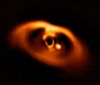
 |  |


