Astronomy:List of exoplanet firsts
This is a list of exoplanet discoveries that were the first by several criteria, including:
- the detection method used,
- the planet type,
- the planetary system type,
- the star type,
and others.
The first
The choice of "first" depends on definition and confirmation, as below. The three systems detected prior to 1994 each have a drawback, with Gamma Cephei Ab being unconfirmed until 2002; while the PSR B1257+12 planets orbit a pulsar. This leaves 51 Pegasi b (discovered and confirmed 1995) as the first confirmed exoplanet around a non-compact star.
| First | Planet | Star | Year | Notes |
|---|---|---|---|---|
| First detected exoplanet later confirmed | Gamma Cephei Ab | Gamma Cephei | 1988 (suspected), 2002 (confirmed) | First evidence for exoplanet to receive later confirmation. |
| First exoplanets to be confirmed | PSR B1257+12 B PSR B1257+12 C |
PSR B1257+12 | 1992 | First super-Earths.[1]
These exoplanets orbit a pulsar. |
| First confirmed exoplanet around non-compact star | 51 Pegasi b | 51 Pegasi | 1995 | First convincing exoplanet discovered around a Sun-like star.[2] While the minimum mass of HD 114762 b was high enough (11 Jupiter-masses) that it could be a brown dwarf, 51 Peg b's minimum mass meant that it almost certainly was near the mass of Jupiter. |
By discovery method
| Discovery method | Planet | Star | Year | Notes |
|---|---|---|---|---|
| First planet discovered via pulsar timing | PSR B1257+12 B PSR B1257+12 C |
PSR B1257+12 | 1992 | First super-earths.[1] |
| First planet discovered via radial velocity | 51 Pegasi b | 51 Pegasi | 1995 | First convincing exoplanet discovered around a Sun-like star.[2] While the minimum mass of HD 114762 b was high enough (11 Jupiter-masses) that it could be a brown dwarf, 51 Peg b's minimum mass meant that it almost certainly was near the mass of Jupiter. |
| First planet discovered via transit | OGLE-TR-56 b | OGLE-TR-56 | 2002 | [3] This was also the second planet detected through transiting,[3] and the then farthest planet known at time of discovery.[3] The first extrasolar planet detected to be transiting was HD 209458 b, which had already been discovered by the radial velocity method.[3][4] |
| First planet discovered via gravitational lensing | OGLE-2003-BLG-235L b | OGLE-2003-BLG-235L / MOA-2003-BLG-53L | 2004 | This was discovered independently by the OGLE and MOA teams.[5] |
| First planetary-mass companion discovered by direct imaging | 2M1207 b | 2M1207 | 2004/
2005 |
May be a sub-brown dwarf instead of a planet, depending on formation mechanism and definitions chosen.[6] |
| First directly imaged extrasolar planet discovered orbiting a star | DH Tauri b | DH Tauri | 2005 | Revised masses place it below the deuterium-burning limit.[7] May be a brown dwarf companion.[8]
DH Tauri b and GQ Lupi b were confirmed as companions within about three month in 2005. Both could be brown dwarfs. If one is a planet, it is the first planet orbiting a 'normal' star, possibly the first exoplanet directly imaged. |
| First planet discovered through variable star timing | V391 Pegasi b | V391 Pegasi | 2007 | The planet was discovered by examining deviations from pulsation frequency from a subdwarf star.[9] |
| First extrasolar planet discovered by indirect imaging (visible light) | Fomalhaut b | Fomalhaut | 2008 | Discovered by a light reflecting off of a dust cloud surrounding the planet.[10] First planet orbiting an ABO star. In 2020 this object was determined to be an expanding debris cloud from a collision of asteroids rather than a planet.[11] |
| First extrasolar planet discovered by astrometric observations | HD 176051 b | HD 176051 A or HD 176051 B | 2010 | Orbits around one of the stars in a binary star system although it is not known which component it is orbiting around. |
| First exoplanet discovered by orbital perturbations of another planet | Kepler-19c | Kepler-19 (KOI-84, TYC 3134-1549-1) | 2011 | Detected through transit-timing variation method. Its existence was inferred by the gravitational influence it had on the orbital periodicity of Kepler-19b.[12][13] |
| First exoplanets discovered by orbital phase reflected light variations | Kepler-70b, Kepler-70c[14] | Kepler-70 | 2011 | Now dubious.[15][16] |
| First exoplanet discovered by transit-duration variation method | Kepler-88c | Kepler-88 (KOI-142) | 2013 | Both transit timing variation and transit-duration variation was measured to measure deviations from the regular orbit of Kepler-88b. Deviations of the planet's transit duration and timing helped to discover Kepler-88c.[17] |
| First exoplanet discovered by spectral template matching with moderate-resolution spectroscopy | Beta Pictoris d | Beta Pictoris | 2026 | This was simultaneously discovered by two independent teams, using spectral template matching[18] and direct imaging.[19] |
By detection method
Some of these planets had already been discovered by another method but were the first to be detected by the listed method.
| Detection method | Planet | Star | Year | Notes |
|---|---|---|---|---|
| First planet detected via radial velocity | Gamma Cephei Ab | Gamma Cephei | 1988 | First evidence for exoplanet to receive later confirmation. |
| First planet detected via pulsar timing | PSR B1257+12 B PSRB1257+12 C |
PSR B1257+12 | 1992 | [1] |
| First planet detected by transit method | HD 209458 b | HD 209458 | 1999 | This first exoplanet found to be transiting had already been discovered by the radial velocity method. This is also the first planet that has been detected through more than one method.[3][4] |
| First planetary-mass companion directly imaged (infrared) | 2M1207 b | 2M1207 | 2004/ 2005 | May be a sub-brown dwarf instead of a planet, depending on formation mechanism and definitions chosen. If it is a planet, it is the first known planet around a brown dwarf. |
| First directly imaged extrasolar planet orbiting a star (infrared) | DH Tauri b | DH Tauri | 2005 | Revised masses place it below the deuterium-burning limit.[7] May be a brown dwarf companion.[8]
DH Tauri b and GQ Lupi b were confirmed as companions within about three month in 2005. Both could be brown dwarfs. If one is a planet, it is the first planet orbiting a 'normal' star, possibly the first exoplanet directly imaged. |
| First planet with observed secondary eclipse (infrared) | HD 209458 b | HD 209458 | 2005 | Planet was discovered in 1999. This is the first detection of light from an object with a clear planetary origin.[20] |
| First directly imaged extrasolar planet orbiting a sun-like star (infrared) | AB Pictoris b | AB Pictoris | 2005 | [21] It has 10±1 MJ.[22]
GQ Lupi b was found earlier.[23] May, however, be a brown dwarf companion. 1RXS J160929.1−210524 b was found later.[24] Revised mass places it at or above the deuterium-burning limit. May be a sub-brown dwarf instead of a planet, depending on formation mechanism and definitions chosen. The orbital status of the companion was confirmed in 2010.[25] |
| First planet characterized by atmospheric spectroscopy | HD 209458 b | HD 209458 | 2007 | [26] also by[27] HD 189733 b was characterized spectroscopically only few month later.[28]
Any of the earlier Direct imaging exoplanets, e.g. 2M1207 b, DH Tauri b or GQ Lupi b have spatially resolved spectroscopic observations, but the objects need confirmation to be of planetary origin. |
| First extrasolar planet detected by indirect imaging (visible light) | Fomalhaut b | Fomalhaut | 2008 | Discovered by a light reflecting off of a dust cloud surrounding the planet.[10] First planet orbiting an ABO star. In 2020 this object was determined to be an expanding debris cloud from a collision of asteroids rather than a planet.[11] |
| First planets directly characterized through astrometric observations | Gliese 876 b and Gliese 876 c | Gliese 876 | 2009 | |
| First planet detected by orbital phase reflected light variations in visible light | CoRoT-1b[29] | CoRoT-1 | 2009 | The planet in question had already been discovered with transit method. |
| First planet characterized by spatially resolved atmospheric spectroscopy | HR 8799 c | HR 8799 | 2010 | [30][31] Several spectra of Direct imaging exoplanets might be earlier, but the objects need confirmation to be of planetary origin. Especially AB Pictoris b is a candidate, if its mass is confirmed to be 10±1 MJ.[22] |
| First planets detected through ellipsoidal light variations of the host star | HAT-P-7b | HAT-P-7 | 2010 | [32] |
| First planets detected through transit timing variation method | Kepler-9b, Kepler-9c | Kepler-9 | 2010 | Transit-timing variation was used to confirm both planets detected through transit method.[33] |
| First planet detected through transit duration variation method | Kepler-16b[34] | Kepler-16 | 2011 | Orbital motion of the three-body system Kepler-16 causes variations of the duration of stellar eclipses and planetary transits. |
| First planet detected with eclipsing binary timing with well-characterized orbit | Kepler-16b | Kepler-16 | 2011 | Kepler-16b itself was detected through transit method. There are stars with earlier detections through eclipsing binary timing. However, either those signals have matched with unstable orbits or the exact orbits are not known.[35] |
| First planet detected by light variations due to relativistic beaming | TrES-2b | TrES-2A | 2012 | [36] |
| First tilted multi-planetary system discovered | Kepler-56b, c and d | Kepler-56 | 2013 | [37] |
| First extrasolar planet detected through polarimetry | DH Tauri b /
GSC 6214-210 b |
DH Tauri /
GSC 6214–210 |
2021
Polarized scattered light was found for HD 189733 b in 2008.[38] It could not be confirmed and was disputed by two separate teams.[39][40][41] Possibly a "Saharan dust event over the La Palma observatory in 2008 August".[41] HD 189733 b was discovered in 2005. |
By system type
| System type | Planet | Star | Year | Notes |
|---|---|---|---|---|
| First extrasolar planet discovered in a solitary star system | PSR B1257+12 B PSR B1257+12 C |
PSR B1257+12 | 1992 | First extrasolar planets discovered.[42] |
| First multiple planet extrasolar system discovered | PSR B1257+12 A PSR B1257+12 B PSR B1257+12 C |
PSR B1257+12 | 1992 | First pulsar planetary system. |
| First planet discovered in a circumbinary orbit | PSR B1620-26 b | PSR B1620-26 | 1993 | Orbits a pulsar and a white dwarf. Discovery confirmed in 2003. |
| First planet discovered in globular cluster | PSR B1620-26 b | PSR B1620-26 | 1993 | Located in Messier 4. |
| First planet discovered in a multiple main-sequence star system | 55 Cancri Ab | 55 Cancri A | 1996 | 55 Cnc has a distant red dwarf companion.
|
| First "free-floating" planet discovered[NB 1] | S Ori 68 | N/A | 2000 | ~5 MJupiter[43] Isolated status needs confirmation. Could be a companion of SE 70; needs confirmation.[44]
S Ori J053810.1-023626 (S Ori 70) has a mass of 3 MJupiter; needs confirmation.[45][46] |
| First binary star system where both components have separate planetary systems | HD 20781 b HD 20781 c HD 20782 b |
HD 20781 HD 20782 |
2011 | |
| First multiple planet system in a multi-star system where multiple planets orbit multiple stars | Kepler-47b Kepler-47c |
Kepler-47 | 2012 | [47][48] NN Serpentis cataclysmic variable is suspected to have at least 2 planets as of 2009.[49] |
By star type
| Star type | Planet | Star | Year | Notes |
|---|---|---|---|---|
| First pulsar planet discovered | PSR B1257+12 B PSR B1257+12 C |
PSR B1257+12 | 1992 | [42][1] |
| First known planet orbiting a white dwarf | PSR B1620-26 b | PSR B1620-26 | 1993 | Orbits a pulsar and a white dwarf. Discovery confirmed in 2003. GD 66 b was announced in 2007, but has not been confirmed. |
| First known extrasolar planet orbiting a main sequence star (Sun-like) | 51 Pegasi b | 51 Pegasi | 1995 | First hot Jupiter.[42] |
| First known planet orbiting a red dwarf | Gliese 876 b | Gliese 876 | 1998 | [50][51] |
| First "free-floating" planet discovered[NB 1] | S Ori 68 | N/A | 2000 | ~5 MJupiter[43] Isolated status needs confirmation. Could be a companion of SE 70; needs confirmation.[44]
S Ori J053810.1-023626 (S Ori 70) has a mass of 3 MJupiter; needs confirmation.[45][46] |
| First known planet orbiting a true giant star | Iota Draconis b | Iota Draconis | 2002 | Planet Epsilon Reticuli Ab was discovered earlier in 2000, however its host star is a star of sub giant-giant type.[52] |
| First known planet orbiting a brown dwarf | 2M1207 b | 2M1207 | 2004 | May in fact be a sub-brown dwarf instead of a planet, depending on formation mechanism and definitions chosen. First directly imaged exoplanet.[53] |
| First known planet orbiting a pre-main-sequence star | DH Tauri b | DH Tauri | 2005 | Revised masses place it below the deuterium-burning limit.[7] May be a brown dwarf companion.[8] |
| First known planet orbiting an A star (white star) | Fomalhaut b | Fomalhaut | 2008 | First extrasolar planet discovered by visible light image. In 2020 this object was determined to be an expanding debris cloud from a collision of asteroids rather than a planet.[11] |
| First confirmed planet orbiting only a white dwarf | WD 0806−661 B | WD 0806−661 | 2011 | Maybe a sub-brown dwarf instead of planet, depending on the formation mechanism.[54] |
| First known planet orbiting a B star (blue-white star) | b Centauri b | b Centauri | 2021 | [55] |
| First known planet orbiting a hypervelocity star | MOA-2011-BLG-262Lb | MOA-2011-BLG-262L | 2024 | [56] |
By planet type
| Planet type | Planet | Star | Year | Notes |
|---|---|---|---|---|
| First super-Earth discovered[NB 2] | PSR B1257+12 B PSR B1257+12 C |
PSR B1257+12 | 1992 | First exoplanets discovered.[42] |
| First hot Jupiter | 51 Pegasi b | 51 Pegasi | 1995 | First planet discovered orbiting a main sequence star other than the Sun. |
| First evaporating planet discovered | HD 209458 b | HD 209458 | 1999 | First transiting exoplanet.[42] |
| First free-floating planet discovered[NB 1] | OTS 44 | N/A | 1998 | |
| First super-Earth orbiting a main- sequence star[NB 2] | Gliese 876 d | Gliese 876 | 2005 | Orbits a red dwarf star. |
| First icy extrasolar planet orbiting a main-sequence star | OGLE-2005-BLG-390Lb | OGLE-2005-BLG-390L | 2006 | Orbits a red dwarf star. The icy nature of this planet is not confirmed, as no radius measurements are available so the density is unknown. The first extrasolar planet known to have a density compatible with being an icy planet is GJ 1214 b, though even for this case there are other possibilities for the composition.[citation needed] |
| First ocean planet candidate; also first small planet within the circumstellar habitable zone | Gliese 581d | Gliese 581 | 2007 | |
| First extrasolar terrestrial planet orbiting a main-sequence star | CoRoT-7b (planetary nature confirmed in 2009; terrestrial composition confirmed in 2022) / Kepler-10b (planetary nature and terrestrial composition confirmed in 2011) |
CoRoT-7 / Kepler-10 | 2009 / 2011 | |
| First Jupiter analogue | HIP 11915 b | HIP 11915 | 2015 | The discovery raises the possibility that HIP 11915 will be the first Solar System analogue discovered. |
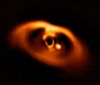
| First protoplanet | PDS 70 b | PDS 70 | 2018 |
Other
| Record | Planet | Star | Year | Notes |
|---|---|---|---|---|
| First map of an extrasolar planet released | HD 189733 b | HD 189733 | 2007 | The map in question is a thermal emission map.[57] |
| First extrasolar planet with a deformation detected | WASP-103b | WASP-103 | 2022 | The radial Love number was estimated for the planet from the transit light curve.[58] |
| First multi-planet extrasolar system directly imaged | HR 8799 b HR 8799 c HR 8799 d HR 8799 e |
HR 8799 | 2008 | |
| First planet discovered with a retrograde orbit | WASP-17b | WASP-17 | 2009 | The planet HAT-P-7b was discovered before WASP-17b, but its retrograde nature was announced after that of WASP-17b. The planet Nu Octantis Ab, whose orbit is retrograde in a close binary star, was suspected to exist since 2004 although it was not confirmed until 2025.[59] |
| First planet discovered orbiting a Sun-like star in a star cluster | Pr0201b Pr0211b |
Pr0201 Pr0211 |
2012 | Beehive Cluster star cluster.[60] |
| First recorded planet-planet transit | Kepler-89d Kepler-89e |
Kepler-89 | 2012 | Kepler-89e was found to partially transit Kepler-89d.[61] |
| First extrasolar planet with serious potential to support life | Kepler-62f | Kepler-62 | 2013 | |
| First transiting planet discovered in a star cluster | Kepler-66b Kepler-67b |
Kepler-66 Kepler-67 |
2013 | NGC 6811 star cluster; these two planets were, at the time of discovery, only two of six total planets known in star clusters.[62] |
| First map of cloud coverage of an extrasolar planet | Kepler-7b | Kepler-7 | 2013 | Observations indicate cloud coverage in the west and clear skies in the east.[63] |
| First not tidally locked extrasolar planet to have its day length measured | Beta Pictoris b | Beta Pictoris | 2014 | Rotation time was calculated to be 8.1 hours.[64] |
| First planet found to contain water in the stratosphere | WASP-121b | WASP-121 | 2017 | [65][66] |
| First extrasolar planet system with one radial velocity and one directly imaged planet | Beta Pictoris b Beta Pictoris c | Beta Pictoris | 2019 | [67] |
| First Earth-mass rogue planet unbounded by any star, and free floating in the Milky Way galaxy. | OGLE-2016-BLG-1928 | N/A | 2020 | Detected by microlensing techniques.[68][69] |
See also
Notes
References
- ↑ 1.0 1.1 1.2 1.3 Space.com, "Earth-Sized Planets Confirmed, But They're Dead Worlds", Robert Roy Britt, 29 May 2003 (accessed 20-10-2010)
- ↑ 2.0 2.1 Queloz, Didier (2006). "Extrasolar planets: Light through a gravitational lens". Nature 439 (7075): 400–401. doi:10.1038/439400a. PMID 16437096. Bibcode: 2006Natur.439..400Q.
- ↑ 3.0 3.1 3.2 3.3 3.4 SpaceDaily.com, "Farthest Known Planet Opens the Door For Finding New Earths", 10 January 2003 (accessed 2010-10-24)
- ↑ 4.0 4.1 PhysOrg.com, "New Era in Planetary Science", 23 March 2005 (accessed 2010-10-24)
- ↑ Sky and Telescope, "First Planet Found by Microlensing", Alan M. MacRobert, 16 April 2004 (accessed 2010-10-24)
- ↑ ESO press releases [1] [2]
- ↑ 7.0 7.1 7.2 Mass was revised to about 11.5 Jupiter masses in 2006. [3] [4] [5]
- ↑ 8.0 8.1 8.2 Itoh, Yoichi; Hayashi, Masahiko; Tamura, Motohide; Tsuji, Takashi; Oasa, Yumiko; Fukagawa, Misato; Hayashi, Saeko S.; Naoi, Takahiro et al. (2005-02-20). "A Young Brown Dwarf Companion to DH Tauri" (in en). The Astrophysical Journal 620 (2): 984–993. doi:10.1086/427086. ISSN 0004-637X. Bibcode: 2005ApJ...620..984I. https://iopscience.iop.org/article/10.1086/427086.
- ↑ Silvotti, R.; Schuh, S.; Janulis, R.; Solheim, J.-E.; Bernabei, S.; Østensen, R.; Oswalt, T. D.; Bruni, I. et al. (2007). "A giant planet orbiting the 'extreme horizontal branch' star V 391 Pegasi". Nature 449 (7159): 189–191. doi:10.1038/nature06143. PMID 17851517. Bibcode: 2007Natur.449..189S. https://authors.library.caltech.edu/17168/2/Silvotti2007p5743Nature_supp.pdf.
- ↑ 10.0 10.1 Kalas, Paul (2008-11-13). "Optical Images of an Exosolar Planet 25 Light-Years from Earth". Science 322 (5906): 1345–8. doi:10.1126/science.1166609. PMID 19008414. Bibcode: 2008Sci...322.1345K.
- ↑ 11.0 11.1 11.2 Gáspár, András; Rieke, George H. (April 20, 2020). "New HST data and modeling reveal a massive planetesimal collision around Fomalhaut". PNAS 117 (18): 9712–9722. doi:10.1073/pnas.1912506117. PMID 32312810. Bibcode: 2020PNAS..117.9712G.
- ↑ TG Daily, "'Invisible' planet detected", Kate Taylor, 9 September 2011
- ↑ Time, "Found: A (So Far) Invisible World", Michael D. Lemonick, 9 September 2011
- ↑ Charpinet, S. and Fontaine, G. and Brassard, P. and Green, EM and Van Grootel, V. and Randall, SK and Silvotti, R. and Baran, AS and Østensen, RH and Kawaler, SD (2011). "A compact system of small planets around a former red-giant star". Nature (Nature Publishing Group) 480 (7378): 496–499. doi:10.1038/nature10631. PMID 22193103. Bibcode: 2011Natur.480..496C.
- ↑ Krzesinski, J. (August 25, 2015), "Planetary candidates around the pulsating sdB star KIC 5807616 considered doubtful", Astronomy & Astrophysics 581: A7, doi:10.1051/0004-6361/201526346, Bibcode: 2015A&A...581A...7K
- ↑ Blokesz, A.; Krzesinski, J.; Kedziora-Chudczer, L. (4 July 2019), "Analysis of putative exoplanetary signatures found in light curves of two sdBV stars observed by Kepler", Astronomy & Astrophysics 627: A86, doi:10.1051/0004-6361/201835003, Bibcode: 2019A&A...627A..86B
- ↑ Nesvorný, David; Kipping, David; Terrell, Dirk; Hartman, Joel; Bakos, Gáspár Á.; Buchhave, Lars A.; Stapelfeldt, Karl; Marois, Christian et al. (2013). "Koi-142, the King of Transit Variations, is a Pair of Planets Near the 2:1 Resonance". The Astrophysical Journal 777 (1): 3. doi:10.1088/0004-637X/777/1/3. Bibcode: 2013ApJ...777....3N.
- ↑ Gibbs, Aidan; Ruffio, Jean-Baptiste; Bidot, Alexis; Barman, Travis S.; Do Ó, Clarissa R. et al. (2026-07-15). "Discovery of an Exterior Third Planet Orbiting β Pictoris". The Astrophysical Journal Letters 1006 (1): L11. doi:10.3847/2041-8213/ae801b. ISSN 2041-8205.
- ↑ Sutlieff, Ben J.; Bonse, Markus J.; Christiaens, Valentin; Fontanive, Clémence; Matthews, Elisabeth C. et al. (2026-07-15). "Direct Imaging Discovery of Giant Exoplanet β Pictoris d: A Decade-long Game of Hide-and-seek". The Astrophysical Journal Letters 1006 (1): L10. doi:10.3847/2041-8213/ae80a0. ISSN 2041-8205.
- ↑ Deming, Drake; Seager, Sara; Richardson, L. Jeremy; Harrington, Joseph (2005-03-23). "Infrared radiation from an extrasolar planet" (in en). Nature 434 (7034): 740–743. doi:10.1038/nature03507. ISSN 0028-0836. PMID 15785769. Bibcode: 2005Natur.434..740D. https://www.nature.com/articles/nature03507.
- ↑ Chauvin, G.; Lagrange, A.-M.; Zuckerman, B.; Dumas, C.; Mouillet, D.; Song, I.; Beuzit, J.-L.; Lowrance, P. et al. (2005-08-01). "A companion to AB Pic at the planet/brown dwarf boundary". Astronomy & Astrophysics 438 (3): L29–L32. doi:10.1051/0004-6361:200500111. ISSN 0004-6361. Bibcode: 2005A&A...438L..29C. http://www.aanda.org/10.1051/0004-6361:200500111.
- ↑ 22.0 22.1 Palma-Bifani, P.; Chauvin, G.; Bonnefoy, M.; Rojo, P. M.; Petrus, S.; Rodet, L.; Langlois, M.; Allard, F. et al. (2023-02-01). "Peering into the young planetary system AB Pic: Atmosphere, orbit, obliquity, and second planetary candidate". Astronomy & Astrophysics 670: A90. doi:10.1051/0004-6361/202244294. ISSN 0004-6361. Bibcode: 2023A&A...670A..90P. https://www.aanda.org/10.1051/0004-6361/202244294.
- ↑ Neuhäuser, R.; Guenther, E. W.; Wuchterl, G.; Mugrauer, M.; Bedalov, A.; Hauschildt, P. H. (2005-05-01). "Evidence for a co-moving sub-stellar companion of GQ Lup". Astronomy & Astrophysics 435 (1): L13–L16. doi:10.1051/0004-6361:200500104. ISSN 0004-6361. Bibcode: 2005A&A...435L..13N. http://www.aanda.org/10.1051/0004-6361:200500104.
- ↑ Exoplanet 'circles normal star', BBC News Online, September 15, 2008
- ↑ Lafrenière, David; Jayawardhana, Ray; van Kerkwijk, Marten H. (2010-08-10). "THE DIRECTLY IMAGED PLANET AROUND THE YOUNG SOLAR ANALOG 1RXS J160929.1 – 210524: CONFIRMATION OF COMMON PROPER MOTION, TEMPERATURE, AND MASS". The Astrophysical Journal 719 (1): 497–504. doi:10.1088/0004-637X/719/1/497. ISSN 0004-637X. Bibcode: 2010ApJ...719..497L. https://iopscience.iop.org/article/10.1088/0004-637X/719/1/497.
- ↑ Richardson, L. Jeremy; Deming, Drake; Horning, Karen; Seager, Sara; Harrington, Joseph (2007-02-01). "A spectrum of an extrasolar planet" (in en). Nature 445 (7130): 892–895. doi:10.1038/nature05636. ISSN 0028-0836. PMID 17314975. Bibcode: 2007Natur.445..892R. https://www.nature.com/articles/nature05636.
- ↑ Swain, M. R.; Bouwman, J.; Akeson, R. L.; Lawler, S.; Beichman, C. A. (2008-02-10). "The Mid-Infrared Spectrum of the Transiting Exoplanet HD 209458b" (in en). The Astrophysical Journal 674 (1): 482–497. doi:10.1086/523832. ISSN 0004-637X. Bibcode: 2008ApJ...674..482S. https://iopscience.iop.org/article/10.1086/523832.
- ↑ Grillmair, C. J.; Charbonneau, D.; Burrows, A.; Armus, L.; Stauffer, J.; Meadows, V.; Van Cleve, J.; Levine, D. (2007-04-01). "A Spitzer Spectrum of the Exoplanet HD 189733b" (in en). The Astrophysical Journal 658 (2): L115–L118. doi:10.1086/513741. ISSN 0004-637X. Bibcode: 2007ApJ...658L.115G. https://iopscience.iop.org/article/10.1086/513741.
- ↑ Ignas A. G. Snellen; Ernst J. W. de Mooij; Simon Albrecht (2009-05-28). "The changing phases of extrasolar planet CoRoT-1b". Nature 459 (7246): 543–545. doi:10.1038/nature08045. PMID 19478779. Bibcode: 2009Natur.459..543S.
- ↑ "VLT Captures First Direct Spectrum of an Exoplanet". 13 January 2010. https://www.eso.org/public/news/eso1002/.
- ↑ Janson, M.; Bergfors, C.; Goto, M.; Brandner, W.; Lafrenière, D. (2010-02-10). "SPATIALLY RESOLVED SPECTROSCOPY OF THE EXOPLANET HR 8799 c". The Astrophysical Journal 710 (1): L35–L38. doi:10.1088/2041-8205/710/1/L35. ISSN 2041-8205. Bibcode: 2010ApJ...710L..35J. https://iopscience.iop.org/article/10.1088/2041-8205/710/1/L35.
- ↑ Welsh, William F.; Orosz, Jerome A.; Seager, Sara; Fortney, Jonathan J.; Jenkins, Jon; Rowe, Jason F.; Koch, David; Borucki, William J. (2010-04-20). "THE DISCOVERY OF ELLIPSOIDAL VARIATIONS IN THE KEPLER LIGHT CURVE OF HAT-P-7". The Astrophysical Journal 713 (2): L145–L149. doi:10.1088/2041-8205/713/2/L145. ISSN 2041-8205. Bibcode: 2010ApJ...713L.145W. https://iopscience.iop.org/article/10.1088/2041-8205/713/2/L145.
- ↑ "NASA's Kepler Mission Discovers Two Planets Transiting the Same Star". 20 November 2015. http://www.nasa.gov/centers/ames/news/releases/2010/10-73AR.html.
- ↑ Doyle, Laurance R.; Carter, Joshua A.; Fabrycky, Daniel C.; Slawson, Robert W.; Howell, Steve B.; Winn, Joshua N.; Orosz, Jerome A.; Prˇsa, Andrej et al. (2011-09-16). "Kepler-16: A Transiting Circumbinary Planet" (in en). Science 333 (6049): 1602–1606. doi:10.1126/science.1210923. ISSN 0036-8075. PMID 21921192. Bibcode: 2011Sci...333.1602D. https://www.science.org/doi/10.1126/science.1210923.
- ↑ Overbye, Dennis (2011-09-15). "NASA Detects Planet Dancing With a Pair of Stars". The New York Times. https://www.nytimes.com/2011/09/16/science/space/16planet.html.
- ↑ Barclay, Thomas; Huber, Daniel; Rowe, Jason F.; Fortney, Jonathan J.; Morley, Caroline V.; Quintana, Elisa V.; Fabrycky, Daniel C.; Barentsen, Geert et al. (2012). "Photometrically derived masses and radii of the planet and star in the TrES-2 system". The Astrophysical Journal 761 (1): 53. doi:10.1088/0004-637X/761/1/53. Bibcode: 2012ApJ...761...53B.
- ↑ Huber, Daniel; Carter, Joshua A.; Barbieri, Mauro; Miglio, Andrea; Deck, Katherine M.; Fabrycky, Daniel C.; Montet, Benjamin T.; Buchhave, Lars A. et al. (2013-10-18). "Stellar Spin-Orbit Misalignment in a Multiplanet System" (in en). Science 342 (6156): 331–334. doi:10.1126/science.1242066. ISSN 0036-8075. PMID 24136961. Bibcode: 2013Sci...342..331H. https://www.science.org/doi/10.1126/science.1242066.
- ↑ Berdyugina, S. V.; Berdyugin, A. V.; Fluri, D. M.; Piirola, V. (2008-01-20). "First Detection of Polarized Scattered Light from an Exoplanetary Atmosphere" (in en). The Astrophysical Journal 673 (1): L83–L86. doi:10.1086/527320. ISSN 0004-637X. Bibcode: 2008ApJ...673L..83B. https://iopscience.iop.org/article/10.1086/527320.
- ↑ Wiktorowicz, Sloane J. (2009-05-10). "NONDETECTION OF POLARIZED, SCATTERED LIGHT FROM THE HD 189733b HOT JUPITER". The Astrophysical Journal 696 (2): 1116–1124. doi:10.1088/0004-637X/696/2/1116. ISSN 0004-637X. Bibcode: 2009ApJ...696.1116W. https://iopscience.iop.org/article/10.1088/0004-637X/696/2/1116.
- ↑ Wiktorowicz, Sloane J.; Nofi, Larissa A.; Jontof-Hutter, Daniel; Kopparla, Pushkar; Laughlin, Gregory P.; Hermis, Ninos; Yung, Yuk L.; Swain, Mark R. (2015-10-27). "A GROUND-BASED ALBEDO UPPER LIMIT FOR HD 189733b FROM POLARIMETRY". The Astrophysical Journal 813 (1): 48. doi:10.1088/0004-637X/813/1/48. ISSN 1538-4357. Bibcode: 2015ApJ...813...48W. https://iopscience.iop.org/article/10.1088/0004-637X/813/1/48.
- ↑ 41.0 41.1 Bott, Kimberly; Bailey, Jeremy; Kedziora-Chudczer, Lucyna; Cotton, Daniel V.; Lucas, P. W.; Marshall, Jonathan P.; Hough, J. H. (2016-05-23). "The polarization of HD 189733" (in en). Monthly Notices of the Royal Astronomical Society: Letters 459 (1): L109–L113. doi:10.1093/mnrasl/slw046. ISSN 1745-3925. Bibcode: 2016MNRAS.459L.109B. https://academic.oup.com/mnrasl/article/459/1/L109/2589655.
- ↑ 42.0 42.1 42.2 42.3 42.4 Space.com, "Out There: A Strange Zoo of Other Worlds", Charles Q. Choi, 14 February 2010 (accessed 2010-10-20)
- ↑ 43.0 43.1 Zapatero Osorio, M. R.; Béjar, V. J. S.; Martı́n, E. L.; Rebolo, R.; Navascués, D. Barrado y; Bailer-Jones, C. A. L.; Mundt, R. (2000-10-06). "Discovery of Young, Isolated Planetary Mass Objects in the σ Orionis Star Cluster" (in en). Science 290 (5489): 103–107. doi:10.1126/science.290.5489.103. ISSN 0036-8075. PMID 11021788. Bibcode: 2000Sci...290..103Z. https://www.science.org/doi/10.1126/science.290.5489.103.
- ↑ 44.0 44.1 Caballero, J. A.; Martín, E. L.; Dobbie, P. D.; Barrado y Navascués, D. (2006-12-01). "Are isolated planetary-mass objects really isolated?: A brown dwarf-exoplanet system candidate in the σ Orionis cluster". Astronomy & Astrophysics 460 (2): 635–640. doi:10.1051/0004-6361:20066162. ISSN 0004-6361. Bibcode: 2006A&A...460..635C. http://www.aanda.org/10.1051/0004-6361:20066162.
- ↑ 45.0 45.1 Space.com, "Mysterious Object Might be First Extrasolar Planet Photographed" , Robert Roy Britt, 22 May 2002 (accessed 2010-10-24)
- ↑ 46.0 46.1 Zapatero Osorio, M. R.; Bejar, V. J. S.; Martin, E. L.; Rebolo, R.; Navascues, D. Barrado y; Mundt, R.; Eisloffel, J.; Caballero, J. A. (2002-10-10). "A Methane, Isolated, Planetary-Mass Object in Orion" (in en). The Astrophysical Journal 578 (1): 536–542. doi:10.1086/342474. ISSN 0004-637X. Bibcode: 2002ApJ...578..536Z. https://iopscience.iop.org/article/10.1086/342474.
- ↑ Space.com, "Newfound 'Tatooine' Alien Planet Bodes Well for E.T. Search", Charles Q. Choi, 4 September 2012 (accessed 5 September 2012)
- ↑ SpaceDaily, "Astronomers Find First Multi-Planet System Around a Binary Star", 3 September 2012 (accessed 5 September 2012)
- ↑ Beuermann, K.; Hessman, F. V.; Dreizler, S.; Marsh, T. R.; Parsons, S. G.; Winget, D. E.; Miller, G. F.; Schreiber, M. R. et al. (2010). "Two planets orbiting the recently formed post-common envelope binary NN Serpentis". Astronomy and Astrophysics 521: L60. doi:10.1051/0004-6361/201015472. Bibcode: 2010A&A...521L..60B. http://www.aanda.org/index.php?option=com_article&access=standard&Itemid=129&url=/articles/aa/abs/2010/13/aa15472-10/aa15472-10.html.
- ↑ Marietta DiChristina (September 1998). "Other Worlds". Popular Science: 77–79.
- ↑ Delfosse, Xavier; Forveille, Thierry; Mayor, Michel; Perrier, Christian; Naef, Dominique; Queloz, Didier (1998). "The closest extrasolar planet. A giant planet around the M4 dwarf GL 876". Astronomy and Astrophysics 338: L67–L70. Bibcode: 1998A&A...338L..67D.
- ↑ Farihi, J.; Burleigh, M. R.; Holberg, J. B.; Casewell, S. L.; Barstow, M. A. (November 2011), "Evolutionary constraints on the planet-hosting subgiant ε Reticulum from its white dwarf companion", Monthly Notices of the Royal Astronomical Society 417 (3): 1735–1741, doi:10.1111/j.1365-2966.2011.19354.x, Bibcode: 2011MNRAS.417.1735F.
- ↑ "2M1207 b – First image of an exoplanet". 26 April 2010. https://science.nasa.gov/resource/2m1207-b-first-image-of-an-exoplanet/.
- ↑ Rodriguez, David R.; Zuckerman, B.; Melis, Carl; Song, Inseok (May 2011). "The Ultra Cool Brown Dwarf Companion of WD 0806-661B: Age, Mass, and Formation Mechanism". The Astrophysical Journal Letters 732 (2): L29. doi:10.1088/2041-8205/732/2/L29. Bibcode: 2011ApJ...732L..29R.
- ↑ Janson, Markus; Squicciarini, Vito; Delorme, Philippe; Gratton, Raffaele; Bonnefoy, Mickaël; Reffert, Sabine; Mamajek, Eric E.; Eriksson, Simon C. et al. (February 2021). "BEAST begins: sample characteristics and survey performance of the B-star Exoplanet Abundance Study". Astronomy & Astrophysics 646: A164. doi:10.1051/0004-6361/202039683. ISSN 0004-6361. Bibcode: 2021A&A...646A.164J. https://www.aanda.org/10.1051/0004-6361/202039683.
- ↑ Terry, Sean K.; Beaulieu, Jean-Philippe; Bennett, David P.; Bhattacharya, Aparna; Hulberg, Jon; Huston, Macy J.; Koshimoto, Naoki; Blackman, Joshua W. et al. (2025). "A Candidate High-velocity Exoplanet System in the Galactic Bulge". The Astronomical Journal 169 (3): 131. doi:10.3847/1538-3881/ad9b0f. Bibcode: 2025AJ....169..131T.
- ↑ Knutson, Heather A.; David Charbonneau; Lori E. Allen; Jonathan J. Fortney; Eric Agol; Nicolas B. Cowan; Adam P. Showman; Curtis S. Cooper et al. (10 May 2007). "A map of the day–night contrast of the extrasolar planet HD 189733b". Nature 447 (7141): 183–186. doi:10.1038/nature05782. PMID 17495920. Bibcode: 2007Natur.447..183K.
- ↑ Barros, S. C. C.; Akinsanmi, B.; Boué, G.; Smith, A. M. S.; Laskar, J.; Ulmer-Moll, S.; Lillo-Box, J.; Queloz, D. et al. (January 2022). "Detection of the tidal deformation of WASP-103b at 3 σ with CHEOPS". Astronomy & Astrophysics 657: A52. doi:10.1051/0004-6361/202142196. ISSN 0004-6361. Bibcode: 2022A&A...657A..52B. https://www.aanda.org/10.1051/0004-6361/202142196.
- ↑ Cheng, Ho Wan; Trifonov, Trifon; Lee, Man Hoi; Cantalloube, Faustine; Reffert, Sabine; Ramm, David; Quirrenbach, Andreas (May 2025). "A retrograde planet in a tight binary star system with a white dwarf". Nature 641 (8064): 866–870. doi:10.1038/s41586-025-09006-x. ISSN 1476-4687. PMID 40399630. Bibcode: 2025Natur.641..866C. https://www.nature.com/articles/s41586-025-09006-x.
- ↑ ScienceDaily, "First Planets Found Around Sun-Like Stars in a Cluster", 14 September 2012
- ↑ Masuda, Kento; Hirano, Teruyuki; Taruya, Atsushi; Nagasawa, Makiko; Suto, Yasushi; Kite, Edwin S.; Stapelfeldt, Karl; Marois, Christian et al. (2013). "Characterization of the Koi-94 System with Transit Timing Variation Analysis: Implication for the Planet-Planet Eclipse". The Astrophysical Journal 778 (2): 185–200. doi:10.1088/0004-637X/778/2/185. Bibcode: 2013ApJ...778..185M.
- ↑ SpaceDaily, First Transiting Planets in a Star Cluster Discovered, 27 June 2013
- ↑ NASA Space Telescopes Find Patchy Clouds on Exotic World nasa.gov
- ↑ Cowen, R. (2014-04-30). "First exoplanet seen spinning". Nature. doi:10.1038/nature.2014.15132.
- ↑ Landau, Elizabeth; Villard, Ray (2 August 2017). "Hubble Detects Exoplanet with Glowing Water Atmosphere". NASA. https://www.jpl.nasa.gov/news/news.php?feature=6909.
- ↑ Evans, Thomas M. (2 August 2017). "An ultrahot gas-giant exoplanet with a stratosphere". Nature 548 (7665): 58–61. doi:10.1038/nature23266. PMID 28770846. Bibcode: 2017Natur.548...58E.
- ↑ Lagrange, A.-M.; Meunier, Nadège; Rubini, Pascal; Keppler, Miriam; Galland, Franck; Chapellier, Eric; Michel, Eric; Balona, Luis et al. (2019-08-19). "Evidence for an additional planet in the β Pictoris system" (in en). Nature Astronomy 3 (12): 1135–1142. doi:10.1038/s41550-019-0857-1. ISSN 2397-3366. Bibcode: 2019NatAs...3.1135L. https://www.nature.com/articles/s41550-019-0857-1.
- ↑ Gough, Evan (1 October 2020). "A Rogue Earth-Mass Planet Has Been Discovered Freely Floating in the Milky Way Without a Star". Universe Today. https://www.universetoday.com/148097/a-rogue-earth-mass-planet-has-been-discovered-freely-floating-in-the-milky-way-without-a-star/.
- ↑ Mroz, Przemek (29 September 2020). "A Terrestrial-mass Rogue Planet Candidate Detected in the Shortest-timescale Microlensing Event". The Astrophysical Journal Letters 903 (1): L11. doi:10.3847/2041-8213/abbfad. Bibcode: 2020ApJ...903L..11M.
 |  |


