Astronomy:NGC 1961
| NGC 1961 | |
|---|---|
 NGC 1961 imaged by the Hubble Space Telescope | |
| Observation data (J2000 epoch) | |
| Constellation | Camelopardalis[1] |
| Right ascension | 05h 42m 04.6477s[2] |
| Declination | +69° 22′ 42.375″[2] |
| Redshift | 0.013122[2] |
| Helio radial velocity | 3,934±1 km/s[2] |
| Distance | 145.42 ± 27.36 Mly (44.586 ± 8.390 Mpc)[2] |
| Apparent magnitude (V) | 10.9[1] |
| Characteristics | |
| Type | SAB(rs)c [2] |
| Size | ~240,100 ly (73.62 kpc) (estimated)[2] |
| Apparent size (V) | 4.5′ × 3.1′[1] |
| Other designations | |
| IRAS 05365+6921, IC 2133, Arp 184, UGC 3334, MCG+12-06-007, PGC 17625[2] | |
Coordinates:  05h 42m 04.6477s, +69° 22′ 42.375″
NGC 1961 is a spiral galaxy in the constellation Camelopardalis.[1] It was discovered by German-British astronomer William Herschel on 3 December 1788.[3] It was also observed by Guillaume Bigourdan on 22 December 1891, causing it to be listed in the Index Catalogue as IC 2133.[3] Its velocity with respect to the cosmic microwave background for is 3,909±2 km/s, which corresponds to a Hubble distance of 188.0 ± 13.2 Mly (57.65 ± 4.04 Mpc).[2] However, seven non redshift measurements give a much closer distance of 145.42 ± 27.36 Mly (44.586 ± 8.390 Mpc).[4]
05h 42m 04.6477s, +69° 22′ 42.375″
NGC 1961 is a spiral galaxy in the constellation Camelopardalis.[1] It was discovered by German-British astronomer William Herschel on 3 December 1788.[3] It was also observed by Guillaume Bigourdan on 22 December 1891, causing it to be listed in the Index Catalogue as IC 2133.[3] Its velocity with respect to the cosmic microwave background for is 3,909±2 km/s, which corresponds to a Hubble distance of 188.0 ± 13.2 Mly (57.65 ± 4.04 Mpc).[2] However, seven non redshift measurements give a much closer distance of 145.42 ± 27.36 Mly (44.586 ± 8.390 Mpc).[4]
The galaxy has been distorted, however no companion has been detected nor double nuclei that could show a recent merger. Its outer arms are highly irregular. Two long straight arms extend from the north side of the galaxy.[5] A luminous X-ray corona has been detected around the galaxy.[6][7] NGC 1961 is the central member of the small group of nine galaxies, the NGC 1961 group.[5]
Supernovae
Four supernovae have been observed in NGC 1961:
- SN 1998eb (Type Ia, mag. 17.8) was discovered by the Lick Observatory Supernova Search (LOSS) on 17 August 1998.[8][9]
- SN 2001is (Type Ib, mag. 17.6) was discovered by BAO and LOTOSS (Lick Observatory and Tenagra Observatory Supernova Searches) on 22 December 2001.[10][11]
- SN 2013cc (Type II, mag. 17) was discovered by Kōichi Itagaki on 28 April 2013.[12][13]
- SN 2021vaz (Type II, mag. 17.5) was discovered by Kōichi Itagaki on 5 August 2021.[14][15]
Gallery
-
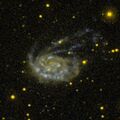 NGC 1961 by GALEX
 -
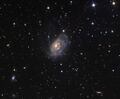 NGC 1961 by Mount Lemmon Observatory
 -
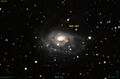 NGC 1961 by DSS
 -
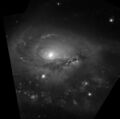 NGC 1961 by Hubble Space Telescope


References
- ↑ 1.0 1.1 1.2 1.3 Finlay, Warren H. (2014). Concise Catalogue of Deep-Sky Objects. The Patrick Moore Practical Astronomy Series (2nd ed.). Springer Cham. p. 184. doi:10.1007/978-3-319-03170-5. ISBN 978-3-319-03169-9.
- ↑ 2.0 2.1 2.2 2.3 2.4 2.5 2.6 2.7 2.8 "Results for object NGC 1961". NASA and Caltech. https://ned.ipac.caltech.edu/byname?objname=NGC+1961.
- ↑ 3.0 3.1 Seligman, Courtney. "New General Catalogue Objects: NGC 1961". https://cseligman.com/text/atlas/ngc19a.htm#1961.
- ↑ "Distance Results for NGC 1961". NASA. https://ned.ipac.caltech.edu/cgi-bin/nDistance?name=NGC+1961.
- ↑ 5.0 5.1 Epinat, B.; Amram, P.; Marcelin, M.; Balkowski, C.; Daigle, O.; Hernandez, O.; Chemin, L.; Carignan, C. et al. (1 August 2008). "GHASP: an Hα kinematic survey of spiral and irregular galaxies – VI. New Hα data cubes for 108 galaxies". Monthly Notices of the Royal Astronomical Society 388 (2): 500–550. doi:10.1111/j.1365-2966.2008.13422.x. Bibcode: 2008MNRAS.388..500E.
- ↑ Michael E. Anderson and Joel N. Bregman (August 2011). "Detection of a Hot Gaseous Halo around the Giant Spiral Galaxy NGC 1961". The Astrophysical Journal 737 (1): 10. doi:10.1088/0004-637X/737/1/22. Bibcode: 2011ApJ...737...22A.
- ↑ Bogdán, Ákos; Forman, William R.; Vogelsberger, Mark; Bourdin, Hervé; Sijacki, Debora; Mazzotta, Pasquale; Kraft, Ralph P.; Jones, Christine et al. (1 August 2013). "Hot X-Ray Coronae around Massive Spiral Galaxies: A Unique Probe of Structure Formation Models". The Astrophysical Journal 772 (2): 97. doi:10.1088/0004-637X/772/2/97. Bibcode: 2013ApJ...772...97B.
- ↑ Li, W. D.; Modjaz, M.; Halderson, E.; Shefler, T.; King, J. Y.; Papenkova, M.; Treffers, R. R.; Filippenko, A. V. (1998). "Supernova 1998eb in NGC 1961". International Astronomical Union Circular (7016): 1. Bibcode: 1998IAUC.7016....1L. http://www.cbat.eps.harvard.edu/iauc/07000/07016.html#Item1.
- ↑ "SN 1998eb". IAU. https://www.wis-tns.org/object/1998eb.
- ↑ Qiu, Y. L.; Hu, J. Y.; Papenkova, M.; Schwartz, M. (2001). "Supernova 2001is in NGC 1961". International Astronomical Union Circular (7782): 1. Bibcode: 2001IAUC.7782....1Q. http://www.cbat.eps.harvard.edu/iauc/07700/07782.html#Item1.
- ↑ "SN 2001is". IAU. https://www.wis-tns.org/object/2001is.
- ↑ Itagaki, K.; Nakano, S.; Elenin, L.; Molotov, I.; Ochner, P.; Tomasella, L.; Pastorello, A.; Benetti, S. et al. (2013). "Supernova 2013cc in NGC 1961 = PSN J05415876+6921409". Central Bureau Electronic Telegrams (3512): 1. Bibcode: 2013CBET.3512....1I.
- ↑ "SN 2013cc". IAU. https://www.wis-tns.org/object/2013cc.
- ↑ Itagaki, Koichi. "Transient Name Server SN 2021vaz Discovery Certificate". TNS. https://www.wis-tns.org/object/2021vaz/discovery-cert.
- ↑ "SN 2021vaz". IAU. https://www.wis-tns.org/object/2021vaz.
External links
- NGC 1961 on WikiSky: DSS2, SDSS, GALEX, IRAS, Hydrogen α, X-Ray, Astrophoto, Sky Map, Articles and images
Template:NGC objects:1001-2000

 |  |


