Astronomy:NGC 5668
| NGC 5668 | |
|---|---|
 NGC 5668 imaged by the Hubble Space Telescope | |
| Observation data (J2000 epoch) | |
| Constellation | Virgo |
| Right ascension | 14h 33m 24.331s[1] |
| Declination | +04° 27′ 01.75″[1] |
| Redshift | 0.005280 |
| Helio radial velocity | 1,582 ± 5[2] km/s |
| Distance | 80.9 ± 5.5 million light years (24.8 ± 1.7 Mpc)[2] |
| Group or cluster | NGC 5638 Group, NGC 5746 Group, Virgo III Groups |
| Characteristics | |
| Type | SA(s)d[2] |
| Mass | 5.7×10¹⁰[2] M☉ |
| Size | ~48,400 ly (14.84 kpc) (estimated) |
| Apparent size (V) | 3.0′ × 3.0′ |
| Other designations | |
| IRAS 14309+0440, UGC 9363, MCG+01-37-028, PGC 52018[3] | |
NGC 5668 is a nearly face-on spiral galaxy, visual magnitude about 11.5,[4] located about 81[2] million light years away in the constellation Virgo. It was discovered on 29 April 1786 by William Herschel.[4]
NGC 5668 is a member of the NGC 5638 Group of galaxies, itself one of the Virgo III Groups strung out to the east of the Virgo Supercluster of galaxies.[5] In addition, A.M. Garcia listed NGC 5668 in the 31 member NGC 5746 galaxy group (also known as LGG 386).[6]
As seen from the Earth, it is inclined by an angle of 18° to the line of sight along a position angle of 145°. The morphological classification in the De Vaucouleurs system is SA(s)d,[2] indicating a pure spiral structure with loosely wound arms.[7] However, optical images of the galaxy indicate the presence of a weak bar structure spanning an angle of 12″ across the nucleus. There is a dwarf galaxy located around 650×103 ly (200 kpc) to the southeast of NGC 5668, and the two may be gravitationally interacting.[2]
Supernovae
Three supernovae have been observed in this galaxy:
- SN 1952G (type unknown, mag. 17.9) was discovered by Fritz Zwicky on 18 April 1952.[8][9]
- SN 1954B (Type Ia, mag. 12.3) was discovered by Paul Wild on 4 May 1954.[10] [Note: Some sources incorrectly list the discovery date as 27 April 1954.][11]
- SN 2004G (Type II, mag. 17.2) was discovered by Reiki Kushida on 19 January 2004.[12][13][14] It was initially imaged at 43" to the west and 12".5 south of the galaxy core.[13]
High velocity clouds of neutral hydrogen have been observed in NGC 5668, which may have their origin in supernova explosions and strong stellar winds.[15]
Gallery
-
 NGC 5668 (SDSS DR14)
 -
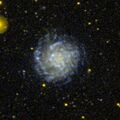 GALEX image of NGC 5668


See also
References
- ↑ 1.0 1.1 Skrutskie, Michael F.; Cutri, Roc M.; Stiening, Rae; Weinberg, Martin D.; Schneider, Stephen E.; Carpenter, John M.; Beichman, Charles A.; Capps, Richard W. et al. (1 February 2006). "The Two Micron All Sky Survey (2MASS)". The Astronomical Journal 131 (2): 1163–1183. doi:10.1086/498708. ISSN 0004-6256. Bibcode: 2006AJ....131.1163S.
- ↑ 2.0 2.1 2.2 2.3 2.4 2.5 2.6 R. A., Marino et al. (July 2012), "Integral Field Spectroscopy and Multi-wavelength Imaging of the nearby Spiral Galaxy NGC 5668: An Unusual Flattening in Metallicity Gradient", The Astrophysical Journal 754 (1): 61, doi:10.1088/0004-637X/754/1/61, Bibcode: 2012ApJ...754...61M.
- ↑ "NGC 5668 -- Galaxy", SIMBAD Astronomical Database (Centre de Données astronomiques de Strasbourg), http://simbad.u-strasbg.fr/simbad/sim-id?Ident=%402272923, retrieved 2013-07-11.
- ↑ 4.0 4.1 "New General Catalog Objects: NGC 5650 - 5699". https://cseligman.com/text/atlas/ngc56a.htm#5668.
- ↑ "The Virgo III Groups". Atlas of the Universe. http://www.atlasoftheuniverse.com/galgrps/viriii.html.
- ↑ Garcia, A. M. (1993). "General study of group membership. II. Determination of nearby groups". Astronomy and Astrophysics Supplement Series 100: 47. Bibcode: 1993A&AS..100...47G.
- ↑ Buta, Ronald J. et al. (2007), Atlas of Galaxies, Cambridge University Press, pp. 13–17, ISBN 978-0521820486, https://books.google.com/books?id=g-P7dCbB5MEC&pg=PA16.
- ↑ "SN 1952G". IAU. https://www.wis-tns.org/object/1952G.
- ↑ Kowal, C. T.; Zwicky, F.; Sargent, W. L. W.; Searle, L. (1974). "The 1973 Palomar Supernova Search". Publications of the Astronomical Society of the Pacific 86 (512): 516. doi:10.1086/129639. Bibcode: 1974PASP...86..516K.
- ↑ Wild, Paul (1960). "Light Curves of the Supernovae of 1954". Publications of the Astronomical Society of the Pacific 72 (425): 97. doi:10.1086/127488. Bibcode: 1960PASP...72...97W.
- ↑ "SN 1954B". IAU. https://www.wis-tns.org/object/1954B.
- ↑ "SN 2004G". IAU. https://www.wis-tns.org/object/2004G.
- ↑ 13.0 13.1 Nakano, S. et al. (2004), "Supernova 2004G in NGC 5668", IAU Circular (8272): 1, Bibcode: 2004IAUC.8272....1N.
- ↑ Elias-Rosa, N. et al. (2004), "Supernova 2004G in NGC 5668", IAU Circular (8273): 2, Bibcode: 2004IAUC.8273....2E.
- ↑ Jiménez-Vicente, J.; Battaner, E. (June 2000), "Vertical motions in the disk of NGC 5668 as seen with optical Fabry-Perot spectroscopy", Astronomy and Astrophysics 358: 812–818, Bibcode: 2000A&A...358..812J.
External links
Coordinates:  14h 33m 24.331s, +04° 27′ 01.75″
 |  |


