Astronomy:NGC 4939
| NGC 4939 | |
|---|---|
 NGC 4939 imaged by the Hubble Space Telescope | |
| Observation data (J2000 epoch) | |
| Constellation | Virgo |
| Right ascension | 13h 04m 14.3133s[1] |
| Declination | −10° 20′ 22.417″[1] |
| Redshift | 0.010561[1] |
| Helio radial velocity | 3166 ± 2 km/s[1] |
| Distance | 118 ± 30 Mly (36.1 ± 9.4 Mpc)[1] |
| Apparent magnitude (V) | 11.3[2] |
| Characteristics | |
| Type | SA(s)bc[1] |
| Size | ~192,800 ly (59.10 kpc) (estimated)[1] |
| Apparent size (V) | 5.5′ × 2.8′[1] |
| Notable features | Seyfert galaxy |
| Other designations | |
| IRAS 13016-1004, MCG-02-33-104, PGC 45170[1] | |
NGC 4939 is a large spiral galaxy located in the constellation Virgo. It is located at a distance of about 120 million light years from Earth, which, given its apparent dimensions, means that NGC 4939 is about 190,000 light years across. It was discovered by William Herschel on March 25, 1786.[3]
Characteristics

NGC 4939 has been characterised as a Seyfert galaxy, a galaxy category which features bright point-like nuclei. NGC 4939 is a type II Seyfert galaxy. Its X-ray spectrum is more consistent with a Compton-thick cold reflection source, which means that the source is hidden behind dense material, mainly gas and dust, and the X-rays observed have been reflected, but a Compton-thin transmission model could not be ruled out.[4] The equivalent width of the FeKα line is large, indicating too that it is a Compton-thick source.[5] Further observations by Swift Observatory confirmed its Compton-thick nature.[6] The source of activity in the active galactic nuclei is a supermassive black hole (SMBH) lying at the centre of the galaxy. The SMBH at the centre of NGC 4939 is accreting material with a rate of 0.077 M☉ per year.[7] The black hole has been detected in hard X-rays, which are not absorbed by the Compton-thick column, by INTEGRAL.[8]
The galaxy has a large elliptical bulge and maybe a weak bar. It is a grand design spiral galaxy, with two tightly wrapped arms emanating from the bulge. The arms are thin, smooth and well defined and can be traced for nearly one and a half revolutions before fading.[9] Two symmetric arm sections or arcs are observed in the central part of the galaxy.[10] The galaxy is seen with an inclination of 56 degrees. The rotational speed of the galaxy is about 270 km/s.[11]
Supernovae
Five supernovae have been observed in NGC 4939:
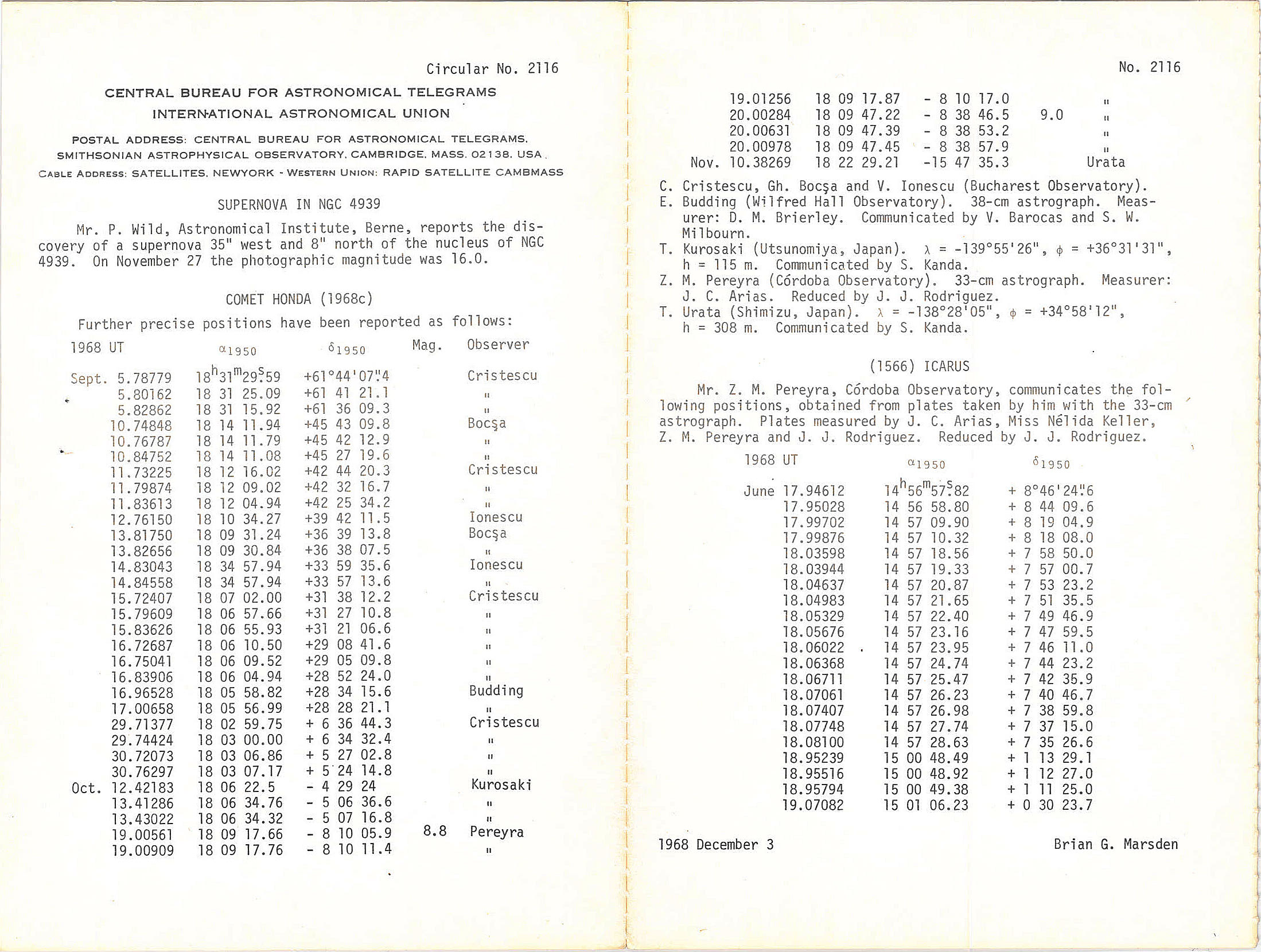
- SN 1968X (type unknown, mag. 16) was discovered by Swiss astronomer Paul Wild on 27 November 1968.[12][13]
- SN 1973J (type unknown, mag. 16) was discovered by Paul Wild on 21 May 1973.[14]
- SN 2008aw (Type II, mag. 15.9) was discovered by the Lick Observatory Supernova Search (LOSS) on 2 March 2008.[15][16]
- SN 2014B (Type II-P, mag. 17.0) was discovered by the Lick Observatory Supernova Search (LOSS) on 2 January 2014.[17][18]
- SN 2020nif (Type II, mag. 16.1492) was discovered by the Zwicky Transient Facility on 24 June 2020.[19]
Nearby galaxies
NGC 4939 belongs to a small galaxy group known as the NGC 4933 group, named after the multiple galaxy NGC 4933 (fr).[20] The group lies between the Local Supercluster and Hydra-Centaurus Supercluster.[21]
References
- ↑ 1.0 1.1 1.2 1.3 1.4 1.5 1.6 1.7 1.8 "Results for object NGC 4939". NASA and Caltech. https://ned.ipac.caltech.edu/byname?objname=NGC+4939.
- ↑ "Revised NGC Data for NGC 4939". http://spider.seds.org/ngc/revngcic.cgi?NGC4939.
- ↑ Seligman, Courtney. "NGC 4939 (= PGC 45170)". http://cseligman.com/text/atlas/ngc49.htm#4939.
- ↑ Maiolino, R.; Salvati, M.; Bassani, L.; Dadina, M.; della Ceca, R.; Matt, G.; Risaliti, G.; Zamorani, G. (October 1998). "Heavy obscuration in X-ray weak AGNs". Astronomy and Astrophysics 338: 781–794. Bibcode: 1998A&A...338..781M.
- ↑ Dadina, M. (4 October 2006). "BeppoSAX observations in the 2–100 keV band of the nearby Seyfert galaxies: an atlas of spectra". Astronomy & Astrophysics 461 (3): 1209–1252. doi:10.1051/0004-6361:20065734. Bibcode: 2007A&A...461.1209D.
- ↑ Vasudevan, Ranjan V.; Brandt, William N.; Mushotzky, Richard F.; Winter, Lisa M.; Baumgartner, Wayne H.; Shimizu, Thomas T.; Schneider, Donald. P.; Nousek, John (15 January 2013). "X-ray properties of the northern galactic cap sources in the 58 month Swift/BAT catalog". The Astrophysical Journal 763 (2): 111. doi:10.1088/0004-637X/763/2/111. Bibcode: 2013ApJ...763..111V.
- ↑ Diamond-Stanic, Aleksandar M.; Rieke, George H. (20 February 2012). "The relationship between black hole growth and star formation in Seyfert galaxies". The Astrophysical Journal 746 (2): 168. doi:10.1088/0004-637X/746/2/168. Bibcode: 2012ApJ...746..168D.
- ↑ "IGR J13042-1020: a massive black hole in spiral galaxy NGC 4939". ESA. 11 June 2010. http://sci.esa.int/integral/47176-igr-j13042-1020-a-massive-black-hole-in-ngc-4939/.
- ↑ Eskridge, Paul B.; Frogel, Jay A.; Pogge, Richard W.; Quillen, Alice C.; Berlind, Andreas A.; Davies, Roger L.; DePoy, D. L.; Gilbert, Karoline M. et al. (November 2002). "Near-Infrared and Optical Morphology of Spiral Galaxies". The Astrophysical Journal Supplement Series 143 (1): 73–111. doi:10.1086/342340. Bibcode: 2002ApJS..143...73E.
- ↑ Grosbøl, P.; Patsis, P. A.; Pompei, E. (12 August 2004). "Spiral galaxies observed in the near-infrared K band". Astronomy & Astrophysics 423 (3): 849–859. doi:10.1051/0004-6361:20035804.
- ↑ Mitchell, Carl J.; Sellwood, J. A.; Williams, T. B.; Spekkens, Kristine; Kuzio de Naray, Rachel; Bixel, Alex (23 February 2018). "The RINGS Survey. III. Medium-resolution H-alpha Fabry–Pérot Kinematic Data Set". The Astronomical Journal 155 (3): 123. doi:10.3847/1538-3881/aaabb8. Bibcode: 2018AJ....155..123M.
- ↑ Wild, P. (3 December 1968). Marsden, Brian G.. ed. "SUPERNOVA IN NGC 4939". Central Bureau for Astronomical Telegrams (Smithsonian Astrophysical Observatory, IAU) 2116: 1. http://www.cbat.eps.harvard.edu/IAUCs/IAUC2116.jpg. Retrieved 22 December 2024.
- ↑ "SN 1968X". IAU. https://www.wis-tns.org/object/1968X.
- ↑ "SN 1973J". IAU. https://www.wis-tns.org/object/1973J.
- ↑ Winslow, D.; Li, W.; Filippenko, A. V. (2008). "Supernova 2008aw in NGC 4939". Central Bureau Electronic Telegrams (1279): 1. Bibcode: 2008CBET.1279....1W. http://www.cbat.eps.harvard.edu/iau/cbet/001200/CBET001279.txt.
- ↑ "SN 2008aw". IAU. https://www.wis-tns.org/object/2008aw.
- ↑ Kim, H.; Zheng, W.; Li, W.; Filippenko, A. V.; Cenko, S. B. (2014). "Supernova 2014B in NGC 4939 = PSN J13041770-1020012". Central Bureau Electronic Telegrams (3772): 1. Bibcode: 2014CBET.3772....1K.
- ↑ "SN 2014B". IAU. https://www.wis-tns.org/object/2014B.
- ↑ "SN 2020nif". IAU. https://www.wis-tns.org/object/2020nif.
- ↑ Makarov, Dmitry; Karachentsev, Igor (21 April 2011). "Galaxy groups and clouds in the local (z~ 0.01) Universe". Monthly Notices of the Royal Astronomical Society 412 (4): 2498–2520. doi:10.1111/j.1365-2966.2010.18071.x. Bibcode: 2011MNRAS.412.2498M.
- ↑ Richter, O. -G.; Huchtmeier, W. K. (1 March 1987). "HI observations of galaxies in between the Local and the Hydra/Centaurus superclusters.". Astronomy and Astrophysics Supplement Series 68: 427–467. ISSN 0365-0138. Bibcode: 1987A&AS...68..427R. https://ui.adsabs.harvard.edu/abs/1987A%26AS...68..427R/abstract.
External links
- NGC 4939 on WikiSky: DSS2, SDSS, GALEX, IRAS, Hydrogen α, X-Ray, Astrophoto, Sky Map, Articles and images
 |  |