Astronomy:NGC 4536
| NGC 4536 | |
|---|---|
 NGC 4536 imaged by the Mount Lemmon Skycenter | |
| Observation data (J2000 epoch) | |
| Constellation | Virgo |
| Right ascension | 12h 34m 27.129s[1] |
| Declination | +02° 11′ 16.37″[1] |
| Redshift | 0.006031 ± 0.000003[2] |
| Helio radial velocity | 1808 ± 1[3] km/s |
| Distance | 48.7 ± 0.9 Mly (14.9 ± 0.3 Mpc)[4] |
| Apparent magnitude (V) | 11.1[5] |
| Characteristics | |
| Type | SAB(rs)bc[6] |
| Size | ~108,200 ly (33.17 kpc) (estimated)[5] |
| Apparent size (V) | 7.6′ × 3.2′[5] |
| Other designations | |
| UGC 7732, MCG+00-32-023, PGC 41823[5] | |
NGC 4536 is an intermediate spiral galaxy in the constellation Virgo. It was discovered by German-British astronomer William Herschel on 24 January 1784.[7]
NGC 4536 is located about 10° south of the midpoint of the Virgo Cluster. However, it is not considered a member of the cluster.[6] Rather, it is a member of the M61 Group of galaxies, which is a member of the Virgo II Groups, a series of galaxies and galaxy clusters strung out from the southern edge of the Virgo Supercluster.[8][9][10] The morphological classification in the De Vaucouleurs system is SAB(rs)bc, which indicates it is a weakly barred spiral galaxy with a hint of an inner ring structure plus moderate to loosely wound arms.[6] It does not have a classical bulge around the nucleus.[11]
NGC 4536 has the optical characteristics of an HII galaxy, which means it is undergoing a strong burst of star formation.[11] This is occurring prominently in the ring that surrounds the bar and nucleus.[12] Based upon the level of X-ray emission from the core, it may have a small supermassive black hole with 104–106 times the mass of the Sun.[11]
One supernova has been observed in NGC 4536: SN 1981B (type Ia, mag. 12.3) was discovered by Dmitry Tsvetkov on 2 March 1981, located 51 arcseconds to the northeast of the Galactic Center.[13][14] It reached a peak visual magnitude of 12 on March 8 before steadily fading from view over the next two months.[6]
Gallery
-
![Detail of a region of extremely rapid star formation in this "starburst galaxy".[15]](/wiki/images/thumb/1/12/Starbursts_in_Virgo.jpg/108px-Starbursts_in_Virgo.jpg) Detail of a region of extremely rapid star formation in this "starburst galaxy".[15]
Detail of a region of extremely rapid star formation in this "starburst galaxy".[15] -
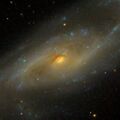 SDSS image of NGC 4536
 -
 NGC 4536 by Spitzer Space Telescope
 -
 NGC 4536 by GALEX (ultraviolet)
 -
 NGC 4536 imaged by the Hubble Space Telescope
![Detail of a region of extremely rapid star formation in this "starburst galaxy".[15]](/wiki/File:Starbursts_in_Virgo.jpg)


.jpg)
See also
- NGC 6946 - a similar spiral galaxy
- NGC 1365 - A similar-looking galaxy
- List of NGC objects (4001–5000)
References
- ↑ 1.0 1.1 Skrutskie, Michael F.; Cutri, Roc M.; Stiening, Rae; Weinberg, Martin D.; Schneider, Stephen E.; Carpenter, John M.; Beichman, Charles A.; Capps, Richard W. et al. (1 February 2006). "The Two Micron All Sky Survey (2MASS)". The Astronomical Journal 131 (2): 1163–1183. doi:10.1086/498708. ISSN 0004-6256. Bibcode: 2006AJ....131.1163S.
- ↑ Grogin, Norman A. et al. (December 1998), "A Complete Redshift Survey to the Zwicky Catalog Limit in a 2h × 15° Region around 3C 273", The Astrophysical Journal Supplement Series 119 (2): 277–285, doi:10.1086/313164, Bibcode: 1998ApJS..119..277G, https://cds.cern.ch/record/359174/files/9807067.pdf.
- ↑ Falco, Emilio E. et al. (April 1999). "The Updated Zwicky Catalog (UZC)". The Publications of the Astronomical Society of the Pacific 111 (758): 438–452. doi:10.1086/316343. Bibcode: 1999PASP..111..438F.
- ↑ Jensen, Joseph B. et al. (February 2003). "Measuring Distances and Probing the Unresolved Stellar Populations of Galaxies Using Infrared Surface Brightness Fluctuations". Astrophysical Journal 583 (2): 712–726. doi:10.1086/345430. Bibcode: 2003ApJ...583..712J.
- ↑ 5.0 5.1 5.2 5.3 "NASA/IPAC Extragalactic Database". Results for NGC 4536. http://nedwww.ipac.caltech.edu/.
- ↑ 6.0 6.1 6.2 6.3 Buta, R. J.; Turner, A. (January 1983), "The photometric properties of the bright Type I supernova 1981b in NGC 4536", Publications of the Astronomical Society of the Pacific 95: 72–78, doi:10.1086/131120, Bibcode: 1983PASP...95...72B.
- ↑ Seligman, Courtney. "New General Catalogue Objects: NGC 4536". https://cseligman.com/text/atlas/ngc45.htm#4536.
- ↑ "The Virgo III Groups". Atlas of the Universe. http://www.atlasoftheuniverse.com/galgrps/viriii.html.
- ↑ Fouqué, P.; Solanes, J. M.; Sanchis, T.; Balkowski, C. (2001-09-01). "Structure, mass and distance of the Virgo cluster from a Tolman-Bondi model" (in en). Astronomy & Astrophysics 375 (3): 770–780. doi:10.1051/0004-6361:20010833. ISSN 0004-6361. Bibcode: 2001A&A...375..770F.
- ↑ "The Virgo II Groups". http://www.atlasoftheuniverse.com/galgrps/virii.html.
- ↑ 11.0 11.1 11.2 McAlpine, W. et al. (February 2011), "Black Holes in Bulgeless Galaxies: An XMM-Newton Investigation of NGC 3367 and NGC 4536", The Astrophysical Journal 728 (1): 25, doi:10.1088/0004-637X/728/1/25, Bibcode: 2011ApJ...728...25M.
- ↑ Davies, Richard I.; Sugai, Hajime; Ward, Martin J. (October 1997), "Molecular hydrogen emission in NGC 4536", Monthly Notices of the Royal Astronomical Society 291 (2): 314–320, doi:10.1093/mnras/291.2.314, Bibcode: 1997MNRAS.291..314D.
- ↑ Aksenov, E. P. (1981). "Supernova in NGC 4536". International Astronomical Union Circular (3580): 1. Bibcode: 1981IAUC.3580....1A.
- ↑ "SN 1981B". IAU. https://www.wis-tns.org/object/1981B.
- ↑ "Starbursts in Virgo". https://www.spacetelescope.org/images/potw1715a/.
External links
 |  |


