Engineering:Basler BT-67
| BT-67 | |
|---|---|
.jpg) A BT-67 of the Guatemalan Air Force | |
| General information | |
| National origin | United States |
| Manufacturer | Basler Turbo Conversions |
| Number built | 70[1] |
| History | |
| Manufactured | 1990–present[2] |
| First flight | 1990 |
| Developed from | Douglas DC-3 Douglas C-47 Skytrain |
The Basler BT-67 is a utility aircraft produced by Basler Turbo Conversions of Oshkosh, Wisconsin. It is a remanufactured and modified Douglas C-47 Skytrain / Douglas DC-3; the modifications are designed to significantly extend the DC-3's serviceable lifetime.
Design and development
Basler Turbo Conversions was founded in 1990 solely to convert existing C-47/DC-3 airframes into BT-67s.[2] Basler configures each new build to the client's specifications. Industries served include cargo, military, cloudseeding, and scientific research.[3][4] The conversion includes fitting the airframe with new Pratt & Whitney Canada PT6A-67R turboprop engines,[5] lengthening the fuselage, strengthening the airframe, upgrading the avionics, and making modifications to the wing leading edges and wingtips.
Due to the higher fuel consumption of the turbine engines of the BT-67, compared to the original piston designs fitted to the standard DC-3, range on the standard fuel tank, with 45 minute reserve, is reduced from 1,160 to 950 nautical miles (2,150 to 1,760 km). Basler provides a long-range fuel tank which increases the aircraft range to 2,140 nmi (3,960 km).[3]
Gunship version
The Basler BT-67 has a gunship version used by the Colombian Aerospace Force as of 2017[update] for counterinsurgency operations.[6][7] The Colombian gunships are equipped with a forward-looking infrared (FLIR) ball, enabling the aircraft to conduct effective nighttime missions.[8][9]
Operators
_(25092318687).jpg)
_at_Missoula,_Montana.jpg)
Military
 Colombia
 El Salvador
- Salvadoran Air Force[12]
 Guatemala
- Guatemalan Air Force[10]
 Mali
Mali
- Malian Air Force[10]
 Mauritania
- Islamic Air Force of Mauritania[10]
 Thailand
- Royal Thai Air Force[10]
Civilian
 Australia
- Australian Antarctic Division[13]
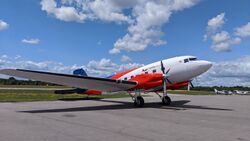
A BT-67 operated by Enterprise Aviation Group at Oshawa Executive Airport

 Canada
 China
China
 Germany
- Alfred Wegener Institute[18]
 United Kingdom
- Bell Geospace[19]
 United States
- United States Forest Service[20]
Accidents and incidents
As of 2019, a total of 15 BT-67 aircraft have been involved in crashes or other incidents since the 1990s.[citation needed]
Specifications (BT-67)
Data from Born Again Basler[21] and Jane's Civil and Military Aircraft Upgrades 1994–95[22]
General characteristics
- Crew: Two (pilot & co-pilot)
- Capacity: 38 Passengers
- Length: 67 ft 9 in (20.65 m)
- Wingspan: 95 ft 0 in (28.95 m)
- Height: 16 ft 11 in (5.15 m)
- Empty weight: 15,700 lb (7,121 kg)
- Max takeoff weight: 28,750 lb (13,041 kg)
- Powerplant: 2 × Pratt & Whitney Canada PT6A-67R turboprop engines, 1,281 shp (955 kW) each
- Propellers: 5-bladed Hartzell constant speed propellers, 9 ft 7 in (2.92 m) diameter
Performance
- Maximum speed: 285 kn (328 mph, 528 km/h)
- Cruise speed: 210 kn (240 mph, 390 km/h)
- Range: 2,140 nmi (2,460 mi, 3,960 km) with 45 minute reserve and long-range fuel tank
- Service ceiling: 25,000 ft (7,600 m)
See also
- That's All, Brother
Related development
- Douglas DC-3
- Conroy Turbo-Three, a similar turboprop DC-3 conversion.
- Conroy Tri-Turbo-Three, a tri-motor turboprop DC-3 conversion.
Related lists
References
- ↑ "DC-3 News". http://www.proplinerinfoexchange.com/1-dc-3_news.htm.
- ↑ 2.0 2.1 "History". https://www.baslerturbo.com/history.html.
- ↑ 3.0 3.1 "Power and Performance". http://www.baslerturbo.com/power-and-performance.html.
- ↑ "BT-67 Worldwide". https://www.baslerturbo.com/bt-67-worldwide.html.
- ↑ Spaeth, Andreas (February 2023). "Making old new again: Reinventing the legendary Douglas DC 3". MTU Aero Engines. https://aeroreport.de/en/aviation/making-old-new-again-reinventing-the-legendary-douglas-dc-3.
- ↑ "Aeronave AC47 Fantasma culmina fase de inspección mayor en CAMAN". Colombian Air Force. https://www.fac.mil.co/aeronave-ac47-fantasma-culmina-fase-de-inspecci%C3%B3n-mayor-en-caman-1.
- ↑ "Basler BT-67 Utility Aircraft, USA" (in en). 2024-04-26. https://www.airforce-technology.com/projects/basler-bt-67-utility-aircraft-usa/?cf-view&cf-closed. "The Mauritania Air Force employs it for logistical support, and intelligence, surveillance and reconnaissance (ISR) tasks, while the Colombian Air Force uses it as a gunship for counterinsurgency operations."
- ↑ "Colombia's AC-47T Fantasmas Are Still Going Strong". 3 October 2016. https://warisboring.com/colombias-ac-47t-fantasmas-are-still-going-strong/.
- ↑ "Argentina to reinforce Antarctic operations with US Basler BT-67 aircraft." (in en). 2024-04-19. https://www.armyrecognition.com/news/army-news/2024/argentina-to-reinforce-antarctic-operations-with-us-basler-bt-67-aircraft. "In addition, a gunship version of the Basler BT-67 has been in use by the Colombian Aerospace Force since 2017. These aircraft, equipped with a forward-looking infrared (FLIR) ball, enhance their capability for nighttime missions."
- ↑ 10.0 10.1 10.2 10.3 10.4 "World Air Forces 2022". Flightglobal Insight. 2022. https://www.flightglobal.com/flight-international/how-afghanistans-fall-reshaped-world-air-forces-inventory/146576.article. Retrieved 15 April 2022.
- ↑ Rivas 2015, p. 120.
- ↑ Hoyle 2015, p. 37.
- ↑ "Basler BT-67 aircraft". Australian Antarctic Division. 31 October 2012. http://www.antarctica.gov.au/living-and-working/travel-and-logistics/aviation/intracontinental-operations/basler-bt-67-aircraft.
- ↑ Charter flights page for Enterprise Aviation Group operated by ALCI Aviation
- ↑ "Air Fleet page at Kenn Borek Air". http://www.borekair.com/index.php/our-fleet.
- ↑ "China to facilitate aviation support in Antarctic research expeditions". http://news.xinhuanet.com/english2010/china/2011-09/26/c_131160781.htm.
- ↑ "China to deploy aircraft in Antarctica expedition". Xinhua. September 25, 2015. http://www.china.org.cn/china/2015-09/25/content_36682868.htm.
- ↑ Ehemalige Flugzeuge (in German) Alfred Wegener Institute – Former airplanes, accessed: 18 April 2009
- ↑ "Low-flying plane returns to Cornwall for surveys". 13 December 2024. https://www.bbc.co.uk/news/articles/c3wexg9v11yo.
- ↑ "As civilian, reservist 'leads' in fight against forest fires". Air Reserve Personnel Center. arpc.afrc.af.mil. 21 September 2015. https://www.arpc.afrc.af.mil/News/Article-Display/Article/617903/as-civilian-reservist-leads-in-fight-against-forest-fires/. Retrieved 15 April 2022.
- ↑ Flight International 24–30 April 1991, p. 42.
- ↑ Michell 1994, pp. 245–246.
- "Born Again Basler". Flight International 139 (4264): 40–43. 24–30 April 1991. http://www.flightglobal.com/pdfarchive/view/1991/1991%20-%201066.html.
- Hoyle, Craig (8–14 December 2015). "World Air Forces Directory". Flight International 188 (5517): 26–53. ISSN 0015-3710.
- Michell, Simon (1994). Jane's Civil and Military Upgrades 1994–95. Coulsdon, Surrey, UK: Jane's Information Group. ISBN 0-7106-1208-7.
- Rivas, Santiago (October 2015). "Fighting Colombia's Drug War". Air International 89 (4): 118–121. ISSN 0306-5634.
External links
- Basler Turbo Conversions, LLC
- The Antarctic Sun "A Timeless Machine Returns"
- The Antarctic Sun "Modern plane and old history maker are birds of a feather"
- Global article
United States military transport aircraft designations, Army/Air Force and Tri-Service systems | |||||||||||||||||||||||||||||||||||||||||||||||||||||||||
|---|---|---|---|---|---|---|---|---|---|---|---|---|---|---|---|---|---|---|---|---|---|---|---|---|---|---|---|---|---|---|---|---|---|---|---|---|---|---|---|---|---|---|---|---|---|---|---|---|---|---|---|---|---|---|---|---|---|
| Army/Air Force sequence (1925–1962) |
| ||||||||||||||||||||||||||||||||||||||||||||||||||||||||
| Tri-service sequence (1962–present) | |||||||||||||||||||||||||||||||||||||||||||||||||||||||||
| Revived original sequence (2005–present) | |||||||||||||||||||||||||||||||||||||||||||||||||||||||||
| Non-sequential designations | |||||||||||||||||||||||||||||||||||||||||||||||||||||||||
| Related designations | |||||||||||||||||||||||||||||||||||||||||||||||||||||||||
1 Not assigned
! rowspan="3" colspan="2" width="14%" style="border-bottom:2px solid grey;" | Date/Time (UTC) ! Configuration ! Serial number ! Launch site ! Outcome |- |style="text-align:center;background-color:#e3e9e9;" | Payload |style="text-align:center;background-color:#e3e9e9;" | Separation orbit |style="text-align:center;background-color:#e3e9e9;" | Operator |style="text-align:center;background-color:#e3e9e9;" | Function |- | colspan="4" style="text-align:center;background-color:#e4dfdf;border-bottom:2px solid grey;" | Remarks |- Parameter 1=time required!
This is a navigational template created using {{navbox}}. It can be transcluded on pages by placing Initial visibilityThis template's initial visibility currently defaults to To change this template's initial visibility, the
Templates using the classes TemplateDataA navigational box that can be placed at the bottom of articles.
Template transclusions
 Not doneLatin pronunciation: [{{{1}}}] Not doneLatin pronunciation: [{{{1}}}]
| rowspan="1" colspan="2" style="border-top:2px solid #aabbcc;" | | style="border-top:2px solid #aabbcc;" | | style="border-top:2px solid #aabbcc;" | | style="border-top:2px solid #aabbcc;" | | style="border-top:2px solid #aabbcc;" | |- |- Vietnamese pronunciation: [{{{1}}}]-4500 — – -4000 — – -3500 — – -3000 — – -2500 — – -2000 — – -1500 — – -1000 — – -500 — – 0 —  Done Done To doRussian pronunciation: [{{{1}}}]Greek pronunciation: [{{{1}}}] To doRussian pronunciation: [{{{1}}}]Greek pronunciation: [{{{1}}}] Danish pronunciation: [{{{1}}}]Northern Sami pronunciation: [{{{1}}}]Mandarin pronunciation: [{{{ipa}}}]Cantonese pronunciation: [{{{1}}}]Entry from Basler BT-67 from TCI Europe, retrieved on {{{Date}}} Danish pronunciation: [{{{1}}}]Northern Sami pronunciation: [{{{1}}}]Mandarin pronunciation: [{{{ipa}}}]Cantonese pronunciation: [{{{1}}}]Entry from Basler BT-67 from TCI Europe, retrieved on {{{Date}}}
This is a navigational template created using {{navbox}}. It can be transcluded on pages by placing Initial visibilityThis template's initial visibility currently defaults to To change this template's initial visibility, the
Templates using the classes TemplateDataA navigational box that can be placed at the bottom of articles.
 In progressPalomares, M. L. D. and Pauly, D., eds. (2011). "{{{1}}} {{{2}}}" in SeaLifeBase. April 2011 version.Turkish pronunciation: [{{{1}}}]Finnish pronunciation: [{{{1}}}]Froese, Rainer and Pauly, Daniel, eds. (2006). "{{{1}}} {{{2}}}" in FishBase. April 2006 version. In progressPalomares, M. L. D. and Pauly, D., eds. (2011). "{{{1}}} {{{2}}}" in SeaLifeBase. April 2011 version.Turkish pronunciation: [{{{1}}}]Finnish pronunciation: [{{{1}}}]Froese, Rainer and Pauly, Daniel, eds. (2006). "{{{1}}} {{{2}}}" in FishBase. April 2006 version.
|- | ... | — | — | — | — | — | — |-Old Norse pronunciation: [{{{1}}}]Salish pronunciation: [{{{1}}}]Basque pronunciation: [{{{1}}}]{{{1}}}data-sort-value="" style="background: #ececec; color: #2C2C2C; vertical-align: middle; font-size: smaller; text-align: center; " class="table-na" | UnreleasedNorwegian pronunciation: [{{{1}}}] (aged {{{4}}})Hungarian pronunciation: [{{{1}}}]Quechua pronunciation: [{{{1}}}]Arabic pronunciation: [{{{1}}}]Punjabi pronunciation: [{{{1}}}]Afrikaans pronunciation: [{{{1}}}]Romanian pronunciation: [{{{1}}}]Hebrew pronunciation: [{{{1}}}][INVALID OR MISSING PARAMETER IN TEMPLATE Basler BT-67]Uto-Aztecan pronunciation: [{{{1}}}]Tamil pronunciation: [{{{1}}}]Hindustani pronunciation: [{{{1}}}]Swedish pronunciation: [{{{1}}}]Kazakh pronunciation: [{{{1}}}]Lao pronunciation: [{{{1}}}]Tibetan pronunciation: [{{{1}}}]Khmer pronunciation: [{{{1}}}]data-sort-value="" style="vertical-align:middle; text-align:center" class="table-na" | —{{{1}}}Welsh pronunciation: [{{{1}}}] Partially doneAthabaskan pronunciation: [{{{1}}}]Māori pronunciation: [{{{1}}}]IPA: [{{{1}}}]Bulgarian pronunciation: [{{{1}}}]Korean pronunciation: [{{{1}}}]Icelandic pronunciation: [{{{1}}}]Sanskrit pronunciation: [{{{1}}}]Bengali pronunciation: [{{{1}}}]Indonesian pronunciation: [{{{1}}}]Serbo-Croatian pronunciation: [{{{1}}}]CROSBI {{{1}}} 2 Assigned to multiple types Partially doneAthabaskan pronunciation: [{{{1}}}]Māori pronunciation: [{{{1}}}]IPA: [{{{1}}}]Bulgarian pronunciation: [{{{1}}}]Korean pronunciation: [{{{1}}}]Icelandic pronunciation: [{{{1}}}]Sanskrit pronunciation: [{{{1}}}]Bengali pronunciation: [{{{1}}}]Indonesian pronunciation: [{{{1}}}]Serbo-Croatian pronunciation: [{{{1}}}]CROSBI {{{1}}} 2 Assigned to multiple types
! rowspan="3" colspan="2" width="14%" style="border-bottom:2px solid grey;" | Date/Time (UTC) ! Configuration ! Serial number ! Launch site ! Outcome |- |style="text-align:center;background-color:#e3e9e9;" | Payload |style="text-align:center;background-color:#e3e9e9;" | Separation orbit |style="text-align:center;background-color:#e3e9e9;" | Operator |style="text-align:center;background-color:#e3e9e9;" | Function |- | colspan="4" style="text-align:center;background-color:#e4dfdf;border-bottom:2px solid grey;" | Remarks |- Parameter 1=time required!
This is a navigational template created using {{navbox}}. It can be transcluded on pages by placing Initial visibilityThis template's initial visibility currently defaults to To change this template's initial visibility, the
Templates using the classes TemplateDataA navigational box that can be placed at the bottom of articles.
Template transclusions
Not doneLatin pronunciation: [{{{1}}}]
| rowspan="1" colspan="2" style="border-top:2px solid #aabbcc;" | | style="border-top:2px solid #aabbcc;" | | style="border-top:2px solid #aabbcc;" | | style="border-top:2px solid #aabbcc;" | | style="border-top:2px solid #aabbcc;" | |- |- Vietnamese pronunciation: [{{{1}}}]-4500 — – -4000 — – -3500 — – -3000 — – -2500 — – -2000 — – -1500 — – -1000 — – -500 — – 0 — Done To doRussian pronunciation: [{{{1}}}]Greek pronunciation: [{{{1}}}]Danish pronunciation: [{{{1}}}]Northern Sami pronunciation: [{{{1}}}]Mandarin pronunciation: [{{{ipa}}}]Cantonese pronunciation: [{{{1}}}]Entry from Basler BT-67 from TCI Europe, retrieved on {{{Date}}}
This is a navigational template created using {{navbox}}. It can be transcluded on pages by placing Initial visibilityThis template's initial visibility currently defaults to To change this template's initial visibility, the
Templates using the classes TemplateDataA navigational box that can be placed at the bottom of articles.
In progressPalomares, M. L. D. and Pauly, D., eds. (2011). "{{{1}}} {{{2}}}" in SeaLifeBase. April 2011 version.Turkish pronunciation: [{{{1}}}]Finnish pronunciation: [{{{1}}}]Froese, Rainer and Pauly, Daniel, eds. (2006). "{{{1}}} {{{2}}}" in FishBase. April 2006 version.
|- | ... | — | — | — | — | — | — |-Old Norse pronunciation: [{{{1}}}]Salish pronunciation: [{{{1}}}]Basque pronunciation: [{{{1}}}]{{{1}}}data-sort-value="" style="background: #ececec; color: #2C2C2C; vertical-align: middle; font-size: smaller; text-align: center; " class="table-na" | UnreleasedNorwegian pronunciation: [{{{1}}}] (aged {{{4}}})Hungarian pronunciation: [{{{1}}}]Quechua pronunciation: [{{{1}}}]Arabic pronunciation: [{{{1}}}]Punjabi pronunciation: [{{{1}}}]Afrikaans pronunciation: [{{{1}}}]Romanian pronunciation: [{{{1}}}]Hebrew pronunciation: [{{{1}}}][INVALID OR MISSING PARAMETER IN TEMPLATE Basler BT-67]Uto-Aztecan pronunciation: [{{{1}}}]Tamil pronunciation: [{{{1}}}]Hindustani pronunciation: [{{{1}}}]Swedish pronunciation: [{{{1}}}]Kazakh pronunciation: [{{{1}}}]Lao pronunciation: [{{{1}}}]Tibetan pronunciation: [{{{1}}}]Khmer pronunciation: [{{{1}}}]data-sort-value="" style="vertical-align:middle; text-align:center" class="table-na" | —{{{1}}}Welsh pronunciation: [{{{1}}}] Partially doneAthabaskan pronunciation: [{{{1}}}]Māori pronunciation: [{{{1}}}]IPA: [{{{1}}}]Bulgarian pronunciation: [{{{1}}}]Korean pronunciation: [{{{1}}}]Icelandic pronunciation: [{{{1}}}]Sanskrit pronunciation: [{{{1}}}]Bengali pronunciation: [{{{1}}}]Indonesian pronunciation: [{{{1}}}]Serbo-Croatian pronunciation: [{{{1}}}]CROSBI {{{1}}} 3 Unconfirmed | |||||||||||||||||||||||||||||||||||||||||||||||||||||||||


Template:Thai transport aircraft designations
 |  |


