Engineering:Fairchild AC-119
| AC-119G Shadow AC-119K Stinger | |
|---|---|
 An AC-119G gunship over Tan Son Nhut Air Base | |
| General information | |
| Manufacturer | Fairchild Aircraft |
| Management and usage | United States Air Force Republic of Vietnam Air Force |
| Number built | 52 |
| History | |
| Introduction date | November 1968 |
| Retired | USAF: 1971 Republic of Vietnam Air Force: 1975 |
| Developed from | Fairchild C-119 Flying Boxcar |
The Fairchild AC-119G Shadow and AC-119K Stinger were twin-engine piston-powered gunships developed by the United States during the Vietnam War. They replaced the Douglas AC-47 Spooky and operated alongside the early versions of the AC-130 Spectre gunship.
Design and development
By late 1967, the idea of the fixed-wing gunship had been proven so successful, the United States Air Force was having a difficult time keeping up with demand. The newer AC-130s that had been created under Project Gunship II were effective, but were being mostly used for armed reconnaissance and interdiction of the Ho Chi Minh Trail. Furthermore, the C-130 airframe was in active service as a transport, vital to the war effort in Southeast Asia. The Air Force desperately needed a new gunship to replace the vulnerable and underpowered AC-47 in the close air support role, as well as supplementing the AC-130 in attacking targets on the Ho Chi Minh Trail.[1]
The Fairchild C-119 Flying Boxcar presented an obvious choice, having been phased out of front-line service in favor of the C-123 and C-130, and with the stock of available airframes in U.S. Air Force Reserve being sufficient. In February 1968, under the USAF program Project Gunship III, 26 C-119Gs were converted to AC-119G standard, initially taking on the name "Creep", but later assigned the callsign "Shadow".[2]
In addition, Fairchild-Hiller, which was contracted for all the conversions, converted another 26 C-119Gs into AC-119Ks, primarily for the "truck hunter" role over the Ho Chi Minh Trail. These aircraft were called "Stingers" primarily in reference to the two M61 Vulcan 20-mm cannons they carried in addition to the AC-119G's four GAU-2/A miniguns. The AC-119K could be visually distinguished by the addition of two General Electric J85 turbojet engines in underwing pods. The conversions were completed at Fairchild-Hiller's facility in St. Augustine, Florida.
Project Gunship III, being a follow-on to the success of the AC-130 series, meant that the AC-119 was a more advanced aircraft in both its iterations than the AC-47. Even the TIC AC-119G featured some of the most up-to-date electronic countermeasures and radar equipment, as well as more basic technology, including an AVQ-8 xenon light, a night observation sight, and an LAU-74/A flare launcher.
The AC-119K, designed to hit trucks on the Ho Chi Minh Trail, was more advanced. Included in the conversion was the AN/APN-147 Doppler navigation radar, AN/AAD-4 forward looking infrared, AN/APQ-133 side-looking beacon tracking radar and AN/APQ-136 search radar.
The armament scheme for both aircraft was simpler than that of the AC-130. The AC-119G had a total of four GAU-2A/A miniguns in SUU-11A/A pods, all on mounts similar to those used on early AC-47s. Like late-model AC-47s, these were soon changed to the purpose-built MXU-470/A minigun modules. The AC-119K, needing a more powerful and longer range "punch" to take out vehicles, featured two M61 20-mm cannons in addition to the four miniguns of the AC-119G.
Operational history

By November 1968, the aircraft had deployed to Vietnam and joined the 14th Special Operations Wing at Nha Trang Air Base. The AC-119Gs were placed in the 71st Special Operations Squadron which was formed from the activated 71st Troop Carrier Squadron, of the Air Force Reserve located at Bakalar Air Force Base in Columbus, Indiana. When the 71 SOS returned to continental USA in 1969, the gunships were taken over by the newly formed 17 SOS.
Earlier on November 8, the 4413th Combat Crew Training Squadron received its first AC-119K.[1]

The AC-119Ks were placed in the 18th Special Operations Squadron. With the addition of the two types, the 14 SOW for a time in 1968 was flying eight different aircraft from ten different bases in South Vietnam. The 14 SOW was inactivated in 1971. Limited numbers continued to be operated out of Thailand as late as the fall of 1972, but the AC-119 was phased out shortly after from the US Air Force. The AC-119G and 119K continued to serve with the Republic of Vietnam Air Force until the Fall of Saigon in 1975. During the Vietnam War, only five AC-119 Gunship IIIs were lost to all causes.[3]
Operators

 South Vietnam
Republic of Vietnam Air Force
 United States
United States Air Force
- 14th Special Operations Wing – Nha Trang Air Base, South Vietnam
- 17th Special Operations Squadron 1969–1971
- 18th Special Operations Squadron 1969–1971
- 71st Special Operations Squadron 1968–1969
- (Detachments at Tan San Nhut, Phan Rang and Phu Cat AB)
- 56th Special Operations Wing – Nakhon Phanom Air Base, Thailand
- 18th Special Operations Squadron 1971–1972
Surviving example
- AC-119G Shadow, AF Ser. No. 53-3144, is on display at the Air Commando Heritage Park at Hurlburt Field, Florida.[4]
Specifications (AC-119G)
General characteristics
- Crew: 6 (day), 8 (night)
- Length: 86 ft 5.75 in (26.3589 m)
- Wingspan: 109 ft 3.25 in (33.3058 m)
- Height: 26 ft 7.75 in (8.1217 m)
- Wing area: 1,400 sq ft (130 m2)
- Airfoil: root: NACA 2418; tip: NACA 4409[5]
- Empty weight: 40,125 lb (18,200 kg)
- Max takeoff weight: 62,000 lb (28,123 kg)
- Powerplant: 2 × Wright R-3350-85 Duplex-Cyclone 18-cylinder air-cooled radial piston engines, 2,500 hp (1,900 kW) each for take-off
- Propellers: 4-bladed constant-speed fully-feathering reversible-pitch propellers
Performance
- Maximum speed: 180 kn (210 mph, 330 km/h)
- Cruise speed: 130 kn (150 mph, 240 km/h)
- Range: 1,680 nmi (1,930 mi, 3,110 km)
- Service ceiling: 23,300 ft (7,100 m)
Armament
- 4× GAU-2/A 7.62 mm (0.30 in) miniguns, 1,500 rounds/gun
- 2× M61 Vulcan 20 mm (0.787 in) 6-barreled Gatling cannon (AC-119K variant only)
- 60× Mk 24 flares in a LAU-74/A flare launcher
Gallery
-
 Armament layout of AC-119G Shadow.
 -
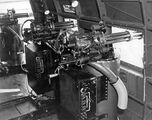 MXU-470 installed on a AC-47.
 -
 Armament layout of AC-119K Stinger.
 -
 SUU-11A/A components.


See also
Related development
Aircraft of comparable role, configuration and era
- Alenia AC-27J
- Douglas AC-47 Spooky
- Lockheed AC-130
Related lists
- List of attack aircraft
- List of military aircraft of the United States
- List of military electronics of the United States
References
Notes
- ↑ 1.0 1.1 1.2 "AC-119 Shadow" (in en-US). https://www.hurlburt.af.mil/About-Us/Fact-Sheets/Fact-Sheets/Article/204594/ac-119-shadow/.
- ↑ "Fairchild AC-119 Gunship 'Shadow'." strategic-air-command. Retrieved: 8 May 2012.
- ↑ Hobson 2001
- ↑ "Hurlburt Field: AC-119 Shadow". United States Air Force. 7 July 2008. http://www2.hurlburt.af.mil/library/factsheets/factsheet.asp?id=3426.
- ↑ Lednicer, David. "The Incomplete Guide to Airfoil Usage". https://m-selig.ae.illinois.edu/ads/aircraft.html.
Bibliography
- Hobson, Chris. Vietnam Air Losses, USAF/USN/USMC, Fixed-Wing Aircraft Losses in Southeast Asia, 1961–1973. North Branch, Minnesota: Specialty Press, 2001. ISBN 1-85780-115-6.
- Petrie, Bill. "AC-119G Shadow (USAF AC-119 Gunships)". AC-119 Gunship Association, updated: 12 January 2006.Retrieved: 11 April 2007.
- Petrie, Bill. "AC-119K Stinger' (USAF AC-119 Gunships)". AC-119 Gunship Association, updated: 27 February 2006. Retrieved: 11 April 2007.
- Project CHECO. Contemporary Historical Evaluation of Combat Operations: Fixed Wing Gunships in Southeast Asia, Retrieved: 22 November 2012.
External links
- AC-119 Gunship Association website
- Fairchild AC-119K – National Museum of the United States Air Force
United States military transport aircraft designations, Army/Air Force and Tri-Service systems | |||||||||||||||||||||||||||||||||||||||||||||||||||||||||
|---|---|---|---|---|---|---|---|---|---|---|---|---|---|---|---|---|---|---|---|---|---|---|---|---|---|---|---|---|---|---|---|---|---|---|---|---|---|---|---|---|---|---|---|---|---|---|---|---|---|---|---|---|---|---|---|---|---|
| Army/Air Force sequence (1925–1962) |
| ||||||||||||||||||||||||||||||||||||||||||||||||||||||||
| Tri-service sequence (1962–present) | |||||||||||||||||||||||||||||||||||||||||||||||||||||||||
| Revived original sequence (2005–present) | |||||||||||||||||||||||||||||||||||||||||||||||||||||||||
| Non-sequential designations | |||||||||||||||||||||||||||||||||||||||||||||||||||||||||
| Related designations | |||||||||||||||||||||||||||||||||||||||||||||||||||||||||
1 Not assigned
! rowspan="3" colspan="2" width="14%" style="border-bottom:2px solid grey;" | Date/Time (UTC) ! Configuration ! Serial number ! Launch site ! Outcome |- |style="text-align:center;background-color:#e3e9e9;" | Payload |style="text-align:center;background-color:#e3e9e9;" | Separation orbit |style="text-align:center;background-color:#e3e9e9;" | Operator |style="text-align:center;background-color:#e3e9e9;" | Function |- | colspan="4" style="text-align:center;background-color:#e4dfdf;border-bottom:2px solid grey;" | Remarks |- Parameter 1=time required!
This is a navigational template created using {{navbox}}. It can be transcluded on pages by placing Initial visibilityThis template's initial visibility currently defaults to To change this template's initial visibility, the
Templates using the classes TemplateDataA navigational box that can be placed at the bottom of articles.
Template transclusions
 Not doneLatin pronunciation: [{{{1}}}] Not doneLatin pronunciation: [{{{1}}}]
| rowspan="1" colspan="2" style="border-top:2px solid #aabbcc;" | | style="border-top:2px solid #aabbcc;" | | style="border-top:2px solid #aabbcc;" | | style="border-top:2px solid #aabbcc;" | | style="border-top:2px solid #aabbcc;" | |- |- Vietnamese pronunciation: [{{{1}}}]-4500 — – -4000 — – -3500 — – -3000 — – -2500 — – -2000 — – -1500 — – -1000 — – -500 — – 0 —  Done Done To doRussian pronunciation: [{{{1}}}]Greek pronunciation: [{{{1}}}] To doRussian pronunciation: [{{{1}}}]Greek pronunciation: [{{{1}}}] Danish pronunciation: [{{{1}}}]Northern Sami pronunciation: [{{{1}}}]Mandarin pronunciation: [{{{ipa}}}]Cantonese pronunciation: [{{{1}}}]Entry from Fairchild AC-119 from TCI Europe, retrieved on {{{Date}}} Danish pronunciation: [{{{1}}}]Northern Sami pronunciation: [{{{1}}}]Mandarin pronunciation: [{{{ipa}}}]Cantonese pronunciation: [{{{1}}}]Entry from Fairchild AC-119 from TCI Europe, retrieved on {{{Date}}}
This is a navigational template created using {{navbox}}. It can be transcluded on pages by placing Initial visibilityThis template's initial visibility currently defaults to To change this template's initial visibility, the
Templates using the classes TemplateDataA navigational box that can be placed at the bottom of articles.
 In progressPalomares, M. L. D. and Pauly, D., eds. (2011). "{{{1}}} {{{2}}}" in SeaLifeBase. April 2011 version.Turkish pronunciation: [{{{1}}}]Finnish pronunciation: [{{{1}}}]Froese, Rainer and Pauly, Daniel, eds. (2006). "{{{1}}} {{{2}}}" in FishBase. April 2006 version. In progressPalomares, M. L. D. and Pauly, D., eds. (2011). "{{{1}}} {{{2}}}" in SeaLifeBase. April 2011 version.Turkish pronunciation: [{{{1}}}]Finnish pronunciation: [{{{1}}}]Froese, Rainer and Pauly, Daniel, eds. (2006). "{{{1}}} {{{2}}}" in FishBase. April 2006 version.
|- | ... | — | — | — | — | — | — |-Old Norse pronunciation: [{{{1}}}]Salish pronunciation: [{{{1}}}]Basque pronunciation: [{{{1}}}]{{{1}}}data-sort-value="" style="background: #ececec; color: #2C2C2C; vertical-align: middle; font-size: smaller; text-align: center; " class="table-na" | UnreleasedNorwegian pronunciation: [{{{1}}}] (aged {{{4}}})Hungarian pronunciation: [{{{1}}}]Quechua pronunciation: [{{{1}}}]Arabic pronunciation: [{{{1}}}]Punjabi pronunciation: [{{{1}}}]Afrikaans pronunciation: [{{{1}}}]Romanian pronunciation: [{{{1}}}]Hebrew pronunciation: [{{{1}}}][INVALID OR MISSING PARAMETER IN TEMPLATE Fairchild AC-119]Uto-Aztecan pronunciation: [{{{1}}}]Tamil pronunciation: [{{{1}}}]Hindustani pronunciation: [{{{1}}}]Swedish pronunciation: [{{{1}}}]Kazakh pronunciation: [{{{1}}}]Lao pronunciation: [{{{1}}}]Tibetan pronunciation: [{{{1}}}]Khmer pronunciation: [{{{1}}}]data-sort-value="" style="vertical-align:middle; text-align:center" class="table-na" | —{{{1}}}Welsh pronunciation: [{{{1}}}] Partially doneAthabaskan pronunciation: [{{{1}}}]Māori pronunciation: [{{{1}}}]IPA: [{{{1}}}]Bulgarian pronunciation: [{{{1}}}]Korean pronunciation: [{{{1}}}]Icelandic pronunciation: [{{{1}}}]Sanskrit pronunciation: [{{{1}}}]Bengali pronunciation: [{{{1}}}]Indonesian pronunciation: [{{{1}}}]Serbo-Croatian pronunciation: [{{{1}}}]CROSBI {{{1}}} 2 Assigned to multiple types Partially doneAthabaskan pronunciation: [{{{1}}}]Māori pronunciation: [{{{1}}}]IPA: [{{{1}}}]Bulgarian pronunciation: [{{{1}}}]Korean pronunciation: [{{{1}}}]Icelandic pronunciation: [{{{1}}}]Sanskrit pronunciation: [{{{1}}}]Bengali pronunciation: [{{{1}}}]Indonesian pronunciation: [{{{1}}}]Serbo-Croatian pronunciation: [{{{1}}}]CROSBI {{{1}}} 2 Assigned to multiple types
! rowspan="3" colspan="2" width="14%" style="border-bottom:2px solid grey;" | Date/Time (UTC) ! Configuration ! Serial number ! Launch site ! Outcome |- |style="text-align:center;background-color:#e3e9e9;" | Payload |style="text-align:center;background-color:#e3e9e9;" | Separation orbit |style="text-align:center;background-color:#e3e9e9;" | Operator |style="text-align:center;background-color:#e3e9e9;" | Function |- | colspan="4" style="text-align:center;background-color:#e4dfdf;border-bottom:2px solid grey;" | Remarks |- Parameter 1=time required!
This is a navigational template created using {{navbox}}. It can be transcluded on pages by placing Initial visibilityThis template's initial visibility currently defaults to To change this template's initial visibility, the
Templates using the classes TemplateDataA navigational box that can be placed at the bottom of articles.
Template transclusions
Not doneLatin pronunciation: [{{{1}}}]
| rowspan="1" colspan="2" style="border-top:2px solid #aabbcc;" | | style="border-top:2px solid #aabbcc;" | | style="border-top:2px solid #aabbcc;" | | style="border-top:2px solid #aabbcc;" | | style="border-top:2px solid #aabbcc;" | |- |- Vietnamese pronunciation: [{{{1}}}]-4500 — – -4000 — – -3500 — – -3000 — – -2500 — – -2000 — – -1500 — – -1000 — – -500 — – 0 — Done To doRussian pronunciation: [{{{1}}}]Greek pronunciation: [{{{1}}}]Danish pronunciation: [{{{1}}}]Northern Sami pronunciation: [{{{1}}}]Mandarin pronunciation: [{{{ipa}}}]Cantonese pronunciation: [{{{1}}}]Entry from Fairchild AC-119 from TCI Europe, retrieved on {{{Date}}}
This is a navigational template created using {{navbox}}. It can be transcluded on pages by placing Initial visibilityThis template's initial visibility currently defaults to To change this template's initial visibility, the
Templates using the classes TemplateDataA navigational box that can be placed at the bottom of articles.
In progressPalomares, M. L. D. and Pauly, D., eds. (2011). "{{{1}}} {{{2}}}" in SeaLifeBase. April 2011 version.Turkish pronunciation: [{{{1}}}]Finnish pronunciation: [{{{1}}}]Froese, Rainer and Pauly, Daniel, eds. (2006). "{{{1}}} {{{2}}}" in FishBase. April 2006 version.
|- | ... | — | — | — | — | — | — |-Old Norse pronunciation: [{{{1}}}]Salish pronunciation: [{{{1}}}]Basque pronunciation: [{{{1}}}]{{{1}}}data-sort-value="" style="background: #ececec; color: #2C2C2C; vertical-align: middle; font-size: smaller; text-align: center; " class="table-na" | UnreleasedNorwegian pronunciation: [{{{1}}}] (aged {{{4}}})Hungarian pronunciation: [{{{1}}}]Quechua pronunciation: [{{{1}}}]Arabic pronunciation: [{{{1}}}]Punjabi pronunciation: [{{{1}}}]Afrikaans pronunciation: [{{{1}}}]Romanian pronunciation: [{{{1}}}]Hebrew pronunciation: [{{{1}}}][INVALID OR MISSING PARAMETER IN TEMPLATE Fairchild AC-119]Uto-Aztecan pronunciation: [{{{1}}}]Tamil pronunciation: [{{{1}}}]Hindustani pronunciation: [{{{1}}}]Swedish pronunciation: [{{{1}}}]Kazakh pronunciation: [{{{1}}}]Lao pronunciation: [{{{1}}}]Tibetan pronunciation: [{{{1}}}]Khmer pronunciation: [{{{1}}}]data-sort-value="" style="vertical-align:middle; text-align:center" class="table-na" | —{{{1}}}Welsh pronunciation: [{{{1}}}] Partially doneAthabaskan pronunciation: [{{{1}}}]Māori pronunciation: [{{{1}}}]IPA: [{{{1}}}]Bulgarian pronunciation: [{{{1}}}]Korean pronunciation: [{{{1}}}]Icelandic pronunciation: [{{{1}}}]Sanskrit pronunciation: [{{{1}}}]Bengali pronunciation: [{{{1}}}]Indonesian pronunciation: [{{{1}}}]Serbo-Croatian pronunciation: [{{{1}}}]CROSBI {{{1}}} 3 Unconfirmed | |||||||||||||||||||||||||||||||||||||||||||||||||||||||||


 |  |


