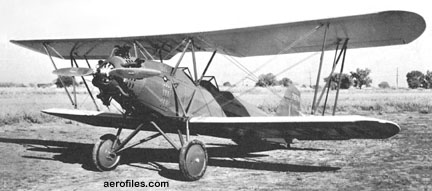
Engineering:Stearman Cloudboy
| Model 6 Cloudboy | |
|---|---|
 The YBT-3 | |
| General information | |
| Type | Training biplane |
| Manufacturer | Stearman Aircraft Company |
| Management and usage | United States Army Air Corps |
| Number built | 7 |
| History | |
| Manufactured | 1930-1931 |
| First flight | 1931 |
The Stearman Model 6 Cloudboy was a 1930s American training biplane designed and built by the Stearman Aircraft Company of Wichita, Kansas.
History
The Cloudboy was designed as a commercial or military trainer. Due to economic pressure during the Great Depression, only a few aircraft were built. Three civil models were built, followed by four similar aircraft for evaluation by the United States Army Air Corps. Designated YPT-9 by the Army, it failed to gain any orders. All models went through a number of engine changes (resulting in new designations for both the military and civil aircraft).[1]
Variants
,_April_1,_2015.jpg)
- Model 6A Cloudboy
- Initial civil production with a 165 hp (123 kW) Wright J-6 Whirlwind 5 engine, three built.
- Model 6C Cloudboy
- Re-engined with a 300 hp (220 kW) Wright J-6-9 Whirlwind (R-975-1), also designated YBT-3.
- Model 6D Cloudboy
- Re-engined with a 300 hp (220 kW) Pratt & Whitney Wasp Junior, also designated YBT-5
- Model 6F Cloudboy
- Re-engined with a 165 hp (123 kW) Continental A70 engine, also designated YBT-9A.
- Model 6H Cloudboy
- Re-engined with a 170 hp (130 kW) Kinner YR-720A engine, also designated YBT-9C.
- Model 6L Cloudboy
- Re-engined with a 200 hp (150 kW) Lycoming R-680-3 engine, also designated YBT-9B

- Model 6P Cloudboy
- One 6F re-engined with 1 220 hp (160 kW) Wright J-5 engine
- YPT-9
- Military production variant of the Model 6A with a 165 hp (123 kW) Wright J-6 Whirlwind 5 engine, four built (one converted to YPT-9A, one to YPT-9B, one to YBT-3 and one YBT-5).
- YPT-9A
- One YPT-9 re-engined with a 165 hp (123 kW) Continental A70 (YR-545-1) engine, later converted to YPT-9B.
- YPT-9B
- One YPT-9 and one YPT-9A re-engined with a 200 hp (150 kW) Lycoming R-680-3 engine.
- YPT-9C
- YBT-3 re-engined with a 170 hp (130 kW) Kinner YR-720A engine.
- YBT-3
- One YPT-9 re-engined with a 300 hp (220 kW) Wright J-6-9 Whirlwind, later converted to a YPT-9C.
- YBT-5
- One YPT-9 re-engined with a 300 hp (220 kW) Pratt & Whitney R-985-1 Wasp Junior engine.
- XPT-943
- A primary trainer derived from the 6A for evaluation at Wright Field. Formed the origins of the Stearman NS and PT-13 for the US Navy and USAAC respectively.
- X-70
- Alternative company designation for the XPT-943.
Operators
 United States
- United States Army Air Corps
Surviving aircraft
- 6002 – 6L airworthy at the Candler Field Museum in Williamson, Georgia.[2][3]
- 6003 – 6L airworthy at the Western Antique Aeroplane & Automobile Museum in Hood River, Oregon.[4] It was previously owned by the Golden Wings Flying Museum.[5]
- 6004 – YPT-9B on display at the Yanks Air Museum in Chino, California. It was previously owned by the Boeing School of Aeronautics and was acquired by the museum in 1987.[6][7]
- 6010 – 6C airworthy with Robert Lock of Lakeland, Florida.[8]
Specifications (YPT-9B)
Data from United States Military Aircraft since 1909[9]
General characteristics
- Crew: 2
- Length: 24 ft 8 in (7.52 m)
- Wingspan: 32 ft 0 in (9.76 m)
- Height: 9 ft 7 in (2.92 m)
- Wing area: 272 sq ft (25.3 m2)
- Gross weight: 2,814 lb (1,279 kg)
- Powerplant: 1 × Lycoming R-680-3 , 200 hp (149 kW)
Performance
- Maximum speed: 135 mph (217 km/h, 117 kn)
- Range: 490 mi (789 km, 430 nmi)
- Service ceiling: 17,000 ft (5,183 m)
- Rate of climb: 1,050 ft/min (5.3 m/s)
See also
Related lists
- List of military aircraft of the United States
Notes
- ↑ Phillips, Edward (2006). Stearman Aircraft: A Detailed History. North Branch, MN: specialtypress. pp. 95,97,106-108. ISBN 9781580070874.
- ↑ "Museum". http://www.peachstateaero.com/museum. Retrieved 25 November 2018.
- ↑ "FAA REGISTRY [N787H"]. U.S. Department of Transportation. http://registry.faa.gov/aircraftinquiry/NNum_Results.aspx?NNumbertxt=N787H. Retrieved 25 November 2018.
- ↑ "FAA REGISTRY [N788H"]. U.S. Department of Transportation. http://registry.faa.gov/aircraftinquiry/NNum_Results.aspx?NNumbertxt=N788H. Retrieved 25 November 2018.
- ↑ "1930 Stearman Cloudboy L-6 / YPT-9". http://www.goldenwingsmuseum.com/collection/AC-Pages/YPT-9.htm. Retrieved 25 November 2018.
- ↑ "Stearman YPT-9B Cloudboy". http://yanksair.org/collection/stearman-6l-6a-ypt-9b. Retrieved 25 November 2018.
- ↑ "FAA REGISTRY [N795H"]. U.S. Department of Transportation. http://registry.faa.gov/aircraftinquiry/NNum_Results.aspx?NNumbertxt=N795H. Retrieved 25 November 2018.
- ↑ "FAA REGISTRY [N786H"]. U.S. Department of Transportation. http://registry.faa.gov/aircraftinquiry/NNum_Results.aspx?NNumbertxt=N786H. Retrieved 25 November 2018.
- ↑ Swanborough and Bowers 1963, p. 441.
References
- Andrade, John (1979). U.S.Military Aircraft Designations and Serials since 1909. Midland Counties Publications. ISBN 0-904597-22-9.
- Swanborough, F.G; Bowers, Peter M. (1963). United States Military Aircraft since 1909. London: Putnam.
- Taylor, Michael J. H. (1989). Jane's Encyclopedia of Aviation. London: Studio Editions.
- The Illustrated Encyclopedia of Aircraft (Part Work 1982-1985). Orbis Publishing. pp. 2958.
External links
- Aerofiles - Stearman
- Aerofiles - Cloudboy 6A photo
- San Diego Air & Space Museum Archives - Cloudboy 6C photo
United States trainer aircraft designations, Army/Air Force and Tri-Service systems | |||||||||||||||||||||||||||||
|---|---|---|---|---|---|---|---|---|---|---|---|---|---|---|---|---|---|---|---|---|---|---|---|---|---|---|---|---|---|
| Advanced trainer (1925–1948) | |||||||||||||||||||||||||||||
| Basic combat (1936–1940) | |||||||||||||||||||||||||||||
| Basic trainer (1930–1948) | |||||||||||||||||||||||||||||
| Primary trainer (1924–1948) | |||||||||||||||||||||||||||||
| Main sequence (1948–present) |
| ||||||||||||||||||||||||||||
| Alternate sequences |
| ||||||||||||||||||||||||||||
1 Not assigned
! rowspan="3" colspan="2" width="14%" style="border-bottom:2px solid grey;" | Date/Time (UTC) ! Configuration ! Serial number ! Launch site ! Outcome |- |style="text-align:center;background-color:#e3e9e9;" | Payload |style="text-align:center;background-color:#e3e9e9;" | Separation orbit |style="text-align:center;background-color:#e3e9e9;" | Operator |style="text-align:center;background-color:#e3e9e9;" | Function |- | colspan="4" style="text-align:center;background-color:#e4dfdf;border-bottom:2px solid grey;" | Remarks |- Parameter 1=time required!
This is a navigational template created using {{navbox}}. It can be transcluded on pages by placing Initial visibilityThis template's initial visibility currently defaults to To change this template's initial visibility, the
Templates using the classes TemplateDataA navigational box that can be placed at the bottom of articles.
Template transclusions
 Not doneLatin pronunciation: [{{{1}}}] Not doneLatin pronunciation: [{{{1}}}]
| rowspan="1" colspan="2" style="border-top:2px solid #aabbcc;" | | style="border-top:2px solid #aabbcc;" | | style="border-top:2px solid #aabbcc;" | | style="border-top:2px solid #aabbcc;" | | style="border-top:2px solid #aabbcc;" | |- |- Vietnamese pronunciation: [{{{1}}}]-4500 — – -4000 — – -3500 — – -3000 — – -2500 — – -2000 — – -1500 — – -1000 — – -500 — – 0 —  Done Done To doRussian pronunciation: [{{{1}}}]Greek pronunciation: [{{{1}}}] To doRussian pronunciation: [{{{1}}}]Greek pronunciation: [{{{1}}}] Danish pronunciation: [{{{1}}}]Northern Sami pronunciation: [{{{1}}}]Mandarin pronunciation: [{{{ipa}}}]Cantonese pronunciation: [{{{1}}}]Entry from Stearman Cloudboy from TCI Europe, retrieved on {{{Date}}} Danish pronunciation: [{{{1}}}]Northern Sami pronunciation: [{{{1}}}]Mandarin pronunciation: [{{{ipa}}}]Cantonese pronunciation: [{{{1}}}]Entry from Stearman Cloudboy from TCI Europe, retrieved on {{{Date}}}
This is a navigational template created using {{navbox}}. It can be transcluded on pages by placing Initial visibilityThis template's initial visibility currently defaults to To change this template's initial visibility, the
Templates using the classes TemplateDataA navigational box that can be placed at the bottom of articles.
 In progressPalomares, M. L. D. and Pauly, D., eds. (2011). "{{{1}}} {{{2}}}" in SeaLifeBase. April 2011 version.Turkish pronunciation: [{{{1}}}]Finnish pronunciation: [{{{1}}}]Froese, Rainer and Pauly, Daniel, eds. (2006). "{{{1}}} {{{2}}}" in FishBase. April 2006 version. In progressPalomares, M. L. D. and Pauly, D., eds. (2011). "{{{1}}} {{{2}}}" in SeaLifeBase. April 2011 version.Turkish pronunciation: [{{{1}}}]Finnish pronunciation: [{{{1}}}]Froese, Rainer and Pauly, Daniel, eds. (2006). "{{{1}}} {{{2}}}" in FishBase. April 2006 version.
|- | ... | — | — | — | — | — | — |-Old Norse pronunciation: [{{{1}}}]Salish pronunciation: [{{{1}}}]Basque pronunciation: [{{{1}}}]{{{1}}}data-sort-value="" style="background: #ececec; color: #2C2C2C; vertical-align: middle; font-size: smaller; text-align: center; " class="table-na" | UnreleasedNorwegian pronunciation: [{{{1}}}] (aged {{{4}}})Hungarian pronunciation: [{{{1}}}]Quechua pronunciation: [{{{1}}}]Arabic pronunciation: [{{{1}}}]Punjabi pronunciation: [{{{1}}}]Afrikaans pronunciation: [{{{1}}}]Romanian pronunciation: [{{{1}}}]Hebrew pronunciation: [{{{1}}}][INVALID OR MISSING PARAMETER IN TEMPLATE Stearman Cloudboy]Uto-Aztecan pronunciation: [{{{1}}}]Tamil pronunciation: [{{{1}}}]Hindustani pronunciation: [{{{1}}}]Swedish pronunciation: [{{{1}}}]Kazakh pronunciation: [{{{1}}}]Lao pronunciation: [{{{1}}}]Tibetan pronunciation: [{{{1}}}]Khmer pronunciation: [{{{1}}}]data-sort-value="" style="vertical-align:middle; text-align:center" class="table-na" | —{{{1}}}Welsh pronunciation: [{{{1}}}] Partially doneAthabaskan pronunciation: [{{{1}}}]Māori pronunciation: [{{{1}}}]IPA: [{{{1}}}]Bulgarian pronunciation: [{{{1}}}]Korean pronunciation: [{{{1}}}]Icelandic pronunciation: [{{{1}}}]Sanskrit pronunciation: [{{{1}}}]Bengali pronunciation: [{{{1}}}]Indonesian pronunciation: [{{{1}}}]Serbo-Croatian pronunciation: [{{{1}}}]CROSBI {{{1}}} 2 Assigned to multiple types Partially doneAthabaskan pronunciation: [{{{1}}}]Māori pronunciation: [{{{1}}}]IPA: [{{{1}}}]Bulgarian pronunciation: [{{{1}}}]Korean pronunciation: [{{{1}}}]Icelandic pronunciation: [{{{1}}}]Sanskrit pronunciation: [{{{1}}}]Bengali pronunciation: [{{{1}}}]Indonesian pronunciation: [{{{1}}}]Serbo-Croatian pronunciation: [{{{1}}}]CROSBI {{{1}}} 2 Assigned to multiple types | |||||||||||||||||||||||||||||


Template:Wright Field project numbers
 |  |