Engineering:STS-101
.jpg) Williams outside Unity during the mission's sole EVA | |
| Names | Space Transportation System-101 |
|---|---|
| Mission type | ISS assembly/logistics |
| Operator | NASA |
| Mission duration | 9 days, 21 hours, 10 minutes, 10 seconds |
| Distance travelled | 6.6 million km (4.1 million mi) |
| Orbits completed | 155 |
| Spacecraft properties | |
| Spacecraft | Space Shuttle Atlantis |
| Landing mass | 100,369 kg (221,276 lb) |
| Payload mass | 1,801 kg (3,971 lb) |
| Crew | |
| Crew size | 7 |
| Members |
|
| EVAs | 1 |
| EVA duration | 6 hours, 44 minutes |
| Start of mission | |
| Launch date | 19 May 2000, 10:11:10 UTC, 06:11:10 am EDT |
| Launch site | Kennedy, LC-39A |
| End of mission | |
| Landing date | 29 May 2000, 06:20:19 UTC, 02:20:19 am EDT |
| Landing site | Kennedy, SLF Runway 15 |
| Orbital parameters | |
| Reference system | Geocentric |
| Regime | Low Earth |
| Perigee altitude | 319 km (198 mi)[1] |
| Apogee altitude | 332 km (206 mi)[1] |
| Inclination | 51.5°[1] |
| Period | 91.04 minutes[1] |
| Epoch | 21 May 2000 |
| Docking with ISS | |
| Docking port | Unity forward (PMA-2) |
| Docking date | 21 May 2000, 04:31 UTC[2] |
| Undocking date | 26 May 2000, 23:03 UTC |
| Time docked | 5 days, 18 hours, 32 minutes |

 Standing, from left: Weber, Williams (in white), Usachov, Voss (in white) and Helms Seated: Halsell and Horowitz | |
STS-101 was a Space Shuttle mission to the International Space Station (ISS) flown by Space Shuttle Atlantis. The mission was a 10-day mission conducted between 19 May 2000 and 29 May 2000. The mission was designated 2A.2a and was a resupply mission to the International Space Station. STS-101 was delayed 3 times in April due to high winds. STS-101 traveled 4.1 million miles and completed 155 revolutions of the earth and landed on runway 15 at Kennedy Space Center. The mission was the first to be flown by a shuttle equipped with a glass cockpit.
Crew
| Position | Astronaut | |
|---|---|---|
| Commander |  James D. Halsell James D. HalsellFifth and last spaceflight | |
| Pilot | Scott J. Horowitz Third spaceflight | |
| Mission Specialist 1 | Mary E. Weber Second and last spaceflight | |
| Mission Specialist 2 Flight Engineer |
Jeffrey N. Williams First spaceflight | |
| Mission Specialist 3 | James S. Voss Fourth spaceflight | |
| Mission Specialist 4 | Susan J. Helms Fourth spaceflight | |
| Mission Specialist 5 |  Yuri V. Usachov, RSA Yuri V. Usachov, RSAThird spaceflight | |
Spacewalks
- Voss and Williams – EVA 1
- EVA 1 Start: 22 May 2000 – 01:48 UTC
- EVA 1 End: 22 May 2000 – 08:32 UTC
- Duration: 6 hours, 44 minutes
Crew seat assignments
| Seat[3] | Launch | Landing | 150px Seats 1–4 are on the flight deck. Seats 5–7 are on the mid-deck. |
|---|---|---|---|
| 1 | Halsell | ||
| 2 | Horowitz | ||
| 3 | Weber | ||
| 4 | Williams | ||
| 5 | Voss | ||
| 6 | Helms | ||
| 7 | Usachov | ||
Mission highlights
| Attempt | Planned | Result | Turnaround | Reason | Decision point | Weather go (%) | Notes |
|---|---|---|---|---|---|---|---|
| 1 | 2000-04-24 16:17:17 24 Apr 2000, 4:17:17 pm | Scrubbed | — | Weather | 2000-04-24 16:07 24 Apr 2000, 4:07 pm (T−00:09:00 hold) | 90 | Crosswind violations at the Shuttle Landing Facility.[4] |
| 2 | 2000-04-25 15:53:17 25 Apr 2000, 3:53:17 pm | Scrubbed | 0 days, 23 hours, 36 minutes | Weather | 2000-04-25 14:19 25 Apr 2000, 2:19 pm (T−00:41:00) | 20[5] | High winds at pad and SLF.[6] |
| 3 | 2000-04-26 15:29:13 26 Apr 2000, 3:29:13 pm | Scrubbed | 0 days, 23 hours, 36 minutes | Weather | 2000-04-26 15:29:13 26 Apr 2000, 3:29 pm (T−00:09:00 hold) | 90 | Low clouds and high winds at Transoceanic Abort Sites.[7] |
| 4 | 2000-05-19 6:11:10 AM 19 May 2000, 6:11:10 am | Success | 22 days, 14 hours, 42 minutes | 100[8] | Problems with an Atlas III rocket caused further delays.[9] |
The flight was originally given the designation "2A.2", serving as a logistics flight to carry cargo to the then-uncrewed space station, in between 2A.1/STS-96 and 3A/STS-92. STS-101 was originally planned to arrive after the Service Module Zvezda, but when Zvezda fell further behind, mission 2A.2 was split into 2A.2a and 2A.2b, the former arriving before Zvezda and the latter arriving after. The original plan for STS-101 was to have crewmembers perform a spacewalk to connect cables to Zvezda, but when the module slipped, so did the EVA, and the three spacewalk crewmembers Lu, Williams, and Malenchenko followed their EVA onto STS-106. Needing three additional crew for STS-101, the Expedition 2 crew of Voss, Helms, and Usachov joined the STS-101 crew for a short mission to their future home.
STS-101 delivered supplies to the International Space Station, hauled up using a Spacehab double module and an Integrated Cargo Carrier pallet. The crew performed a spacewalk and then reboosted the station from 230 miles (370 km) to 250 miles (400 km).
Detailed objectives included ISS ingress/safety to take air samples, monitor carbon dioxide, deploy portable, personal fans, measure air flow, rework/modify ISS ducting, replace air filters, and replace Zarya fire extinguishers and smoke detectors. Critical replacements, repairs and spares were also done to replace four suspect batteries on Zarya, replace failed or suspect electronics for Zarya's batteries, replace Radio Telemetry System memory unit, replace port early communications antenna, replace Radio Frequency Power Distribution Box and clear Space Vision System target.
The mission also included incremental assembly/upgrades such as assembly of Strela crane, installation of additional exterior handrails, set up of center-line camera cable, installation of "Komparus" cable inserts and reseating the U.S. crane. Assembly parts, tools and equipment were also transferred to the station and equipment stowed for future missions.
The station was also resupplied with water, a docking mechanism accessory kit, film and video tape for documentation, office supplies and personal items. Crew health maintenance items were also transferred including exercise equipment, medical support supplies, formaldehyde monitor kit and a passive dosimetry system.
This mission was almost similar to the Columbia disaster. A damaged tile seam caused a breach which allowed superheated gas to enter the left wing during reentry. The gas did not penetrate deeply and the damage was repaired before the next flight. If it had penetrated deeply the Shuttle could have been destroyed during reentry.
This mission was the first mission to fly with a glass cockpit.

Wake-up calls
NASA began a tradition of playing music to astronauts during the Gemini program, which was first used to wake up a flight crew during Apollo 15. Each track is specially chosen, often by their families, and usually has a special meaning to an individual member of the crew, or is applicable to their daily activities.[10][11]
| Flight Day | Song | Artist | Played for |
|---|---|---|---|
| Day 2 | "Free Fallin" | Tom Petty | Susan Helms |
| Day 3 | "Lookin' Out The Window" | Stevie Ray Vaughan | |
| Day 4 | "Haunted House" | Roy Buchanan | |
| Day 5 | "I Only Have Eyes for You" | Flamingos | Jim Halsell |
| Day 6 | "I'm Gonna Fly" | Amy Grant | Scott Horowitz |
| Day 7 | "Don't It Make You Wanna Dance" | Jerry Jeff Walker | Jeffrey Williams |
| Day 8 | "Your Noble Highness, Lady Luck (ru)" (Russian: Ваше благородие, госпожа Удача, lit. 'Vashe blagorodye, gospozha Udacha') | Bulat Shalvovich | Yuri Usachov |
| Day 9 | "25 or 6 to 4" | Chicago | |
| Day 10 | "El Capitan" | John Philip Sousa |
Gallery
-

-
 Atlantis after SRB igntition
 -
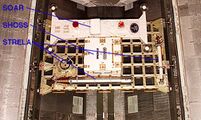 ICC STS-101 with SOAR, SHOSS Box, and Strela
 -
 STS-101 launches from Kennedy Space Center, 19 May 2000.
 -
 Illustration of the ISS during STS-101
 -
 STS-101 landing at the Shuttle Landing Facility, 29 May 2000.


See also
- List of human spaceflights
- List of International Space Station spacewalks
- List of Space Shuttle missions
- List of spacewalks and moonwalks 1965–1999
- Outline of space science
References
 This article incorporates public domain material from websites or documents of the National Aeronautics and Space Administration.
- ↑ 1.0 1.1 1.2 1.3 McDowell, Jonathan. "Satellite Catalog". Jonathan's Space Page. https://planet4589.org/space/log/satcat.txt.
- ↑ Evans, Ben (20 May 2020). "A New Vehicle: Remembering Atlantis' STS-101 Mission, 20 Years On". https://www.americaspace.com/2020/05/19/a-new-vehicle-remembering-atlantis-sts-101-mission-20-years-on/.
- ↑ "Spaceflight mission report: STS-101". http://www.spacefacts.de/mission/english/sts-101.htm.
- ↑ Harwood, William (2000-04-24). "Launch delayed at least 24 hours". CBS News. https://www.cbsnews.com/network/news/space/STS-101_Archive.txt.
- ↑ Ray, Justin (2000-04-24). "Atlantis launch scrubbed". https://spaceflightnow.com/shuttle/sts101/000424count/.
- ↑ Harwood, William (2000-04-25). "Launch scrubbed by high winds; NASA will try again Wednesday". CBS News. https://www.cbsnews.com/network/news/space/STS-101_Archive.txt.
- ↑ Harwood, William (2000-04-26). "Shuttle launch scrubbed due to high winds in Africa". CBS News. https://www.cbsnews.com/network/news/space/STS-101_Archive.txt.
- ↑ Harwood, William (2000-05-18). "Shuttle Atlantis cleared for Friday launch try". CBS News. https://www.cbsnews.com/network/news/space/STS-101_Archive.txt.
- ↑ Harwood, William (2000-05-19). "Shuttle Atlantis rockets into space". CBS News. https://www.cbsnews.com/network/news/space/STS-101_Archive.txt.
- ↑ "Chronology of Wakeup Calls". NASA. 2 August 2005. https://history.nasa.gov/wakeup.htm.
- ↑ "STS-130 Wakeup Calls". NASA. 5 April 2010. http://spaceflight1.nasa.gov/gallery/audio/shuttle/sts-130/html/ndxpage1.html.
STS-101 Extravehicular Activities (21/22 May) [1]
External links
Space Shuttle Atlantis (OV-104) | ||
|---|---|---|
| Completed flights | .jpg) | |
| Status |
| |
| On display | ||
| 1998–2004 |
|  | ||||||||||||||||||||||||||||||||||||||||||||||||||||||||
|---|---|---|---|---|---|---|---|---|---|---|---|---|---|---|---|---|---|---|---|---|---|---|---|---|---|---|---|---|---|---|---|---|---|---|---|---|---|---|---|---|---|---|---|---|---|---|---|---|---|---|---|---|---|---|---|---|---|---|
| 2005–2009 | ||||||||||||||||||||||||||||||||||||||||||||||||||||||||||
| 2010–2014 | ||||||||||||||||||||||||||||||||||||||||||||||||||||||||||
| 2015–2019 |
| |||||||||||||||||||||||||||||||||||||||||||||||||||||||||
| 2020–2024 | ||||||||||||||||||||||||||||||||||||||||||||||||||||||||||
| Individuals | ||||||||||||||||||||||||||||||||||||||||||||||||||||||||||
| Vehicles |
| |||||||||||||||||||||||||||||||||||||||||||||||||||||||||
Ongoing spaceflights in bold
! rowspan="3" colspan="2" width="14%" style="border-bottom:2px solid grey;" | Date/Time (UTC) ! Configuration ! Serial number ! Launch site ! Outcome |- |style="text-align:center;background-color:#e3e9e9;" | Payload |style="text-align:center;background-color:#e3e9e9;" | Separation orbit |style="text-align:center;background-color:#e3e9e9;" | Operator |style="text-align:center;background-color:#e3e9e9;" | Function |- | colspan="4" style="text-align:center;background-color:#e4dfdf;border-bottom:2px solid grey;" | Remarks |- Parameter 1=time required!
This is a navigational template created using {{navbox}}. It can be transcluded on pages by placing Initial visibilityThis template's initial visibility currently defaults to To change this template's initial visibility, the
Templates using the classes TemplateDataA navigational box that can be placed at the bottom of articles.
Template transclusions
 Not doneLatin pronunciation: [{{{1}}}] Not doneLatin pronunciation: [{{{1}}}]
| rowspan="1" colspan="2" style="border-top:2px solid #aabbcc;" | | style="border-top:2px solid #aabbcc;" | | style="border-top:2px solid #aabbcc;" | | style="border-top:2px solid #aabbcc;" | | style="border-top:2px solid #aabbcc;" | |- |- Vietnamese pronunciation: [{{{1}}}]-4500 — – -4000 — – -3500 — – -3000 — – -2500 — – -2000 — – -1500 — – -1000 — – -500 — – 0 —  Done Done To doRussian pronunciation: [{{{1}}}]Greek pronunciation: [{{{1}}}] To doRussian pronunciation: [{{{1}}}]Greek pronunciation: [{{{1}}}] Danish pronunciation: [{{{1}}}]Northern Sami pronunciation: [{{{1}}}]Mandarin pronunciation: [{{{ipa}}}]Cantonese pronunciation: [{{{1}}}]Entry from STS-101 from TCI Europe, retrieved on {{{Date}}} Danish pronunciation: [{{{1}}}]Northern Sami pronunciation: [{{{1}}}]Mandarin pronunciation: [{{{ipa}}}]Cantonese pronunciation: [{{{1}}}]Entry from STS-101 from TCI Europe, retrieved on {{{Date}}}
This is a navigational template created using {{navbox}}. It can be transcluded on pages by placing Initial visibilityThis template's initial visibility currently defaults to To change this template's initial visibility, the
Templates using the classes TemplateDataA navigational box that can be placed at the bottom of articles.
 In progressPalomares, M. L. D. and Pauly, D., eds. (2011). "{{{1}}} {{{2}}}" in SeaLifeBase. April 2011 version.Turkish pronunciation: [{{{1}}}]Finnish pronunciation: [{{{1}}}]Froese, Rainer and Pauly, Daniel, eds. (2006). "{{{1}}} {{{2}}}" in FishBase. April 2006 version. In progressPalomares, M. L. D. and Pauly, D., eds. (2011). "{{{1}}} {{{2}}}" in SeaLifeBase. April 2011 version.Turkish pronunciation: [{{{1}}}]Finnish pronunciation: [{{{1}}}]Froese, Rainer and Pauly, Daniel, eds. (2006). "{{{1}}} {{{2}}}" in FishBase. April 2006 version.
|- | ... | — | — | — | — | — | — |-Old Norse pronunciation: [{{{1}}}]Salish pronunciation: [{{{1}}}]Basque pronunciation: [{{{1}}}]{{{1}}}data-sort-value="" style="background: #ececec; color: #2C2C2C; vertical-align: middle; font-size: smaller; text-align: center; " class="table-na" | UnreleasedNorwegian pronunciation: [{{{1}}}] (aged {{{4}}})Hungarian pronunciation: [{{{1}}}]Quechua pronunciation: [{{{1}}}]Arabic pronunciation: [{{{1}}}]Punjabi pronunciation: [{{{1}}}]Afrikaans pronunciation: [{{{1}}}]Romanian pronunciation: [{{{1}}}]Hebrew pronunciation: [{{{1}}}][INVALID OR MISSING PARAMETER IN TEMPLATE STS-101]Uto-Aztecan pronunciation: [{{{1}}}]Tamil pronunciation: [{{{1}}}]Hindustani pronunciation: [{{{1}}}]Swedish pronunciation: [{{{1}}}]Kazakh pronunciation: [{{{1}}}]Lao pronunciation: [{{{1}}}]Tibetan pronunciation: [{{{1}}}]Khmer pronunciation: [{{{1}}}]data-sort-value="" style="vertical-align:middle; text-align:center" class="table-na" | —{{{1}}}Welsh pronunciation: [{{{1}}}] Partially doneAthabaskan pronunciation: [{{{1}}}]Māori pronunciation: [{{{1}}}]IPA: [{{{1}}}]Bulgarian pronunciation: [{{{1}}}]Korean pronunciation: [{{{1}}}]Icelandic pronunciation: [{{{1}}}]Sanskrit pronunciation: [{{{1}}}]Bengali pronunciation: [{{{1}}}]Indonesian pronunciation: [{{{1}}}]Serbo-Croatian pronunciation: [{{{1}}}]CROSBI {{{1}}} Future spaceflights in italics Partially doneAthabaskan pronunciation: [{{{1}}}]Māori pronunciation: [{{{1}}}]IPA: [{{{1}}}]Bulgarian pronunciation: [{{{1}}}]Korean pronunciation: [{{{1}}}]Icelandic pronunciation: [{{{1}}}]Sanskrit pronunciation: [{{{1}}}]Bengali pronunciation: [{{{1}}}]Indonesian pronunciation: [{{{1}}}]Serbo-Croatian pronunciation: [{{{1}}}]CROSBI {{{1}}} Future spaceflights in italics
! rowspan="3" colspan="2" width="14%" style="border-bottom:2px solid grey;" | Date/Time (UTC) ! Configuration ! Serial number ! Launch site ! Outcome |- |style="text-align:center;background-color:#e3e9e9;" | Payload |style="text-align:center;background-color:#e3e9e9;" | Separation orbit |style="text-align:center;background-color:#e3e9e9;" | Operator |style="text-align:center;background-color:#e3e9e9;" | Function |- | colspan="4" style="text-align:center;background-color:#e4dfdf;border-bottom:2px solid grey;" | Remarks |- Parameter 1=time required!
This is a navigational template created using {{navbox}}. It can be transcluded on pages by placing Initial visibilityThis template's initial visibility currently defaults to To change this template's initial visibility, the
Templates using the classes TemplateDataA navigational box that can be placed at the bottom of articles.
Template transclusions
Not doneLatin pronunciation: [{{{1}}}]
| rowspan="1" colspan="2" style="border-top:2px solid #aabbcc;" | | style="border-top:2px solid #aabbcc;" | | style="border-top:2px solid #aabbcc;" | | style="border-top:2px solid #aabbcc;" | | style="border-top:2px solid #aabbcc;" | |- |- Vietnamese pronunciation: [{{{1}}}]-4500 — – -4000 — – -3500 — – -3000 — – -2500 — – -2000 — – -1500 — – -1000 — – -500 — – 0 — Done To doRussian pronunciation: [{{{1}}}]Greek pronunciation: [{{{1}}}]Danish pronunciation: [{{{1}}}]Northern Sami pronunciation: [{{{1}}}]Mandarin pronunciation: [{{{ipa}}}]Cantonese pronunciation: [{{{1}}}]Entry from STS-101 from TCI Europe, retrieved on {{{Date}}}
This is a navigational template created using {{navbox}}. It can be transcluded on pages by placing Initial visibilityThis template's initial visibility currently defaults to To change this template's initial visibility, the
Templates using the classes TemplateDataA navigational box that can be placed at the bottom of articles.
In progressPalomares, M. L. D. and Pauly, D., eds. (2011). "{{{1}}} {{{2}}}" in SeaLifeBase. April 2011 version.Turkish pronunciation: [{{{1}}}]Finnish pronunciation: [{{{1}}}]Froese, Rainer and Pauly, Daniel, eds. (2006). "{{{1}}} {{{2}}}" in FishBase. April 2006 version.
|- | ... | — | — | — | — | — | — |-Old Norse pronunciation: [{{{1}}}]Salish pronunciation: [{{{1}}}]Basque pronunciation: [{{{1}}}]{{{1}}}data-sort-value="" style="background: #ececec; color: #2C2C2C; vertical-align: middle; font-size: smaller; text-align: center; " class="table-na" | UnreleasedNorwegian pronunciation: [{{{1}}}] (aged {{{4}}})Hungarian pronunciation: [{{{1}}}]Quechua pronunciation: [{{{1}}}]Arabic pronunciation: [{{{1}}}]Punjabi pronunciation: [{{{1}}}]Afrikaans pronunciation: [{{{1}}}]Romanian pronunciation: [{{{1}}}]Hebrew pronunciation: [{{{1}}}][INVALID OR MISSING PARAMETER IN TEMPLATE STS-101]Uto-Aztecan pronunciation: [{{{1}}}]Tamil pronunciation: [{{{1}}}]Hindustani pronunciation: [{{{1}}}]Swedish pronunciation: [{{{1}}}]Kazakh pronunciation: [{{{1}}}]Lao pronunciation: [{{{1}}}]Tibetan pronunciation: [{{{1}}}]Khmer pronunciation: [{{{1}}}]data-sort-value="" style="vertical-align:middle; text-align:center" class="table-na" | —{{{1}}}Welsh pronunciation: [{{{1}}}] Partially doneAthabaskan pronunciation: [{{{1}}}]Māori pronunciation: [{{{1}}}]IPA: [{{{1}}}]Bulgarian pronunciation: [{{{1}}}]Korean pronunciation: [{{{1}}}]Icelandic pronunciation: [{{{1}}}]Sanskrit pronunciation: [{{{1}}}]Bengali pronunciation: [{{{1}}}]Indonesian pronunciation: [{{{1}}}]Serbo-Croatian pronunciation: [{{{1}}}]CROSBI {{{1}}} † - mission failed to reach ISS | ||||||||||||||||||||||||||||||||||||||||||||||||||||||||||


 |  |


