Engineering:STS-113
 Astronaut Michael López-Alegría climbs the newly-installed P1 truss during the mission's second EVA | |
| Names | Space Transportation System-113 |
|---|---|
| Mission type | ISS assembly Crew rotation |
| Operator | NASA |
| Mission duration | 13 days, 18 hours, 48 minutes, 38 seconds |
| Distance travelled | 9,000,000 kilometres (5,600,000 mi) |
| Spacecraft properties | |
| Spacecraft | Space Shuttle Endeavour |
| Launch mass | 116,460 kilograms (256,750 lb) |
| Landing mass | 91,498 kilograms (201,719 lb) |
| Payload mass | 12,477 kilograms (27,507 lb) |
| Crew | |
| Crew size | 7 |
| Members |
|
| Launching |
|
| Landing |
|
| Start of mission | |
| Launch date | 24 November 2002, 00:49:47 UTC |
| Launch site | Kennedy, LC-39A |
| End of mission | |
| Landing date | 7 December 2002, 19:38:25 UTC |
| Landing site | Kennedy, SLF Runway 33 |
| Orbital parameters | |
| Reference system | Geocentric |
| Regime | Low Earth |
| Perigee altitude | 379 kilometres (235 mi) |
| Apogee altitude | 397 kilometres (247 mi) |
| Inclination | 51.6 degrees |
| Period | 92.3 min |
| Docking with ISS | |
| Docking port | PMA-2 (Destiny forward) |
| Docking date | 25 November 2002, 21:59 UTC |
| Undocking date | 2 December 2002, 20:50 UTC |
| Time docked | 6 days, 22 hours, 51 minutes |

 (L-R): Paul S. Lockhart, Michael E. López-Alegría, John B. Herrington, and James D. Wetherbee | |
STS-113 was a Space Shuttle mission to the International Space Station (ISS) flown by Space Shuttle Endeavour. During the 14-day mission in late 2002, Endeavour and its crew extended the ISS backbone with the P1 truss and exchanged the Expedition 5 and Expedition 6 crews aboard the station. With commander Jim Wetherbee and pilot Paul Lockhart at the controls, Endeavour docked with the station on 25 November 2002 to begin seven days of station assembly, spacewalks, and crew and equipment transfers. This was the last flight of Endeavour before entering its Orbiter Major Modification period until STS-118 in 2007, which included modernizing the cockpit, and also the final shuttle mission before the Columbia disaster.
Crew
| Position | Launching Astronaut | Landing Astronaut |
|---|---|---|
| Commander |  James D. Wetherbee James D. WetherbeeSixth and last spaceflight | |
| Pilot | Paul S. Lockhart Second and last spaceflight | |
| Mission Specialist 1 | Michael López-Alegría Third spaceflight | |
| Mission Specialist 2 Flight Engineer |
John B. Herrington Only spaceflight | |
| Mission Specialist 3 | Kenneth D. Bowersox Expedition 6 Fifth and last spaceflight ISS Commander |
 Valery G. Korzun, RKA Valery G. Korzun, RKAExpedition 5 Second and last spaceflight ISS Commander/Soyuz Commander |
| Mission Specialist 4 | Nikolai M. Budarin, RKA Expedition 6 Third and last spaceflight ISS Flight Engineer/Soyuz Commander |
Peggy A. Whitson Expedition 5 First spaceflight ISS Flight Engineer |
| Mission Specialist 5 | Donald R. Pettit Expedition 6 First spaceflight ISS Flight Engineer |
Sergey Y. Treshchov, RKA Expedition 5 Only spaceflight ISS Flight Engineer |
Mission highlights
STS-113 was an Assembly Mission (11A) to the International Space Station, delivering the P1 Truss segment, which provides structural support for the Space Station radiators. Mission Specialists John Herrington and Michael López-Alegría performed three spacewalks to activate and outfit the P1. The STS-113 crew and both Expedition crews transferred about 1,969 kilograms (4,340 pounds) of cargo between the shuttle and station.
STS-113 delivered the Expedition 6 crew to the station for a four-month increment. The Expedition 5 crew returned to Earth aboard STS-113, ending a 185-day stay in space.
STS-113 came to a close when Endeavour glided in to a landing at Kennedy Space Center on 7 December. It was the 19th flight of Endeavour, the 112th shuttle mission, and the 16th shuttle mission to the station. The landing was the first (and only) time a mission ended on the fourth day of landing attempts.
Also carried aboard STS-113 was the Micro-Electromechanical System (MEMS) based Pico Satellite Inspector (MEPSI). This payload deployed two small satellites which are connected via a 15 metres (49 ft) tether.
STS-113 was the last successful mission before STS-107. Gus Loria was originally scheduled to fly as the pilot for this mission, but was replaced due to an injury. His replacement was Paul S. Lockhart. John Herrington, a member of the Chickasaw Nation, became the first enrolled member of a Native American tribe to fly in space.[note 1]
STS-113 was the final mission during which Russian cosmonauts flew on the Space Shuttle.
Because Endeavour entered its Orbiter Major Modification period after the Columbia disaster, this was the last shuttle mission to fly with an analog-style cockpit.
| Attempt | Planned | Result | Turnaround | Reason | Decision point | Weather go (%) | Notes |
|---|---|---|---|---|---|---|---|
| 1 | 2002-11-11 00:58:40 11 Nov 2002, 12:58:40 am | Scrubbed | — | Technical | 2002-11-10 21:00 10 Nov 2002, 9:00 pm | 90%[1] | Problems with an oxygen system in the orbiter's midbody.[2] |
| 2 | 2002-11-22 20:15:30 22 Nov 2002, 8:15:30 pm | Scrubbed | 11 days, 19 hours, 17 minutes | Weather | 2002-11-22 20:05 22 Nov 2002, 8:05 pm (T−00:09:00 hold) | 90% | Weather at TAL sites Zaragoza and Moron, Spain.[3] |
| 3 | 2002-11-23 19:49:47 23 Nov 2002, 7:49:47 pm | Success | 0 days, 23 hours, 34 minutes | 95%[3] | Initial weather reports for TAL sites was not favorable but cleared in time for launch. |
Mission parameters
Docking with ISS
- Docked: 25 November 2002, 21:59:00 UTC
- Undocked: 2 December 2002, 20:50:00 UTC
- Time Docked: 6 days, 22 h, 51 min, 00 s
Crew seat assignments
| Seat[4] | Launch | Landing | 150px Seats 1–4 are on the flight deck. Seats 5–7 are on the mid-deck. |
|---|---|---|---|
| 1 | Wetherbee | ||
| 2 | Lockhart | ||
| 3 | Lopez-Alegria | Unused | |
| 4 | Herrington | ||
| 5 | Bowersox | Lopez-Alegria | |
| 6 | Pettit | Whitson | |
| 7 | Budarin | Korzun | |
| 8 | Unused | Treshchov | |
Spacewalks
| Mission | Spacewalkers | Start – UTC | End – UTC | Duration | Mission | |
|---|---|---|---|---|---|---|
| 47. | STS-113 EVA 1 |
Michael López-Alegría John Herrington |
26 November 2002 19:49 |
27 November 2002 02:34 |
6 h, 45 min | Install P1 truss |
| 48. | STS-113 EVA 2 |
Michael López-Alegría John Herrington |
28 November 2002 18:36 |
29 November 2002 00:46 |
6 h, 10 min | Install TV cameras, move CETA |
| 49. | STS-113 EVA 3 |
Michael López-Alegría John Herrington |
30 November 2002 19:25 |
1 December 2002 02:25 |
7 h, 00 min | Inspect Mobile Transporter |
Gallery
-
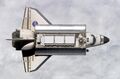 Endeavour with the P1 Truss segment in its payload bay
 -
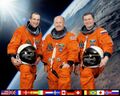 Launched Expedition 6 crew
L-R: Donald Pettit, Ken Bowersox and Nikolai Budarin -
 Landed Expedition 5 crew
L-R: Valery G. Korzun, Peggy Whitson, and Sergey Y. Treshchev -
-
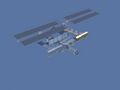 Illustration of the International Space Station after STS-113
 -
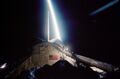
 López-Alegría and Herrington installing the P1 Truss segment
 -
Whitson viewing the ISS after undocking


See also
- List of human spaceflights
- List of International Space Station spacewalks
- List of Space Shuttle missions
- List of spacewalks and moonwalks 1965–1999
- Outline of space science
Notes
References
 | This article includes a list of references, but its sources remain unclear because it has insufficient inline citations. (May 2008) (Learn how and when to remove this template message) |
 This article incorporates public domain material from websites or documents of the National Aeronautics and Space Administration.
- ↑ Harwood, William (10 November 2002). "Shuttle fueling begins". CBS News. http://www.cbsnews.com/network/news/space/STS-113_Archive.txt.
- ↑ Harwood, William (10 November 2002). "Launch scrubbed by oxygen problem". CBS News. http://www.cbsnews.com/network/news/space/STS-113_Archive.txt.
- ↑ 3.0 3.1 Harwood, William (22 November 2002). "Shuttle grounded by rain in Spain". CBS News. http://www.cbsnews.com/network/news/space/STS-113_Archive.txt.
- ↑ "STS-113". Spacefacts. http://spacefacts.de/mission/english/sts-113.htm.
External links
- NASA mission summary
- Status reports – Detailed NASA status reports for each day of the mission.
- STS-113 Video Highlights
| 1998–2004 |
|  | ||||||||||||||||||||||||||||||||||||||||||||||||||||||||
|---|---|---|---|---|---|---|---|---|---|---|---|---|---|---|---|---|---|---|---|---|---|---|---|---|---|---|---|---|---|---|---|---|---|---|---|---|---|---|---|---|---|---|---|---|---|---|---|---|---|---|---|---|---|---|---|---|---|---|
| 2005–2009 | ||||||||||||||||||||||||||||||||||||||||||||||||||||||||||
| 2010–2014 | ||||||||||||||||||||||||||||||||||||||||||||||||||||||||||
| 2015–2019 |
| |||||||||||||||||||||||||||||||||||||||||||||||||||||||||
| 2020–2024 | ||||||||||||||||||||||||||||||||||||||||||||||||||||||||||
| Individuals | ||||||||||||||||||||||||||||||||||||||||||||||||||||||||||
| Vehicles |
| |||||||||||||||||||||||||||||||||||||||||||||||||||||||||
Ongoing spaceflights in bold
! rowspan="3" colspan="2" width="14%" style="border-bottom:2px solid grey;" | Date/Time (UTC) ! Configuration ! Serial number ! Launch site ! Outcome |- |style="text-align:center;background-color:#e3e9e9;" | Payload |style="text-align:center;background-color:#e3e9e9;" | Separation orbit |style="text-align:center;background-color:#e3e9e9;" | Operator |style="text-align:center;background-color:#e3e9e9;" | Function |- | colspan="4" style="text-align:center;background-color:#e4dfdf;border-bottom:2px solid grey;" | Remarks |- Parameter 1=time required!
This is a navigational template created using {{navbox}}. It can be transcluded on pages by placing Initial visibilityThis template's initial visibility currently defaults to To change this template's initial visibility, the
Templates using the classes TemplateDataA navigational box that can be placed at the bottom of articles.
Template transclusions
 Not doneLatin pronunciation: [{{{1}}}] Not doneLatin pronunciation: [{{{1}}}]
| rowspan="1" colspan="2" style="border-top:2px solid #aabbcc;" | | style="border-top:2px solid #aabbcc;" | | style="border-top:2px solid #aabbcc;" | | style="border-top:2px solid #aabbcc;" | | style="border-top:2px solid #aabbcc;" | |- |- Vietnamese pronunciation: [{{{1}}}]-4500 — – -4000 — – -3500 — – -3000 — – -2500 — – -2000 — – -1500 — – -1000 — – -500 — – 0 —  Done Done To doRussian pronunciation: [{{{1}}}]Greek pronunciation: [{{{1}}}] To doRussian pronunciation: [{{{1}}}]Greek pronunciation: [{{{1}}}] Danish pronunciation: [{{{1}}}]Northern Sami pronunciation: [{{{1}}}]Mandarin pronunciation: [{{{ipa}}}]Cantonese pronunciation: [{{{1}}}]Entry from STS-113 from TCI Europe, retrieved on {{{Date}}} Danish pronunciation: [{{{1}}}]Northern Sami pronunciation: [{{{1}}}]Mandarin pronunciation: [{{{ipa}}}]Cantonese pronunciation: [{{{1}}}]Entry from STS-113 from TCI Europe, retrieved on {{{Date}}}
This is a navigational template created using {{navbox}}. It can be transcluded on pages by placing Initial visibilityThis template's initial visibility currently defaults to To change this template's initial visibility, the
Templates using the classes TemplateDataA navigational box that can be placed at the bottom of articles.
 In progressPalomares, M. L. D. and Pauly, D., eds. (2011). "{{{1}}} {{{2}}}" in SeaLifeBase. April 2011 version.Turkish pronunciation: [{{{1}}}]Finnish pronunciation: [{{{1}}}]Froese, Rainer and Pauly, Daniel, eds. (2006). "{{{1}}} {{{2}}}" in FishBase. April 2006 version. In progressPalomares, M. L. D. and Pauly, D., eds. (2011). "{{{1}}} {{{2}}}" in SeaLifeBase. April 2011 version.Turkish pronunciation: [{{{1}}}]Finnish pronunciation: [{{{1}}}]Froese, Rainer and Pauly, Daniel, eds. (2006). "{{{1}}} {{{2}}}" in FishBase. April 2006 version.
|- | ... | — | — | — | — | — | — |-Old Norse pronunciation: [{{{1}}}]Salish pronunciation: [{{{1}}}]Basque pronunciation: [{{{1}}}]{{{1}}}data-sort-value="" style="background: #ececec; color: #2C2C2C; vertical-align: middle; font-size: smaller; text-align: center; " class="table-na" | UnreleasedNorwegian pronunciation: [{{{1}}}] (aged {{{4}}})Hungarian pronunciation: [{{{1}}}]Quechua pronunciation: [{{{1}}}]Arabic pronunciation: [{{{1}}}]Punjabi pronunciation: [{{{1}}}]Afrikaans pronunciation: [{{{1}}}]Romanian pronunciation: [{{{1}}}]Hebrew pronunciation: [{{{1}}}][INVALID OR MISSING PARAMETER IN TEMPLATE STS-113]Uto-Aztecan pronunciation: [{{{1}}}]Tamil pronunciation: [{{{1}}}]Hindustani pronunciation: [{{{1}}}]Swedish pronunciation: [{{{1}}}]Kazakh pronunciation: [{{{1}}}]Lao pronunciation: [{{{1}}}]Tibetan pronunciation: [{{{1}}}]Khmer pronunciation: [{{{1}}}]data-sort-value="" style="vertical-align:middle; text-align:center" class="table-na" | —{{{1}}}Welsh pronunciation: [{{{1}}}] Partially doneAthabaskan pronunciation: [{{{1}}}]Māori pronunciation: [{{{1}}}]IPA: [{{{1}}}]Bulgarian pronunciation: [{{{1}}}]Korean pronunciation: [{{{1}}}]Icelandic pronunciation: [{{{1}}}]Sanskrit pronunciation: [{{{1}}}]Bengali pronunciation: [{{{1}}}]Indonesian pronunciation: [{{{1}}}]Serbo-Croatian pronunciation: [{{{1}}}]CROSBI {{{1}}} Future spaceflights in italics Partially doneAthabaskan pronunciation: [{{{1}}}]Māori pronunciation: [{{{1}}}]IPA: [{{{1}}}]Bulgarian pronunciation: [{{{1}}}]Korean pronunciation: [{{{1}}}]Icelandic pronunciation: [{{{1}}}]Sanskrit pronunciation: [{{{1}}}]Bengali pronunciation: [{{{1}}}]Indonesian pronunciation: [{{{1}}}]Serbo-Croatian pronunciation: [{{{1}}}]CROSBI {{{1}}} Future spaceflights in italics
! rowspan="3" colspan="2" width="14%" style="border-bottom:2px solid grey;" | Date/Time (UTC) ! Configuration ! Serial number ! Launch site ! Outcome |- |style="text-align:center;background-color:#e3e9e9;" | Payload |style="text-align:center;background-color:#e3e9e9;" | Separation orbit |style="text-align:center;background-color:#e3e9e9;" | Operator |style="text-align:center;background-color:#e3e9e9;" | Function |- | colspan="4" style="text-align:center;background-color:#e4dfdf;border-bottom:2px solid grey;" | Remarks |- Parameter 1=time required!
This is a navigational template created using {{navbox}}. It can be transcluded on pages by placing Initial visibilityThis template's initial visibility currently defaults to To change this template's initial visibility, the
Templates using the classes TemplateDataA navigational box that can be placed at the bottom of articles.
Template transclusions
Not doneLatin pronunciation: [{{{1}}}]
| rowspan="1" colspan="2" style="border-top:2px solid #aabbcc;" | | style="border-top:2px solid #aabbcc;" | | style="border-top:2px solid #aabbcc;" | | style="border-top:2px solid #aabbcc;" | | style="border-top:2px solid #aabbcc;" | |- |- Vietnamese pronunciation: [{{{1}}}]-4500 — – -4000 — – -3500 — – -3000 — – -2500 — – -2000 — – -1500 — – -1000 — – -500 — – 0 — Done To doRussian pronunciation: [{{{1}}}]Greek pronunciation: [{{{1}}}]Danish pronunciation: [{{{1}}}]Northern Sami pronunciation: [{{{1}}}]Mandarin pronunciation: [{{{ipa}}}]Cantonese pronunciation: [{{{1}}}]Entry from STS-113 from TCI Europe, retrieved on {{{Date}}}
This is a navigational template created using {{navbox}}. It can be transcluded on pages by placing Initial visibilityThis template's initial visibility currently defaults to To change this template's initial visibility, the
Templates using the classes TemplateDataA navigational box that can be placed at the bottom of articles.
In progressPalomares, M. L. D. and Pauly, D., eds. (2011). "{{{1}}} {{{2}}}" in SeaLifeBase. April 2011 version.Turkish pronunciation: [{{{1}}}]Finnish pronunciation: [{{{1}}}]Froese, Rainer and Pauly, Daniel, eds. (2006). "{{{1}}} {{{2}}}" in FishBase. April 2006 version.
|- | ... | — | — | — | — | — | — |-Old Norse pronunciation: [{{{1}}}]Salish pronunciation: [{{{1}}}]Basque pronunciation: [{{{1}}}]{{{1}}}data-sort-value="" style="background: #ececec; color: #2C2C2C; vertical-align: middle; font-size: smaller; text-align: center; " class="table-na" | UnreleasedNorwegian pronunciation: [{{{1}}}] (aged {{{4}}})Hungarian pronunciation: [{{{1}}}]Quechua pronunciation: [{{{1}}}]Arabic pronunciation: [{{{1}}}]Punjabi pronunciation: [{{{1}}}]Afrikaans pronunciation: [{{{1}}}]Romanian pronunciation: [{{{1}}}]Hebrew pronunciation: [{{{1}}}][INVALID OR MISSING PARAMETER IN TEMPLATE STS-113]Uto-Aztecan pronunciation: [{{{1}}}]Tamil pronunciation: [{{{1}}}]Hindustani pronunciation: [{{{1}}}]Swedish pronunciation: [{{{1}}}]Kazakh pronunciation: [{{{1}}}]Lao pronunciation: [{{{1}}}]Tibetan pronunciation: [{{{1}}}]Khmer pronunciation: [{{{1}}}]data-sort-value="" style="vertical-align:middle; text-align:center" class="table-na" | —{{{1}}}Welsh pronunciation: [{{{1}}}] Partially doneAthabaskan pronunciation: [{{{1}}}]Māori pronunciation: [{{{1}}}]IPA: [{{{1}}}]Bulgarian pronunciation: [{{{1}}}]Korean pronunciation: [{{{1}}}]Icelandic pronunciation: [{{{1}}}]Sanskrit pronunciation: [{{{1}}}]Bengali pronunciation: [{{{1}}}]Indonesian pronunciation: [{{{1}}}]Serbo-Croatian pronunciation: [{{{1}}}]CROSBI {{{1}}} † - mission failed to reach ISS | ||||||||||||||||||||||||||||||||||||||||||||||||||||||||||


 |  |


